 Playable Books
Jean-Philippe Rameau · section 107 of 109
CHAPTER XX. Distinguishing the bass notes that must bear a chord
Read and hear this section in the playable edition →A chord should be played at the first instant of each beat of the measure, although one note may bear the same chord for several beats or several measures.
A note worth only one beat may be divided into two beats and thus bear two different chords. It could even be divided into more, but the chords would then follow too hurriedly.
In basses with melodic figuration, several notes often pass within one beat. The chord, however, should fall on the first note of each beat. The right hand, striking a chord on each beat, thus marks the meter, as it were.
When the movement is somewhat rapid and the same chord can serve for several successive beats, it is best not to repeat it until one hears that the instrument's sound has died away entirely. Too much repetition of the same chord becomes tiresome.
Some basses with melodic figuration are often difficult to figure properly, because their notes are not always contained in the chord that must be heard. Our rules are therefore very useful here: one cannot go wrong by using the chords known to follow one another naturally. For example, suppose there are several dissonant chords in succession, such as repeated 7s or 2s, over a diatonically moving bass, without the intervening sixth chords required by the rule. Even if each dissonant chord strikes at the beginning of a beat, divide each such beat into two equal parts. On the note beginning the second half, play the chord known to follow and precede the dissonant chords in question. Once good habits have been acquired through the preceding principles, the fingers often anticipate us in this situation. And since the note bearing this unfigured or unusually figured chord is not always the note that would naturally be expected, be guided here by the fingers' natural succession rather than by that note, which might mislead us.
Example
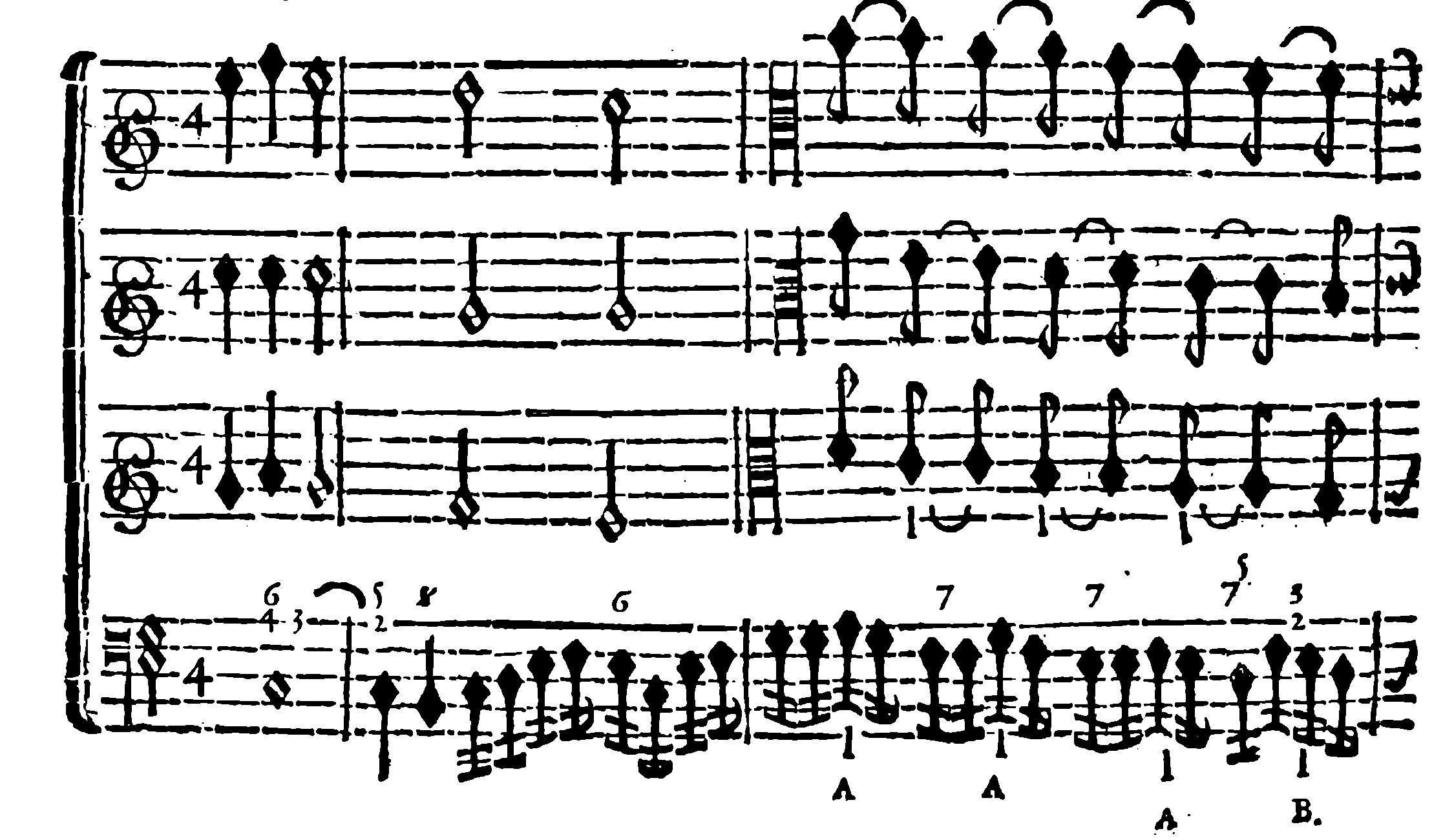
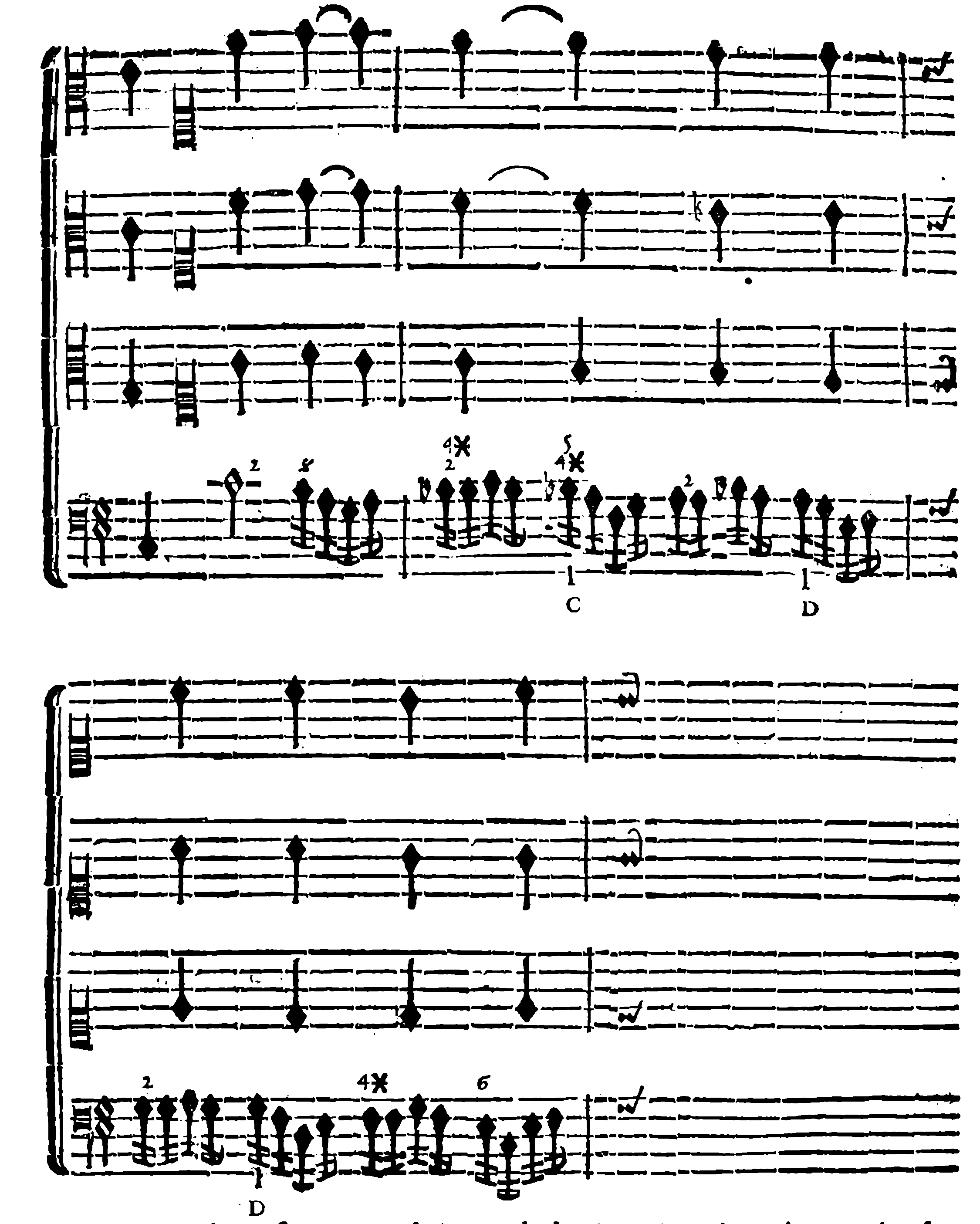
We know that the small-sixth chord should precede the seventh chord when the bass descends diatonically, and that the great-sixth or diminished-fifth chord should precede the second chord over two notes on the same degree. Even if those bass notes do not occur at the first instant of the beat when the chord must be heard, and even if that chord is unfigured, as at A and D, or figured in a way difficult to understand, as at B and C, the small- or great-sixth chords must still be played between the seventh or second chords. This follows the rules and the habit of letting one or two fingers descend after a minor dissonance while the others remain at the same degree. The same applies to many other progressions in which similar difficulties may arise.
Never abandon a sharp or flat that has served one chord and can still serve the next, unless a new figure expressly cancels it. Those sharps or flats, being natural to the key in use, may produce diminished or augmented fifths, which in this case must be preferred to the perfect fifth. The same applies to any other interval. The composer must indicate the contrary when the subject requires it; otherwise, only the ear can decide.
END.
Grant of the office of sole printer to the King for music
By letters patent of the King issued at Fontainebleau on the fifth day of October in the year of grace sixteen hundred and ninety-five, signed LOUIS, and on the fold, “By the King, Phelypeaux,” sealed with the great seal in yellow wax; confirmed by letters of “Suranation” issued at Marly on the twenty-eighth of May seventeen hundred and fifteen, signed as above; all these letters having been verified and registered in Parlement on 7 June 1715: J B-Christophe Ballard, sole printer to the King for music and music copyist to His Majesty's Chapel, is permitted to print, have printed, sell and distribute every kind of music, vocal and instrumental, by any author or authors whatsoever. All printers, booksellers, engravers and type-founders, and all other persons whatsoever, are expressly forbidden to engrave, cast or counterfeit the notes, characters, ornamental initial letters and other things invented by the said Ballard, or to undertake or commission the said printing of music anywhere in this kingdom or in the lands and lordships under His Majesty's authority, notwithstanding any letters to the contrary, without Ballard's leave and permission. The penalties are confiscation of the books or copies, notes, characters and other instruments used in that printing of music, and a fine of six thousand livres, as is set out more fully in those letters. His Majesty wills that this extract, placed at the beginning or end of such printed books, be credited as the original itself.