 Playable Books
Jean-Philippe Rameau · section 108 of 109
SUPPLEMENT: changes to two chapters and necessary corrections
Read and hear this section in the playable edition →Book I

Page 8, line 5: replace “ces” (these) with “ses” (its/their).
Page 9, line 13: after “L’accord parfait” (the perfect chord), add a footnote clarifying what follows: “See chapter VII and chapter VIII, article I, pages 35 and 36.”
Page 14, lines 22–25: replace “majeure ou mineure” with “majeur ou mineur” (major or minor; correct the French grammatical gender).
Page 15, line 5: replace “nombre 1” with “nombre” (number), removing 1. On the same page, third line from the bottom, also remove the numeral 1.
Page 19, line 11: replace “aussi” (as much/also) with “plus” (more).
Page 21, second paragraph, line 1: replace “si nous trouvons des Accords” (if we find chords) with “si nous trouvons dans la suite des Accords” (if we subsequently find chords). Add this footnote: “See the demonstrations in chapter VIII to understand what we assert here.”
Page 22, first paragraph, line 3: replace “chapter VI, articles VII and VIII” with “chapter VIII, articles VI and VII.” The demonstration at the foot of the page should be as follows.
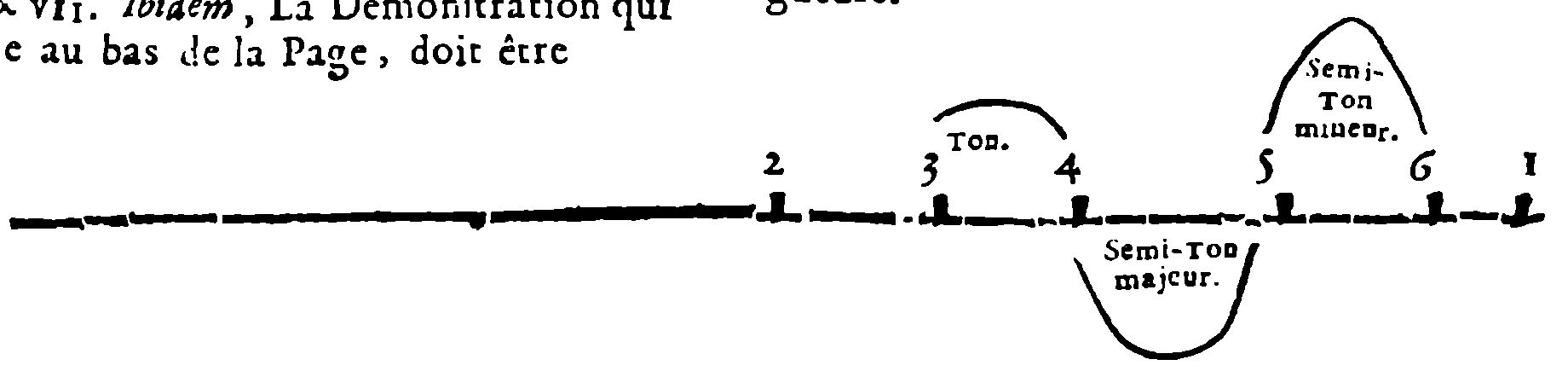
Page 24, line 2: replace “s’épuiser” (be exhausted) with “se puiser” (be drawn from).
Page 25: replace “double” with “doublée” (doubled).
Page 27, line 18: begin a new paragraph with “l’on peut pousser,” etc. (“one can extend,” etc.). Fourth line from the bottom: replace “dont on sert” with “dont on se sert” (which one uses). Last line: replace “Systême” (system) with “Systême Chromatique suivant” (following chromatic system).
Page 28: “Systême Chromatique” (chromatic system) suffices; remove the additional words “Chromatique suivant.” In the first line after the system, replace “le” with “ce” (the → this).
Page 34, chapter VIII, line 2: replace “avoir” with “a” (to have → has). Line 5: replace “on a fait” with “on fait” (one has made → one makes).
Page 36, line 1: replace “comme majeur” with “comme le majeur” (as major → as the major). Line 9: replace “donc le dernier” with “donc ce dernier” (therefore the latter → therefore this latter).
Page 40, line 3: replace 20 with 10.
Page 41, line 6: replace “occupant” (occupying) with “octuplant” (multiplying eightfold).
Page 47, last line: replace “par ce moyen” (by this means) with “par le Moyen” (by the Mean).
Page 48, paragraph, line 10: replace “elle contiendra” with “contiendra” (remove the pronoun before “will contain”). Line 12: replace “que les longueurs” with “que ces longueurs” (than the lengths → than these lengths).
Book II
Page 52, second paragraph, next-to-last line: replace “see below, chapters XIX, etc.” with “chapters XVIII, XIX, and XXI.”
Page 53, line 7: do not divide the words “toute la piéce de Musique étant fondée sur lui” (the whole piece of music being founded upon it) with a comma. Instead, put the entire phrase between two commas or parentheses.
Page 54, chapter V, line 3: begin a new paragraph at “Nous devons avoir déja,” etc. (“We should already have,” etc.).
Page 55, first paragraph, lines 12–14: delete “Que leur extremitez aiment naturellement à se porter vers la partie qui approche le plus de leur être ; de sorte” (“That their extremes naturally tend toward the part closest to their nature; so that”).
Page 56, second paragraph: replace the passage beginning “La Septiéme qui provient,” etc., with: “The seventh produced by a minor third added to the dominant’s perfect chord forms a dissonance not only with the dominant but also with its major third. Thus the major third itself forms a new dissonance against the added seventh. This major third is the source of all major dissonances, and this seventh the source of all minor dissonances, without exception.”
Page 57: arrange the example as follows.
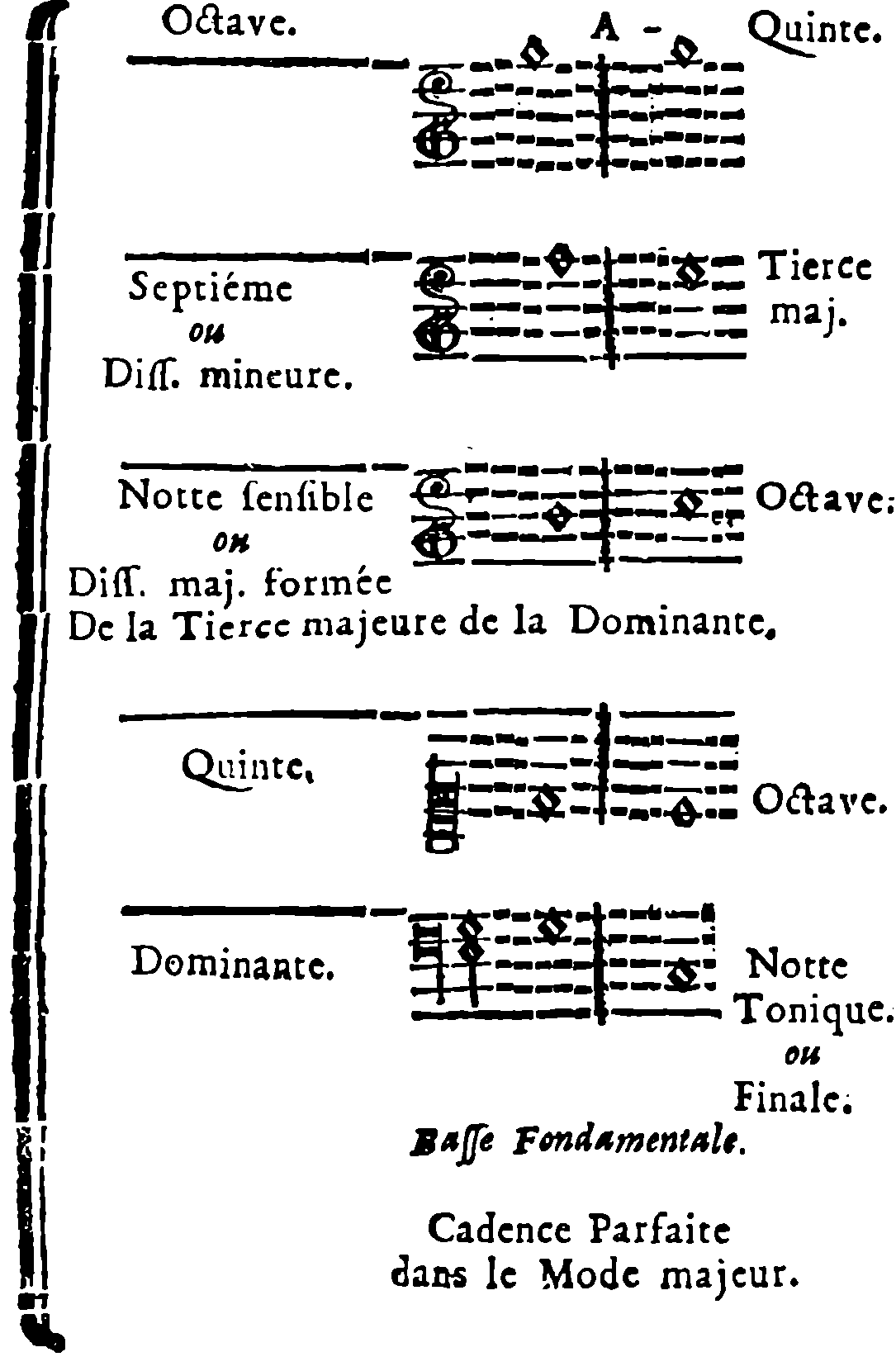
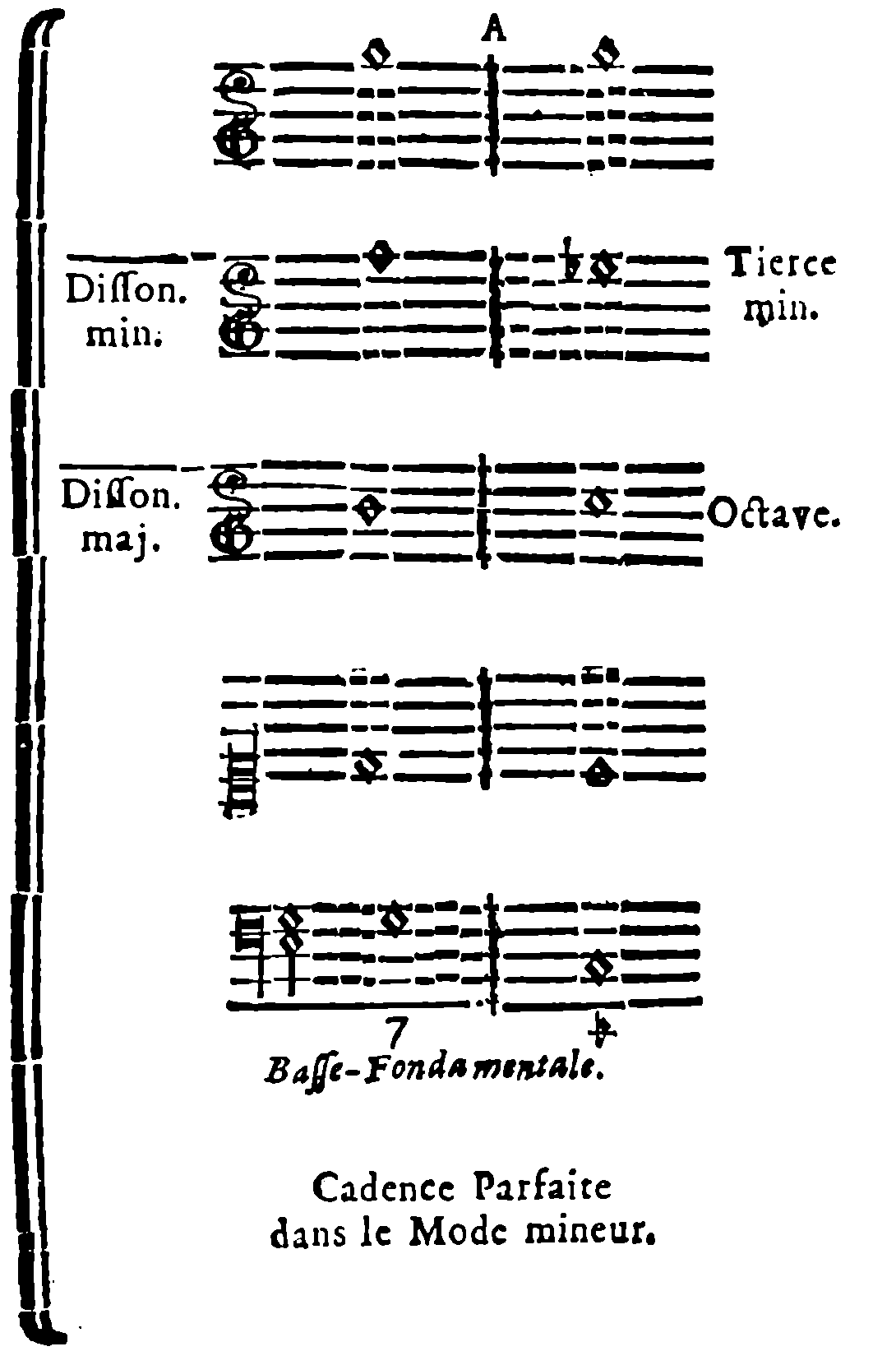
Page 58: slash the example’s figure 6 instead of attaching a sharp. This same error occurs wherever I intended a chord of the kind that this figure denotes. Admittedly, authors have not yet used this distinction in their published works.
Same page, references at the bottom: replace “(b cap. 5, f. 251.)” with “(b cap. 51, f. 251.).”
Page 59, footnote reference: replace “cap. 6” with “cap. 52.” Line 6: replace “chap. VI” with “Chap. LII.” Delete the example’s top part entirely.
Page 62: arrange the example as follows.
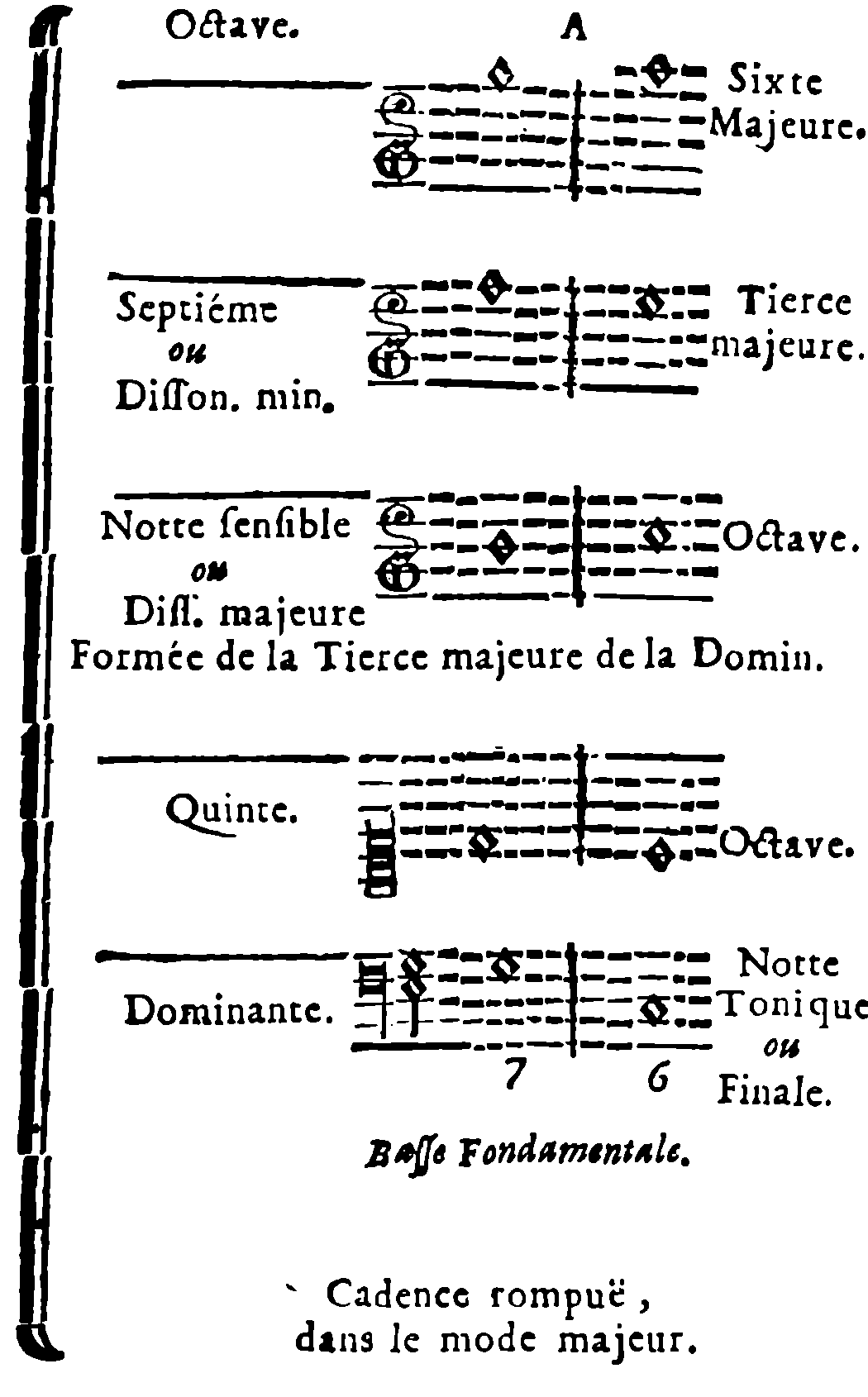
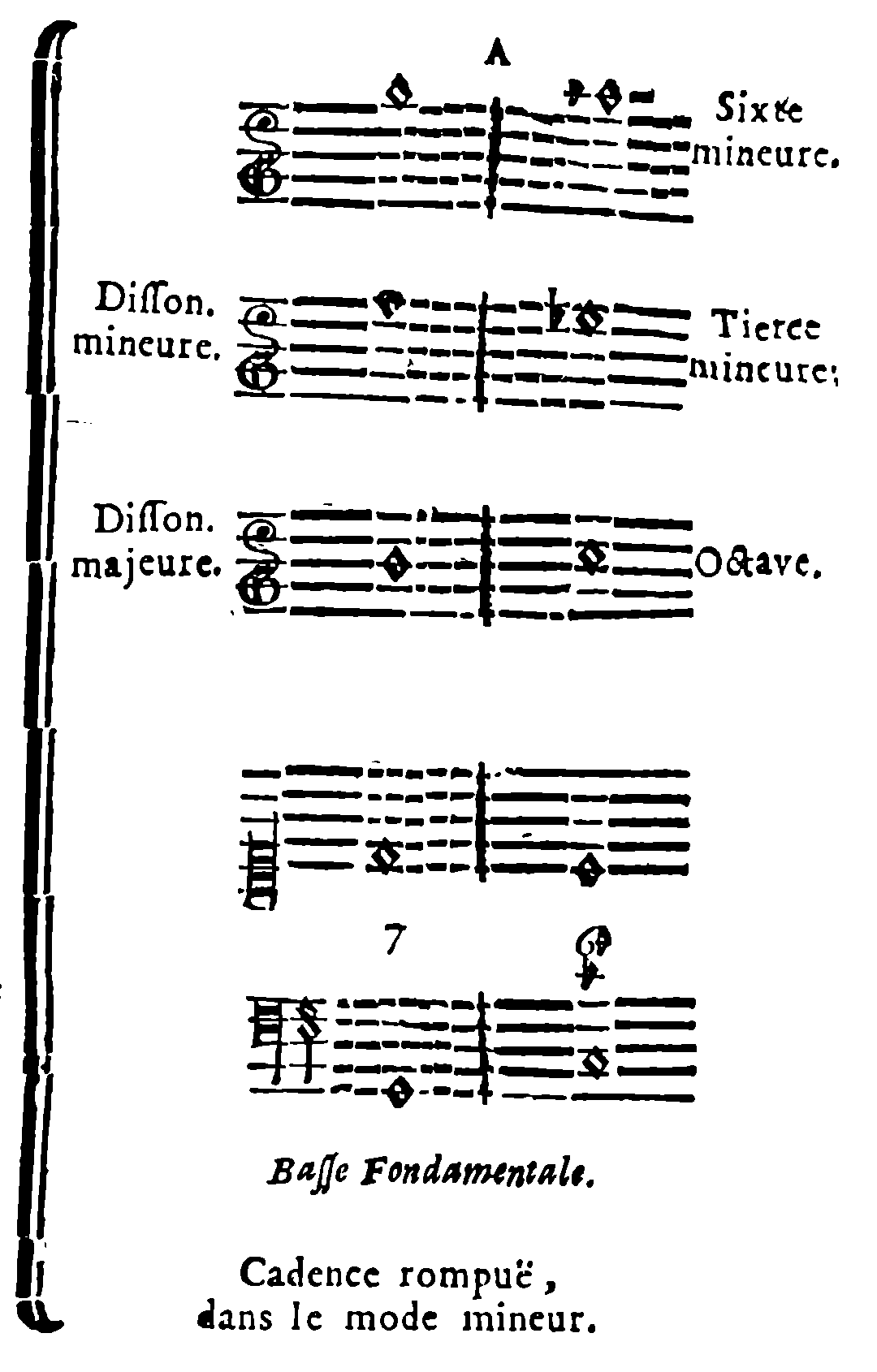
Pages 64–67: delete chapter VII and replace it with the following chapter.
CHAPTER SEVEN, revised · On the irregular cadence
Whereas the perfect cadence ends by moving from dominant to tonic, this cadence reverses that course, from tonic to dominant, or from fourth note to tonic. We therefore call it irregular.
We propose a new dissonance not yet discussed, although most accomplished musicians use it successfully. It gives harmony delightful variety, produces graceful melodies, and offers great resources in pieces of four or more parts. We can only praise those who first ventured to use it.
This sound is not dissonant against the bass. It is a consonant sixth, but clashes with the bass’s fifth. It must therefore resolve upward, as we shall try to prove.
Adding this sixth to the perfect chord forms the great-sixth chord. It naturally derives from the seventh chord,* but here must be treated as original. Elsewhere it must follow the nature and properties of the chord from which it first arose.
* See Book I, chapter VIII, article IV.
Example
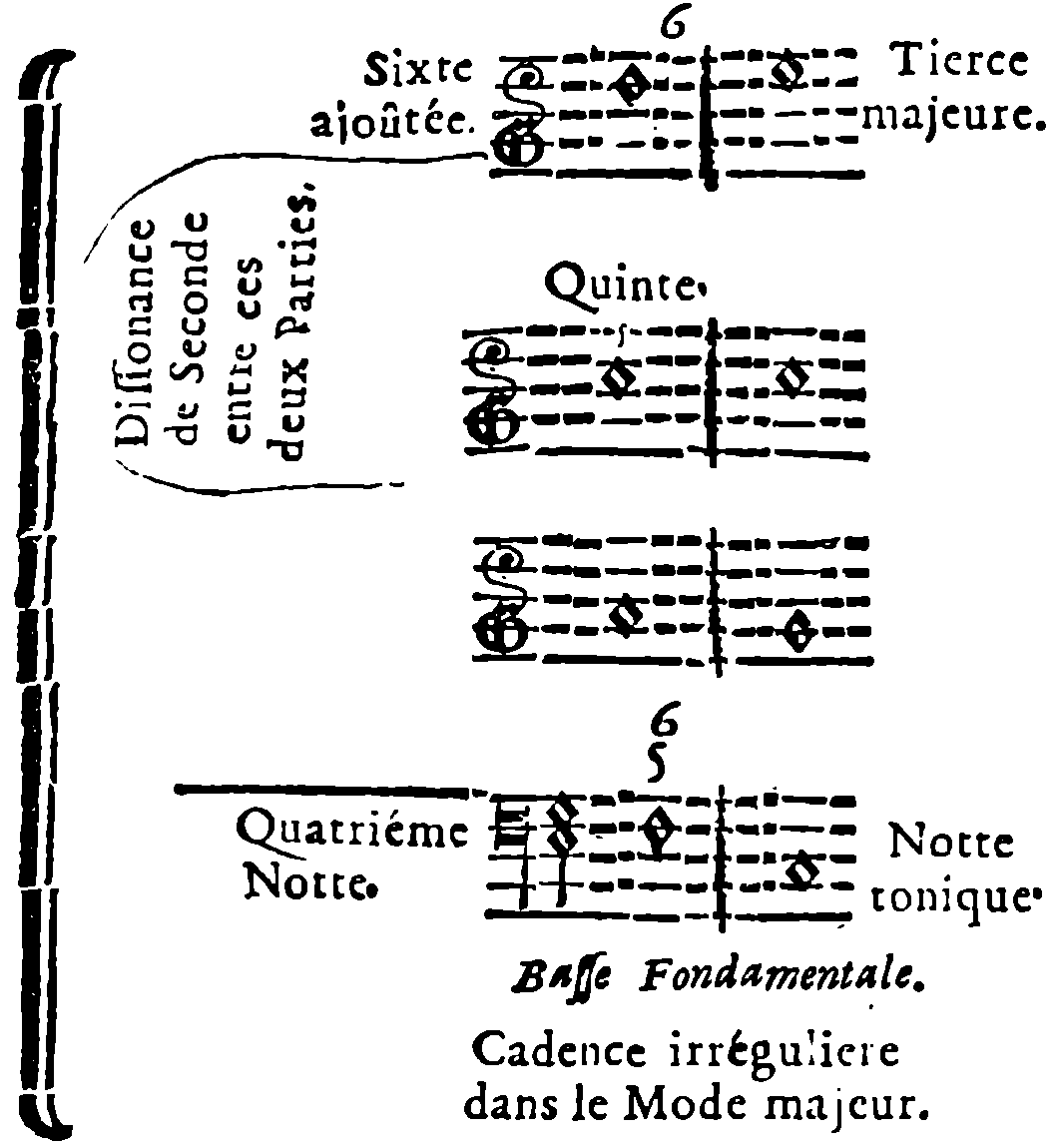
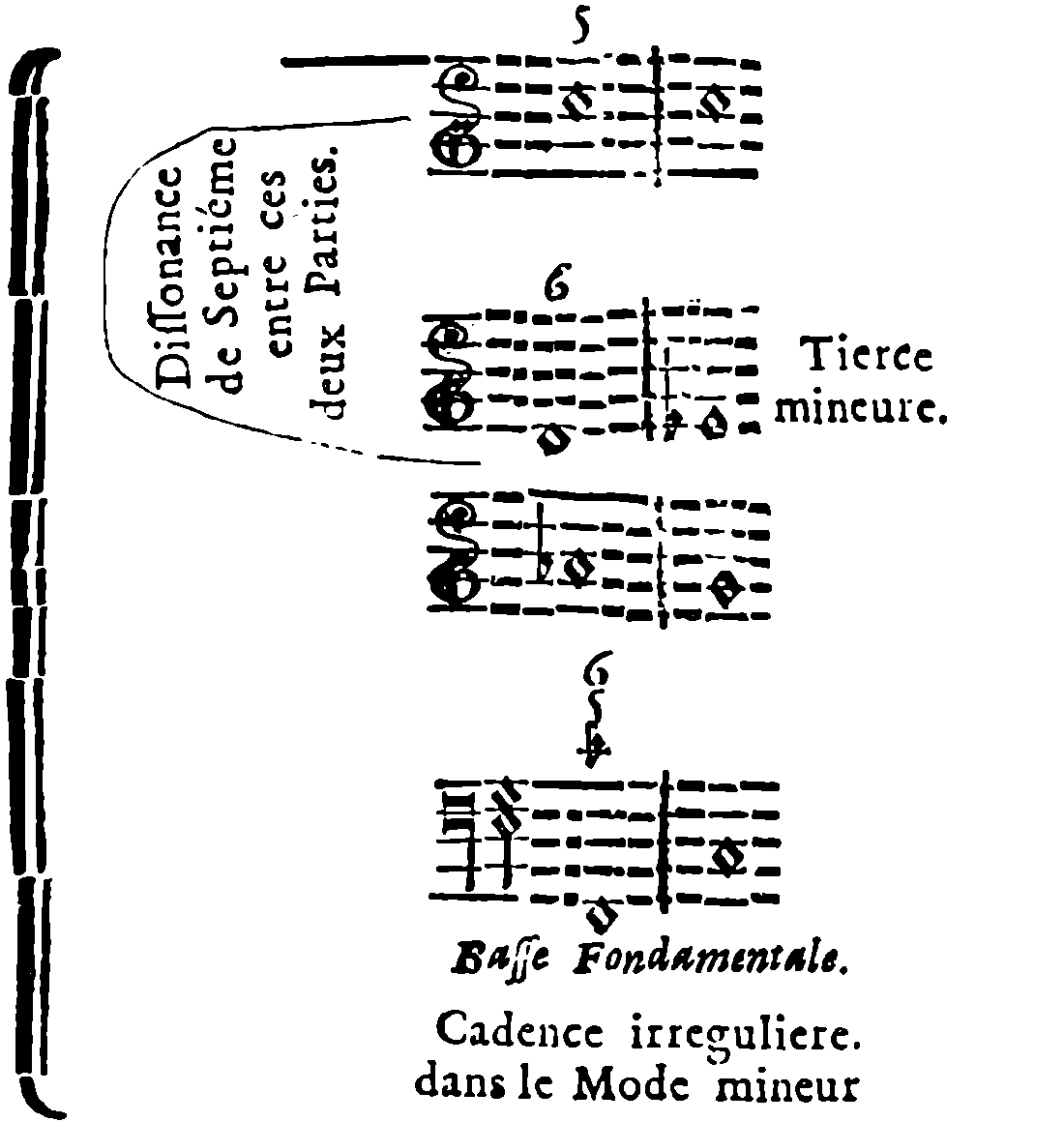
To make the cadence’s first note count as tonic and its last as dominant, always give the last a major third. The mode’s difference then appears only on the first note, the tonic, which may take either major or minor third.
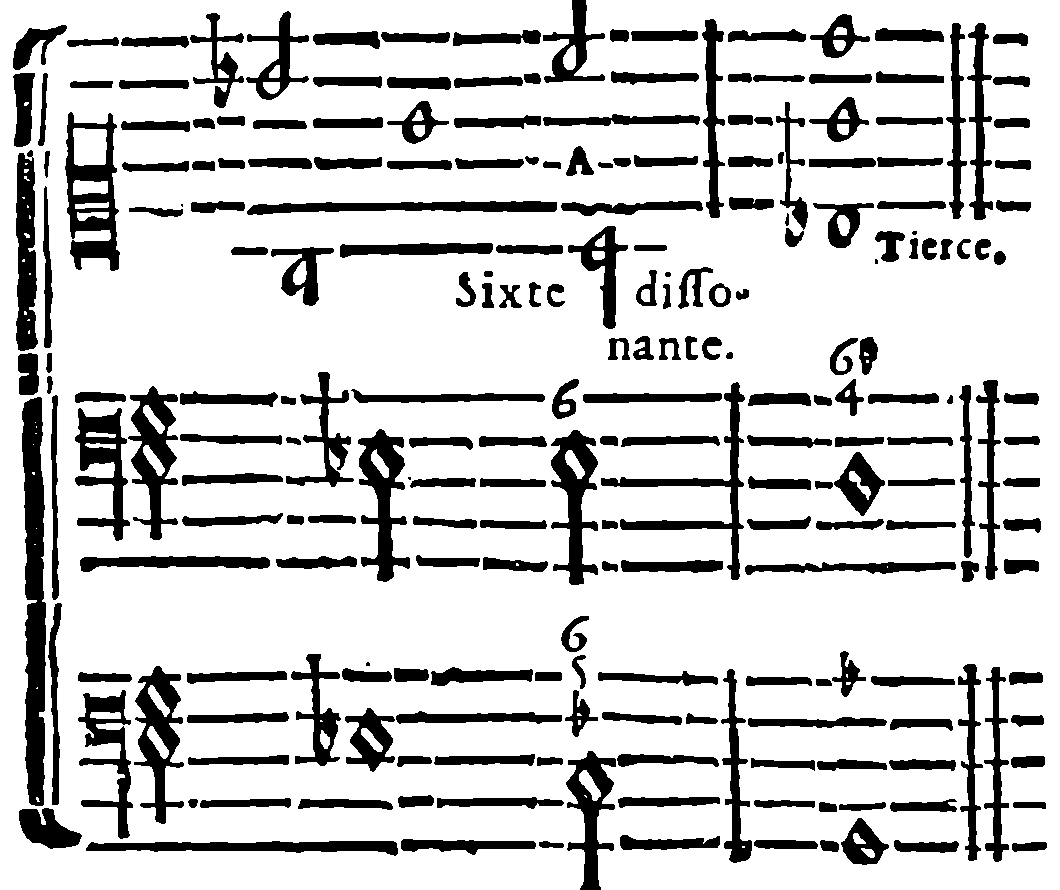
Masson does not discuss this cadence as we do, but supplies an inverted example in chords whose origin he does not know. He calls A a tritone, although it is fundamentally only a fourth altered by modulation—or, more precisely, a sixth against the fundamental bass.
Example by mr. masson
in which the added fundamental bass shows the irregular cadence in inversion. a
Zarlin does not mention this cadence; Masson calls it imperfect. Brossard does likewise, using irregular only to describe where cadences are used. An irregular cadence, he says,b ends on a note outside the essential pitches of the current mode. These essential pitches are tonic or final, its third, and its fifth. His term therefore describes the use of different cadences rather than their kind, leaving their choice uncertain and giving the same description to each. It concerns modulation rather than cadence type: modulation is supposedly irregular whenever cadences depart from the original mode’s essential notes.
a Masson, Nouveau Traité de Musique, page 99.
b Mr. de Brossard’s dictionary, under irregolare.
In translating this ancient passage, Brossard apparently overlooked how different their modulation was from ours. Lacking experience, they were extremely restricted. They applied irregular not only to cadences foreign to the first mode but also to melodic range, which depends only on the voice. All their music continued and ended in its initial mode, if Zarlin’s music is our evidence. Cadencing outside it was an irregularity, if not a fault. We, fortunately knowing true and proper modulation, regard well-judged movement between modes as a perfection that adds harmonic variety. The ancients understood modulation so poorly that they invented countless rules to cover its defects; our discoveries make these unnecessary. Had Brossard remembered his own discussion of ancient and modern modes, he would surely have qualified this category of irregular cadences.
Perhaps this is merely a dispute over names, and we should follow usage. We could agree if usage were settled. Practicing musicians care so little about terminology that they constantly confuse it, seemingly even enjoying the confusion as a way to embarrass disputants. Writers too have followed whim more than reason. If usage is authoritative, Zarlin should guide us before later authors. He discusses almost only perfect cadence, calling its inversions Cadenze fuggite*—what interrupted cadence ought to translate. To approach his meaning in French, however, we should call those inversions imperfect. “Interrupted” suggests a break in the perfect cadence, absent from inversions but present in what modern musicians call interrupted cadence. Since he applies irregular to things we find entirely regular, we should use that word more appropriately. Our cadence truly reverses the perfect cadence’s course: its fundamental rises a fifth instead of falling; its dissonant sixth rises instead of a seventh falling. Cadences properly called imperfect are imperfect only because the fundamental bass is removed, transposed, or inverted. Although imperfect and irregular are nearly synonymous, imperfect seems closer to perfect in this context.
We have said more than enough on this subject. Let us turn to something more substantial.
This dissonance is used by every accomplished master, pleases the ear as much as the perfect cadence’s dissonance, and greatly assists harmony and melody. Yet so little has been said about it that we must supplement approving experience with every reason clarifying its proper use.
Different names for dissonance in different circumstances merely ease practice. Fundamentally there is only one, from which the others derive directly or indirectly. Already named the seventh, it is even easier to recognize as a second, its inversion. Recall the admirable order of harmonic ratios: their first divisions give every consonance; division of the major third finally gives this single dissonance, completing the harmonic properties of division.
* Zarlino, Terza Parte, chapter 52, folio 254.
Experience shows no usable diatonic sound can be inserted between two sounds a second apart, so sounds cannot approach more closely. Treating them momentarily like solid bodies, we might say they touch and collide. This fits their audible effect: dissonance is said to strike or offend the ear, just as mismatched colors offend the eye. We attribute to the senses the effect of their objects. Nor is the collision idea invented by us. Syncope, a term chiefly applied to dissonance, combines Greek syn, “together,” and copto, “I strike or collide.” The collision was evidently felt as soon as dissonance sounded. Brossard partly confirms this, sayinga that a syncopated note strikes the natural beats and the conductor’s hand. Yet he describes only a secondary cause arising from the supposed collision of sounds. How else could the syncopated note relate to the beat and hand, except by striking another note, with the collision then felt in the natural beats and the hand marking them?
The supposed collision of sounds resembles the behavior of solid bodies in the following two propositions by Reverend Father Pardie:b
A moving body encountering another body at rest gives it all its motion and itself becomes motionless.
A hard body striking an immovable body rebounds with all its motion.
The first effect appears, in a manner, in prepared dissonance; the second in unprepared dissonance.
Example
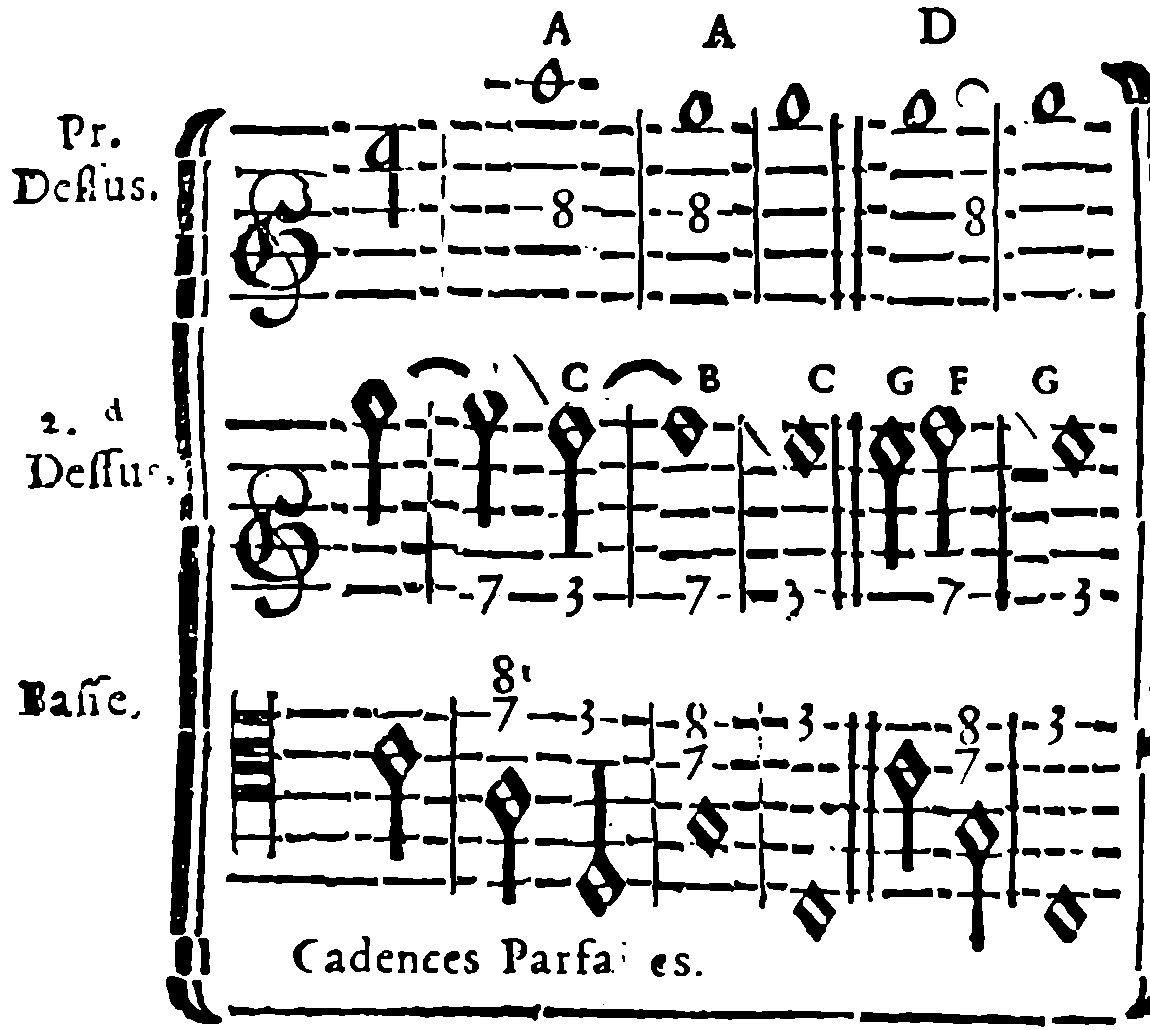
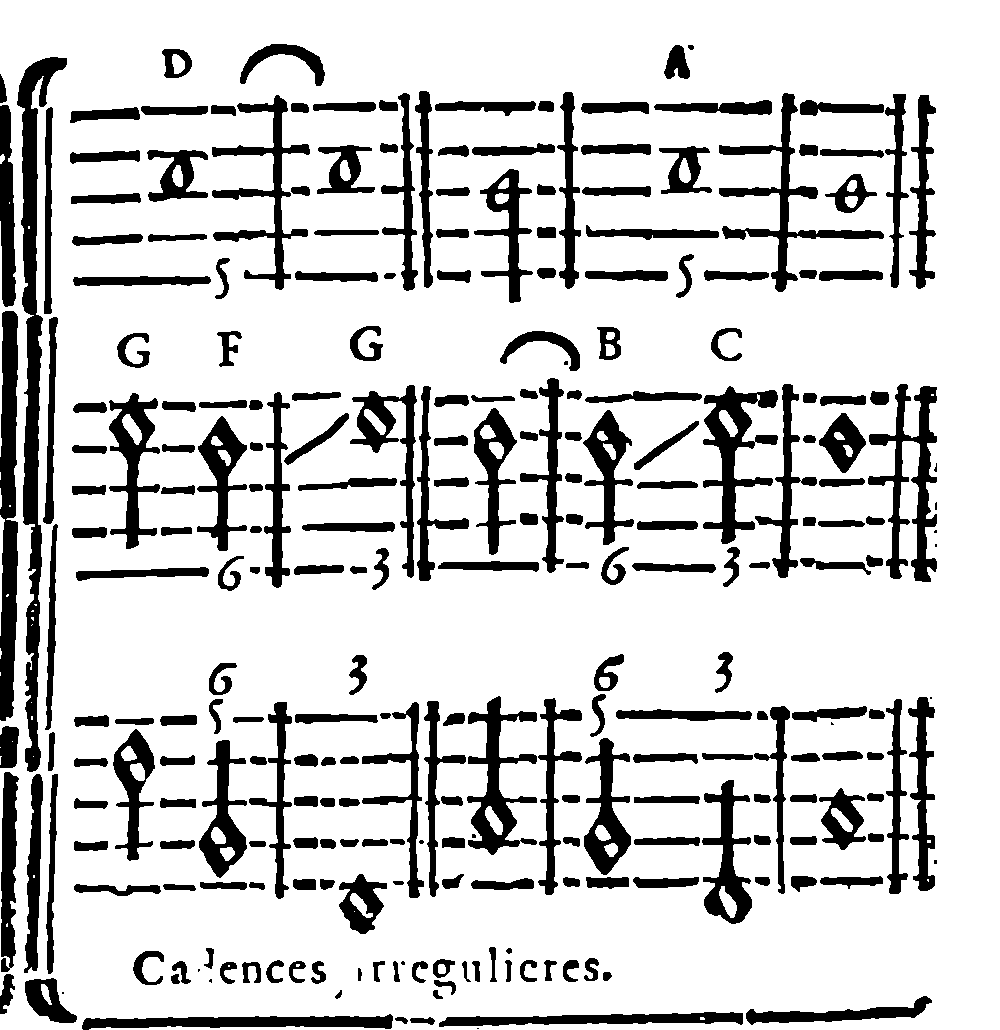
Consonances are in the first upper part; dissonances in the second.
a Mr. de Brossard’s dictionary, under Syncope.
b Reverend Father Pardie, page 147, proposition XVIII, and page 153, proposition XXIII.
Figures show the intervals each upper part forms with the bass. Diagonal lines ↘ ↗ show dissonance moving down or up. B marks prepared dissonances; F marks unprepared dissonances.
In the example, dissonance B rests while consonance A strikes it. Immediately afterward the consonance stops and forces the dissonance toward C, where the consonance itself might have moved. The consonance can no longer go there once the dissonance takes its place; it seems to give the dissonance all its movement. Consonance D, meanwhile, appears immovable. Struck by dissonance F, it forces F back to its starting point G. The dissonance seems to rebound with all its motion from the immovable consonance.
Dissonances thus depend for their movement on the nearest consonances. Moreover, each consonance acts according to its degree of perfection.
In perfect cadence, octave A and D represents the fundamental and forces seventh B and F away downward. In irregular cadence, fifth D and A departs from the octave as much as this cadence departs from perfect cadence. It forces sixth F and B away upward. Clearly 7, after striking 8, can only descend; 6, after striking 5, can only ascend. Third C and G comes to the aid of both dissonances that it generated, softening them, as noted in chapter II, page 53.
The preceding example gives the most perfect harmony for prepared or unprepared dissonance, setting aside notes that could fill out its chords. Remember that harmony’s principle lies solely in the perfect chord: any new sound added must be dissonant,* and dissonant only against its nearest consonance. That consonance determines its movement. The added sound has only the properties supplied by the neighboring consonance, which belongs to the principle. Thus, if experience permits adding a sixth to the first perfect chord of an irregular cadence, that sixth must resolve upward. It is always major here. The disposition causing this irregular movement parallels the one forcing the perfect cadence’s seventh downward. These dissonances differ only in their nearest consonance; each forms a second or inverted seventh against it. Both lose their harshness on the consonance that generated them: the third.
One might object that the example’s movements are arbitrary, both the consonances before unprepared dissonances and consonance C, to which we said A could have moved. We answer that these movements are good, if not the best; nothing more need be demanded.
The three cadences discussed in the last three chapters contain everything essential to harmony. All chords and their movements, and true modulation itself, arise from them. Every consonant chord lies in the perfect chord. Dissonant chords come from adding a sound, producing the seventh chord containing them all. We have just seen that the irregular cadence’s great-sixth chord likewise reduces to a seventh chord. Students should therefore study the three cadences’ properties carefully. Everything still to be said depends upon them in some way.
End of chapter VII.
* See chapter XIV, article I, pages 95, 96, 97, and 98.
Page 70, next-to-last paragraph: retain only its first line, “La Cadence rompuë s’évite de même que la Parfaite” (“The interrupted cadence is avoided like the perfect cadence”); delete the remainder. Third line from the bottom: replace “renversée” with “renversé” (correct the grammatical gender of “inverted”).
Page 71: replace the example with the following.
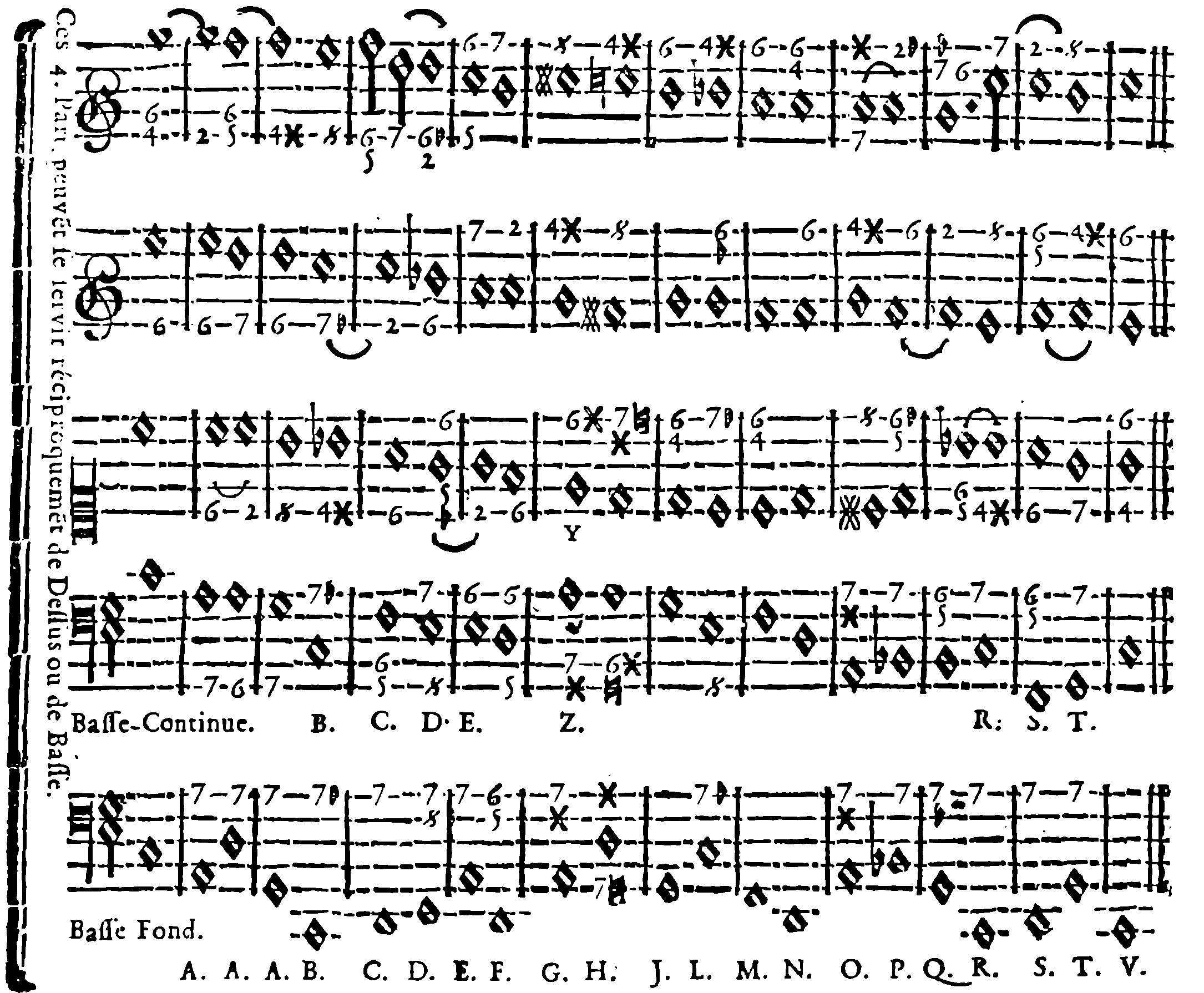
Page 72: delete the eighth paragraph, which begins with X.
Page 75: delete the example’s upper part.
Page 76: at note A in the example’s bass by supposition, write 4 over 9 instead of 4 over 2.
Page 77, fourth line from the bottom: put reference letter b after “mention” and remove it from the next line. In the Zarlino citation, put 290 before 291.
Page 78, paragraph, line 7: add a reference mark at “Onziéme” (eleventh) for this footnote: “Zarlin reports in the same chapter, folio 178, that the Pythagoreans disputed this with Ptolemy; there would be much more to reflect upon here.”
Page 80: the example’s second staff should appear as follows.
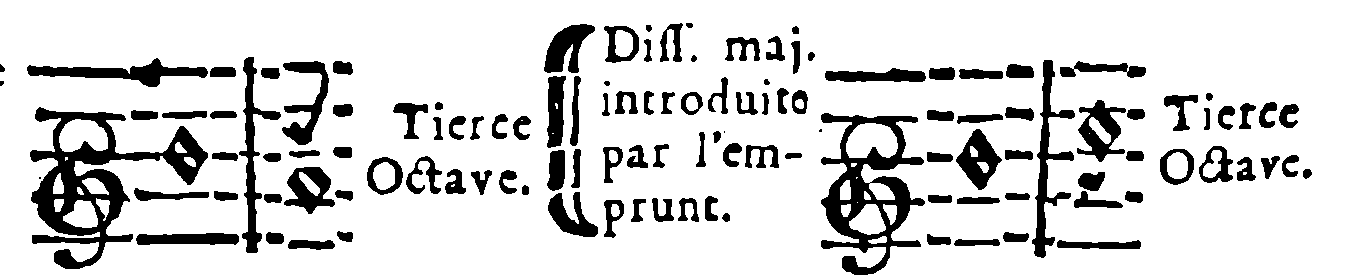
Horizontal lines in this example divide text belonging to the same staff. They should not do so. Readers should correct this themselves, as we have done on pages 57 and 62.
Page 82, paragraph, last two lines: replace “Cinquiéme ou de la Sixiéme” with “Quinte ou de la Sixte” (use the interval names fifth and sixth, rather than ordinal degree names). In the second paragraph, line 2, the star beside Zarlin refers to the following example. The footnotes should read:
(A) De Brossard, Dictionnaire de Musique, pages 91 and 110.
(B) Masson, pages 74, 75, and 77.
Page 85, line 11: delete “soit.” Line 15: replace “parlerons” with “parlons” (shall speak → speak).
Page 86, last paragraph, third line from the bottom: start a new paragraph at “Si l’on fait monter la Basse,” etc. (“If the bass is made to rise,” etc.).
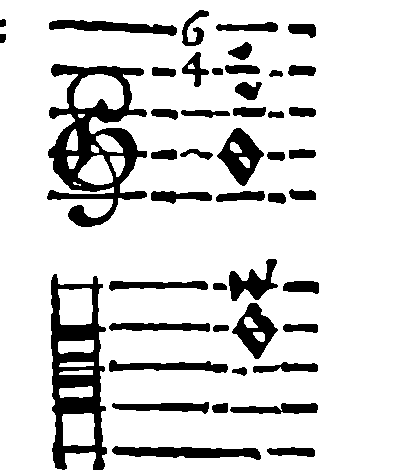
Page 87: the guide signs in the two parts immediately above the fundamental bass should be as follows.
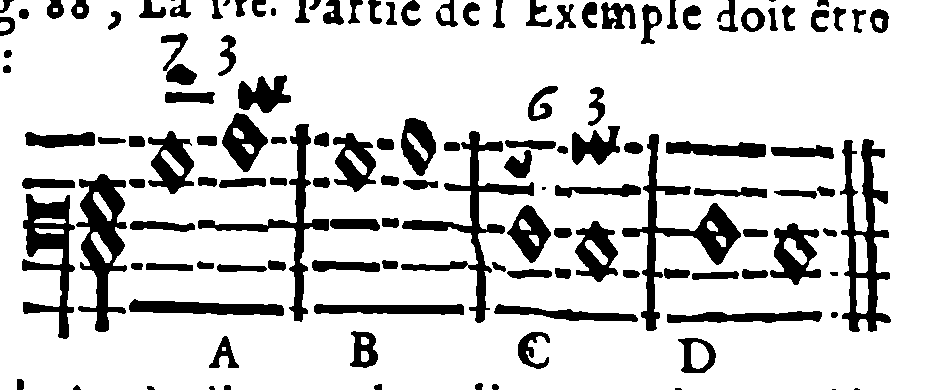
Page 88: the example’s first part should be as follows.
Same page, third line after the example: replace “s’épuiser” (be exhausted) with “se puiser” (be drawn from).
Page 90: add at the end of the first paragraph: “Furthermore, two successive perfect chords over a diatonic bass progression would not follow proper modulation.”
Page 92, second paragraph, line 1: replace “qui” with “lequel” (which). Line 2: replace “dans” (in) with “audessus de” (above).
Page 92: insert the following before the last paragraph.
A minor third may also rise to the octave, provided a seventh can be understood with that octave and the following chord reaches the consonance that naturally resolves the implied seventh.
Example
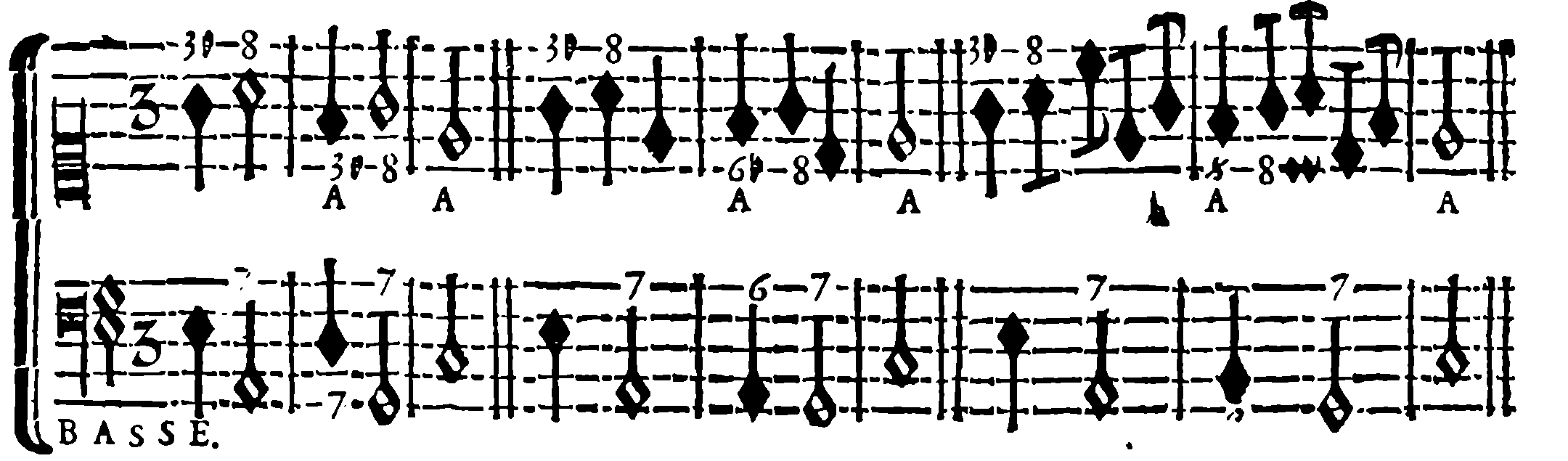
Notes marked A must resolve the implied seventh indicated by the bass figures.
In discussing the minor third, we also discuss dissonances derived from it through different bass arrangements. Notice, however, that this concerns melodic expression: the octave is admitted only by supposition. We return to this in Book III.
“De plus, si la Tierce mineure,” etc. (“Furthermore, if the minor third,” etc.) begins page 92’s last paragraph. Continue that paragraph to its end.
Page 95, line 4: replace “audessus” (above) with “au-dessous” (below).
Page 97, first paragraph, line 6: replace “ce qui s’éclaircira,” etc. (“which will be clarified,” etc.) with “what was explained in chapter VII of the Supplement, and must always be understood throughout the rest of this chapter.”
Page 98, line 4: replace chapter XIX with chapter XVIII.
Page 104, lines 10–11: replace “consecutive octaves” with “consecutive octaves or fifths.”
Page 113, next-to-last line: replace “ou en exclure” with “ou exclure” (or exclude; remove en).
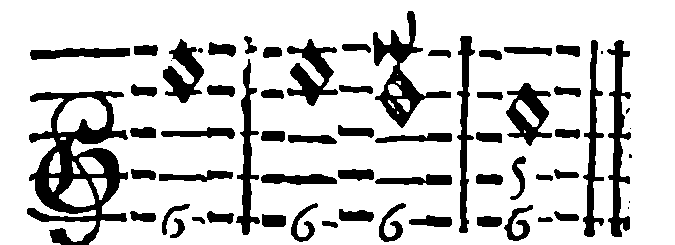
Page 115: delete the example’s top part labeled “Partie ajoûtée” (added part). The guide sign in the part below it should be as follows.
Page 116, lines 4–6: replace the passage beginning “de plus la Partie ajoûtée,” etc., with only: “Furthermore, these two basses must not be placed above the other parts.” Second paragraph, line 6: replace “audessus” (above) with “audessous” (below).
Page 117, line 8: replace “devienne-t-elle” with “devienne telle” (becomes such, rather than an inverted question). Delete the next-to-last paragraph beginning “Ce n’est pas le tout” up to the last paragraph beginning “Au reste, nos raisons,” etc.
Page 118, line 3: replace “continuës” (continuous) with “contenuës” (contained). Line 6: replace “perfection” with “imperfection.”
Page 121, last paragraph, line 2: replace “ces Consonances” (these consonances) with “les Consonances” (the consonances).
Page 122, last paragraph, line 4: end the paragraph at “les plus naturelles” (the most natural); delete the rest.
Page 124, line 2: replace “qui” with “qu’on.”
Page 126, second paragraph, line 1: replace “tous ceux qui ne sont” with “tous ceux qui ne se sont” (restore the reflexive se).
Page 127, line 2: replace “la pratique de ceux” with “la pratique dans ceux” (practice of those → practice within those). Line 5: replace chapter XXIII with chapter XXI.
Page 128, first paragraph, line 6: replace “s’accordant” with “s’accordent” (agreeing → agree). Second paragraph, line 4: correct “prouvient” to “provient”; line 5: replace “dans un son” with “dans un seul son” (in a sound → in a single sound).
Page 130, third line from the bottom: replace “ne dépend du” with “ne dépend que du” (depends only on).
Page 134, lines 5–6: replace “chapters XXII, etc.” with “chapters XXI, XXII, and XXIII.”
Page 135, last line, and page 136, first line: replace “faire préceder” (make precede) with “faire procéder” (make proceed).
Page 136, lines 18–19: replace “Ces Sons devant être absolument extraits de l’idée dans la preuve” (“These sounds must be entirely removed from the idea in the proof”) with “Ces sons devant être absolument retranchez dans la preuve” (“These sounds must be entirely removed in the proof”). Line 25: replace “cela étant fait” (this being done) with “cela supposé” (this being assumed).
Page 139, line 27: replace chapter XXII with chapter XXI.
Page 142, ninth line from the bottom: replace “Misse” with “Ulisse” (Ulysses). Fourth and third lines from the bottom: replace “toutes les particularitez” (all the particulars) with “tous ces effets” (all these effects).
Page 143, line 6: replace “qu’ils appellent” with “qu’il appelle” (which they call → which he calls).
Page 145, second paragraph, line 3: separate the three words “par ce que.” Eighth and seventh lines from the bottom: replace “Does this perfect system therefore have nothing distinctive, etc.?” with “Does this perfect system cease to be perfect when we are to imitate it? Why, etc.?”
Page 146, thirteenth line from the bottom: replace “ainsi” (thus) with “& si” (and if).
Page 147, line 24: replace “établirent” with “établir” (they established → establish). Third line from the bottom: replace “par la Quinte & le Collateral, & où” with “par la Quinte, & le Collateral, où” (correct the comma and remove the second &).
Page 148: arrange the example as follows.
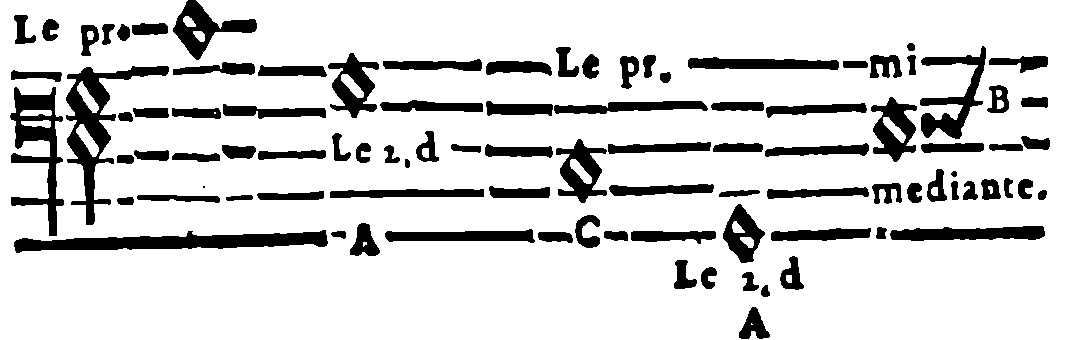
Same page, ninth line from the bottom: replace “leur” with “lui” (to them → to him).
Pages 149–150: place the chapter numbered XXIV on page 157, “On the character of modes and keys,” between the chapters on pages 149 and 150.
Page 150, last paragraph, line 2: replace the spelled-out “nombres deux, trois, quatre” with “nombres 2, 3, 4.” Last line: replace spelled-out “quatre six,” etc., with “4, 6, 8, 10, 12, 15, 16, 20,” etc. Tenth line from the bottom: delete “Par une volonté contre nature” (“By a will contrary to nature”).
Page 151, first line: replace spelled-out “deux, trois & cinq” with “2, 3 & 5.”
Page 152, fourth paragraph, first line: replace “voudroit” (would wish) with “vaudroit” (would be worth). Next-to-last line before the last paragraph: replace “lourré, & aux” with “lourré aux.” Last line: replace “l’observerons” with “l’observons” (shall observe it → observe it).
Page 157, line 5: replace “& de celles” with “& des Mesures” (and of those → and of the measures).
Page 158: arrange the example as follows.
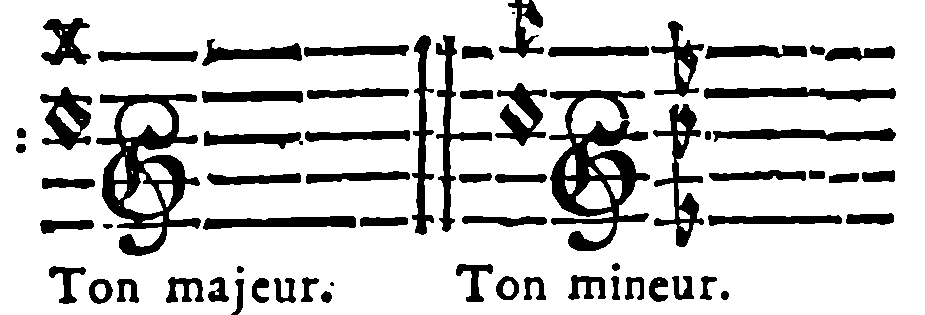
Same page, fifth line below the example: replace “ne soit pas observé” with “ne sont pas observez” (correct the verb and participle to the plural).
Add the following at the end of this chapter.
Two things deserve notice. First, the tempo may change within an air. If the note value filling each beat changes, place the new beat note in parentheses above the staff. If its value remains the same, this is unnecessary. See the example.

Second, inexact numbers of sharps and flats after clefs, intended to show the natural degrees of a transposed mode, often force one to sing “sol” for a note that should be called “ut,” or “ré” for one that should be “la.” These are movable solmization syllables. We should therefore show all transpositions correctly, then explain what to do when they are not written this way.
TURN THE PAGE for the continuing example. Its explanation follows.
Explanation
Only one major key has no sharps or flats at the clef; there should likewise be only one minor key without them. French musicians do otherwise: in minor they do not distinguish D from A by signature. Either becomes the model, so the tonic is called “ré” or “la” inconsistently. This error has long been recognized, but no one dares correct it, apparently because of existing music. Mr. Frere* might have encouraged accuracy had he not replaced one error with another. Instead of the flat we place in D minor’s signature to identify the minor sixth, which must always be regarded as minor, he adds a sharp to the customary minor-key sharps. That sharp marks a major sixth and destroys minor modulation’s order. His aim nevertheless had merit: all transposed minor tonics would receive one singing syllable. Had he preferred “la” as he preferred “ré,” he would have preserved the natural order. We still owe him thanks for considering it.
If the matter is thought worth attention, it would be better to make every transposed minor key conform to A’s octave, calling every minor tonic “la,” just as every transposed major tonic is sung “ut.” These are movable syllables, not changes of sounding key.
The book shows that this reflection came afterward: page 158 itself says minor tonics should always be called “ré.” Our error arose from the original wish to follow usage as far as possible and avoid becoming a tedious reformer of apparently inconsequential matters. We would have remained silent had we not noticed that the customary omission of one flat from D minor through the last flat minor key contradicts our rule. We already knew most musicians pay little attention to proposals intended merely to simplify and clarify. Those guided only by their experience—and that excludes few—might even condemn anything explained differently from their own ideas. But this digression would grow too long; let us return.
If French musicians omit a flat in transposed minor keys, almost all Italians omit a sharp in transposed major keys, from A through the last sharp key.
The explanation continues after the example.
* Mr. Frere, Transposition de Musique, page 35.
ORDER OF SHARPS AND FLATS · to be placed after the clef to indicate transposition of the modes
Table of major modes or keys
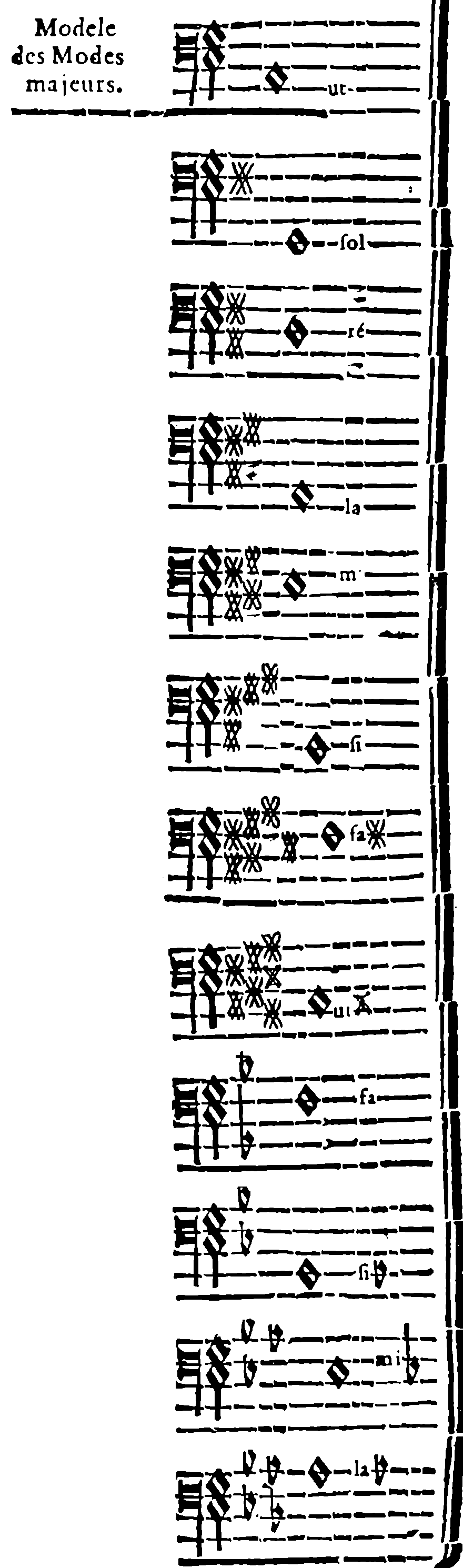
Table of minor modes or keys
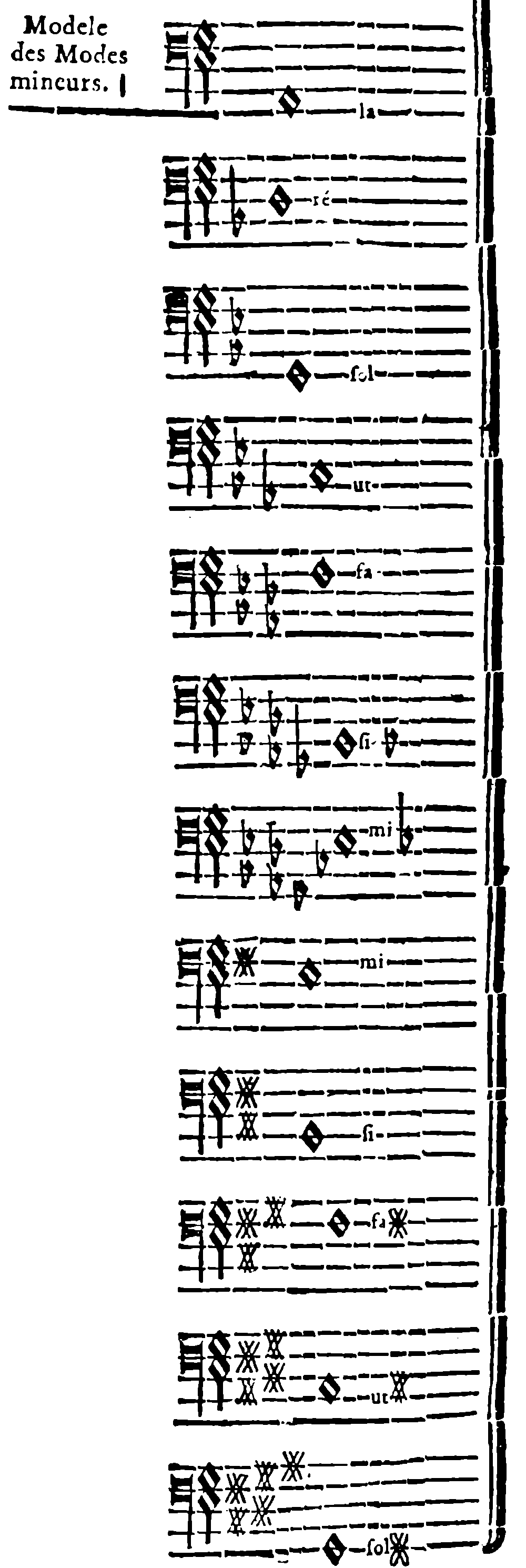
To avoid these faults when using our solmization method, call every major tonic “ut” and every minor tonic “la” when the signature contains the number of sharps or flats specified above. If a major key lacks one sharp, call its tonic “sol” instead; if a minor key lacks one flat, call its tonic “ré.” These observations are useless, however, if one cannot distinguish major from minor. In that case it is better to call the last sharp “si” and last flat “fa.” A missing sign still makes this awkward, besides the small difficulty of finding the last sharp or flat. At least the prescribed order of signs makes the task easier.
END OF CHAPTER XXV.
Page 163, line 1: replace “esclavage” with “asservissement” (slavery → subjection). Second paragraph, line 6: replace “trop grande repetition” with “trop frequente repetition” (too great repetition → too frequent repetition). Line 8: replace “dépendent” with “dépendant” (depend → depending). Next-to-last line before chapter XXIX: replace “suit” with “fuit” (follows → flees).
Page 165: the example should be as follows.

Page 167: the example should be as follows.
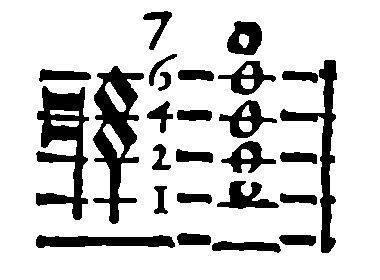
END OF BOOK II.
Book III
Page 271, line 9: replace the passage beginning “l’on ne doit pas moins,” etc., with “One should also practice finding descending intervals in the scale, where one will find,” etc.
Page 174, line 4: begin a new paragraph with “Comme il est absolument,” etc. (“Since it is absolutely,” etc.).
Page 176, last paragraph, line 1: replace “Composition” with “comparaison” (composition → comparison).
Page 178, second paragraph, line 9: replace “& de même que celle-cy” with “& pareillement celle-cy” (and just as this one → and likewise this one).
Page 179, below the next-to-last staff: replace “une Ronde ou deux Blanches,” etc. (“one whole note or two half notes,” etc.) with only “idem” (the same).
Page 182, line 1: replace “le Mis” with “le ♯ Mis” (restore the sharp sign before “placed”). Next-to-last paragraph, line 2: replace “se distinguant” with “se distinguent” (being distinguished → are distinguished). Last paragraph, line 1: replace “pour revenir au ♯ & aux ♯” with “pour revenir aux ♯ & aux ♭” (returning to sharps and flats).
Page 183, second paragraph, line 1: replace “lorsque le, le ♮” with “lorsque le ♯, le ♮” (restore the omitted sharp sign).
Page 185, second paragraph, line 7: replace “nous sous-entendons” (“we imply”) with “nous sous-entendrons” (“we shall imply”).
Page 186, last line before Chapter IV: replace “of the fundamental bass” with “of the tenor part”.
Page 187, third paragraph, line 3: replace “which is the bass” with “which is in the bass”.
Page 192, last paragraph, line 2: replace “être préparée & sauvée” with “être préparé & sauvé” (“be prepared and resolved”); use the masculine rather than feminine French forms.
Page 193, first staff of the example: the cue sign below letter B should be in the middle of the space, indicating C, rather than on the line.
Page 198, line 10: replace “of the third” with “of the second”.
Page 202, first paragraph after the list of chords, line 2: replace “sa Médiante se porte” (“its mediant moves”) with “sa Médiante le porte” (“its mediant bears it”).
Same page, line 13: replace “devoit” (“was to” or “should”) with “doit” (“must”).
Page 209, next-to-last paragraph, line 1: for “one cannot here make the …”, read “one cannot here distinguish a second degree from a sixth degree, nor a tonic from a dominant, because …”.
Page 214, last paragraph, lines 5 and 6: replace “the seventh being” with “the seventh of this note being”. Same page, third line from the bottom: replace “(Y) removes the tone or the second …” with “(Y) removed; the interval of a tone or second between notes (Z) and (A) is formed …”.
Page 216, line 19 of the small type: replace “remontoit” (“rose again”) with “rencontroit” (“encountered”).
Page 222: arrange the example as follows.
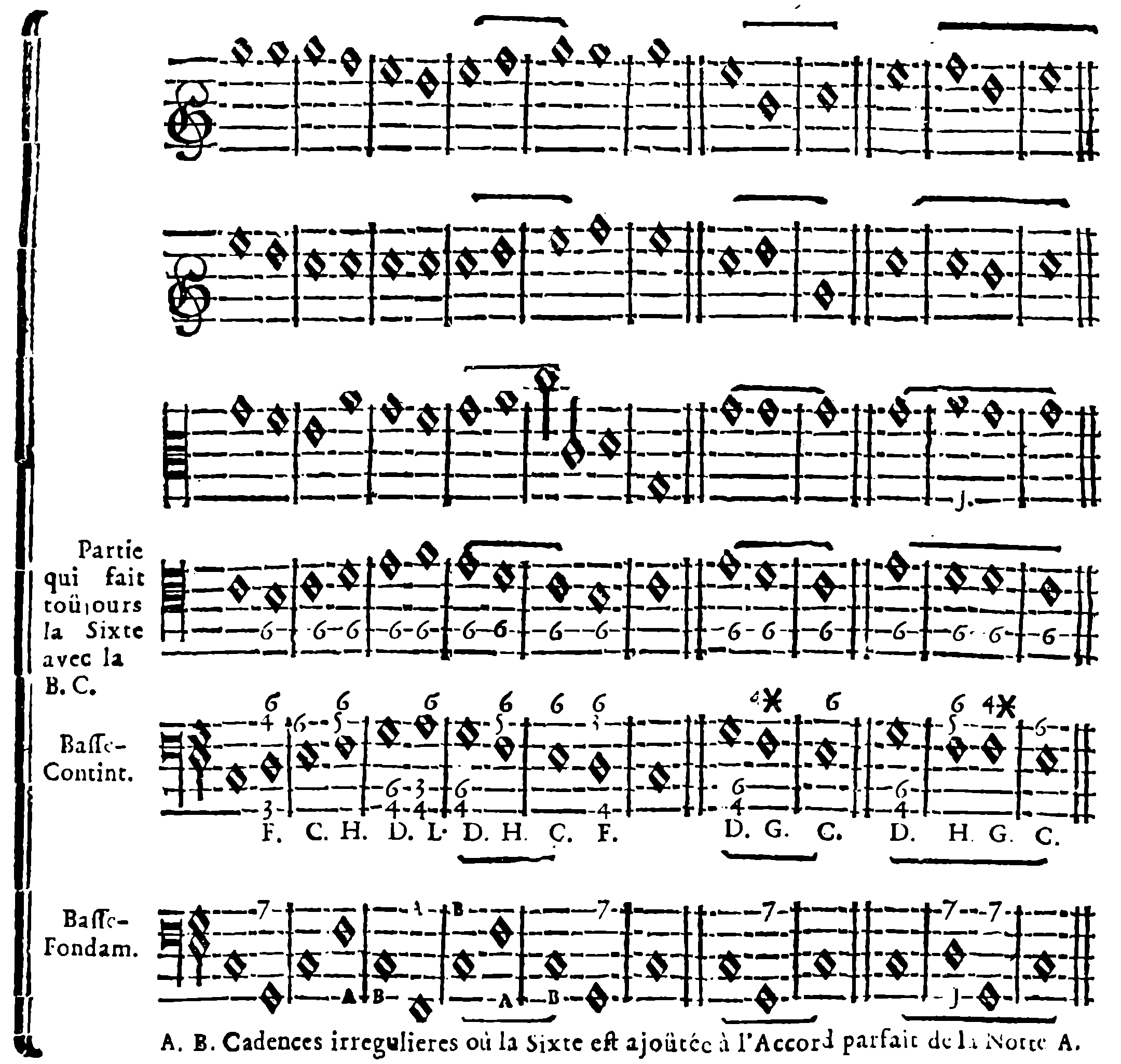
Page 227: the figure 3 after letter G below the second example means that note G forms the third of the second note F. The figure 5 after letter H in the third example means that note H forms the fifth of the second note F.
Page 229, line 9: replace “Chapter XVI” with “Chapter XIII”.
Page 231, line 2: replace “P” with “D”. In the second paragraph, line 2, letter G should begin a new paragraph. The last measure of the example’s continuo bass should read as follows.
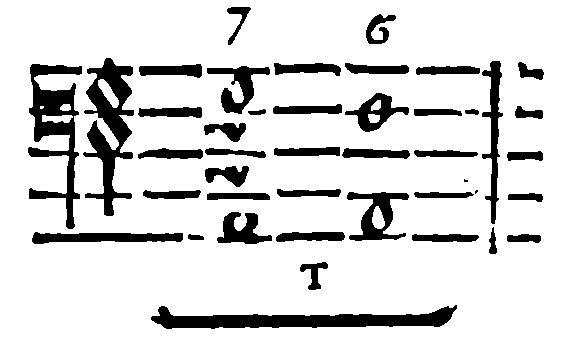
Page 232, third paragraph: replace “as N” with “as at J”.
Page 233, Chapter 19, line 8: replace “see Book II, Chapter XVI” with “see Book II, Chapter XIII”.
Page 234: the next-to-last measure of the fundamental bass should read as follows.
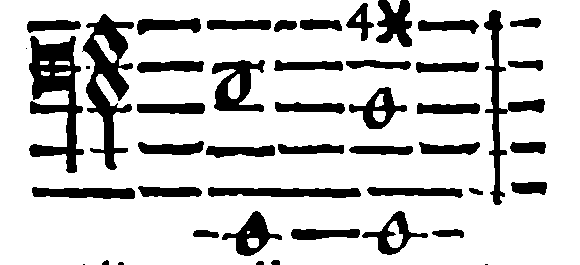
Page 239, fifth paragraph, line 4: replace “the bass precedes” with “the bass proceeds”.
Page 240: a dot is missing to the right of the C that begins each staff of the example.
Page 245, second paragraph, line 5, and third and fourth paragraphs; also page 247: “de cinq en cinq” (“by fives”) and “de quatre en quatre” (“by fours”) occur several times. Read “de Quinte en Quinte” (“from fifth to fifth”) and “de Quarte en Quarte” (“from fourth to fourth”), or simply “by fifths” and “by fourths”.
Page 252: remove the first G label in the example. Move the sharp below the E labelled G to the figure 6 above that same note. Line 2: replace “chiffrez” with “chiffrée”, correcting the French form of “figured”. Line 3: replace “which makes a mediant heard there” with “which is heard there requires only the perfect chord”.
The following words should begin a new paragraph: “A mediant …”.
Page 256, last line before the paragraph break: replace “of the sharp fourth” with “of the tritone”.
Page 259, last paragraph, line 8: replace “peuvent nous marquer ; le rapport” (“can indicate to us; the relation …”) with “peuvent nous marquer, a le rapport” (“can indicate to us, has the relation …”).
Page 260: add a ♭ to the E labelled F.
Page 261, last line before the example: replace “on n’en put faire ainsi” with “on n’eût pû faire ainsi”, changing the wording to “one could not have done so”.
Page 262, line 2: replace “sharp sixth” with “major sixth”. In the last paragraph, line 6, remove the “&”.
Page 266: place letter C below the first note of its measure, rather than below the second note.
Page 267: place an A below the example’s first D.
Page 268, last line before the paragraph break: replace “Chapter XX, on licenses” with “Chapter XVII of Book II”.
Page 269, second line from the bottom: replace “ne diminuent rien” (“diminish nothing”) with “ne dominent rien” (“dominate nothing”).
Page 276, line 2: replace “sharp fifths” with “augmented fifths”.
Page 277, last paragraph, lines 4 and 5: delete “although the seventh is suitable only in preparing the irregular eleventh”.
Page 278: put letter A above the first note of the next-to-last measure in the continuo-bass example.
Page 281, first example: add a ♯ to the left of the C note and another to the right of the word “Ut” (C). In the second example, remove the ♯ attached to figure 7.
Page 282, line 2: replace “Deuxiéme” with “Seconde” (both mean “second”; the latter is the interval name). On the same page replace “Cinquiéme” with “Quinte” (the interval “fifth”).
Page 284, end of the third paragraph: replace “Basse” (“bass”) with the letter B alone.
Page 287: place a ♯ instead of a ♮ beside the second note on the example’s first staff. Move the ♮ to the immediately following note at the same degree.
Page 288, line 6: replace “Chapter XXXI” with “Chapter XXIX, page 274”.
Page 290: remove the last three paragraphs and replace them with the following. To become fully convinced of the truth of this book’s rules, consult our observations on establishing the rules in Book II, Chapter XVIII, page 25. As for chromatic motion, note that it may be used in major keys on the major third of a dominant, which then descends a semitone to become the seventh of another dominant; or by raising the fourth degree a semitone to the leading note of a new key.
Page 293: the example should read as follows.
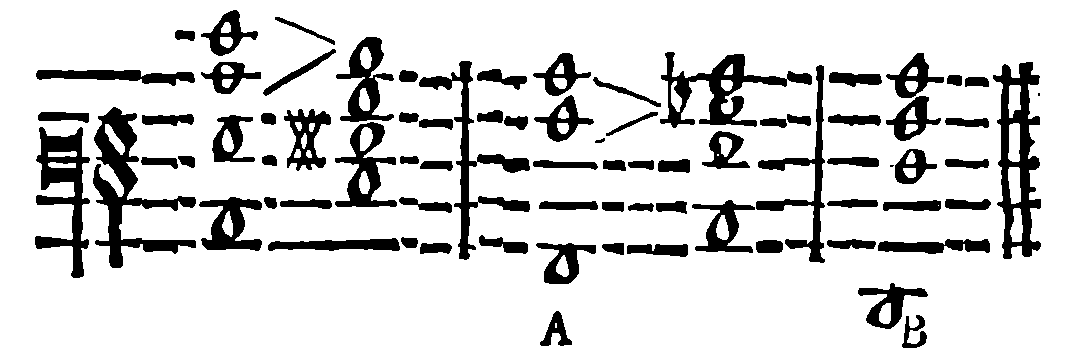
Page 294, sixth paragraph: replace “la Cinquiéme” with “la Quinte” (the interval “fifth”). Add the following as a new paragraph immediately before Article IV:
Sometimes a tritone occurs on a note other than the fourth degree, and a diminished fifth on a note other than the leading note. These intervals then no longer define the chord: they serve only as accompaniment, and the modulation requires their alteration. Likewise, some sevenths in the progression just seen are altered, meaning that they do not have their ordinary proportion. Never worry about such alteration once you know the required chord and the current key. The successive degrees of the natural voice within the octave of that key or mode determine whether an interval belonging to a chord is ordinary or altered.
Page 296, last line before Article VII: replace “and in Book II, the chapters …” with “and in Book II, all the chapters discussing meter”.
Page 299, Chapter XXXVI, next-to-last paragraph: replace “d’une Consonance parfaite une imparfaite” with “d’une Consonance parfaite à une imparfaite”, supplying the missing “à” (“from a perfect consonance to an imperfect one”).
Page 309: remove the figure 6 above G in the second measure of the figured bass. Move the 6 below A in the next-to-last measure of the same bass above that note. In the last paragraph, replace “the figures above” with “the figures below”.
Page 310, line 7: replace “even in the first” with “and especially in the first”.
Page 315, first paragraph, sixth line from the bottom: replace “Chapters XXV and XXVI” with “XXIV and XXV”.
Page 316, line 2: replace “Deuxiéme” with “Seconde”, the interval name for a second. In the second paragraph’s last line, replace “Ton” (“tone”) with “Temps” (“beat”).
Page 317, last line: replace “I cannot” with “I can”.
Page 336, paragraph numbered 40, line 10: replace “and we have said” with “and if we have said”.
Page 357, line 1: replace “guides us, one may” with “guides us, and one may”. Line 4: replace “parts, find” with “parts, and find”. Seventh line from the bottom: replace “Tons” (“tones”) with “Temps” (“beats”).
Book IV
Page 366, seventh paragraph: replace “for now, distinguish thirds from sixths, majors from minors …” with “for now, distinguish major thirds from minor thirds, and major sixths from minor sixths …”. Fifth line from the bottom in the small type: replace “the diminished seventh of 4½ tones, C to B♭, G to F” with “the diminished seventh of 4½ tones, as C♯ to B♭, G♯ to F, etc.”.
Page 367: place the heading “Minor thirds” above the example’s second staff.
Page 368: remove the ♯ beside D in the fourth measure of the major-sixths example.
Page 369, sixth line from the bottom: replace “sharp second and flat third” with “augmented second and minor third”.
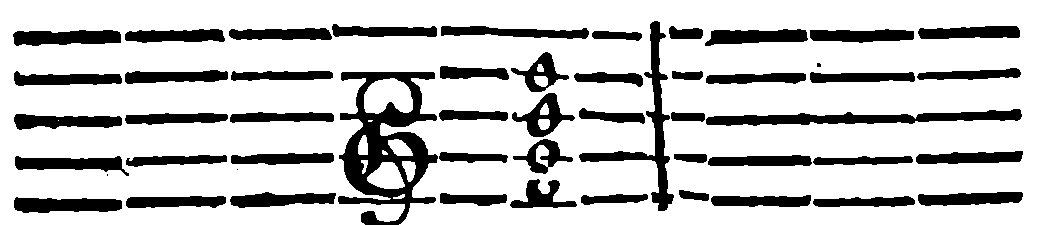
Page 382, fourth staff counting from the bottom: in measure 5 replace figure 4 with 3. In the next-to-last measure of that staff, add F as follows.
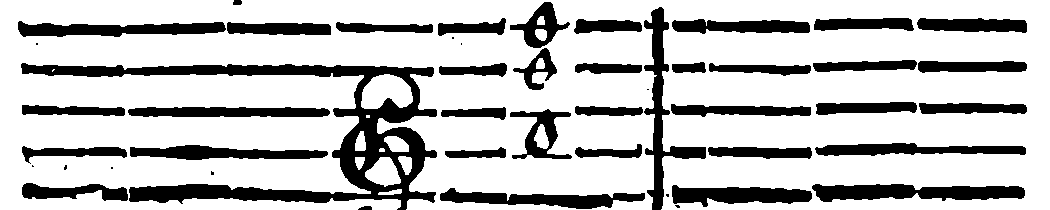
Page 383, fourth staff counting from the bottom: arrange the fifth measure’s chord as follows.
On the same page, some chord and fingering figures are missing from the examples. The reader can easily supply them by following the correct beginning. Notice, however, that the figure 3 at the start of the second staff on page 387 must be changed to 5.
Page 393, third line from the bottom: replace “donc il doit” (“therefore it must”) with “dont celui-là doit ou du moins peut suivre l’autre, conformément …” (“of which that one must, or at least may, follow the other, in accordance …”).
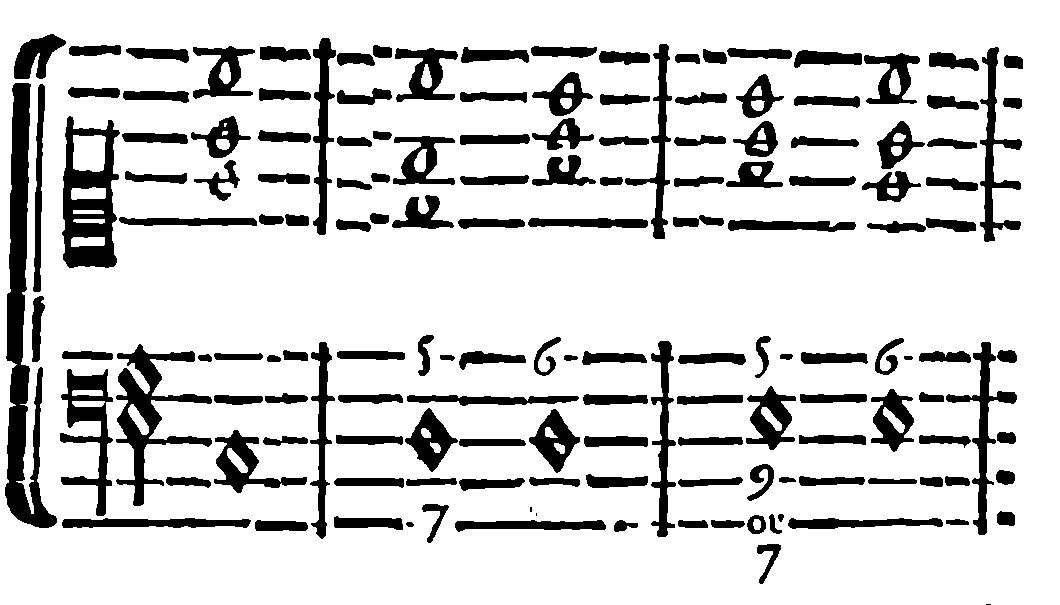
Page 399: throughout the example, replace the G clef with a C clef on the first line. Arrange the first three measures as follows.
Page 400: arrange the example’s fifth chord as follows.
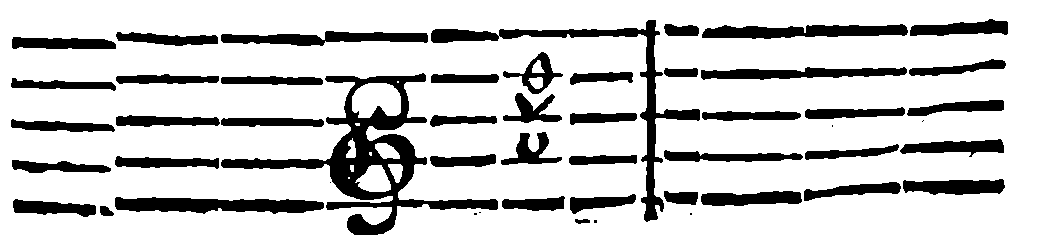
Page 402, line 8: after “in the bass of seconds”, add “page 396”.
Page 403: the second chord of the fourth measure should read as follows.
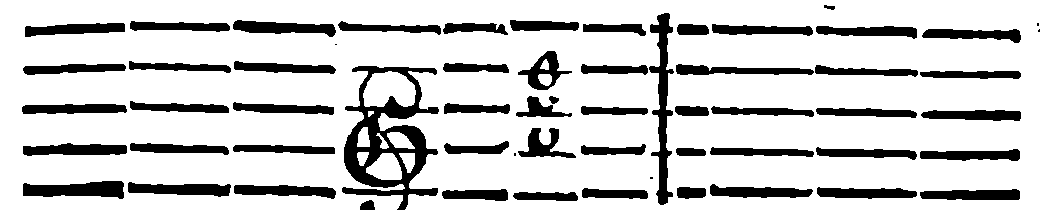
Same page, line 3: replace “sixth; of the mediant to that …” with “sixth of the mediant; to the sixth–fourth chord of the dominant, or to the perfect chord of the tonic; one will find …”.
Page 406, Article I, line 1: replace “third” with “second”. Line 3: replace the plural French verb “se chiffrent” with singular “se chiffre” (“is figured”).
Page 407, last line: replace plural “précedent” with singular “précede” (“precedes”).
Page 408, line 2: replace “devoit” (“should” or “was to”) with “pourroit” (“could”).
Page 409, line 6: replace plural “trouvent” with singular “trouve” (“finds”).
Page 416, Chapter XVI, second paragraph, line 2: replace “Chapter XI” with “Chapter IX”.
Page 419: replace the ♯ beside F in the second chord of measure 6 with a ♮.
On the same page, the figure cannot distinguish the small-sixth chord here, any more than elsewhere. At least it can be recognized in the upper part, which contains all the chords.
Page 423: the fifth chord of the example should read as follows.
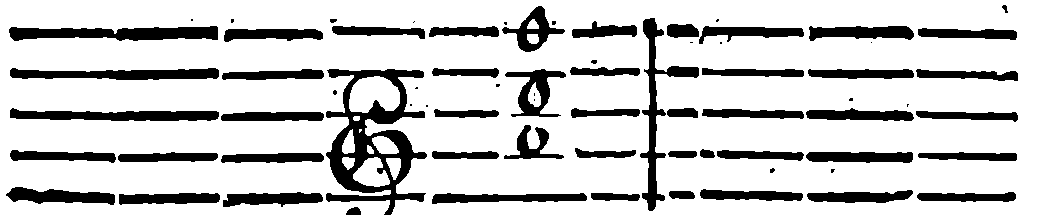
Page 424: the fourth measure of the example’s chords, counting backward, should read as follows.

Page 425, next-to-last paragraph: replace “Chapter XIX” with “Chapter XVII”.
Page 427, end of the first paragraph: replace “contenus” (“contained”) with “continus” (“continuous”).
Page 428, end of the second paragraph: replace “naturel” (“natural”) with “nature” (“nature”). The example contains a 4 and a 6 indicating the tritone and small sixth respectively; each should have a line through it. The author was absent during printing, and these characters were not yet customary in the printing trade, so they were not thought important enough to attend to. Yet a barred 6 distinguishes the small-sixth chord, not the major sixth as some claim. Our principal aim should be to represent a complete chord with a single figure, avoiding a confusing multiplicity of figures. Since there are four different sixth chords, they should be distinguished as far as possible by characters assigned to each. Little attention has been paid to this. The barred 6 has merely been intended to indicate the major sixth, on the assumption that this sixth is accompanied by a third and fourth. But that is not always true: during a piece one often must figure a major sixth that is not the one in question, marked major only because of a new transposed modulation whose necessary sharps are not beside the clef. Even the small sixth is often minor. Moreover, since custom alone authorizes these characters, the barred 5, written 5̸, indicating the diminished or false fifth, undermines the reason for claiming that another figure crossed by the same kind of line should indicate a major or augmented interval. It would therefore be better for these new characters to convey a complete chord accurately than to make an interval sometimes minor and sometimes major—especially when that interval can be accompanied in several different ways.
What we say in this chapter will serve the future more than the past; in return, our rules can make up for past shortcomings.
Page 430, line 11: delete “&”. In the example, combine the parts above the bass on a single staff so that they can serve as accompaniment.
Since most of our music and harpsichord masters find it hard to relinquish their prejudices, we do not expect everyone’s approval. We therefore ask those who have difficulty accepting our conclusions to inform the public, thereby giving us the means to bring this work to the perfection we would wish it to attain.
END OF THE SUPPLEMENT.