 Playable Books
Jean-Philippe Rameau · section 19 of 109
Chapter five
Read and hear this section in the playable edition →On the Perfect Cadence, in Which the Nature and Properties of All Intervals Meet
A perfect cadence is a certain conclusion of a melody that satisfies so fully that nothing further is desired. The first two chapters should already have given us an idea of this cadence, both in the bass's descent by a fifth or ascent by a fourth and in the chords composing it, the perfect chord and the seventh chord. Its perfection does not end there: the progression of every interval is determined by that of the thirds prevailing in the chords, except for the octave and fifth, which were generated first and consequently have an independent progression.
If we have regarded the fifth as the primary object of every chord, we must attribute this quality no less to the thirds composing it. After generating the fifth by division, the octave entrusts it with the construction of every chord; likewise, after generating the thirds by division, the fifth entrusts them with the progression of the other intervals, which follow the nature and properties of these thirds in every respect. Thus, since the major third is naturally lively and cheerful, everything major or augmented must have this property; and since the minor third is naturally tender and sad, everything minor or diminished must likewise follow its property. Concerning the progression of thirds, Zarlino says* that their outer sounds naturally tend toward the direction closest to their being: the major wishes to become major, that is, to ascend, and the minor to descend. This is evident, he says, to all skillful musicians of sound discernment, because the movement in the upper part is a semitone. This semitone is the salt, if I may say so, the ornament and the occasion of beautiful harmony and good modulation, which without it would be almost unbearable. From these two different progressions we derive those of every interval distinguished as major, augmented, minor, or diminished. Our general rule must be that everything major or augmented ascends, and everything minor or diminished descends.
The semitone to which the progression of every interval should conform, and which Zarlino seems to offer as a general rule, is indeed the only movement suited to major or augmented intervals. Minor and diminished intervals, however, may also descend a whole tone, according to the modulation. It is extraordinary that, after speaking so successfully of this semitone, Zarlino abandoned it precisely where it is most strongly felt. Observe in the perfect system that the semitone lies between the octave and the sound preceding it in ascent, that repose is determined on this octave, and that a diatonic ascent can reach it only through this semitone. The sound preceding the octave must therefore have no less a share in harmony than the octave itself, since one must pass through the former to reach the latter. Yet although Zarlino could not avoid saying that one must ascend from the major third and major sixth to the octave—a rule that can arise only from the observation just made—he forgets that the tritone must share the rule. He mentions it only in passing and omits it entirely from his perfect cadence. The other major or augmented dissonances arising from this major third, always formed by the sound preceding the octave, receive even less attention. Precisely those things whose progression conforms without qualification to his proposed semitone are the ones he discusses least. We should therefore expose his blindness through an example of the perfect cadence, in which the sound preceding the octave forms a major third, from which arise all the major dissonances that must ascend a semitone to this octave.
* Third part, chapter 10, fol. 182; chapter 38, fols. 219 and 220.
The first of the two bass notes forming the perfect cadence is called the dominant, because it must always precede the final note and consequently dominates it.
The seventh arising from a minor third added to the dominant's perfect chord forms a dissonance not only with the dominant but also with its major third. That third therefore becomes dissonant in relation to the seventh: the former is the origin of every major dissonance, and the latter of every minor dissonance, without exception.
The note ending the perfect cadence is called the tonic, because it begins and ends the piece, and all modulation is determined within the compass of its octave.
The sound preceding the octave, which forms every major dissonance, is called the leading note: no major dissonance is heard without our feeling that the tonic or its octave must follow immediately. The name therefore aptly describes the sound that makes us anticipate the object of all modulation.
Examples
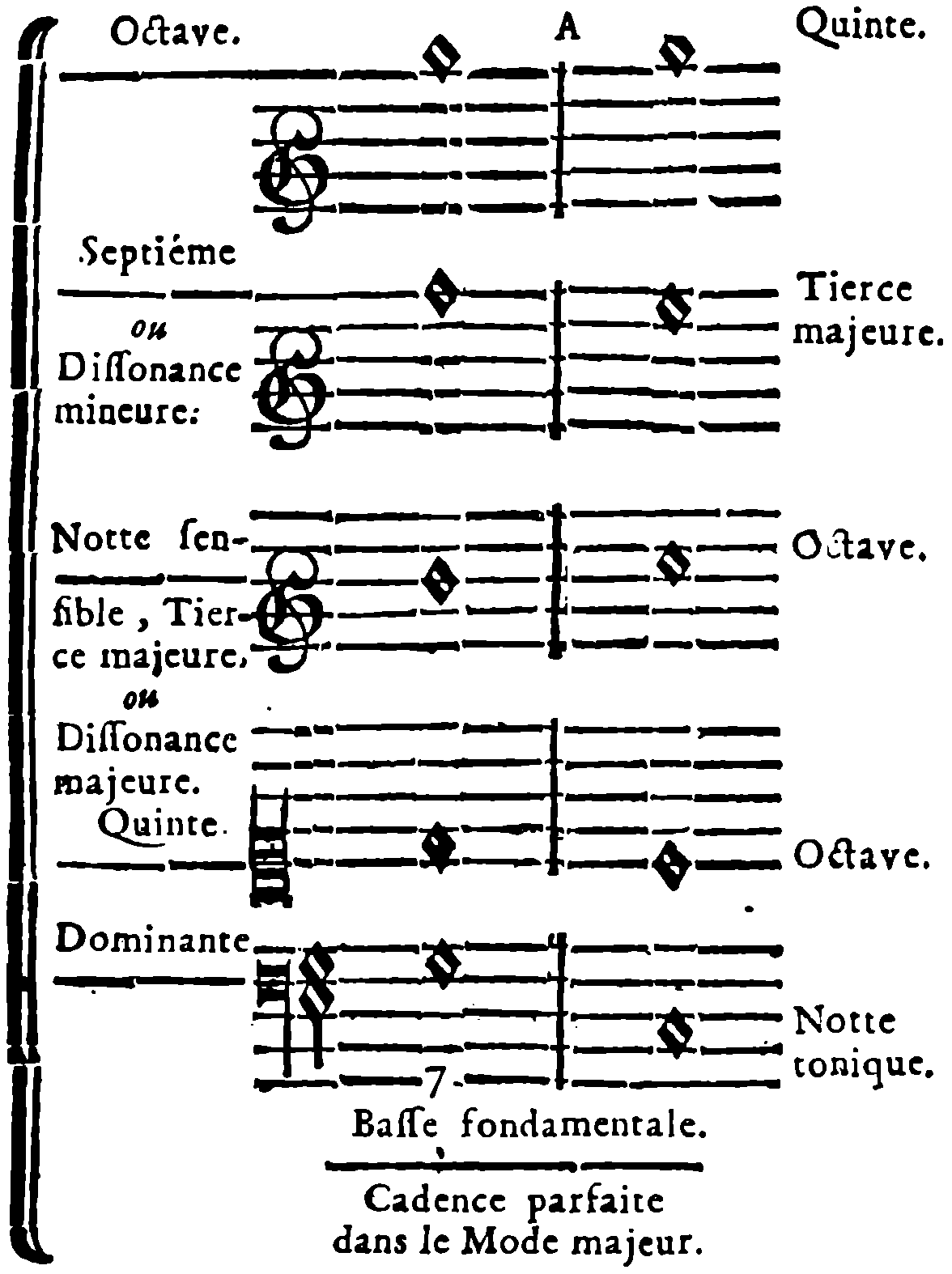
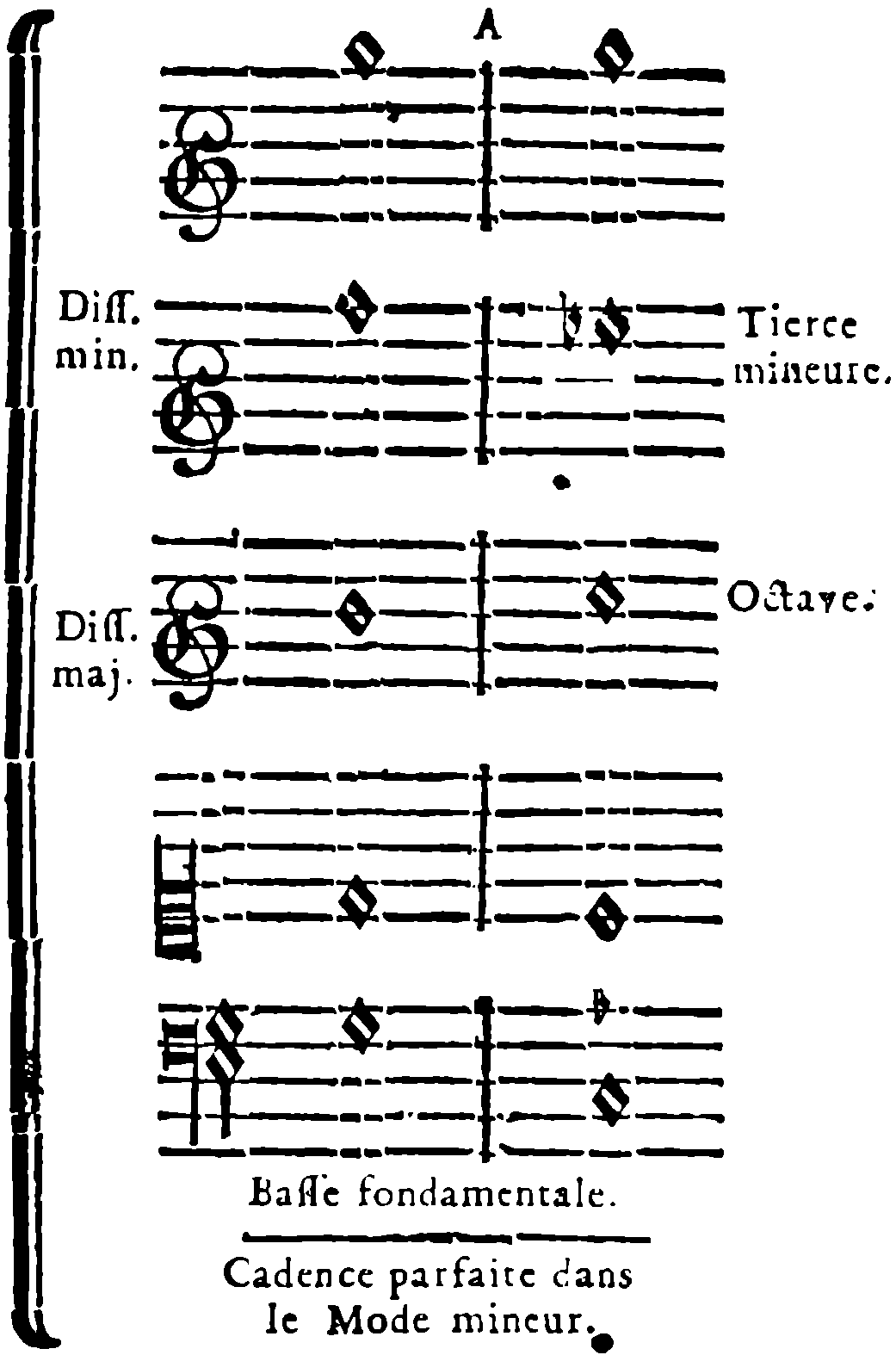
Observe that these two examples are uniform except for the minor dissonance, which descends only a semitone in one and a whole tone in the other, while the major dissonance always ascends a semitone from the major third to the octave. Remove the fundamental bass and alternately put each of the other parts in its place: every inversion of these chords will be found, and the harmony will always be good, because the fundamental bass, though removed, remains implied. The different dissonances heard as a result of the parts' different positions must invariably follow the progression assigned to them in the original chords. The major dissonance always rises a semitone to the tonic or its octave; the minor always descends to the major or minor third of the tonic. Nothing is clearer,* and Zarlino himself supplies the proof in his examples of the diminished fifth and tritone, whose inversion he demonstrates without realizing it.
* Third part, chapter 61, fol. 293.
Example by Zarlino, to Which We Add the Fundamental Bass
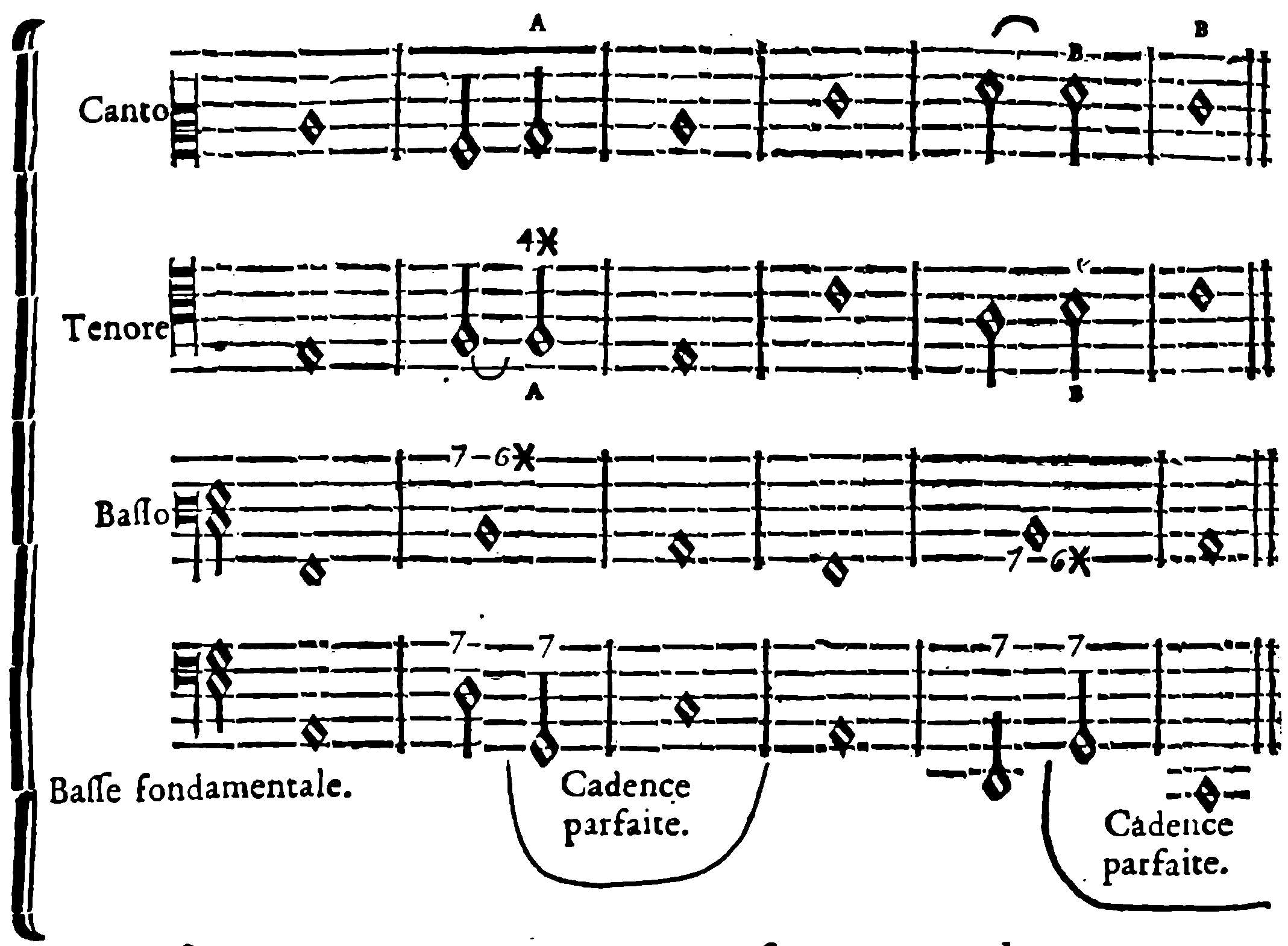
If we consider the two upper parts separately, we find the tritone marked (A) and the diminished fifth marked (B). Compare them next with the part he calls Basso: the tritone supplies its major sixth, ascending a semitone to the octave. Finally, compare them with our fundamental bass: the tritone supplies its major third, and the diminished fifth its seventh, progressing according to our preceding rule. These different chords therefore always represent the perfect cadence, because their progression does not change and the foundation remains, though implied. Otherwise the piece would be filled with confusion and dissonance.a Zarlino means this when he says it and forgets it in practice. If he further says that the natural progressionb of the lowest part in perfect cadences is to descend a fifth, he gives an example in which the upper part always ascends from the major third to the octave (A).c Elsewhere, while this major third of the dominant ascends, the fifth of the same dominant also descends to the octave (B);d and while this fifth descends, its third, which is the dominant's seventh, descends to the third (C). Assemble these three different examples, and we find our complete cadence. For this purpose we shall take his example from Chapter VI and add its missing parts as follows.
a Third part, chapter 58, fol. 282.
b Chapter 5, fol. 251.
c Fol. 251.
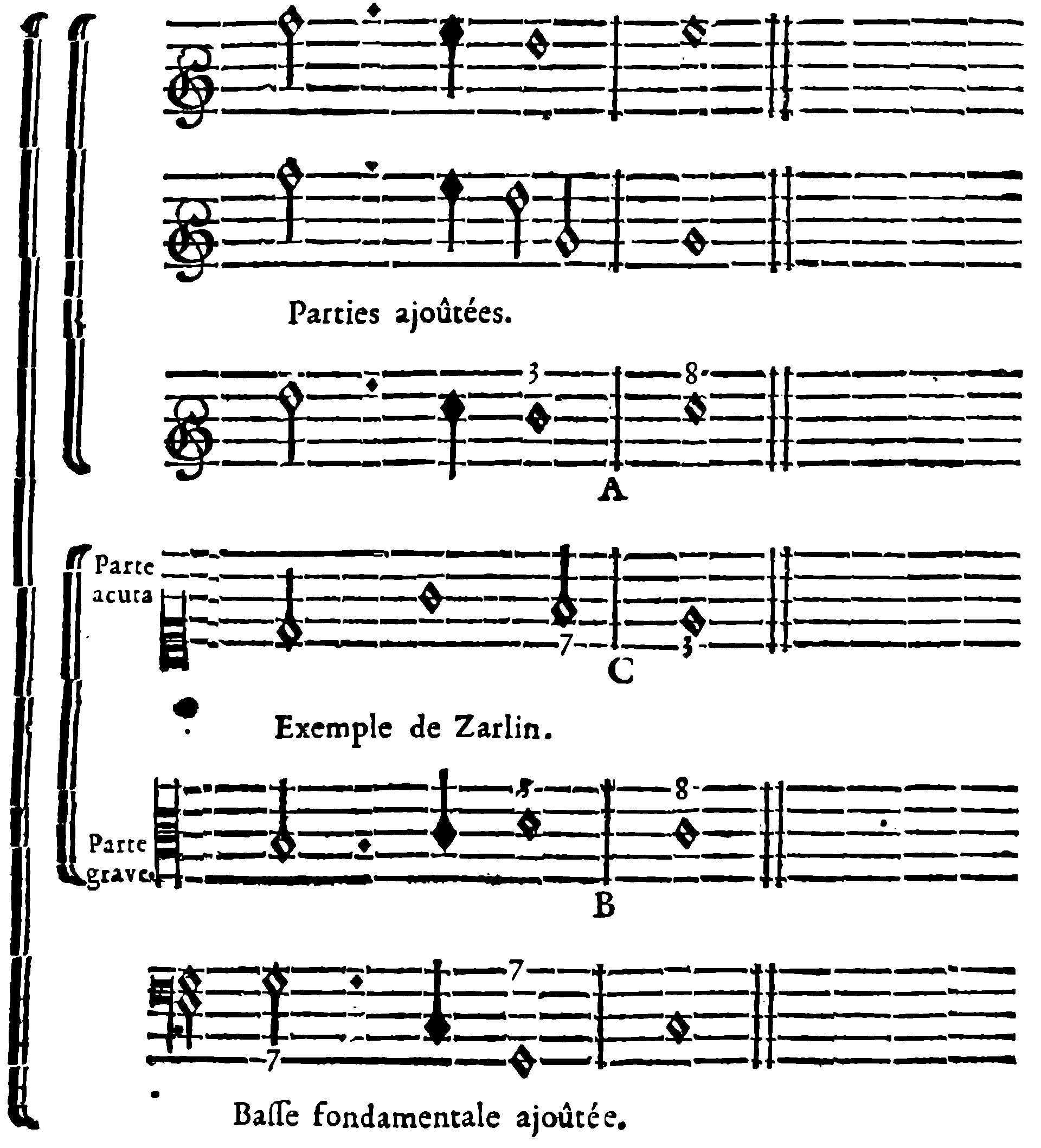
This is not the harmony Zarlino understood as implied here. He apparently intended the perfect chord to sound on the second beat of the whole note that forms a fifth with the fundamental bass, because in his view the fourth struck on the first beat of that same whole note is dissonant rather than consonant. But how can the perfect chord of the final whole note, which ends the cadence, follow that of the other whole note in question? If the latter's minor third, forming a seventh against the fundamental bass, descends, what progression will the fifth and octave take? A skillful musician should always figure his bass, especially when his examples have only two parts, so that they can be judged soundly; otherwise the conclusions drawn from them may often be false. Perhaps, however, Zarlino left his basses unfigured for fear of drawing attention to intervals he wished to ignore, and apparently wished others to ignore as well.
d Chapter 6, fol. 254, fourteenth and fifteenth measures.
Moreover, if a perfect chord is to sound on each of the last two notes in the part he calls Grave, our first observations, drawn from his own reasoning, prove this contrary to the foundation of harmony: the bass cannot proceed diatonically beneath perfect chords. The fourth in this example must therefore be consonant in relation to the fundamental bass, with which it forms an octave. If it were dissonant, the perfect cadence could no longer be felt on the final note; the cadence would then be irregular.
Example
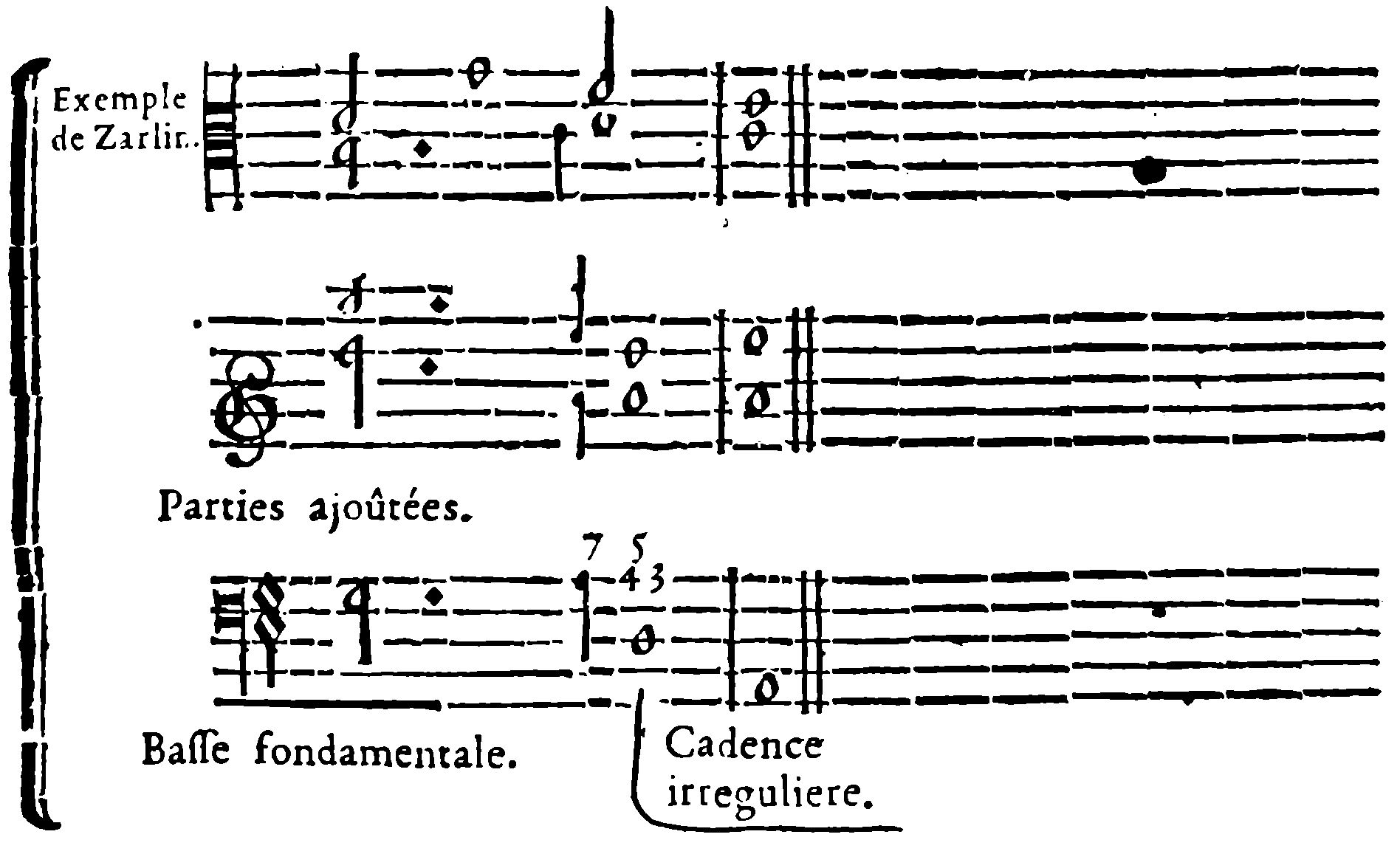
Ask us now which of the two cadences Zarlino intended here. Apparently the perfect cadence, since his whole piece revolves around the key of C, whereas this irregular cadence is in A or D. Moreover, he makes no mention of the irregular cadence; when it occurs in his examples, it is merely within a chord succession in which he does not point it out.
Our first example must therefore supply every way of practicing the perfect cadence in two, three, four, or five parts. Choose whichever parts seem appropriate to sound together, and freely place beneath one part those lying above it. Only the fundamental bass cannot naturally change position, although even this is permitted when good taste guides us, especially to avoid a perfect conclusion in an upper part while the bass moves diatonically. Thus harmony is contained in the two proposed chords, the perfect chord and the seventh chord; all our rules rest on the progression natural to these two chords.