 Playable Books
Jean-Philippe Rameau · section 20 of 109
Chapter six
Read and hear this section in the playable edition →On the Interrupted Cadence
If we change the progression of one of the sounds in the first chord of a perfect cadence, we necessarily interrupt its conclusion. The interrupted cadence originates in this interruption caused by a change of progression.
This cadence differs little from the perfect cadence, since both are composed either of the same chords or of the same fundamental bass. If their chords are the same, the fundamental bass, which must descend a fifth in the perfect cadence, ascends diatonically here. If the fundamental bass is the same in both, the perfect chord ending the perfect cadence is changed here into a sixth chord. Observe carefully that these changes affect only consonant sounds—the fundamental, its octave, or its fifth—not the sounds forming dissonances. Thus the major third, the object of all major dissonances, always rises a semitone; and the seventh, the object of all minor dissonances, descends a whole tone or semitone. This agrees with our rules for dissonance progression and undermines the foundation in only one principle at a time: if the perfect chord no longer remains, the fundamental bass stays unchanged; if the bass changes, the perfect chord comes to its aid. Yet does not the sixth substituted for the fifth form a chord derived from the perfect chord? And have we not observed that the seventh introduces a bass progression corresponding to its interval? Everything therefore still remains, although this latter cadence can be admitted only by license: either its chord is no longer fundamental, or its bass progression is no longer generated by consonances, and the freedom dissonance gives us here alters perfection. But this alteration is not harsh. Far from displeasing, it only makes perfection more agreeable when it returns after being withheld for a time.
Examples
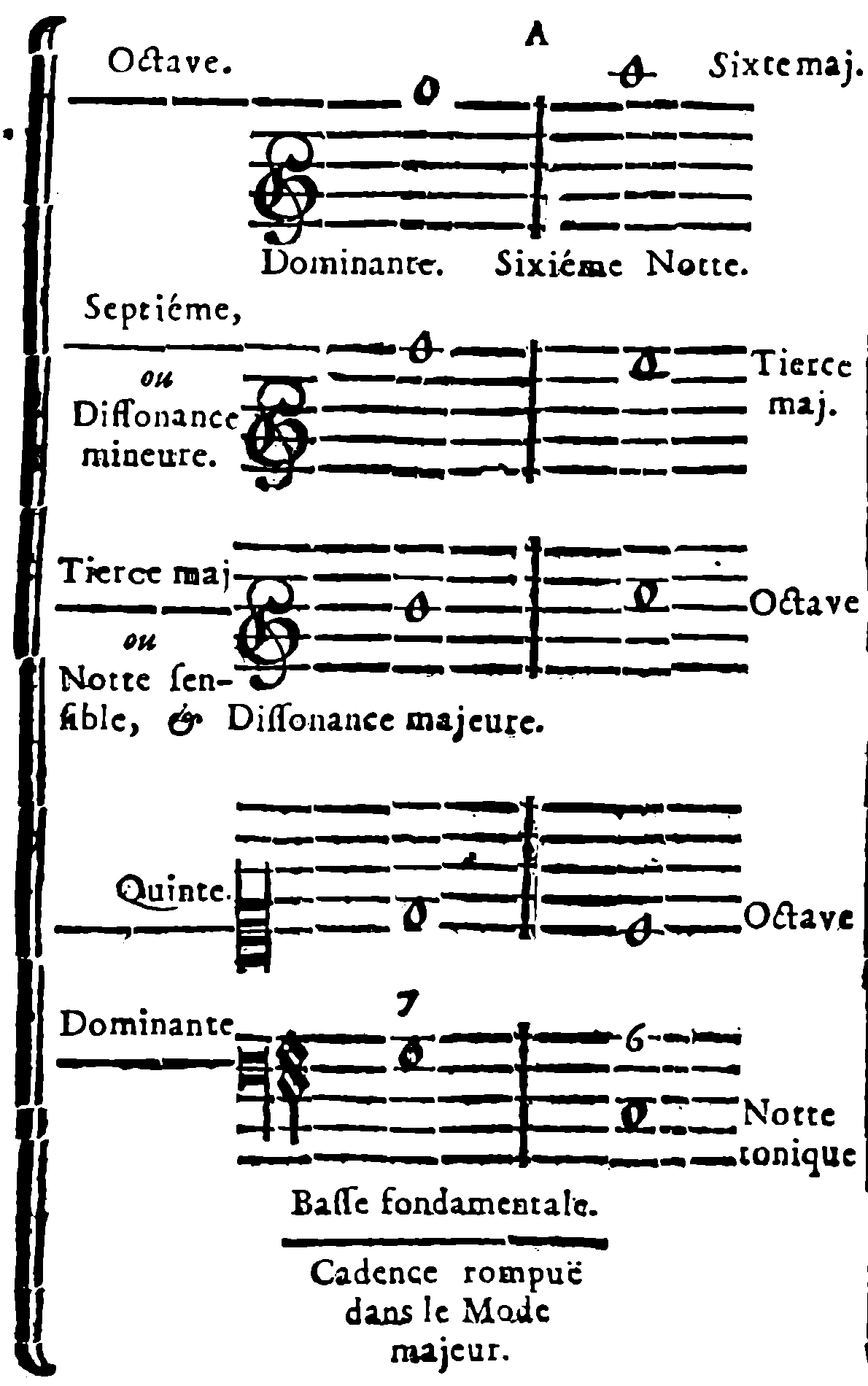
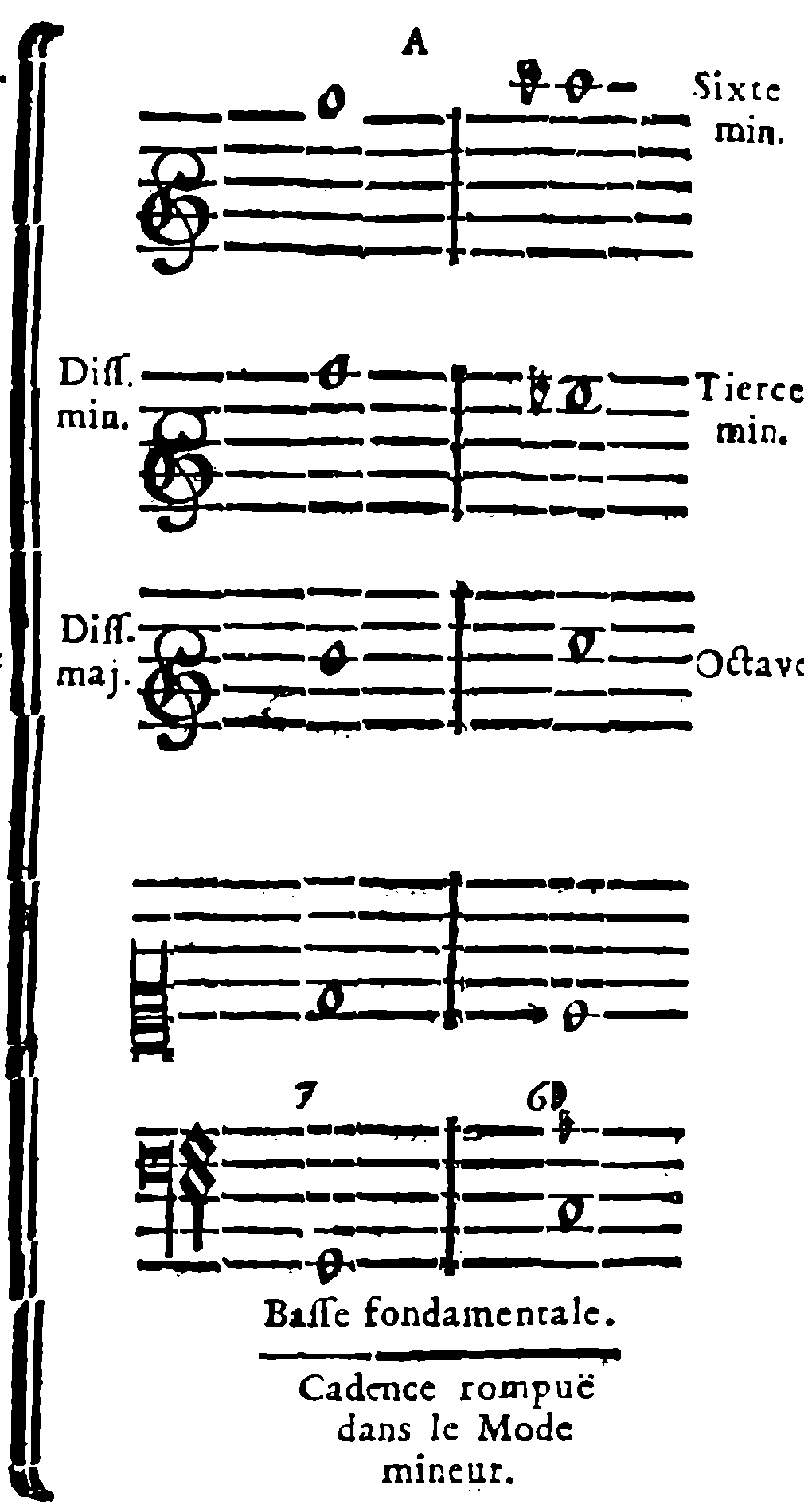
Compare these examples with those of the perfect cadence: the only difference is the substitution of the sixth for the fifth in the parts marked (A). Then place part (A) of these latter examples beneath the fundamental bass. We find only a seventh chord and a perfect chord, according to our first proposition. This is the most usual way of practicing the interrupted cadence.
All these parts may be inverted, and two, three, or four taken separately. Remember to use the fundamental bass as the soprano only insofar as good taste permits, and that the interrupted cadence can be felt only through the substitution of the sixth for the fifth—that is, by putting the sixth in place of the fifth in the perfect chord ending the perfect cadence, since every other part is the same in both cadences.
Observe that when part (A) serves as the bass, the octave of the third is heard in the chords in preference to the octave of the bass. This third then stands for the true fundamental sound, whose replication cannot displease. In a succession of perfect harmony, by contrast, preferring the octave of the third to that of the fundamental sound would be faulty. This does not mean that the bass's octave cannot be used here instead of the third's; but one must first be fully certain of what one is doing, since that octave can hardly sound here without causing gross faults. Judgment is therefore necessary, and one should never depart from a principle without knowing it thoroughly.