 Playable Books
Jean-Philippe Rameau · section 21 of 109
Chapter seven
Read and hear this section in the playable edition →On the Irregular Cadence
Whereas the perfect cadence concludes from the dominant to the tonic, this one, conversely, concludes from the tonic to its dominant; hence we call it irregular.
The perfect chord alone belongs to the fundamental-bass notes from which every cadence is formed. But could not the same reason that led us to alter the first perfect chord of the two preceding cadences by adding a new sound, producing dissonance, also serve us here? If we have recognized that dissonance suits a cadence's first note, we do not believe it should here be avoided rather than sought, when this is our only opportunity to use it.
Will the dissonance we add here be against the fundamental sound? It will be a sixth, which is consonant, but will form a dissonance with that fundamental sound's fifth. If this seems to contradict our assertion that the seventh is the source of every dissonance, observe nevertheless that the dissonant chord formed by adding this sixth to the perfect chord is none other than the great-sixth chord, inverted from the seventh chord. See Book I, Chapter VIII, Article IV, p. 39.
It is true that the dissonance added here will not follow the seventh's natural progression; the term irregular therefore suits it as well as the cadence in which it occurs. But recall what we said of the minor dissonance, formed equally by the seventh and by this added sixth: it seems generated only to soften the imperfection of the third upon which it subsides. The truth of this observation appears here too. The added sixth resolves upward to the third, whereas the seventh resolves downward to it. We explain the reason for this difference in Chapter XVIII.
Since the fourth note characteristically bears a great-sixth chord, and the tonic a perfect chord, we may make a substitution here and form the irregular cadence from these latter two notes as well.
Examples
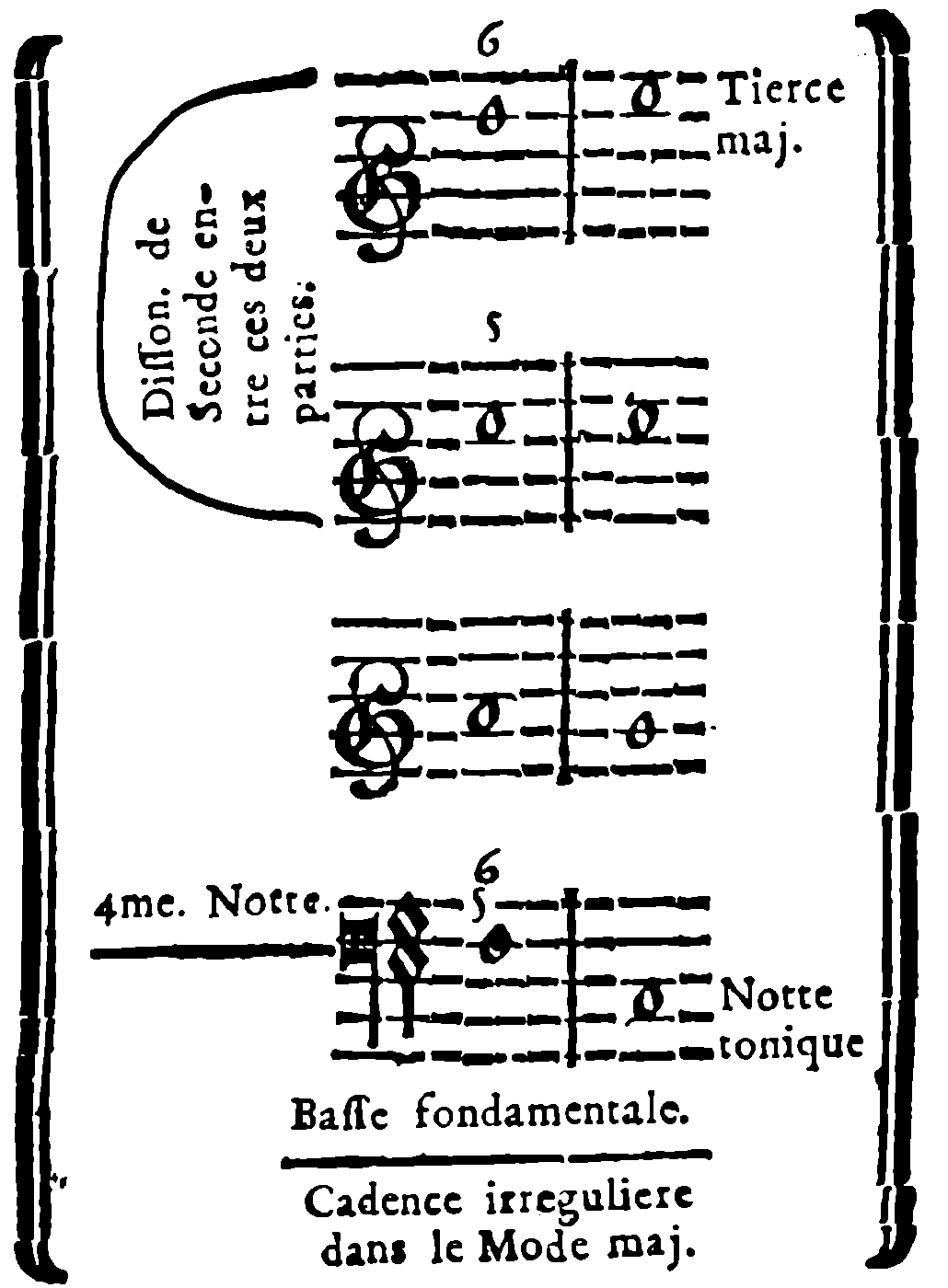
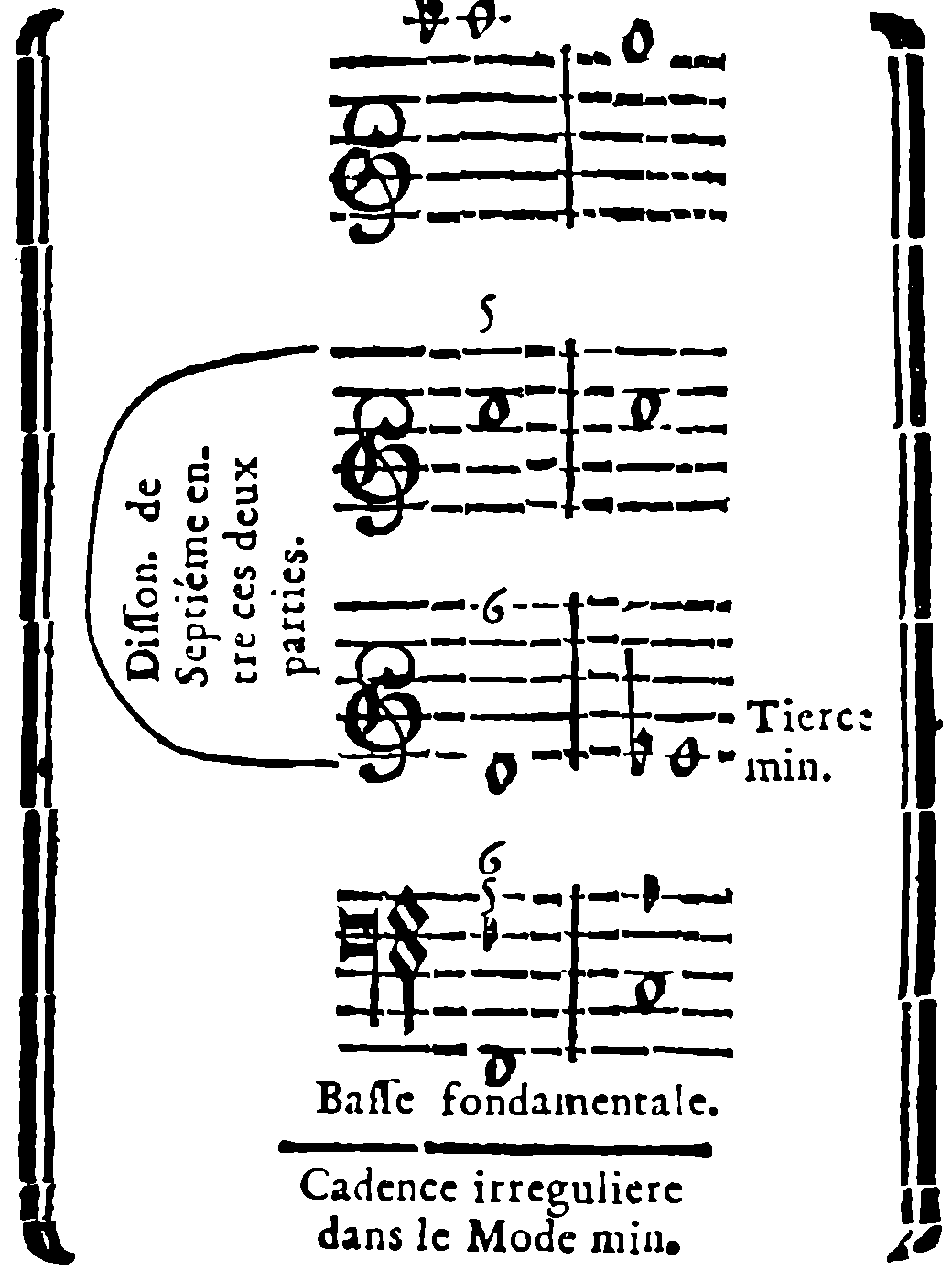
For the note ending this cadence to be regarded as a dominant, we need only give it a major third every time. The difference of mode can then appear only in the third of the tonic, which in this case must precede the dominant.
Although Monsieur Masson does not discuss this cadence as we do, he nevertheless gives an example of it, but in inversion and in chords whose origin he does not know. He calls a tritone (A) what is fundamentally only a fourth altered by modulation—or rather, what is merely a sixth in relation to the fundamental bass.
Example
By Monsieur Masson. The fundamental bass we add will show that the irregular cadence appears here in inversion.
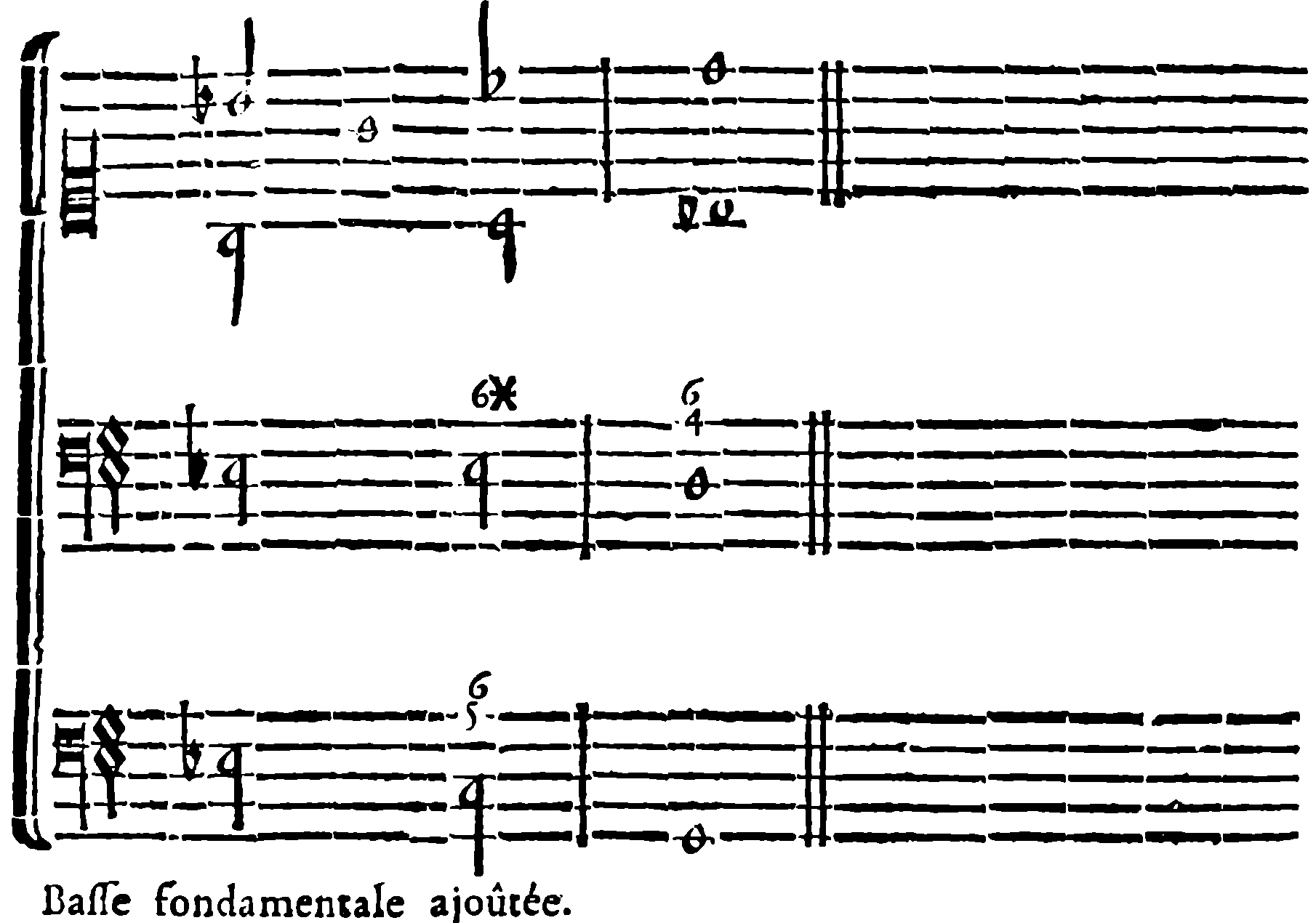
Moreover, this added sixth may always be removed from the perfect chord, since we owe it only to good taste. But the variety it creates, the ease it brings to composition in four, five, and six parts, and the pleasing melodies arising from it should make us desire rather than reject it. We can only praise those who first used it.
It was appropriate to discuss these three cadences before anything else, to prove that harmony consists only of the perfect chord and seventh chord. Every variety introduced into it arises only from their inversion, though the dissonant chord may also be heard through supposition or borrowing. Its progression always conforms to that assigned in these cadences, especially in the parts dissonant with one another. As soon as the origin of a dissonant chord is known, it is not difficult to know what chord should follow, however the bass is arranged. The consonant chord's course is less restricted. Once we know what modulation is, on which notes of a key the derived chords should occur, how dissonances are prepared and resolved, and to what kinds of bass progression all this must conform, we shall see how necessary knowledge of these three cadences is: they contain every different progression of dissonances.