 Playable Books
Jean-Philippe Rameau · section 23 of 109
CHAPTER NINE. On Avoiding Cadences while Imitating Them
Read and hear this section in the playable edition →To imitate cadences only in part is already to avoid them. More precisely, however, we use the term avoid for cases in which the chords forming the cadences may be altered. This practice has endless forms, although it can be reduced to a very simple principle, as follows.
A consonant chord can be altered by adding a third, introducing the dissonance of the seventh. A dissonant chord can be altered by making minor the third that is naturally major in dominants. In this way a fairly long succession of melody and harmony can be sustained without introducing any conclusion.
First observe that we give the name tonic only to notes bearing the perfect chord, and dominant only to those bearing the seventh chord. A tonic can appear only after a dominant whose third is major and forms a diminished fifth with its seventh. If that dominant's third is not major, and neither a diminished fifth nor a tritone occurs between its third and seventh, it can be followed only by another dominant. We should therefore distinguish these dominants: call those whose seventh chords contain a diminished fifth or tritone tonic dominants, and those without these intervals simply dominants. Their different seventh-chord structures immediately distinguish a cadence from its imitation and tell us whether the following note is tonic, and consequently which chord every note must bear. We are concerned here only with fundamental chords in the bass's fundamental progression.
Beginning with the perfect cadence, we immediately derive a certain principle: in every progression descending a fifth or ascending a fourth, which amount to the same thing, the first sound may and indeed should bear a seventh chord. If no diminished fifth or tritone occurs between this chord's third and seventh, the following sound will certainly not be tonic. It must therefore bear another seventh chord, and so on until one of those intervals occurs between the third and seventh. The leading note will then determine that the tonic must follow. Observe that if we understand a seventh chord as implied on the first sound of a descending fifth, this progression must likewise be understood as implied after a seventh chord, unless we wish to imitate the interrupted cadence or use certain licenses discussed later. The number of seventh chords and intervals through which the bass may pass in such a case is limited only by modulation.
Example
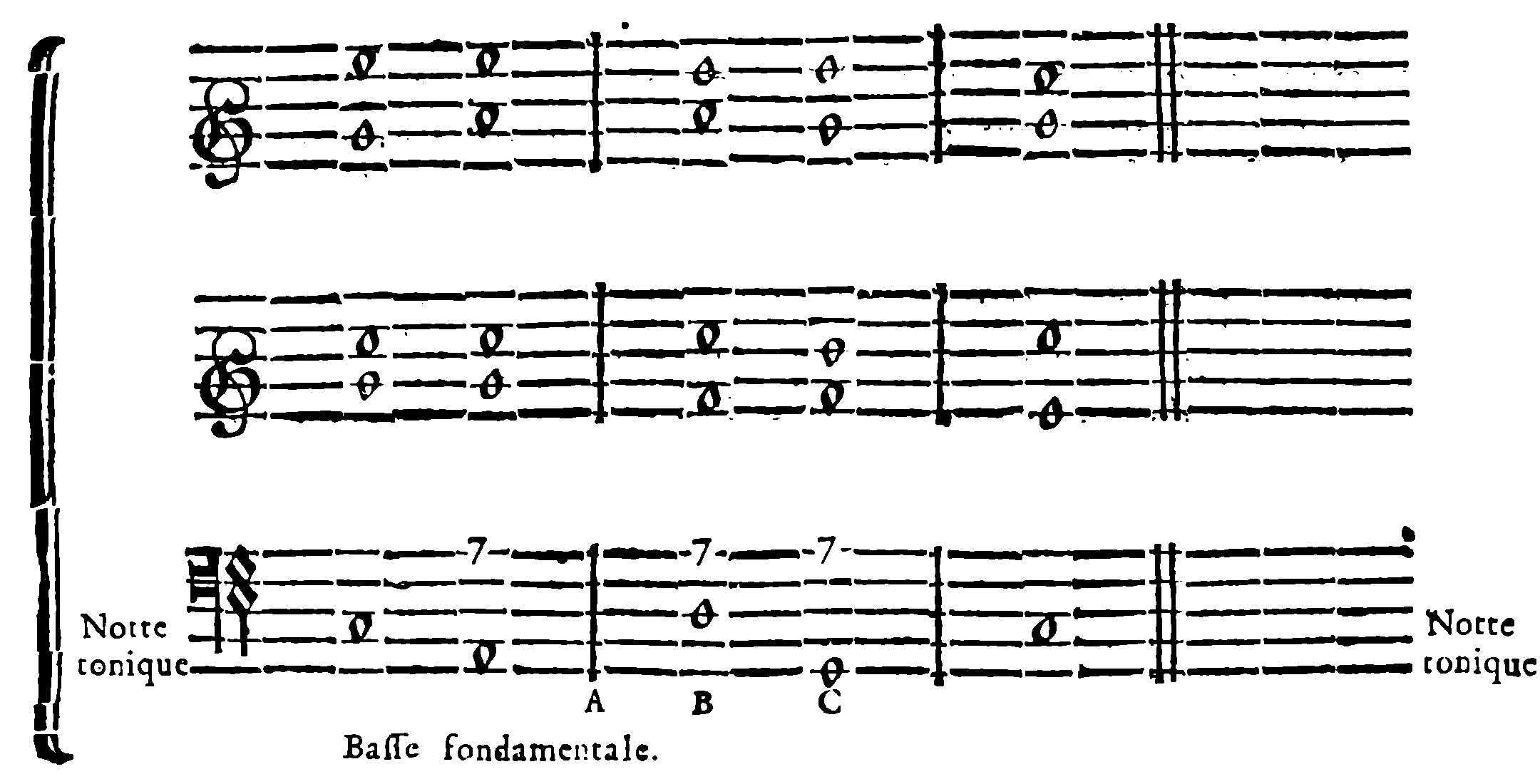
Notes A, B, and C each bear a seventh chord, with the same progression from A to B and B to C as from C to the tonic. Thus A–B and B–C represent a kind of perfect cadence avoided through the minor third in their seventh chords. At C the cadence becomes perceptible through the major third, which introduces a tritone and determines the conclusion on the tonic. We can carry this avoidance further by changing key and consequently making the tonic a dominant through an added seventh. If the added seventh introduces neither a diminished fifth nor a tritone, the tonic becomes a simple dominant; otherwise it becomes a tonic dominant. Either is permitted when good modulation guides us. Making it a tonic dominant introduces the chromatic genus into harmony; we shall discuss this in Book III.
The irregular cadence cannot be avoided in its first chord, since its dissonance cannot be changed from minor to major or major to minor. It can be avoided in the second chord by adding a sixth or seventh, preparing another cadence that may in turn be avoided, and so on.
The interrupted cadence is avoided like the perfect cadence, with this difference: if the first note's major third is made minor, the following note cannot be made a tonic dominant. Indeed, sound judgment is required whenever one wishes to make it such, however it has been approached in this cadence.
We can also avoid perfect and interrupted cadences even in their imitation, by adding a sixth instead of a seventh to every second note of these cadences, provided the fifth is prepared by the preceding note's octave or third: the fifth then represents the upper sound of the dissonance. The added sixth produces the great-sixth chord, an inversion of the seventh chord. It can therefore give rise to an irregular cadence, or through inversion to an imitation of an avoided perfect or interrupted cadence.
Example of the whole
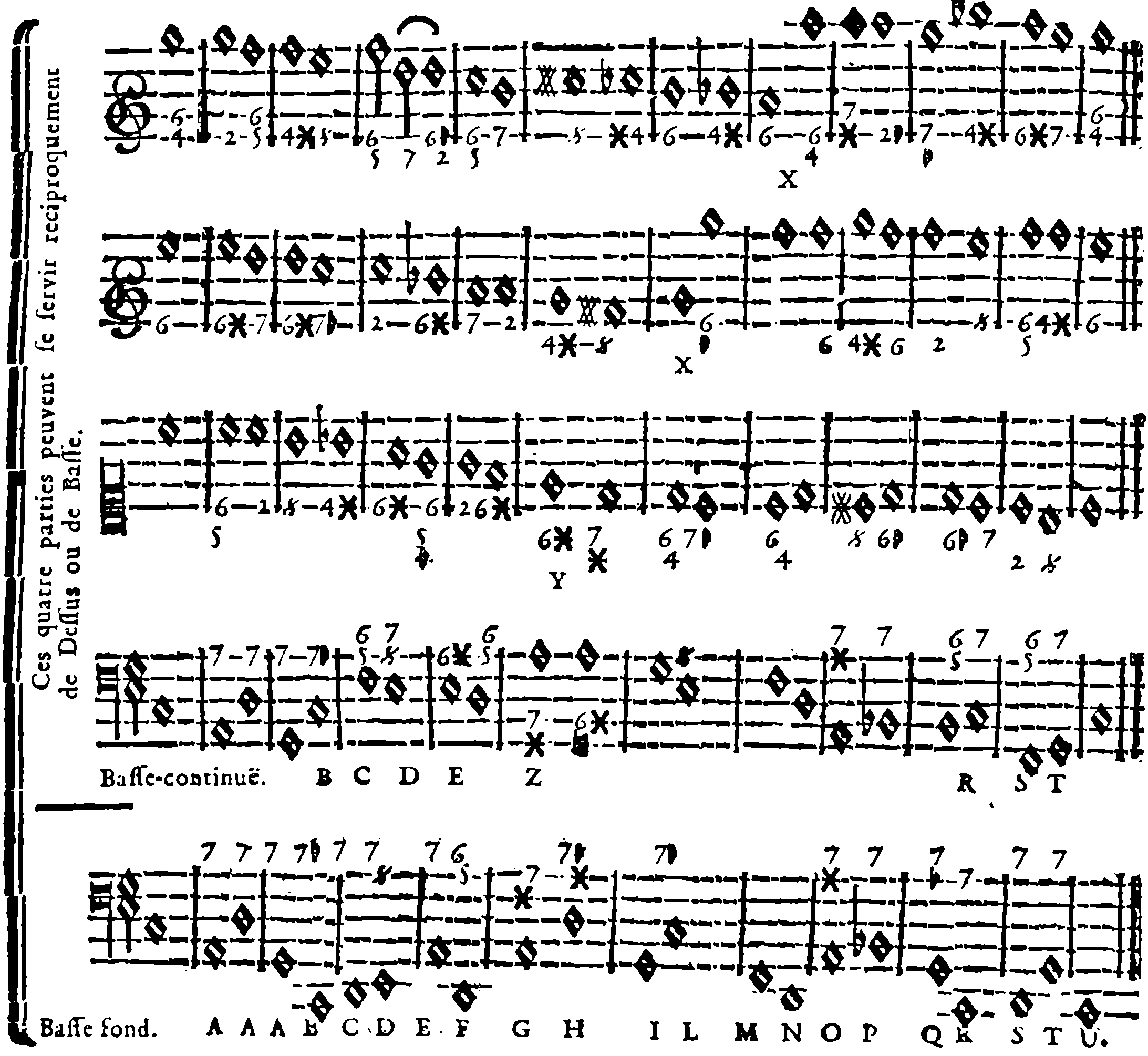
A. A. A. D. E. F. S. T. Perfect cadences avoided because neither the diminished fifth nor the tritone occurs in the first chord between the third and seventh of the fundamental-bass note.
B. C. O. P. R. S. Interrupted cadences avoided by adding a seventh to the second fundamental-bass note, namely C, P, and S.
B. C. R. S. Perfect cadences avoided by adding a sixth to the second continuo-bass note.
C. D. Interrupted cadence avoided because neither the diminished fifth nor the tritone occurs in the first fundamental-bass chord, and a seventh is added to the perfect chord on D.
D. E. S. T. The ordinary succession of the avoided cadence in the continuo bass.
F. G. Irregular cadence avoided by adding a seventh to G. Certain licenses occur here, which we shall discuss in Chapter XIII. Meanwhile, remember that if part Y served as the bass, the part beneath it would have to move to custos Z rather than to the note occurring at the same time.
A. B. G. H. I. L. The first note's major third, subsequently made minor, introduces a diminished fifth into the following chord, turning B, H, and L into tonic dominants instead of the tonics they were to have been. This is how the chromatic genus is practiced, which we shall discuss only in the following book. Meanwhile, observe one of the upper parts descending here by semitones.
E. F. Perfect cadence avoided on E through a minor third, and on F through an added sixth, although adding the seventh is more natural, especially when it is prepared.
N. O. P. Q. Licenses to be discussed elsewhere.
M. N. Two consecutive perfect chords over a consonant bass progression.
L. M. T. V. Perfect cadences.
X. It is sometimes appropriate to transpose parts an octave higher or lower to restore their natural range, provided this introduces neither two consecutive octaves nor two consecutive fifths.
Each part may serve as the bass if the fundamental bass is removed. The various chord progressions arising from inversion of the fundamental chords will then be found; we have taken care to figure them in every part.
Music filled with so many consecutive dissonances would not be among the most pleasing. We have fallen into this fault only to contain all we had to say in a short example, whose modulation is not even particularly regular; but it is not yet time to discuss that.
Nothing is easier than using consonant chords, since the bass's progression beneath them must always be consonant, except in certain changes of key. There this rule may be broken only with inverted consonant chords, and only in a single progression of two notes, as modulation will teach us in time. Using dissonances is scarcely harder, since a fundamental bass allows us to judge their succession immediately. Even without that bass, we know that minor dissonances must descend and major ones ascend, except in the chromatic genus and irregular cadence; these exceptions are easily distinguished through our rules. Moreover, short, simple examples in the next book show every different way of using them. Once the fundamental rules of harmony are mastered, we can derive every imaginable melody and easily arrange suitable chords upon it. In two- and three-part pieces, we choose consonances or dissonances most suited to the subject or to the beautiful melody we wish to make prevail in the parts. We are never ignorant of the sounds that could complete the chords we use. Lack of this knowledge has produced false rules and has often misled masters nevertheless considered skillful when they tried to fill out chords or figure continuo basses.