 Playable Books
Jean-Philippe Rameau · section 24 of 109
CHAPTER TEN. On Chords by Supposition, with Which Cadences Can Also Be Avoided while Being Imitated
Read and hear this section in the playable edition →To understand a chord by supposition, we must first accept the limits prescribed for chords. If all chords are formed from the fifth and thirds, as observed in Book I, Chapters VII and VIII, they must consequently be divided into thirds according to the natural division of the fifth. And if the two sounds of the octave bound all those capable of forming perfect harmony—since sounds beyond that octave merely replicate those within it—the octave must bound every chord. Moreover, the foundation of harmony lies in the lowest sound of the perfect chord and remains there even when a third is added to form the chord and dissonance of the seventh. This is all the more so because the dissonance does not exceed the octave's bounds and its addition does not destroy the proposed division. But adding yet another third would confuse the foundation of harmony: its relation to this fourth third would no longer be distinguishable from its relation to the sound within its octave of which that last third is merely the replication. The division of chords into thirds would also be interrupted, since a ninth or eleventh would always represent a second or fourth. Suppose we disregarded this representation and considered these intervals solely as ninths and elevenths: what would their principle then be, since they exceed the bounds of the octave, which is the principle—or, in Zarlino's words, the mother, source, and origin—of every interval?
If a fifth sound can be added to the seventh chord, therefore, it can only be below, not above. The added sound then stands by supposition beneath the fundamental, which lies immediately above it. We shall seek the principle not in the added sound's octave but in the octave of the fundamental above it. Thus the progression of these chords can be related exactly to that of the preceding ones. The seventh chord, which always begins from the fundamental sound above the added bass, may be inverted as before; but the added sound can never change its place. It must always remain lowest while the others take part in inversion among themselves,* since they lie within the bounds prescribed by harmony. These latter sounds follow their natural progression in the mode they represent, while the added sound vanishes by reuniting with them. It can therefore be considered only supernumerary: fundamental harmony always exists without it, and the chords' progression remains unaltered.
* See Book I, Chapter VIII, Articles III, IV, and V.
Example
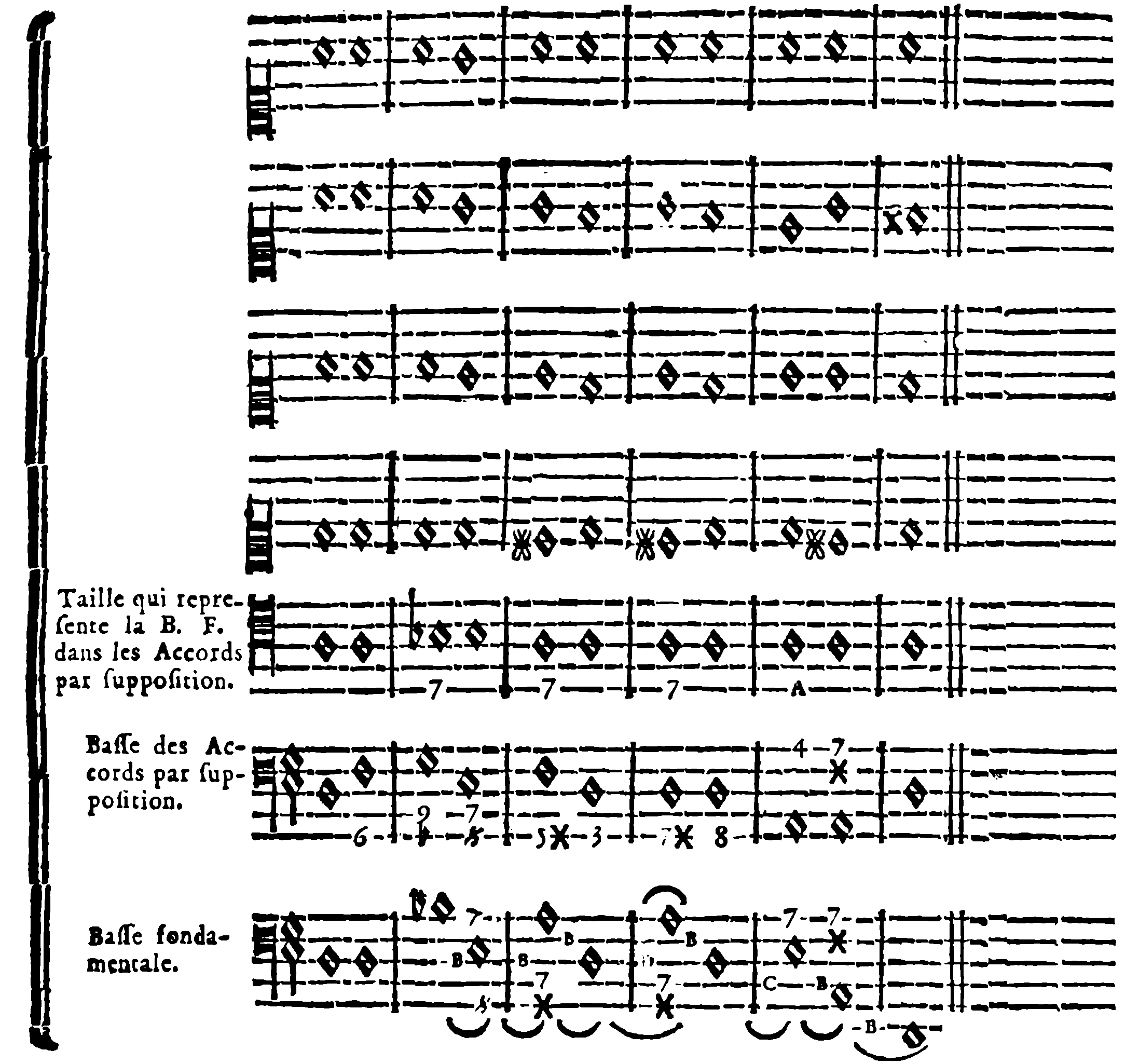
Observe: 1. The fundamental-bass sounds bear only perfect or seventh chords, and their progression conforms to perfect cadences (B), interrupted cadences (C), or irregular cadences (D).
2. The sounds of this bass lie above those of the other bass in the chords by supposition, figured 9, 5♯, 7♯, and 4. If they were placed below, the sounds of the other bass would have to be removed from the chords for harmony to retain its perfection without offending the ear.
3. In chords by supposition, the fundamental-bass sounds form unisons with those of the part representing that bass. Between this part and the upper parts there are only seventh chords, all divided into thirds, whose progression conforms to that prescribed.
4. Finally, the eleventh chord, figured 4, is extremely harsh in its ordinary composition. Its middle sounds are therefore almost always removed, retaining only the two principal ones, the fundamental and its seventh, and sometimes also its minor third or fifth. A new sound is substituted beneath them, a fifth below the fundamental, consequently forming an eleventh, not a fourth, with the fundamental's seventh. We may therefore call this chord irregular in construction, since it is not divided like the others. Otherwise it follows the property of chords by supposition, which cannot be inverted. Sometimes, however, all the sounds composing it are included.
Example
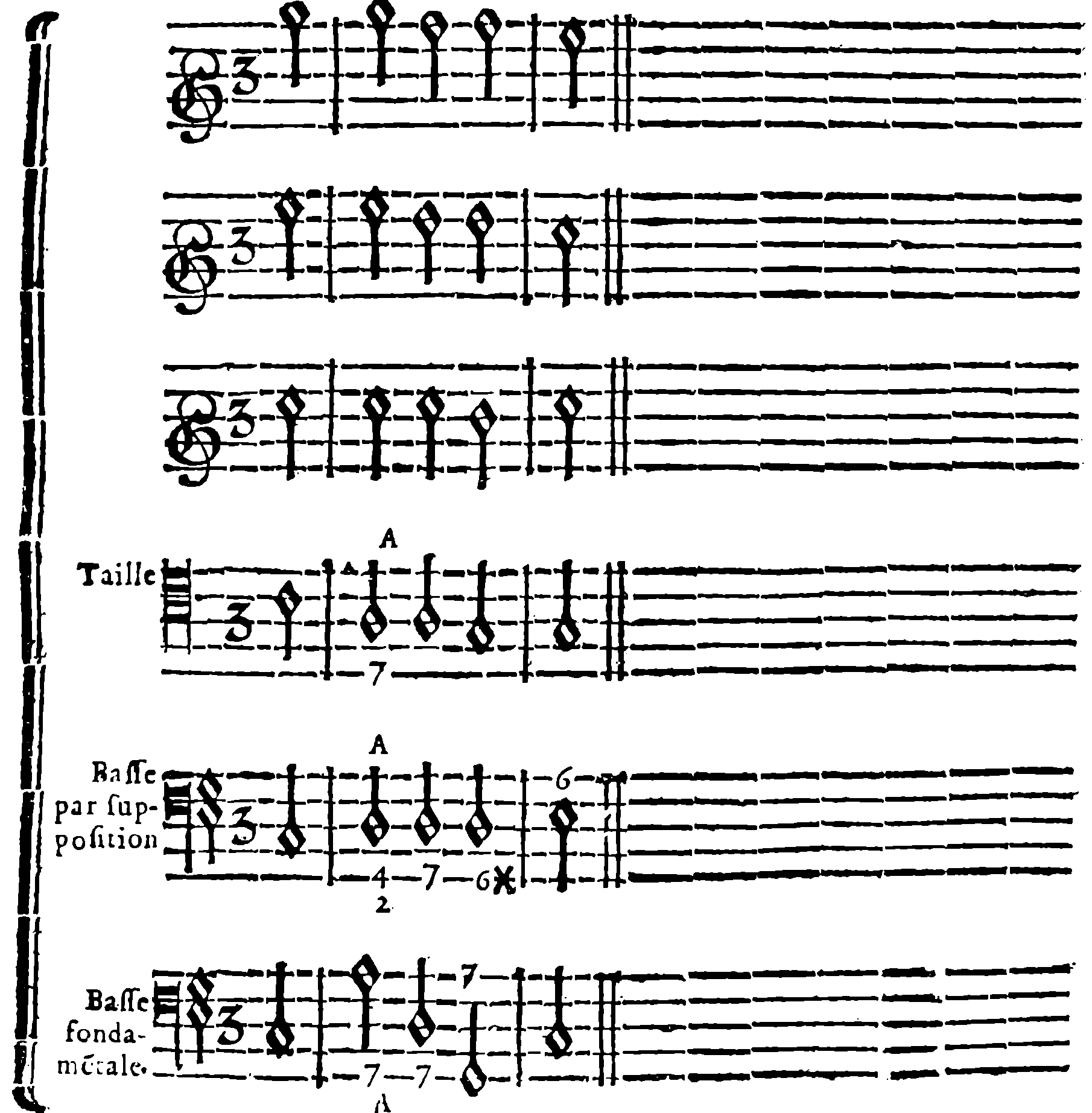
Here the sound marked (A) in the bass by supposition stands beneath the equally marked sound of the fundamental bass or tenor. The upper parts form a seventh chord among themselves, following its natural progression.
Compare this chord with the one marked (a) in the other example. There, for the sake of the parts' diatonic progression, we did not insist on placing the fundamental-bass sound in the tenor. The difference in our treatment, and the reason for calling the chord irregular in construction, can be observed there.
These examples of chords by supposition readily show that perfect, interrupted, or irregular cadences lie beneath them, and may thus be avoided while being imitated. See also our further discussion in Book III, Chapter XXXII.