 Playable Books
Jean-Philippe Rameau · section 32 of 109
Chapter eighteen
Read and hear this section in the playable edition →FIRST ARTICLE · Establishing the rules
Music can be judged only through hearing, and reason has authority only insofar as it agrees with the ear. Yet nothing should convince us more than their union in judgment. The ear naturally satisfies us; reason satisfies the mind. Let us judge nothing without their mutual agreement.
Experience offers countless chords capable of infinite variety, among which we will always lose our way unless we seek their principle in another cause. It scatters doubt everywhere; each person, imagining his ear infallible, trusts only himself. Reason instead presents one chord, whose properties it can readily determine with a little experiential help. Whenever experience does not contradict what reason authorizes, reason should prevail. Its decisions are supremely convincing, especially when drawn from so simple a principle. Let us therefore follow reason wherever possible and call on experience only to strengthen its proofs.
The earliest musicians—or, in short, all those concerned only with speculation—accept the perfect chord as their sole principle. Zarlin, combining practice with theory, also discusses sixth and sixth–fourth chords, but we already know that they come from the same source. Dissonances can easily be referred there too: all arise from a new sound added to the first chord, which remains fully perfect within them. Reason alone can therefore authorize and determine their use. The addition follows naturally by a rule of three or a new multiplication of the numbers yielding the first chord, as Book I, chapter VII, page 29 explained. Musical rules concern usable consonances and dissonances. All consonances lie within the perfect chord, all dissonances within that chord plus its added seventh. Rules must therefore rest principally on those two chords. If conclusions drawn from this simple natural principle agree point by point with the finest musicians’ teaching and practice, and continually conform to what experience approves, who can doubt that it is their true foundation?
Examine Zarlin on fundamental bass, its progression, the upper-part movement it determines, thirds, consonances in general, and dissonances. Notice his omissions: the dissonances we call major; a proper definition of interrupted cadence; irregular cadence; and chord inversion, though he teaches sixth, second, and other inverted chords. He mentions the ninth chord without distinguishing that it is admitted by supposition. His modes are ill-founded, as chapter XXIII will show; his music therefore lacks our refinements, and his examples fail to match his discourse. Examine whether his reasons are reasons or merely words, their source, his explanations and comparisons, and his knowledge’s limits. Correct conclusions reveal that all harmony and melody revolve around our two chords—and, more precisely, their lowest sound, the same in either, and its progression. Then listen to and examine the finest masters’ music. Test it with a fundamental bass as explained at this chapter’s end. You will find only perfect and seventh chords, only tonic or dominant, provided you understand modulation well enough to recognize every change of key. Notice also that only in minor keys the sixth note often replaces the dominant.
Harmony’s principle lies not only in the perfect chord from which the seventh chord is formed, but more precisely in their lowest sound: the harmonic center to which all other sounds must relate. This is one reason we founded our system on dividing a string. The string giving this low sound is the principle of every string length derived by its division, just as the unit compared with it is the principle of all numbers.
It is not enough to see all chords and their properties arising from perfect and seventh chords. Their own properties depend wholly upon the harmonic center and its progression. Their intervals exist as such only relative to that center, which then adopts the same intervals for its movement. That movement alone determines the order and progression of the two original chords. All these intervals lie in third, fifth, and seventh. Others are their inversions—sixth, fourth, second—their octave extensions, such as ninth and eleventh, or alterations, such as tritone and diminished fifth. The octave needs no mention, being only repetition. This reduction of intervals corresponds exactly to chord reduction: inverted intervals form inverted chords; compound intervals form chords by supposition; altered intervals form chords by borrowing. Everything comes from the three first intervals forming fundamental chords and relates solely to the harmonic center.
Moreover, the ear approves not just fundamental chords. Once their movement is fixed by their lowest fundamental sound, everything conforming to that movement pleases it, and nothing else does—whether the fundamental is implied, inverted, supplied by supposition, or borrowed. Reason and hearing agree so completely here that there is not even an exception.
How marvelous this principle is in its simplicity! So many chords, beautiful melodies, infinite varieties, fine and truthful expressions, feelings so well conveyed—all arise from two or three intervals arranged in thirds, whose principle lies in one sound, thus:

Our preceding observations should already have persuaded us. The rules now founded on this principle will complete the demonstration.
1. Begin with consonances, all contained in the perfect chord. Here the fundamental bass can move only by consonant intervals, as chapters I and II and Book III, chapter IV explain. It determines a diatonic upper-part movement from which almost every consonance rule can be drawn. We say almost only because dissonance introduces certain freedoms. The chief rules are always present, especially those the ancients presented as the only ones.
In harmony, for example, these natural progressions never produce consecutive octaves or fifths. Let each consonance move to its permitted successor without disturbing the parts’ order: perfect consonances ordinarily move to imperfect, and imperfect to perfect; we also find which perfect consonances may succeed one another. Since successive thirds are unrestricted, their movement and that of their inverted sixths must be free. The fourth, as inversion of the fifth, might seem bound by the fifth’s rule. Experience nevertheless permits successive fourths in diatonic movement and must outweigh that inference.
In melody, plainchant moves only by diatonic or consonant intervals, with even the major sixth forbidden. Our principle therefore holds. But do not impose that rule upon complete music, where dissonance has a wonderful effect. Modulation alone must judge. Our modern practice enables musicians to overcome former difficulties in singing certain dissonances that give expression its beauty.
2. The descending fifth is the first and most perfect bass progression: only a final cadence using it fully satisfies us. The fifth seems to return to its source by reaching a sound of the octave that generated it; ascending a fourth is equivalent here. Musicians have therefore naturally studied this cadence’s properties for advantage. We are especially justified in doing so, since this first movement of the principle alone suffices to complete our rules, as the sequel will prove.
The rule making a major third rise to the octave, and forbidding a minor third to do so, can arise only from our principle: only in this progression does the third move diatonically to the octave. Do not misapply it. There is only one third relative to the principle, which must reside in one of our two fundamental chords. These thirds are not to be measured indiscriminately from every sound inversion permits in the bass. They are thirds relative to the foundation only in perfect or seventh chords. The rule’s necessary extension to sixths confirms this. Sixths occur only in inverted chords and follow thirds’ properties only when representing them, as reduction to either original chord shows. Properly interpreted, therefore, the rule needs no separate mention of sixths: what we say of a fundamental third includes everything representing it. Dissonance itself will supply further proof.
3. The first dissonance comes from adding a third to the perfect chord. This added third is naturally minor relative to the fifth of the chord’s lowest sound; it also forms a new dissonance with that lowest sound’s major third. Dissonance therefore originates in these thirds and must be divided into two kinds. Call minor the dissonance from the added minor third, and major that from the perfect chord’s natural major third. This previously unmade distinction immediately determines every dissonance’s movement: major ones rise, minor ones descend, without exception. It also proves fundamental harmony consists only of perfect and seventh chords, provided every major dissonance reduces to a seventh chord’s major third, and every minor dissonance to a seventh—an assumption presenting no difficulty.
We have not yet examined the origin of the minor third’s movement, on which every minor dissonance’s movement rests. What has already been shown nevertheless assures us of our claim’s truth until an opportunity arises to explain further.
Chromatic writing and the irregular cadence’s license might be offered as exceptions. But the irregular cadence’s added sixth is supernumerary; harmony loses no perfection without it, and its use depends on taste. Without the other dissonances, harmony would become insipid. In chromatic writing a major dissonance may fall a semitone rather than rise, yet the rule remains intact. 1. Its expected destination is implied if not sounded in another part; moreover, that destination is the fundamental, naturally belonging in the bass. 2. Major dissonance is not dissonant in itself, unlike minor dissonance: remove the minor one and the major dissonance disappears, as experience proves. 3. The major third producing it belongs naturally to the perfect chord; saying it should rise does not absolutely forbid its staying still. 4. A major dissonance can only be the major third of a tonic dominant; relative to the immediately following key it is therefore merely incidental. 5. It is regarded as staying on the same degree to prepare the following minor dissonance. The interval’s kind does not change: leave the bass at its original degree and a third remains a third, a seventh a seventh. Only major becomes minor, or augmented becomes just. The written note likewise stays the same, altered only by an added flat or natural.
Accomplished musicians will feel these proofs’ force, though we have not fully expanded them, to avoid tedious repetition. Moreover, chromatic writing is a new kind of harmony with particular properties. Those properties may seem to depart from the principle, but still depend on it; only brief clarification is needed.
4. If upper parts naturally move diatonically and a minor third cannot rise to the octave, that third must stay still during a perfect or final cadence so that it may subsequently descend a step during a similar cadence, as knowledgeable musicians plainly see. This may have prompted dissonance’s introduction and its rules: the stationary minor third becomes a seventh, then descends to another third. The rule of consonant preparation and resolution apparently arises here. We therefore justifiably derive it from perfect cadence rather than another progression, even to conform with general opinion. The general demand for preparation and resolution shows attention was confined to the first three descending fundamental-bass movements—third, fifth, seventh—since only these permit both, with the fifth primary among them. Our chapter II observations also suggest that dissonance originates in perfect cadence. Thus all rules share one source. Add that the seventh, source of all minor dissonances, naturally resolves only to a third in fundamental harmony, as chapter XVII, article IV explained.
These considerations suggest that the original author of the rules could have understood harmony’s properties profoundly while following only our principle. This is plausible: Zarlin repeatedly argues that the earliest musicians knew only the perfect chord, though he himself did not know every chord now used. Beginning with him, each writer focused narrowly on the interval being discussed and gave vague accounts of the principle. Knowledge of inverted chords evidently accumulated over time through experience alone. Treating them as originals lost sight of the foundation, generating endless detours, exceptions, and ambiguities, confusing terms, intervals, chords, movements, and properties, especially in modes. They seem to have deliberately obscured the world’s simplest and most natural science. Anyone sensible can recognize this by comparing old and new rules with our exact reduction to the principle. The geometer proposed it in vain: lacking the experience to explain it as we do, he was accused of ignorance by the ignorant, themselves lost among its many resulting chords. The error is now easily corrected. Accept the reduction of chords into thirds and their limits within the octave,* as experience must compel you, and only perfect and seventh remain original. The perfect is found within the sixth chord, the seventh within the second chord, and similarly in all inverted chords, where the fundamental is implied. The seventh also underlies ninth and augmented-second chords, and all supposition and borrowing, where the fundamental is supposed or borrowed. These are all chord kinds, generated by fundamentals, which in turn arise from the lowest fundamental sound assisted by its first offspring, the octave. From this come all usable consonances and dissonances—a truth worth repeating, half-acknowledged by theorists and continually disputed by most practitioners.
5. The chief rules just explained plainly come from descending fundamental-bass progressions, as shown by the requirement that every dissonance be prepared. This rule needs exceptions because opposite progressions produce the contrary result. For brevity, consult chapter XIII, where this is sufficiently treated.
6. Since major dissonance comes from the perfect chord’s natural major third, its only required precaution is to rise a semitone, as that third does. It need not be prepared; we may say that minor dissonance shares this privilege in its favor within the prescribed fundamental-bass progressions.
7. Rules for dissonances used for melodic expression, syncopation, and so forth may be omitted here. They rest only on taste, though always drawn from the same principle.
8. Modulation should be discussed here, since it ties the preceding rules together. Their mutual connection leaves no doubt about the principle. But showing the importance of this connection, neglected by Zarlin and others, requires extended discussion, reserved for chapters XXII, XXIII, and XXIV.
* Zarlin prescribes this reduction and these limits in Part III of his Istitutioni harmoniche: chapter 3, folio 174; chapter 31, folio 210; chapter 66, folio 323.
9. Further objections might concern extra sounds in supposition and irregular cadence, or the sound borrowing its foundation from the fundamental itself. Since these are not included in our rules, they seem to require special rules. This need not detain us: they are voluntary additions leaving the principle intact, easily understood through explanations in our other books. To judge more certainly, add a fundamental bass beneath any music as follows.
SECOND ARTICLE · How to compose a fundamental bass beneath every kind of music
1. Harmony is ordinarily perceived at the first instant of each beat. A beat may sometimes divide into two equal halves, in which case harmony is perceived at each half’s beginning. All parts, including the fundamental bass, must agree at those instants. Notice carefully that several notes within a beat—even at its first instant—may not belong to the harmonic body, being added only for melodic expression.
2. The fundamental bass can exist only if it remains below all other parts and forms with them a perfect or seventh chord, removing supernumerary and borrowed sounds where necessary.
3. When a ninth or augmented-fifth chord appears, the fundamental bass must lie a third above the composed bass. With an eleventh, called fourth, or augmented-seventh chord, it lies a fifth above. The other parts then form a seventh chord with it. Remember that the octave of the eleventh’s extra sound is also supernumerary, although the prescribed arrangement sounds well as a whole.
4. With a borrowed chord, substitute the dominant for the sixth note in the fundamental bass. That sixth always forms an augmented second, or its inversion the diminished seventh, with the dominant’s major third. The remaining sounds then make a seventh chord with our fundamental bass. We return to this in point VIII.
5. Watch for irregular cadences. The sound that might otherwise be taken as the seventh chord’s root must be removed, leaving only the perfect chord present in the remaining notes. Points VIII, IX, and X will discuss this further.
6. If a seventh-and-sixth chord occurs, as in chapter XVII, article V, disregard it for this purpose. The fundamental bass stays on its previous degree.
7. This bass is added only as proof. Do not dwell on voice-leading faults, such as consecutive octaves, that arise with it but do not occur among the already composed parts.
8. Understanding modulation greatly assists this proof. It immediately identifies the key, each note’s place, its required chord, and the fundamental sound that may be implied, supposed, or borrowed. It also shows that borrowed chords occur only in minor keys, where the sixth borrows the tonic dominant’s foundation. That dominant must remain the fundamental bass even when supposition accompanies borrowing. An irregular cadence occurs only from tonic to dominant, or from fourth note to tonic. Those notes must then stand in the fundamental bass with perfect chords, mentally removing the lower sound of the dissonant interval.
9. Compose this bass with consonant progressions whenever possible. Exceptions occur only when a seventh resolves to a fifth or another seventh, or is prepared by an octave. Always suppose that the parts form only thirds, fifths, octaves, and sevenths with the fundamental bass. Chords are not always complete, so the person making the proof must notice omissions. Their substance remains even when melodic taste requires a doubled sound instead of a missing chord member. Our requirement excludes the extra low sound in supposition, the sound added to the first perfect chord of an irregular cadence, and the sound borrowing the tonic dominant’s foundation. Mentally remove all these for the proof. The second note’s fifth in a minor key is often naturally diminished. Regard it here as perfect, altered only incidentally, assuming it belongs to a perfect or seventh chord relative to the fundamental bass. Then observe:
10. Whether the minor dissonance, always a seventh against the fundamental bass, is properly prepared and resolved within the prescribed progressions. Ascending a fourth equals descending a fifth here, and likewise for other equivalent intervals. Sometimes we may imply a dissonance absent from the actual composition to give the fundamental bass consonant movement or only its permitted chords. Do not blame the composer for faulty movement of that implied dissonance if it appears only with the added fundamental bass. The same applies to other faults created solely by this bass, which the composer does not always intend to sound. Faults present without it, however, belong to the composer. None of this destroys the harmonic substance, which must always lie in our two chords.
Furthermore, if two sounds form a second or seventh and the upper sound of the second, or lower sound of the seventh, rises while the other stays still, this identifies an irregular cadence. The rising sound must then be regarded as extra and must never occupy any bass. Likewise, check that major dissonance—the leading note or tonic dominant’s major third, dissonant only while joined by the minor dissonance—resolves properly by rising a semitone.
11. Several qualifications concern resolution. 1. A dissonance held on the same degree and eventually resolved correctly counts as properly resolved while the same fundamental chord persists. 2. A minor third between ordinary and fundamental bass need not concern us. 3. While the fundamental chord remains, a dissonance may move to any of its sounds, but ordinarily must then proceed to its originally required destination. If the major or minor dissonance sounds last, however, it may retain its privilege of resolving as required. 4. The major dissonance may resolve to the consonance naturally following the minor, and the minor to that naturally following the major, provided the harmony is natural and motion remains upward where ascent was required or downward where descent was required, as in Zarlin’s example.*
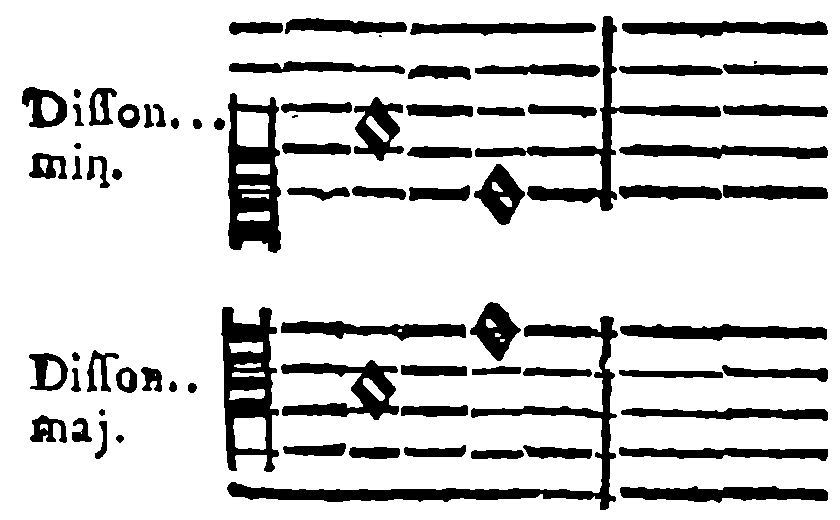
5. In chromatic writing the major dissonance descends a semitone instead of rising, and is then regarded as remaining on the same degree, as already observed.
Music admitting such a fundamental bass under all these conditions will certainly be good. It may at most err in a particular ordering of consonances, melody, or modulation; in the equality of note values preparing, forming, and resolving dissonance; or in the beats where dissonance is prepared and heard. It will not offend harmony’s foundation, the principal concern. The remaining matters are easy to observe; good taste, which dictates most of these rules, sometimes even requires departing from them.
* Terza Parte, chapter 30, folio 210.
The fundamental bass has a very beautiful effect in choruses. If it is intended to sound, however, strict rules must be observed among all parts. The continuo may nevertheless form repeated unisons or octaves with it, especially in sixth chords, supposition, and borrowing, without concern then for the fundamental sound.
Earlier teachers consistently omitted the principle underlying these rules. We therefore thought an extended explanation necessary, so its evident truth might lift us above doubts and disputes.