 Playable Books
Jean-Philippe Rameau · section 39 of 109
Chapter twenty-five
Read and hear this section in the playable edition →The usefulness of this new way of marking different meters
First, even if accomplished musicians find this innovation unnecessary for themselves, they cannot deny its great usefulness to beginners. We need only point out that the numeral at the beginning of each piece gives the number of beats in each measure, and that the note placed before the clef gives the value of each beat. Beginners immediately understand every kind of meter and perceive their differences. Their number does not bewilder them, because the signs used to mark them are not only familiar but few, and do not change position. If one then wishes to know the key in which the air is composed, the position of this note declares it at once. Since that key may be major or minor, one need only place a sharp above or below this note to mark a major key, and a flat to mark a minor key.
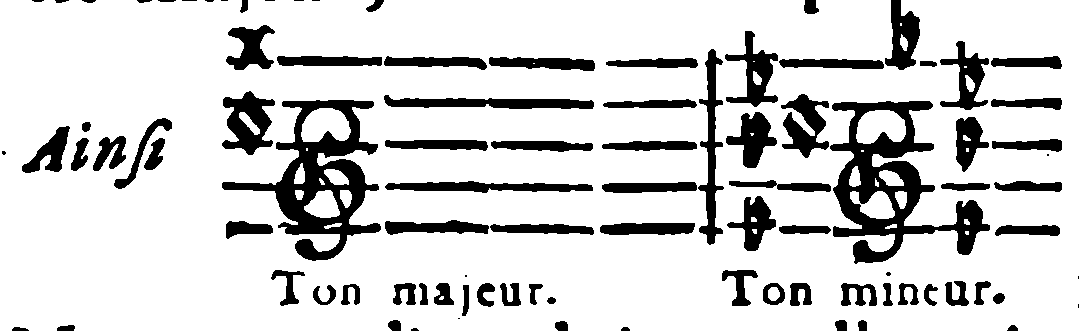
This sign saves musicians the trouble of counting the sharps or flats after the clefs to distinguish the notes that should receive the solmization names “si” or “fa.” For by calling the note accompanied by a sharp “ut,” and the note accompanied by a flat “ré,” one can sol-fa every kind of music without error, even though the arrangement and number of sharps or flats are not observed exactly everywhere. Thus no one need trouble themselves any longer about the number of these ♯ or ♭ signs, or count them to find the notes to be called “si” or “fa.” The distinction between the sharp and the flat suffices for that knowledge. Here “ut,” “ré,” “si,” and “fa” are movable singing syllables, not fixed pitches.
With simple numerals marking the number of beats, and notes designating their value, a music master can confidently entrust the direction of a piece to another, without fearing that its performance will fail on that account. This fairly common fault is more easily avoided in this way than with Mr. Loullier's chronometer, whose use has been neglected because of its difficulty. Nevertheless, that is an ingenious invention, well suited to determining with very precise accuracy the various degrees of tempo one intends for one's compositions.