 Playable Books
Jean-Philippe Rameau · section 41 of 109
Chapter twenty-seven
Read and hear this section in the playable edition →What to observe when setting words to music
Beginners wishing to set words to music should prefer verse to prose, as is customary. Verse has a certain cadence to which the melody must conform; that cadence indicates the appropriate movement and the places where repose should be felt.
Lines suited to airs with a definite rhythmic movement contain equal numbers of syllables or feet, and their meaning is in some sense complete at the end of each line. In setting them, make the last syllable of each line sound at the first instant of a measure's first beat. Observe two qualifications: first, the penultimate syllable of a line with a feminine rhyme may come under this rule; second, avoid as far as possible making a final cadence on the last syllables of lines that do not completely finish the sentence's meaning.
Example
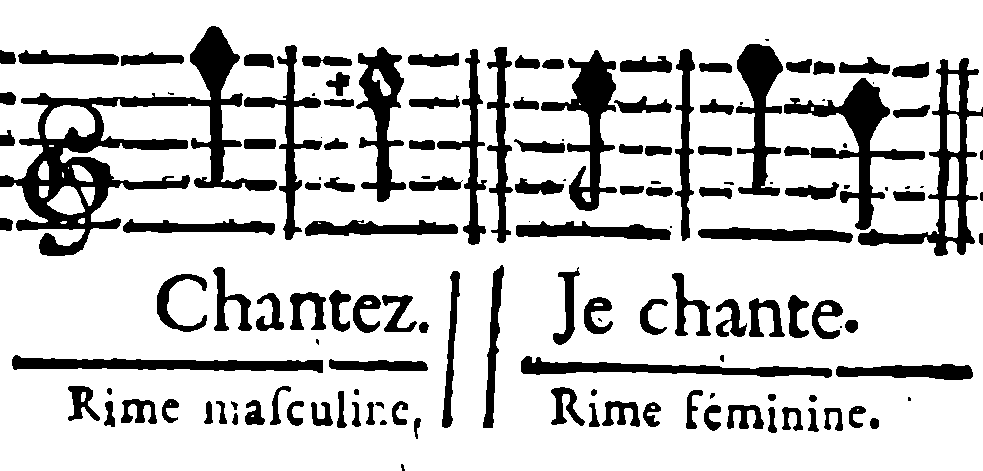
These kinds of cadences heard at the end of each line are a great help to beginners. If they cannot avoid cadences resembling perfect cadences when the meaning is not fully complete, they can disguise them through the bass. Give it a diatonic progression made from the sounds contained in the chords accompanying a perfect cadence's fundamental bass; or give it the progression of an irregular or interrupted cadence.
Recitative requires more caution than airs. When narrating or reciting stories or similar events, the melody must imitate speech so that one seems to speak rather than sing. Perfect cadences should therefore occur only where the meaning comes to a close. Here all the abilities we have said a good musician needs are required. Long syllables should also be expressed by notes of suitable value, and short syllables by shorter notes, so that their rhythm can be heard as easily as in a declaimer's pronunciation. Nevertheless, several long and short syllables may be set to notes of equal value, provided the long syllables are heard at the beginning of each beat, and especially on the first beat.
Operas and many other good musical works provide evidence for what we say here. Taste is often formed through repeatedly seeing and hearing these works rather than through rules.