 Playable Books
Jean-Philippe Rameau · section 43 of 109
Chapter twenty-nine
Read and hear this section in the playable edition →Intervals distinguished as major and minor; just or perfect; augmented and diminished
The octave, the source of all intervals, admits no alteration in harmony.
The fifth and fourth, arising from the octave’s division, can indeed be altered, but thereby lose all the perfection received from their origin. If they retain their names after alteration, those names merely determine the span of the resulting interval. The diminished or false fifth arises from adding two minor thirds; the augmented fifth from adding two major thirds. The augmented fourth, or tritone, is the inversion of the diminished fifth; the diminished fourth, which cannot occur in harmony for reasons stated elsewhere, is the inversion of the augmented fifth. These altered intervals can no longer be considered what they originally were; they now represent the intervals from which they receive their imperfection.
Dividing the fifth gives two different kinds of third, which must be distinguished as major and minor, since each remains a third. The fifth and fourth cannot admit this distinction, because alteration makes them depart from their origin. They are accordingly distinguished as just or perfect, augmented, and diminished. Their perfection comes from their first origin, which makes them independent. The terms augmented and diminished, applied when they are altered, correspond to the major and minor found in the thirds from which all altered intervals are formed.
Dividing the major third likewise gives two kinds of whole tone, which must always be distinguished as major and minor. Since the ear cannot perceive this difference, however, we may say in practice that there is only one kind of tone, second, and seventh. The tone forms the second, and the second’s inversion forms the seventh, although custom distinguishes these as major and minor.
The major and minor semitones obtained by dividing the major tone do not stand in the same relation to the tone as the major third does to the minor third. The tone has a different origin from these semitones, whereas both thirds are generated by dividing the single fifth. Since the minor semitone is the difference between major and minor thirds, we must conclude that altering any other interval by that semitone arises solely from the power of those thirds, generated with this difference. Fifth, fourth, and tone possessed no such difference at their origin. Yet the difference called major versus minor seventh is caused only by this same semitone, as is the difference between fifth and diminished fifth. No one has dared call the diminished fifth a minor fifth, or the augmented fifth a major fifth. This plainly proves that the major/minor distinction belongs strictly to thirds, and those adjectives belong only to them or to what directly depends on them. We therefore apply them to sixths, inversions of thirds, and to modes, whose difference depends only on thirds. But altered fifths and fourths are called augmented and diminished to show that they lack their proper proportion: they are not generated from thirds; on the contrary, thirds are generated from them.
Consider also each interval’s place within the octave. In proper modulation, fifth, fourth, seventh, and second are fixed; only third and sixth are movable. Only third and sixth, then, should be distinguished as major and minor. The distinction used for fifth and fourth should also be used for seventh and second. The seventh admittedly changes in minor keys, but only in descent, just as the sixth changes in ascent. This merely brings their movement into conformity with the interval approaching one of the mode’s principal notes, tonic or dominant. The second cannot be said to change. Since second and seventh are inversions of one another, nothing can be assigned to either without the other sharing it.
Furthermore, intervals distinguished as major and minor can also be distinguished as augmented and diminished.
Example
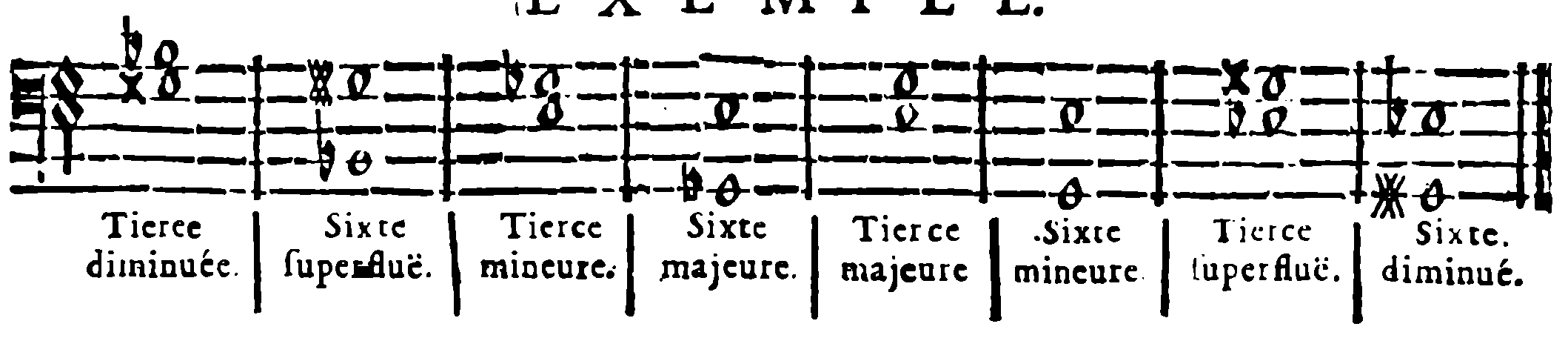
This example proves that thirds and sixths have four kinds, something found in no other interval.
Example
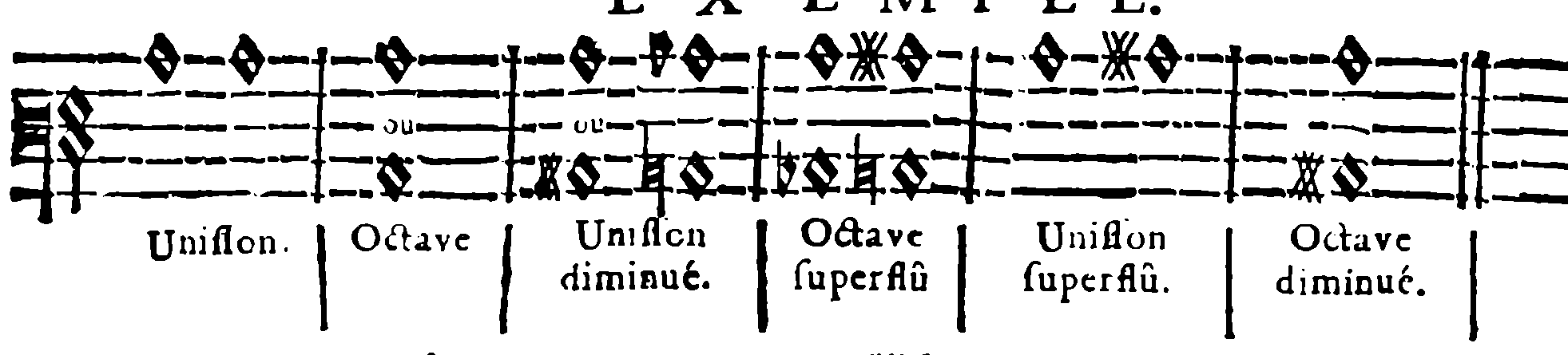
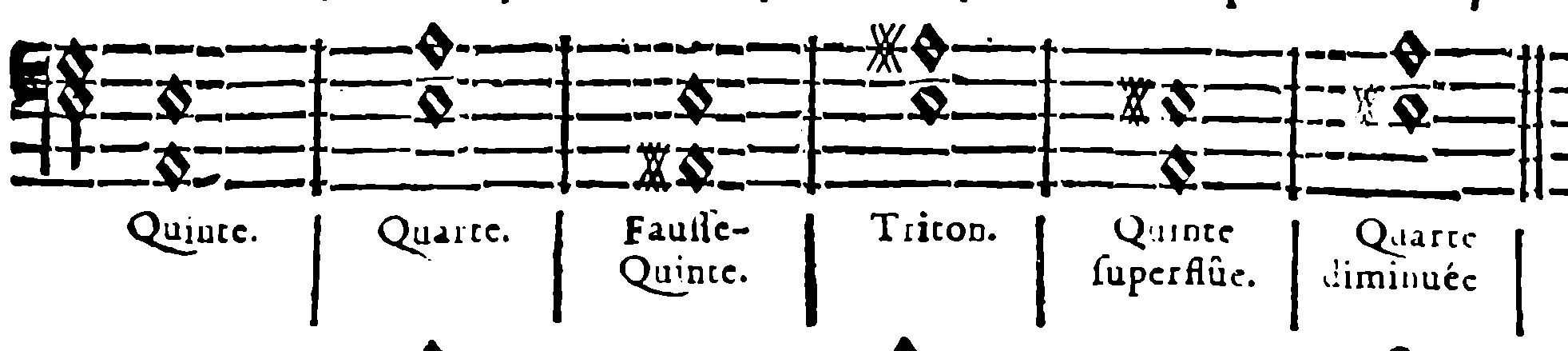
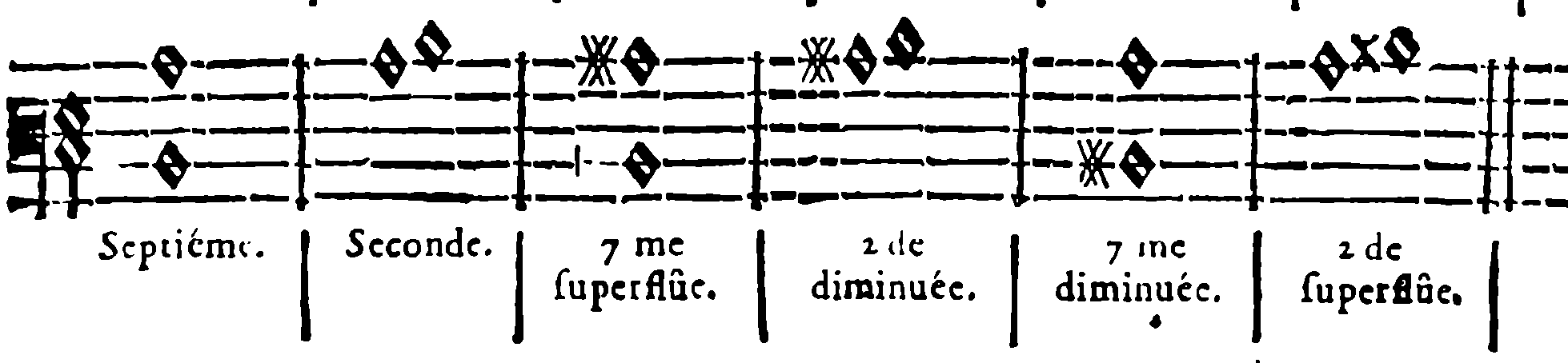
If we call the seventh and augmented seventh minor and major, there will be no further augmented form as there is for third and sixth. Likewise, calling the diminished second minor leaves no diminished form. If seventh and second have only three kinds, like fifth and fourth, why not use the same terms for both pairs? Calling seventh and second major and minor assigns them qualities belonging to third and sixth. Mr. de Brossard, it is true, seeks to justify calling the true augmented seventh major by giving another augmented seventh between B♭ and A♯. Thus:*
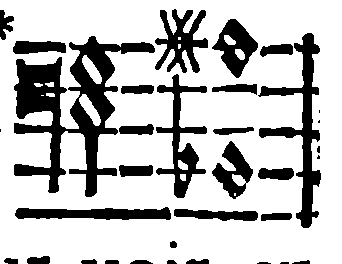
He admits, however, that it has no use and that many confuse it with the octave. We need consider this interval only to see his error. The diminished second, he says,* lies between C and C♯. This has no relation to his proposed augmented seventh, since inverted intervals must consist of the same notes, as the preceding example and the table in Book I, chapter V show. Furthermore, if the note names of an interval change only through a sharp or flat, the interval must keep its name, adding only major, minor, augmented, or diminished as appropriate. His diminished second C–C♯ is therefore merely an augmented unison. His augmented seventh B♭–A♯ is larger than a diminished octave, if not an octave outright: B♭ and A♯ occupy the same key on the organ and most other instruments. Some objections might be raised here; we omit them for brevity and because they are very easy to resolve.
* See Settima in his dictionary.
* See Seconda.
This author is no more successful in explaining the seventh chord or its resolution. Without specifying whether he means the augmented seventh,* he says it is used thus.
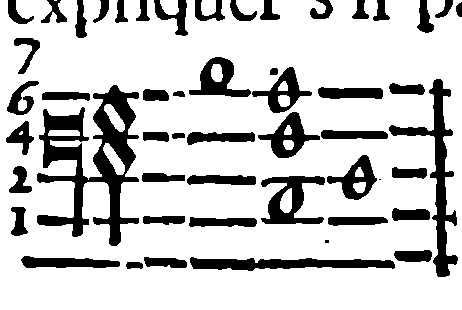
He certainly did not consult his ear: this chord is worthless. Adding a flat to the 6, or specifying minor keys only, would have made him more excusable. Yet a rule stated without exception must be general; to make this one even somewhat general, the fifth should have replaced the sixth.
Despite this discussion, some may still prefer to call sevenths and seconds major and minor, since we are allowed to use them under that conception. But consider our proper distinction of dissonances: major ones derive from the major third, minor ones from the minor third, and follow the nature and properties of those thirds in every respect. How can an interval following the minor third’s property be called major? Every seventh must descend unless augmented. If the so-called major seventh occupies the same interval as what we call augmented, a choice must be made. We found both in the ratio 8:15. The augmented one ascends, following the major third’s property, from which it is indeed formed: in fundamental harmony it is simply the major third of the tonic dominant. The major one, conversely, always descends and follows the minor third’s property. We also showed that a ninth is almost always implied in a chord dominated by this latter seventh; in fundamental harmony the seventh then represents only a fifth. What objection is there to calling the seventh, the first of all dissonances, a perfect or just dissonance—without extending perfect and just beyond the bounds of dissonance—and then distinguishing it as diminished and augmented, as evidently must be done?
* See Settima.
The same difficulties with fifth and fourth confirm this. Give the second note of a minor key a seventh chord: is its naturally occurring diminished fifth really the diminished fifth ordinarily used? Must its lower sound rise a semitone, as it does when derived from the major third? Instead, we feel that it may remain still—or rather must descend a fifth—while the upper sound descends. The diminished fifth is not the chord’s governing object here; everything follows the movement determined by the seventh. Again, must a tritone ascend after sounding in a small-sixth chord on the sixth note of a minor key? No: it stays on the same degree. As Book I explained, these intervals occupy the places of those that should naturally occur and are admitted only for the sake of modulation. Yet no one calls the diminished fifth a minor fifth or the tritone a major fourth in these cases. Such adjectives are absolutely forbidden for intervals that are in themselves just and perfect. We therefore cannot grant them to the seventh, which becomes major only through modulation; otherwise we must grant them equally to every interval.
Thirds govern modulation. Fifth, fourth, and seventh, which may occur in major or minor forms in the sense just explained, merely follow what modulation prescribes and determine nothing themselves. If mode is distinguished as major or minor, these terms should belong only to the intervals determining its order and progression.
What we have said of the seventh also applies to second and ninth: the second is the seventh’s inversion, and the ninth merely repeats the second, or, in fundamental harmony, always represents the seventh.
The eleventh, called the fourth, never changes its interval.