 Playable Books
Jean-Philippe Rameau · section 45 of 109
Chapter two
Read and hear this section in the playable edition →On the fundamental bass
The central difficulty of composition, whether in harmony or melody, lies chiefly—and especially for our present purposes—in the bass we call fundamental. Here it must proceed by consonant intervals: thirds, fourths, fifths, and sixths. Each fundamental-bass note can therefore rise or fall only by one of these intervals, always preferring smaller intervals to larger ones. Thus, instead of making the bass rise or fall a sixth, it would be better to make it fall or rise a third. Notice that rising a third is the same as falling a sixth; likewise, rising a sixth is the same as falling a third, rising a fifth as falling a fourth, and rising a fourth as falling a fifth. We need keep these intervals in mind in only one direction, ascending or descending, since one amounts to the other.
Example
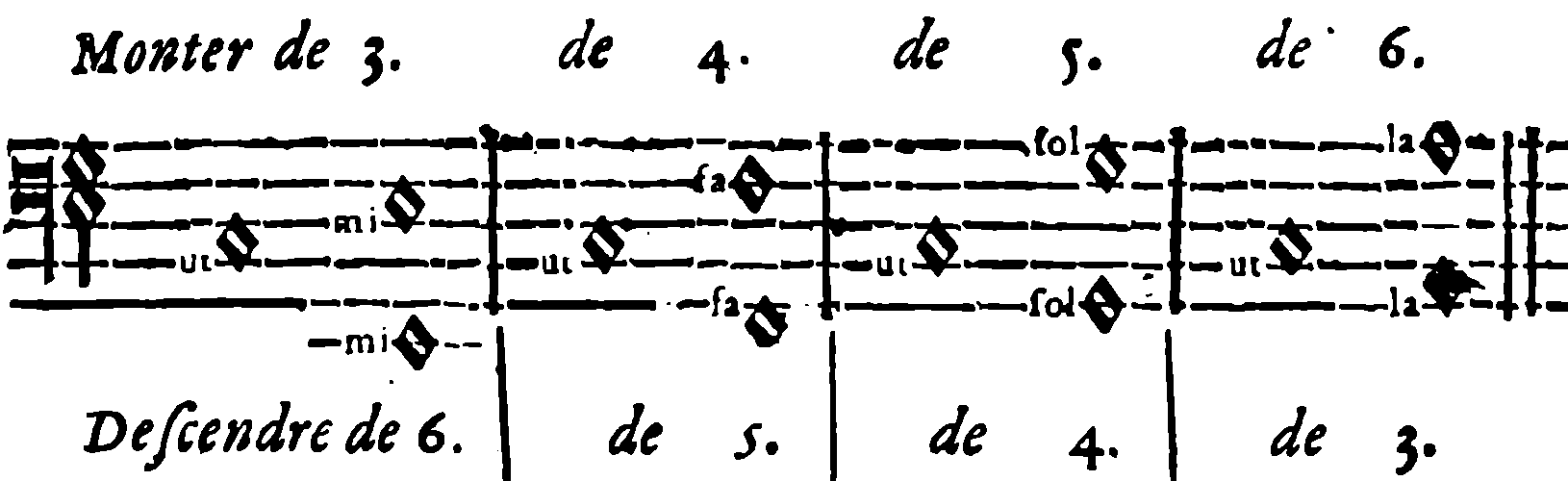
As already stated, the note's name suffices to determine the intended interval. Knowing that the third of C is E, it does not matter in this bass progression whether E lies above or below C; the same holds for the others. Remember this carefully: when we later say rise a third, fourth, fifth, or sixth, we always also mean fall a sixth, fifth, fourth, or third. Conversely, if we say fall a third, we would also mean rise a sixth, and so forth. Notice that this concerns only the bass's progression.
We have not included the octave among the consonances governing the bass's progression. Since the octave is only a repetition of 1, the bass may just as well remain on 1 as rise or fall to its octave. Sometimes, however, the bass must descend an octave to give the other parts more freedom, and especially to ensure that they always lie above it, as they should.