 Playable Books
Jean-Philippe Rameau · section 47 of 109
Chapter four
Read and hear this section in the playable edition →On the succession of chords
Whereas the bass must proceed by consonant intervals, the other parts must proceed by diatonic intervals. In those parts, therefore, movement from one note to another can only be to its nearest neighbor. C, for example, can go only to D or B, unless it remains on the same degree, as often happens. The same applies to the other notes. Here is the procedure.
1. Choose a note called tonic, upon which the bass must begin and end. This note determines the progression of all notes within its octave. If C is tonic, bass and upper parts may use only C, D, E, F, G, A, and B, without alteration by any sharp or flat.
Place C in the bass and arrange its perfect chord in the other parts, noting which part has C’s octave, which its fifth, and which its third.
2. If after C the bass rises a third, A, or a fourth, B, the part—for example the tenor—that had C’s octave must next take the fifth of the new bass note.
The haute-contre, which had C’s third, must next take the octave of the note reached by that ascending third or fourth.
The upper part, which had C’s fifth, must next take the third of the note reached by the ascending third or fourth.
3. If after C the bass rises a fifth, C, or a sixth, D, the tenor that had the octave must take the third; the haute-contre that had the third must take the fifth; and the upper part that had the fifth must take the octave.
4. Finally, anyone unwilling to memorize each upper part’s prescribed progression relative to the bass need remember only this: each part can reach one of the perfect chord’s three intervals in only three ways—remaining on the same note or degree, ascending diatonically, or descending diatonically—whatever route the bass takes. Thus, if an upper note can form the third, fifth, or octave without moving, it must stay. If none of those intervals results, one will certainly be found by raising or lowering the note a diatonic step.
If two parts happen to meet on one note and thereby leave an interval missing from the perfect chord, one of those parts must be able to form a chord interval both upward and downward. Reverse its chosen movement: if it rose, make it descend; if it descended, make it rise. This occurs naturally in the part making the fifth when the bass next rises a fourth. That part can descend to the new octave or rise to the new third; here it must rise. It also occurs in the part making the octave when the bass next rises a fifth; here the part must descend to the third above the new bass note.
Examples
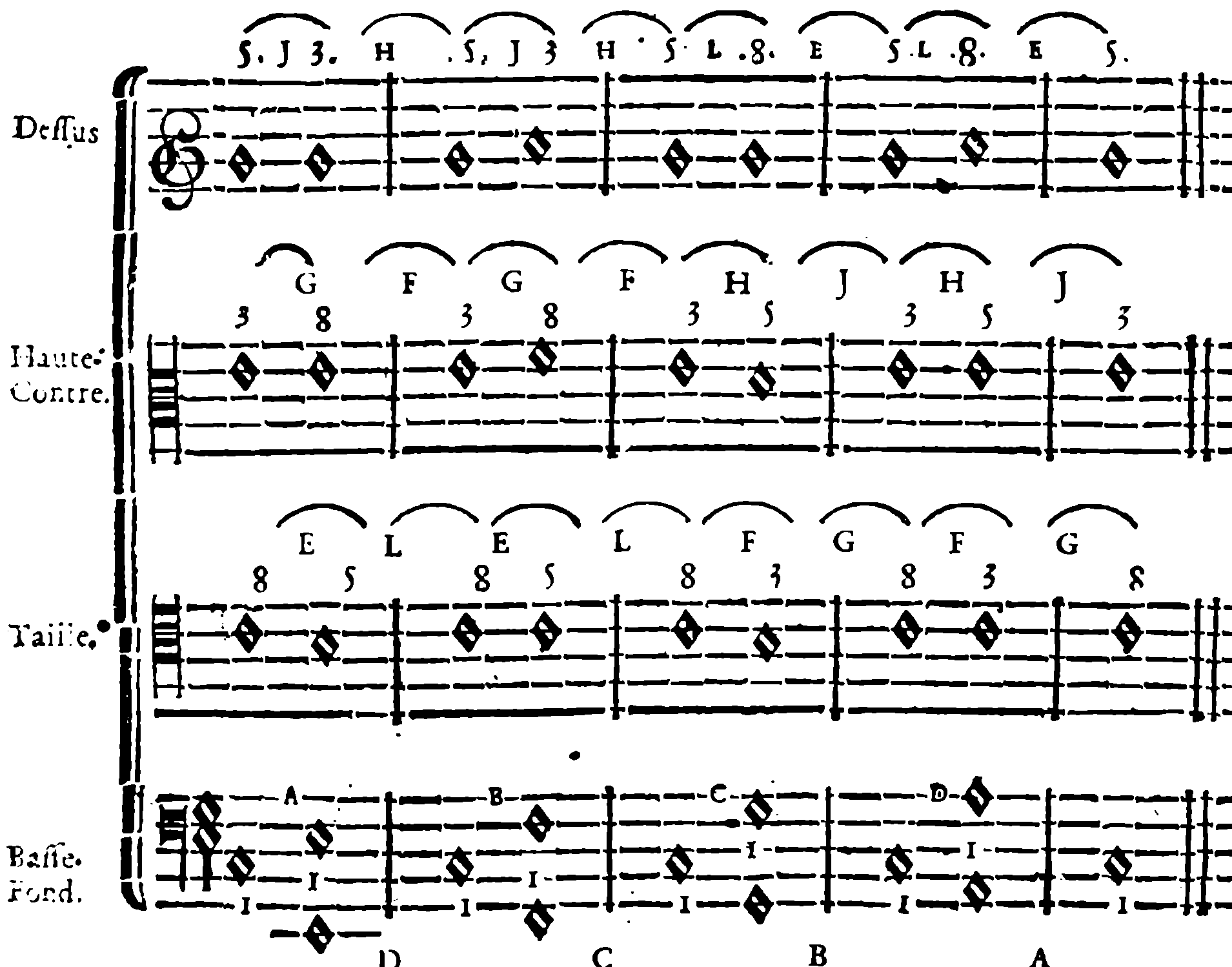
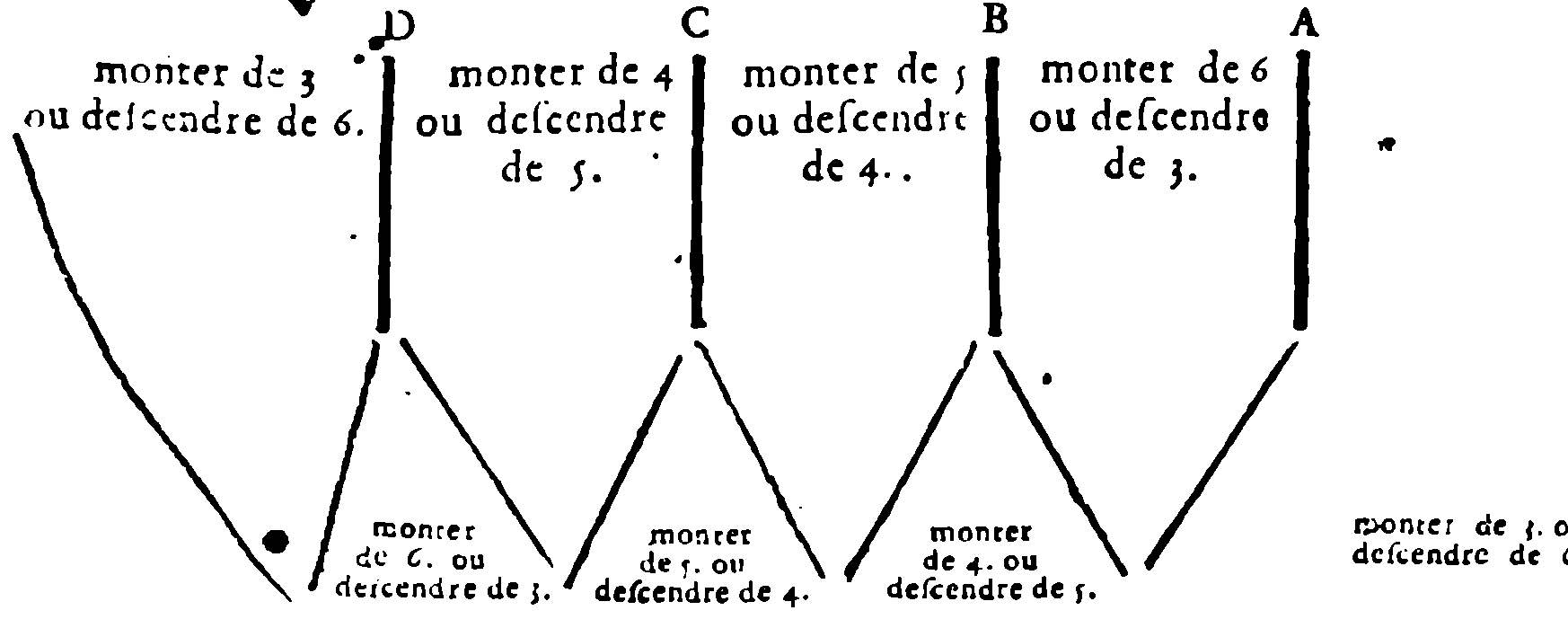
These upper-part progressions are easy to remember because there are only 8–5 and 8–3, E F; 3–8 and 3–5, G H; 5–3 and 5–8, J L. When the bass rises a third, A, or fourth, B, 8 leads to 5 at E, 5 to 3 at J, and 3 to 8 at G. When the bass rises a fifth, C, or sixth, D, 8 leads to 3 at F, 3 to 5 at H, and 5 to 8 at L. Whatever the bass’s route, the first interval formed by a part—third, fifth, or octave—thus guides the interval it should form over the next bass note. Continue this way to the end. Work through each part separately if unable to place all of them at once above each bass note.
Above all, ensure that third, fifth, and octave are always present in the three upper parts. Any part may take any of these over the first bass note, but afterward each must follow the prescribed order according to the interval it has just made. In the example this order governs not only the first and second notes of a measure, but also its second note and the next measure’s first. Wherever the bass progression is the same, the upper parts have the same relation. Thus the interval A between the first measure’s notes and between the example’s last two notes requires the same upper-part progression. The same applies to B, C, and D, marked above and below the bass. Do not seek this uniformity in a single named upper part, since successive chords make it take a third, then a fifth, and so forth. Instead, whichever part has made third, fifth, or octave always follows the movement dictated by the bass.
It follows that after arranging the parts’ chords for the bass’s first two notes, one must determine their continuation from the second bass note to the third, then third to fourth, fourth to fifth, and onward to the end. Every bass note forms one prescribed consonant interval with its predecessor or successor, and each bass interval determines the parts’ progression.
We placed 1 above or below every bass note to emphasize that each chord contains only 1 3 5 8.
You may now compose a bass as you please, provided it begins and ends on C. Otherwise it may move through any consonant intervals you can imagine, without sharpening or flattening C, D, E, F, G, A, or B. Avoid B in the bass only, as our examples carefully do. Arrange the first perfect chord, then give each part the movement prescribed by the bass according to whether that part has the third, fifth, or octave.
Example
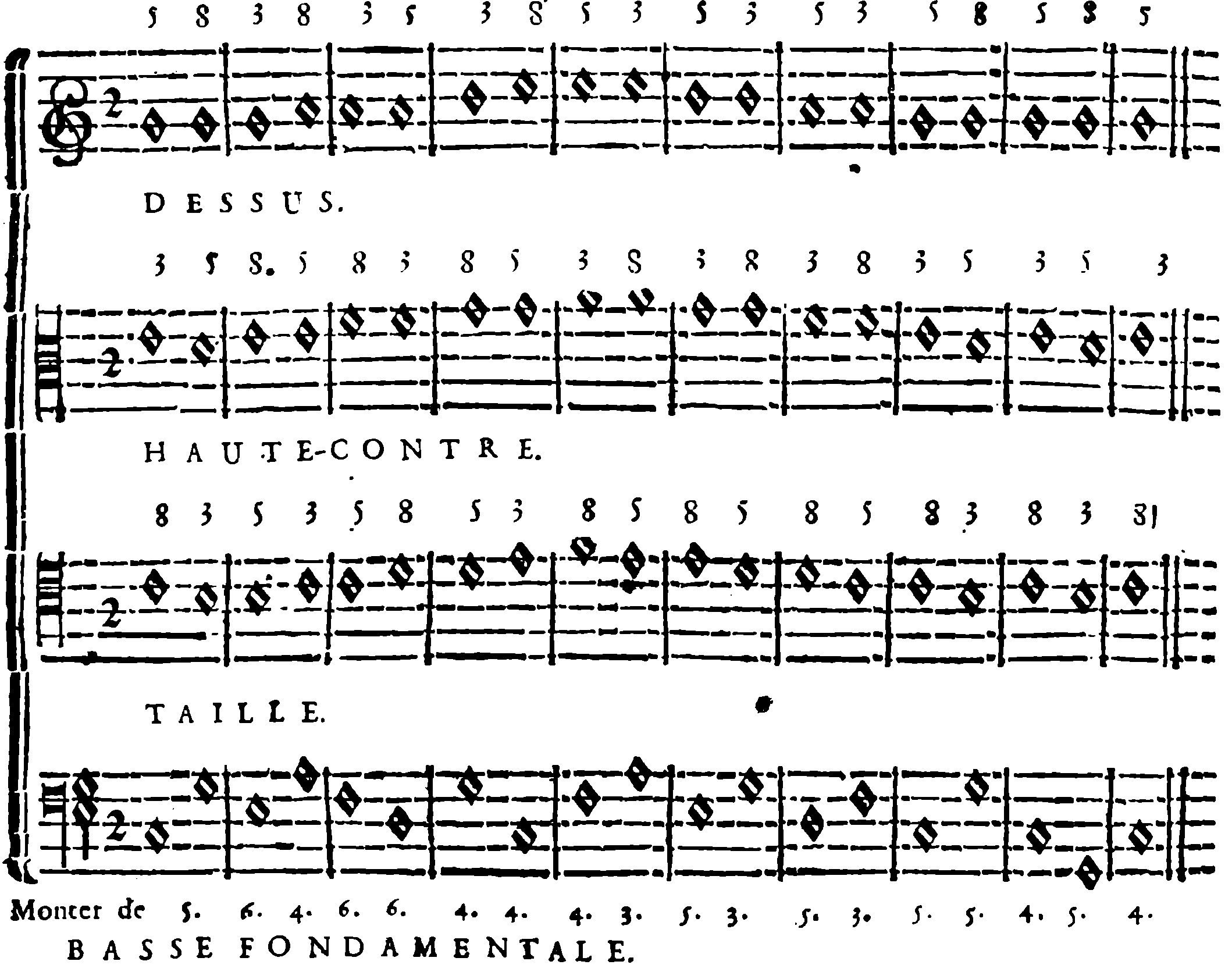
At first always use two-beat meter. Each beat may be a half note or quarter note, just as we have used a whole note.
Remember that rising a sixth is the same as falling a third, and rising a fourth the same as falling a fifth.
This bass’s arrangement depends only on imagination and taste. At first you may nevertheless copy its route to check whether your upper parts match ours. Then compose other basses freely. Remember that the final bass note must be preceded by a note a fourth below or fifth above: to end, C must follow G.