 Playable Books
Jean-Philippe Rameau · section 52 of 109
Chapter nine
Read and hear this section in the playable edition →How to proceed harmonically when the bass moves diatonically
Since C’s octave is our model, it will be easy to recognize intervals distinguished as major and minor: thirds and sixths. E forms C’s major third, and so forth. Consult the list in Book IV, chapter II.
All notes carrying perfect chords may be regarded as tonics, and all carrying seventh chords as dominants. We must distinguish the tonic dominant from notes called simply dominants: the tonic dominant’s third must always be major, while the others’ thirds are often minor. In C, however, there is no tonic but C itself, so only C may receive a perfect chord.
Likewise, G is the only tonic dominant in this key. Therefore only G may receive a seventh chord with a major third.
The perfect and seventh chords are, so to speak, the only chords in all harmony; every other chord is composed of these two. They belong only to the bass progression described thus far. Changing that progression does not change the chords, only their disposition: one constituent sound is placed an octave higher or lower. We must give these arrangements new names to distinguish them from their originals.
List of consonant chords derived from the perfect chord
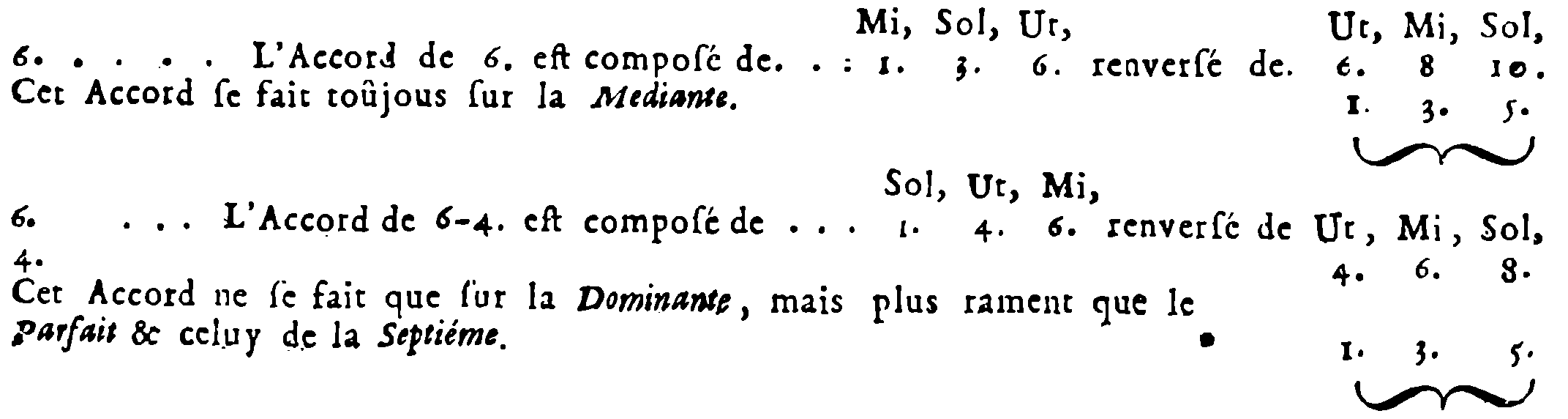
Remember that 1 always represents the bass; other numbers indicate a sound’s or note’s distance from it. The numbers 8, 10, 12, and so on merely repeat 1, 3, 5, and so on. If 8 repeats 1, the same reasoning makes 10 and 12 repetitions of 3 and 5.
Remember also that all numbers can be reduced to smaller ones preserving equal interval distances. Thus 4 5 6 reduces to 1 2 3, since 4 to 5 is no farther than 1 to 2. Similarly, 6 8 10 12 reduces to 1 3 5 7, since 6 to 8 equals 1 to 3, and so forth. The first number of each chord must be reduced to unity, which always represents the bass of the perfect or seventh chord from which all consonant and dissonant chords derive.
We do not mention the octave in these chords, since it always repeats the bass, 1.

Chords derived from the perfect chord by inversion
List of dissonant chords derived from the seventh chord

Chords derived by inversion
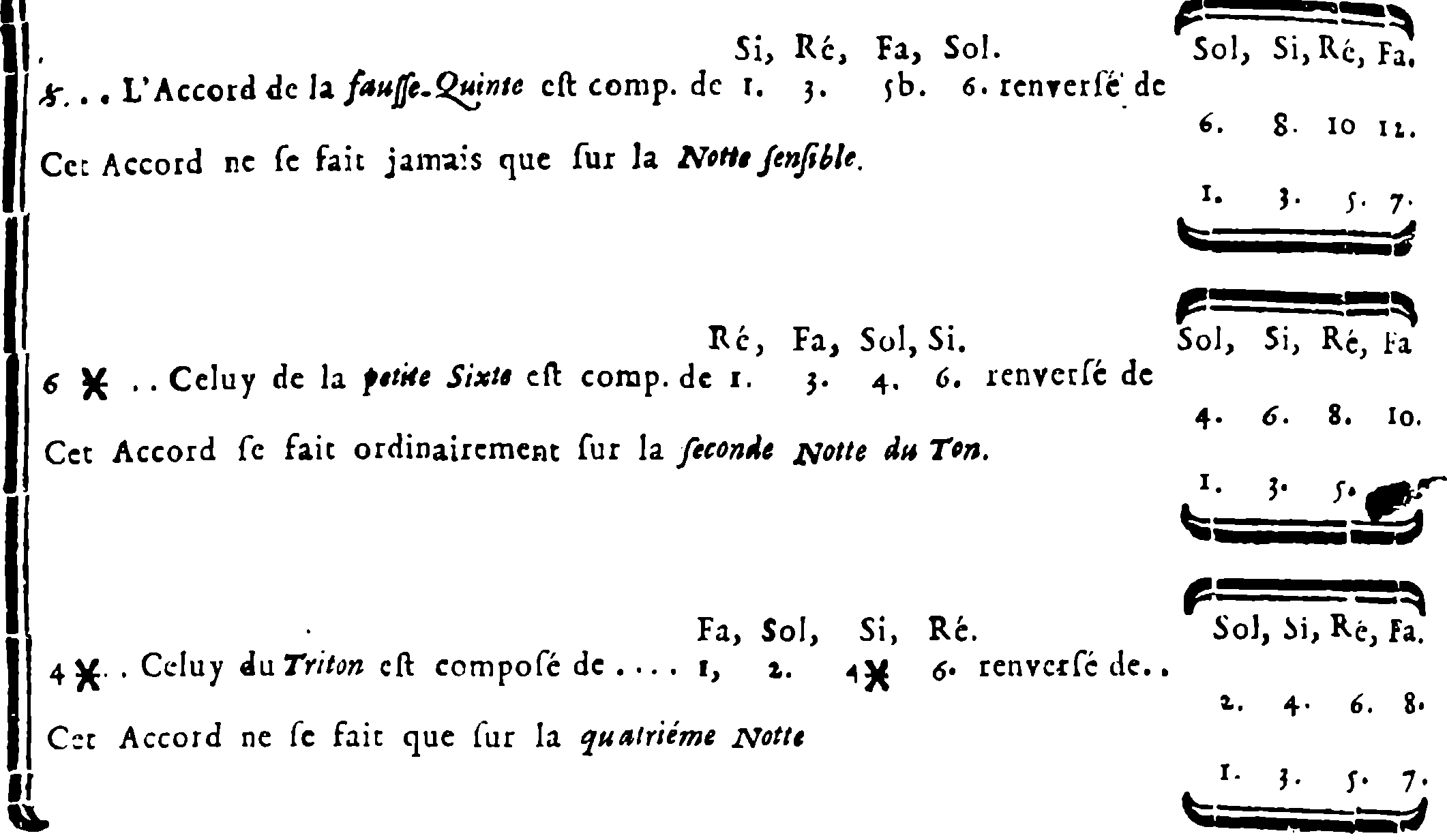
First notice that the tonic lends its perfect chord only to its mediant and dominant. Over the mediant it is called a sixth chord; over the dominant a sixth–fourth. Once these two notes are recognized in any key, their chords are known. The perfect chord nevertheless suits the tonic dominant better than the sixth–fourth, and the seventh chord seems assigned especially to it, above all immediately before the tonic. Do not be distracted by the difference between perfect and seventh chords: the latter merely adds a sound that the composer may remove. Wherever a seventh chord should occur, the perfect chord alone may therefore sound. Yet one should know what one is doing: omit nothing without knowing what it is and why it is removed. This matters especially because the seventh chord is the source of every dissonant chord. Knowing its progression—the chord that follows—is as necessary as knowing its construction—the sounds composing it. Both govern every other dissonant chord.
When we said the dominant bears a seventh chord only before the tonic, this also includes notes of the tonic’s perfect chord: its mediant and the dominant itself, when these carry their natural derivatives of that perfect chord. The dominant may carry a sixth–fourth chord after its seventh chord if its duration permits, at the composer’s discretion. Just as the tonic’s derivatives may be preceded like the tonic, the tonic dominant’s derivatives can appear as such only immediately before the tonic or its derivatives. Consider therefore not only a chord’s construction and natural progression, but its different arrangements, placing bass sounds above or upper sounds in the bass. Different names for the same chord identify which note now occupies the bass. Having recognized that mediant and dominant can represent the tonic by carrying its perfect chord’s derivatives, apply the same reasoning to the notes of the tonic dominant’s seventh chord. Immediately before the tonic or its derivatives, they must carry derivatives of the seventh chord assigned to the dominant in that situation. Thus in C, if G, B, D, or F immediately precedes C or E in the bass, the other three must accompany it. We set G aside as a destination here because it is our first object in the seventh chord G B D F.
The dominant may carry a perfect chord as well as a seventh chord, and the perfect chord remains present inside the seventh chord. A seventh chord must therefore be preceded in the same way as a perfect chord. Thus every seventh-bearing note must have its own dominant. A dominant is always a fifth above or fourth below the note it governs, so G’s dominant can only be D. A note is called dominant because it precedes another a fourth above or fifth below; it must then carry a seventh chord. Applying G’s seventh-chord arrangement to D gives D F A C. Thus D, or any note of this chord, immediately before G in the bass can be accompanied only by D F A C. Similarly, G B D F must form the chord on any of those notes before C. The entire harmonic progression of dissonances is a chain of dominants, easy to understand fundamentally, as the seventh-chord examples show. The real difficulty is relating this foundation to the varied bass progressions allowed by choosing any note of the fundamental perfect or seventh chords. That relationship demands almost all our attention. Confine it to one octave, however, and we need know only how the consonant chord is preceded, because the dissonant one is preceded no differently. Reason as follows, using each note’s interval from the tonic rather than its pitch name, so the reasoning applies to every key. Once identifying the tonic is the only remaining task, all difficulties will soon be overcome.
The tonic always carries a perfect chord; the mediant a sixth chord; the dominant a perfect chord when not immediately preceding the tonic. Otherwise add seventh F to its perfect chord G B D.
The second note, lying between tonic and mediant in a diatonic progression, can then bear only the small-sixth chord D F G B.
The leading note ascending to the tonic must carry the diminished-fifth chord B D F G. But when descending before a note absent from the tonic’s chord, it is regarded as the dominant’s mediant, being its third. It then takes the sixth chord B D G, inverted from G B D.
The fourth note ascending to the dominant must take a chord corresponding to the leading note’s chord when that note ascends to the tonic, since tonic and dominant must be preceded alike. The leading note took a derivative of the tonic dominant’s chord. The fourth note must similarly take a derivative of the chord on the note dominating that dominant. As G dominates C, D dominates G. Thus F, the fourth note in C, takes the great-sixth chord F A C D, derived from seventh chord D F A C.
Do not be surprised by the name great sixth. This chord differs from the diminished-fifth chord only in having a perfect rather than diminished fifth. The difference comes from the thirds: major between G and B, minor between D and F. Otherwise both chords have the same disposition and occur on the third of the fundamental note bearing the seventh chord. Elsewhere we shall explain why this distinction is made in derived chords but not fundamental ones.
When this fourth note descends to the mediant, it must bear the tritone chord F G B D.
The sixth note, preceding dominant and mediant on either side, must bear the small-sixth chord A C D F, inverted or derived from the seventh chord of D, which dominates G. Likewise the second note bears a corresponding chord before tonic or mediant.
Compare these details with the chord list; their agreement will clarify the whole. Notice that the dominant can always be regarded as tonic, since both are preceded by the same chords. This fixes our object. In a diatonic progression, then identify notes derived from the chords belonging to tonic and dominant, and the notes following them. The same bass note may belong to two different fundamental chords, so the following note determines which chord it should carry. Always consider the three or four sounds of the perfect or seventh chord that must accompany the bass in the upper parts.