 Playable Books
Jean-Philippe Rameau · section 51 of 109
Chapter eight
Read and hear this section in the playable edition →On key and mode
Recall that we called the note on which the bass begins and ends the tonic, and said that it determines the progression of the other notes within its octave. Consequently, if C is our tonic, we cannot alter the disposition of C, D, E, F, G, A, and B with any sharp or flat without destroying our premise: this is how the scale represents them within C's octave. We conclude that the word ton, ordinarily applied to an interval, such as that of the third, should here apply chiefly to a note chosen as the basis of a piece in a particular key. The key is determined by that note's name, and the note is therefore called tonic. It has the privilege of determining every diatonic interval, or every whole tone and semitone, between consecutive notes from the tonic to its octave. Proceeding in this way is called modulation. Here, then, is the difference between mode and key.
Mode consists in the third of the note chosen as tonic. Since that third can only be major or minor, mode likewise has only those two kinds. This is why the word mode is ordinarily included within key: we simply say major key or minor key.
If we give C a major third, we say we are in C major, rather than in the key of C, major mode. Likewise, with its minor third we say C minor. All modulation consists of these two kinds, major and minor, depending solely upon the third assigned to the chosen tonic. C, within its octave, represents every major key we can employ. Since the difference between major and minor is very small, we shall study it only after thoroughly mastering major.
To make our knowledge of C useful for every other key, we shall no longer speak of the notes within its octave by their pitch names, but by names particular to each note's position in a key. For example, tonic may mean any note: D, E, F, G, and so forth can be tonics as well as C. Once a note has been designated tonic, however, the others can be discussed only in relation to it. The second, third, fourth, fifth, and so forth are so named only through comparison with the chosen tonic, which is always regarded as the first. Thus in C the second note is D, the third E, the fourth F, and so forth.
Names of the notes in every key, illustrated in C
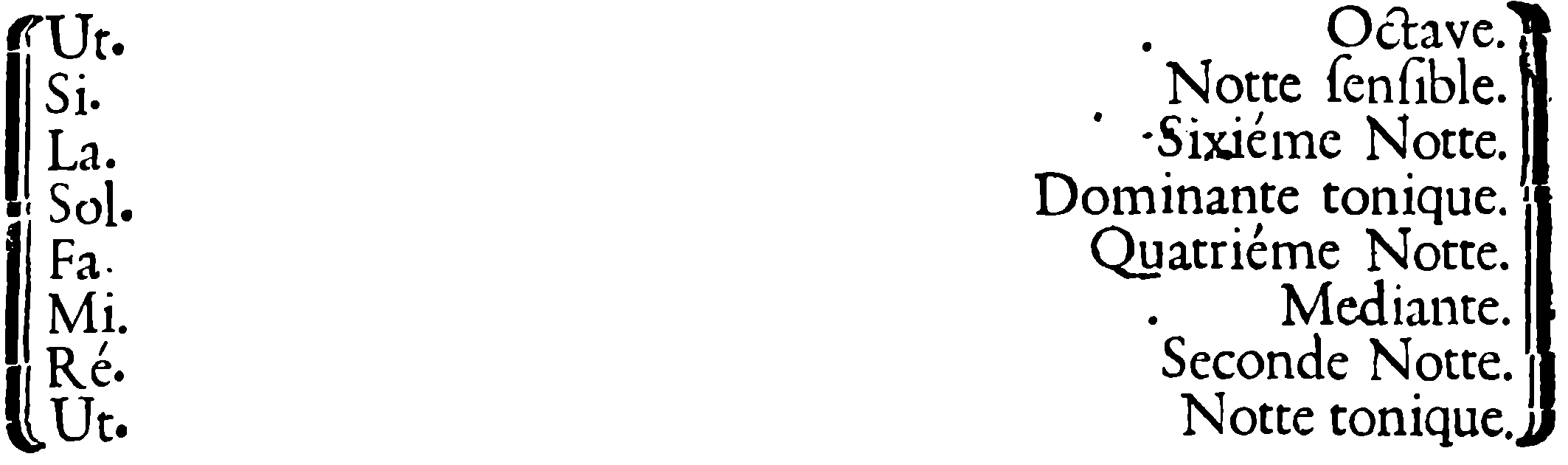
Besides the tonic, three notes here have individual names: the mediant, dominant, and leading note. The first two complete the tonic's perfect chord, and also possess properties distinguishing them from the other notes.
The mediant is so called because it divides the interval between tonic and dominant into two thirds and therefore lies in the middle. It also determines the mode: when it is major, the mode is major; when minor, the mode is minor, since it is the third to which we assigned this property.
The tonic dominant is so called because in every ending it always immediately precedes the tonic. We could observe this in the preceding examples, where G, C's dominant, preceded C wherever C was heard, especially at the end.
The leading note is so called because it is never heard in any part without the tonic immediately following it. We may therefore say that it makes the key perceptible. Thus in C, E is the mediant, G the dominant, and B the leading note. In every key these notes form the same intervals with the tonic as E, G, and B form with C. The only exception is the mediant in minor keys, where it forms a minor third instead of the major third found here.