 Playable Books
Jean-Philippe Rameau · section 54 of 109
Chapter eleven
Read and hear this section in the playable edition →
Bass progression as the simultaneous determinant of chord progression; how to relate a derived chord to its foundation
The progression of bass notes bearing consonant chords—tonic, mediant, and dominant—is unrestricted, provided it stays within the key. Since we are considering only one key, we cannot err by using only C, D, E, F, G, A, and B.
Bass notes bearing dissonant chords have restricted progressions: the dominant with its seventh chord and all derivatives, or rather any note bearing neither perfect chord nor a derivative of it. Once a note carries a dissonant chord, it certainly dominates another. If the dissonant chord is not itself a seventh chord, it derives from one. Referring it to its foundation therefore reveals beyond doubt the following chord, whatever note lies in the bass.
To find a dissonant chord’s foundation, notice that it always contains two adjoining notes or numbers, such as 3 4 [F G] or 5 6 [C D]. The seventh likewise does so if the bass is moved an octave higher: 7 8 [F G]; so does the second: 1 2 [C D]. Take the higher note, or greater number, as fundamental bass. The lower note or smaller number always forms its seventh. Thus derived chords reduce to the fundamental division 1 3 5 7, exactly as in the list on page 202. If this reduction puts G in the bass, C must follow. If C itself is absent from the bass, a note of its perfect chord—or its seventh chord, supposing another key—must be there. Likewise, fundamental D is followed by G or its derivatives, and so forth. Remember that after a seventh chord the fundamental bass must always descend a fifth.
A bass failing to follow this prescribed succession would have to be changed. The rule is easy to observe through the chords assigned to each scale note according to its movement, or through immediate verification by the fundamental bass. That bass can bear only perfect or seventh chords, and a seventh-bearing note must next descend a fifth. What we say of an already composed bass also governs composing one. Exceptions such as interrupted or irregular cadences should not concern us yet.
Before giving an example, understand that the chord on a note naturally leading to a perfect-chord note always relates to what follows, not what precedes. This progression ordinarily goes from tonic to dominant or vice versa; the dominant is always treated as a tonic, as repeatedly stated. In diatonic movement, knowing the chords leading to either therefore tells us those leading to the other. Hence our general rules:
1. Every note rising a whole tone or semitone to a note bearing a perfect chord must carry a great-sixth or diminished-fifth chord.
Example
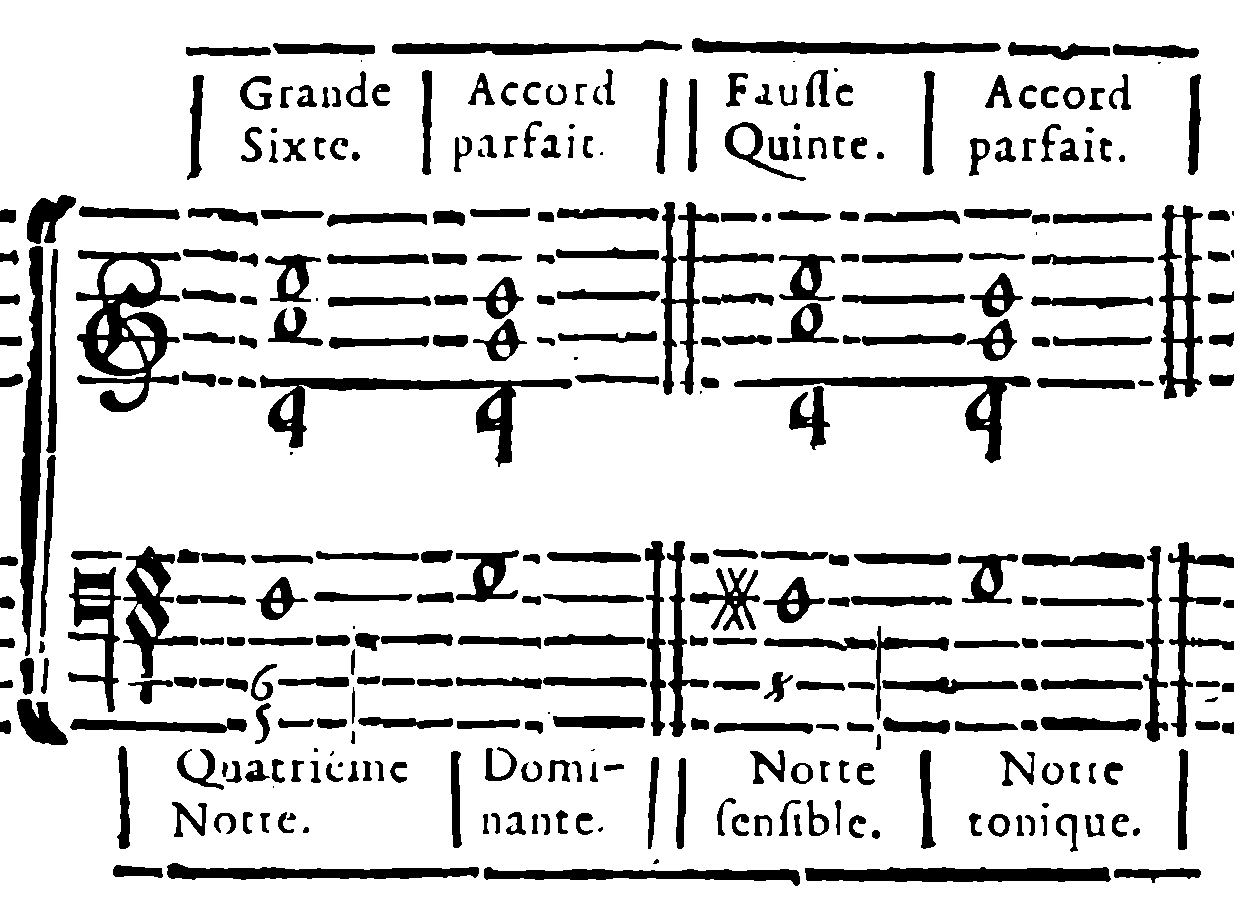
The two chords differ only in their bass. Whether the bass rises a whole tone or semitone to the perfect-chord note, the upper chord is the same. The composer may choose either step, even in a key where the semitone would not belong. Since the dominant may be treated as tonic, it may be approached by all sounds naturally preceding a tonic. As shown, sharpening the fourth note makes it a leading note. It is this ascending whole-tone or semitone approach to the perfect-chord note that distinguishes dominant from tonic. The bass always rises a whole tone to the dominant and a semitone to the tonic. If the semitone approach gives a dominant every attribute of a tonic, we may nevertheless continue in the original key afterward: after a perfect chord, we may proceed wherever we wish.
2. Every note descending to one bearing a perfect chord must carry a small-sixth chord.
Example
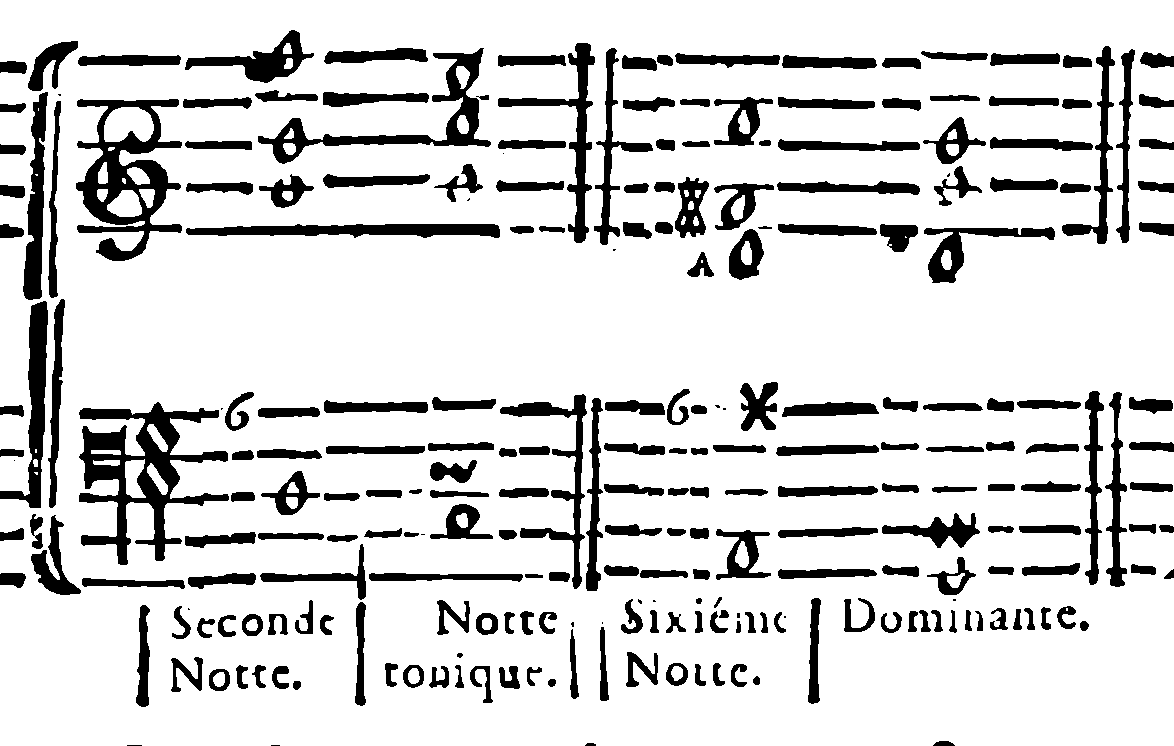
The guides mean that the bass may move to the mediant of either perfect-chord note without changing the chords’ substance. Those mediants therefore carry sixth chords.
Here a second note cannot be distinguished, nor a tonic note from a sixth note or a dominant, because tonic and dominant perfect chords require the same approach and cannot then be distinguished in major. In minor, however, the sixth descending to the dominant lies only a semitone above it, while the second always lies a whole tone above the tonic. Moreover, the dominant always has a major third, while a minor-key tonic has a minor third. If a dominant cannot be identified in major, do not be troubled: treat it as tonic, adapting preceding chords to its key. What follows easily reveals whether it is truly tonic or dominant.
Example
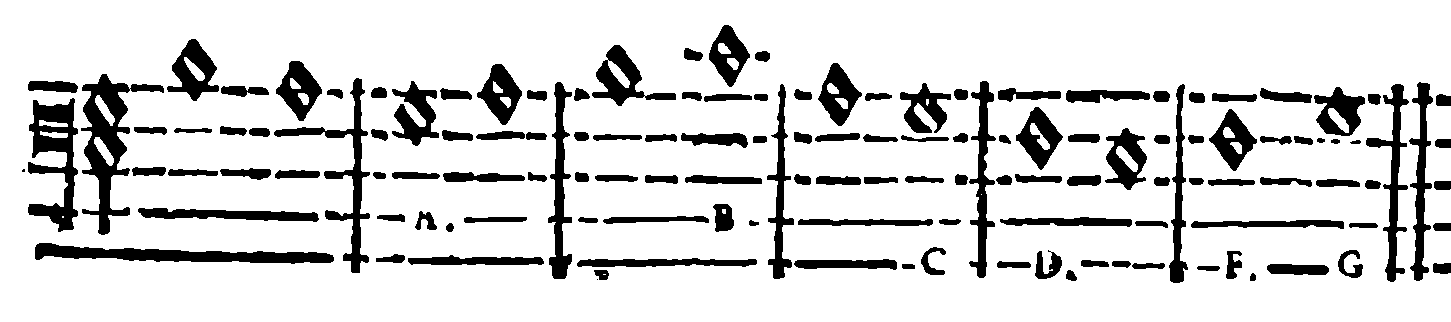
The movement from the first note to A does not reveal whether A is tonic or dominant. This does not matter, since both progressions require the same chords. But A to B leads to a tonic, so A is dominant. If B to C remains uncertain, the following D reveals C as dominant. Likewise F reveals the dominant at G. In every key, the note immediately below the tonic lies only a semitone away, while the note immediately below the dominant must be a whole tone away.
In minor, the note below the tonic may lie a whole tone away when descending from tonic toward dominant, or at least toward the sixth note. The tonic’s required minor third then identifies it immediately, since the dominant always requires a major third.
3. Every note a third above or below tonic or dominant must carry a sixth chord when the bass progression leads to either of those notes.
Example
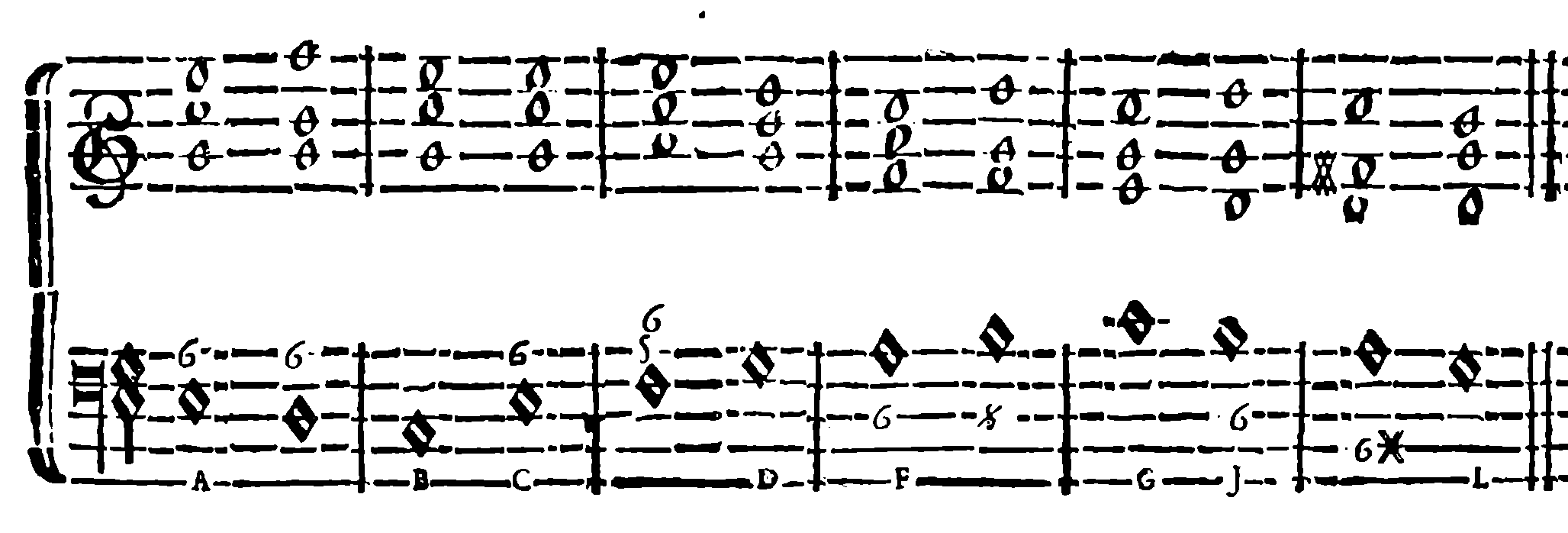
The bass movements toward B, D, G, and L, where perfect chords are required, oblige us to give sixth chords to A, C, F, and J.
4. The mediant always represents the tonic: its natural sixth chord is merely the tonic’s perfect chord. Thus the fourth note descending to the mediant must bear a tritone chord. It may also receive a great-sixth chord, but we shall discuss that elsewhere.
Example
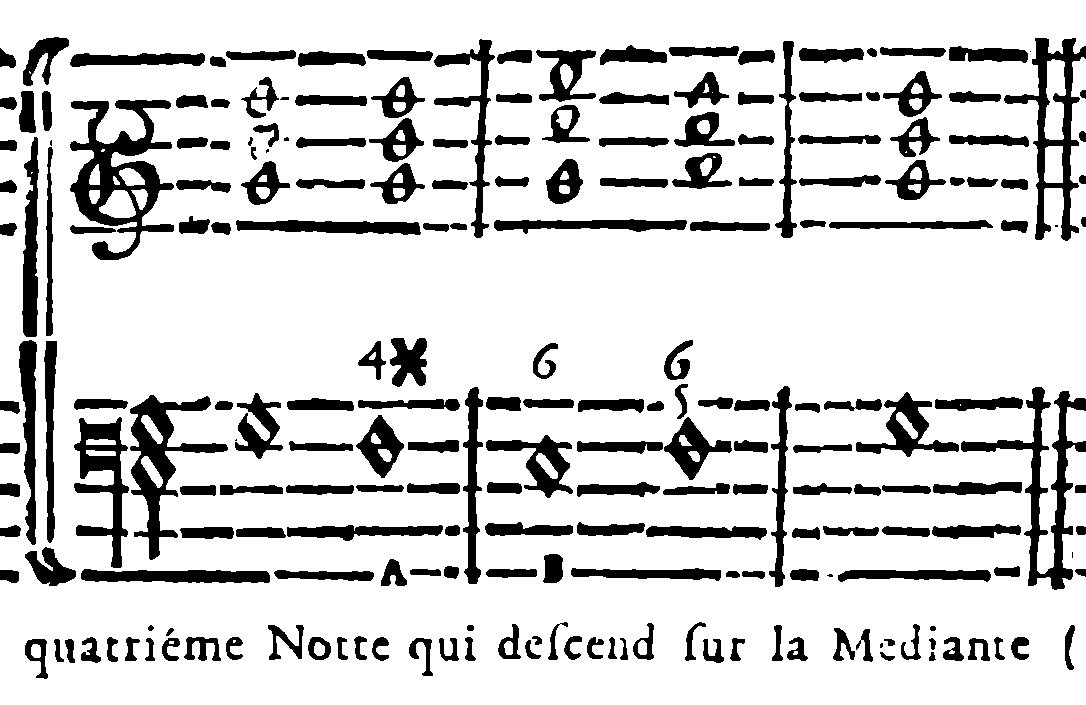
These five examples yield useful consequences if we observe how fundamental chord sounds are rearranged with different bass movements. The fourth takes a great-sixth chord ascending to the dominant and a tritone descending to the mediant, which represents tonic; the leading note takes a diminished-fifth chord ascending to tonic; second and sixth take small-sixth chords descending to tonic or dominant. All these derive from seventh chords on notes that dominate the following notes. A fundamental bass below the general example will clarify this. Notice that the leading note acts as such only when rising to tonic. Descending, it must instead be regarded as the dominant’s mediant. Treating that dominant as tonic avoids mistakes.
General example of the octave, ascending and descending
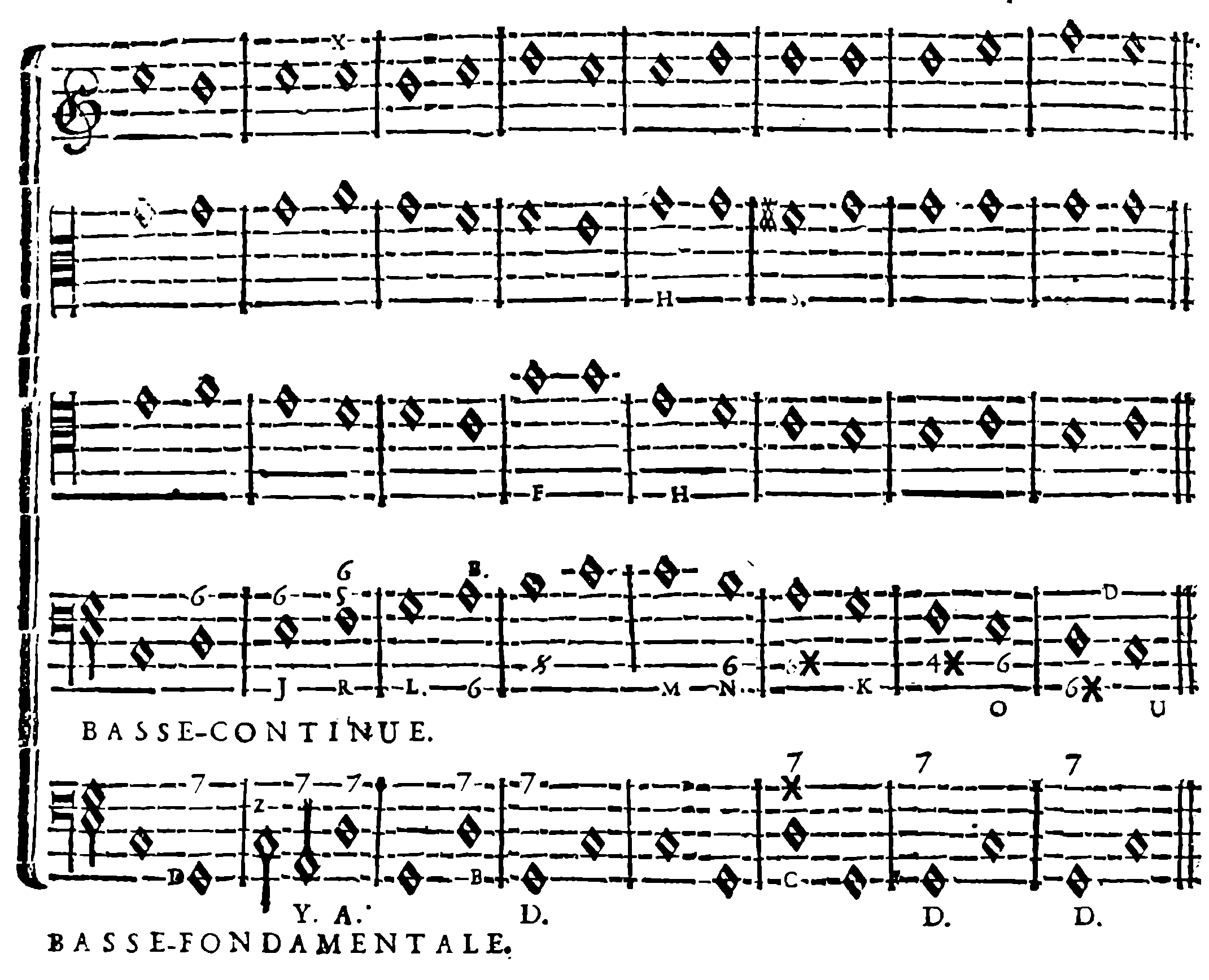
The fundamental bass appears beneath the other parts only to prove that all their harmony lies within perfect and seventh chords without departing from its natural progression. Do not test whether every rule is strictly observed between the parts and this analytical bass. Check only whether the resulting chords differ from those figured on each bass. The succession of sounds relates solely to the continuo bass, since its diatonic progression is now our subject.
1. Compare the continuo-bass chord successions J–L and B–M ascending to dominant or tonic with N–K and O–U descending to dominant or tonic. Everything relates to these two notes, the only ones naturally bearing perfect chords in any key. Notes a third above them act as their mediants when the bass descends to them, though the tonic’s mediant remains so whatever its path. Reason that a perfect chord can follow only the dissonant chord dominating it. Small-sixth, great-sixth, diminished-fifth, and tritone chords are simply seventh chords on fundamental-bass notes that naturally dominate their successors. The second note’s small sixth, leading note’s diminished fifth, and fourth note’s tritone derive from the tonic dominant’s seventh chord at D, immediately followed by tonic. The fourth note’s great sixth and sixth note’s small sixth derive from the second note’s seventh chord at A and C, which dominates the immediately following tonic dominant. The sixth chords on mediant, sixth note, and leading note belong there only because those notes lie a third above or below the tonic or dominant to which the bass immediately proceeds.
2. Sixth note B seems to require a small-sixth chord corresponding to fundamental-bass B’s seventh chord. We omit one dissonant sound for several reasons. First, either choice is permissible. Second, the next bass note is the leading note and therefore the major dissonance, as we shall see. Dissonances resist doubling; a small-sixth chord here would force the sixth note’s third to descend onto that same major dissonance. Finally, our rule still holds: use a sixth chord on every note preceding a perfect-chord note a third higher or lower.
3. If fourth note R were absent from the continuo bass and replaced by second note A or C, or sixth note T, immediately before dominant L or K, the fourth note would need a sharp, as at S. Every perfect-chord note likes its leading note before it. Minor keys are excepted: their sixth descends only a semitone to the dominant, and the dominant’s own leading note then cannot sound, whatever bass note precedes it. Were that leading note present, the dominant would be tonic, and the actual key could be determined only from the following notes. Our example shows this: the dominant may be taken as tonic, revealing its true role only through the next note. Therefore the tritone chord derives from the seventh chord on that same dominant, shown below at fundamental-bass D.
4. The continuo bass’s diatonic movement disturbs the other parts’ movement at F, G, and H. This is unavoidable to prevent consecutive octaves or fifths, restore a part to its natural range and above the bass, or sound every chord member.
Upper parts must move diatonically only while the bass moves consonantly. If the bass changes its manner, the others may do likewise. It is often good to interrupt any part’s diatonic order to vary the melody. One could even change the order and progression of the parts above the continuo bass without error, but this should not occupy us yet.
5. Several unprepared sevenths in this example contradict our first rule, but this is not the place to discuss them. Attend only to the prescribed chord progression within this octave. Later we shall see that after a consonant chord we may proceed freely, observing modulation’s rules.
6. Here is the preceding book’s observation: when fundamental bass is allowed to rise a tone or semitone, a third and fourth are always implied. The added Y between Z and A shows this. The seventh is prepared by Z’s fifth, and the third prepares A’s seventh; the chord substance is unchanged. Remove Y, and the whole tone or second between Z and A consists of the same notes as the seventh between A and X.