 Playable Books
Jean-Philippe Rameau · section 65 of 109
Chapter twenty-two
Read and hear this section in the playable edition →On keys and modes in general
Once we have firmly understood what was said about keys and modes in Chapter VIII, only the following remains to be learned.
Article one
On major keys
We may take any note we wish as tonic, provided that, if the key is major, we make its octave progression conform to that of C. We use sharps and flats to enlarge or diminish by a semitone the intervals that would otherwise prevent this correspondence. We therefore need only know how many sharps or flats to place, ordinarily after the clef, to indicate that all notes on the same degrees as those signs must be raised or lowered a semitone. For example, take D as tonic and make its key conform to C. F forms a minor third above D, unlike the major third above C. Adding a sharp to F therefore makes D's third major, just as E forms the major third above C, and so forth. Likewise, the fourth above F is B♭; thus, in the key of F we must add a flat to B to make it conform to C.
Example of all transposed major keys, whose octave modulation corresponds to that of C's octave.


Here are eleven major keys, making twelve with C, since there are only twelve chromatic notes in the entire octave system. See Book One, Chapter V.
The order in which sharps are placed is F, C, G, D, A, E, B, and so forth. Thus, if there is only one, it must be F; with two, they are F and C; with three, F, C, and G; and so on. Always count upward by fives from the first sharp, F, to the last.
To find how many sharps designate a particular major key, observe that the leading note determines their number, because the last sharp is always placed on it. D major therefore requires two sharps before the clef: its leading note is C♯, and we cannot put a sharp on the C line without also putting one on F, where the first sharp always stands. E major consequently requires four sharps, since D♯ is its leading note; likewise for the others. We may also find this by counting by fives from the major key with one sharp. Knowing that this is G, we say G, D, A, E, B, and so forth: 1, 2, 3, 4, 5 sharps.
Flats are placed by counting upward by fours, beginning with B: thus B, E, A, D, G, and so on. In major keys the fourth note determines their number. For example, the fourth above F is B♭, so a flat must be placed on the B line in F major; likewise for the others. Remember that the major keys written with flats begin with F. By counting by fours, as we counted by fives for sharps, we shall find what we seek.
Article two
On minor keys
The octave of D is ordinarily taken as the model for all minor keys.
See the following example.
Example
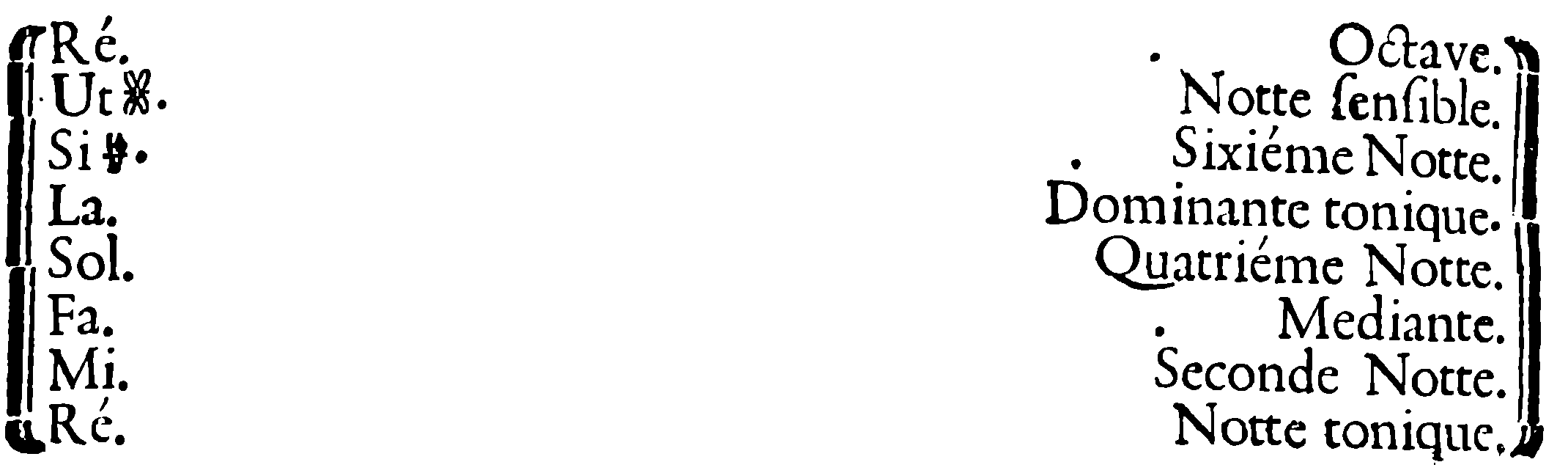
In ascent, the minor-key progression differs from the major only in the third, minor in one and major in the other. In descent, however, the flat must be restored to B and the sharp removed from the leading note C.
Example

We can never go wrong by following these progressions in every minor key.
Example of all transposed minor keys, whose octave modulation corresponds to the preceding octave of D.
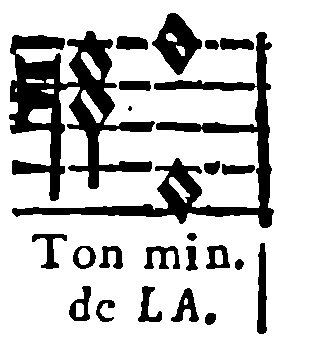
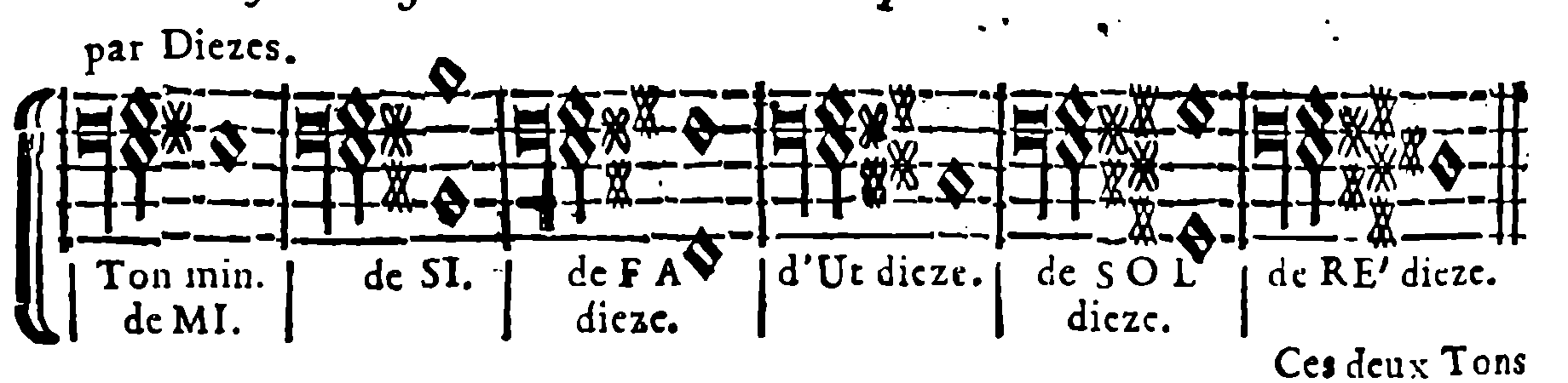
These two keys are one and the same.
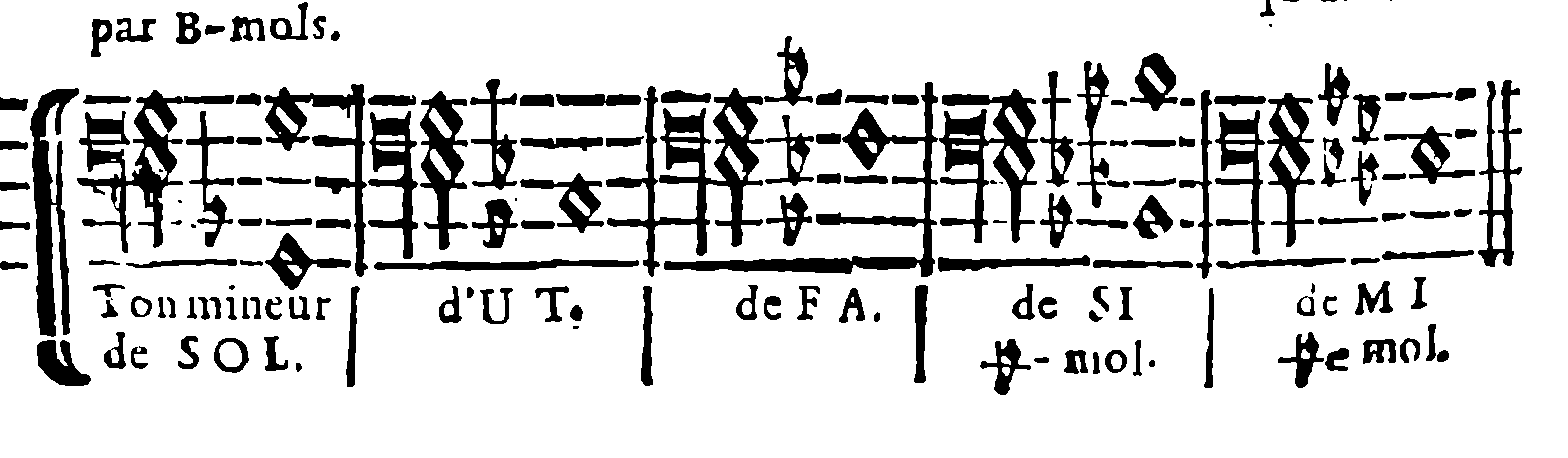
Here, likewise, are twelve minor keys, counting D, which, together with A, is written without a sharp or flat.
The first key with a sharp before the clef is E. To determine how many sharps each minor key requires, count the keys by fives from E: E, B, F♯, C♯, and so forth, with 1, 2, 3, 4 sharps. B minor, being second, must therefore have two sharps; likewise for the others. The second note of the key also determines this number, because it receives the last sharp.
The first minor key with a flat before the clef is G. Counting by fours—G, C, F, B♭, E♭, with 1, 2, 3, 4, 5 flats—tells us how many flats belong to each key. The minor third, which bears the last flat, also determines their number.
We must keep clearly in mind the different numbers of sharps and flats required by each major or minor key. This is necessary not only to place them before the clefs, but also to know when to add them beside notes, or remove them, when the key changes during a piece. The information serves not merely to compose in one key rather than another, but also to recognize the keys into which we pass and make them recognizable to the performers.
Observe that, by calling the tonic of every major key ‘ut’ as a transposed note-name, its octave progression will always correspond to C's; and by calling the tonic of every minor key ‘ré,’ its octave progression will always correspond to D's, both ascending and descending. The intervals and chords to be used in any major key never change, nor do those in minor keys. Remember the change that must be observed in any part according to whether it ascends or descends.
Book Four, Chapter VI gives the octaves of all keys, ascending and descending, with their sharps and flats.