 Playable Books
Jean-Philippe Rameau · section 64 of 109
Chapter twenty-one
Read and hear this section in the playable edition →On the second chord
The second is the inversion of the seventh interval. Likewise, the second chord is an inversion of the seventh chord.
Example
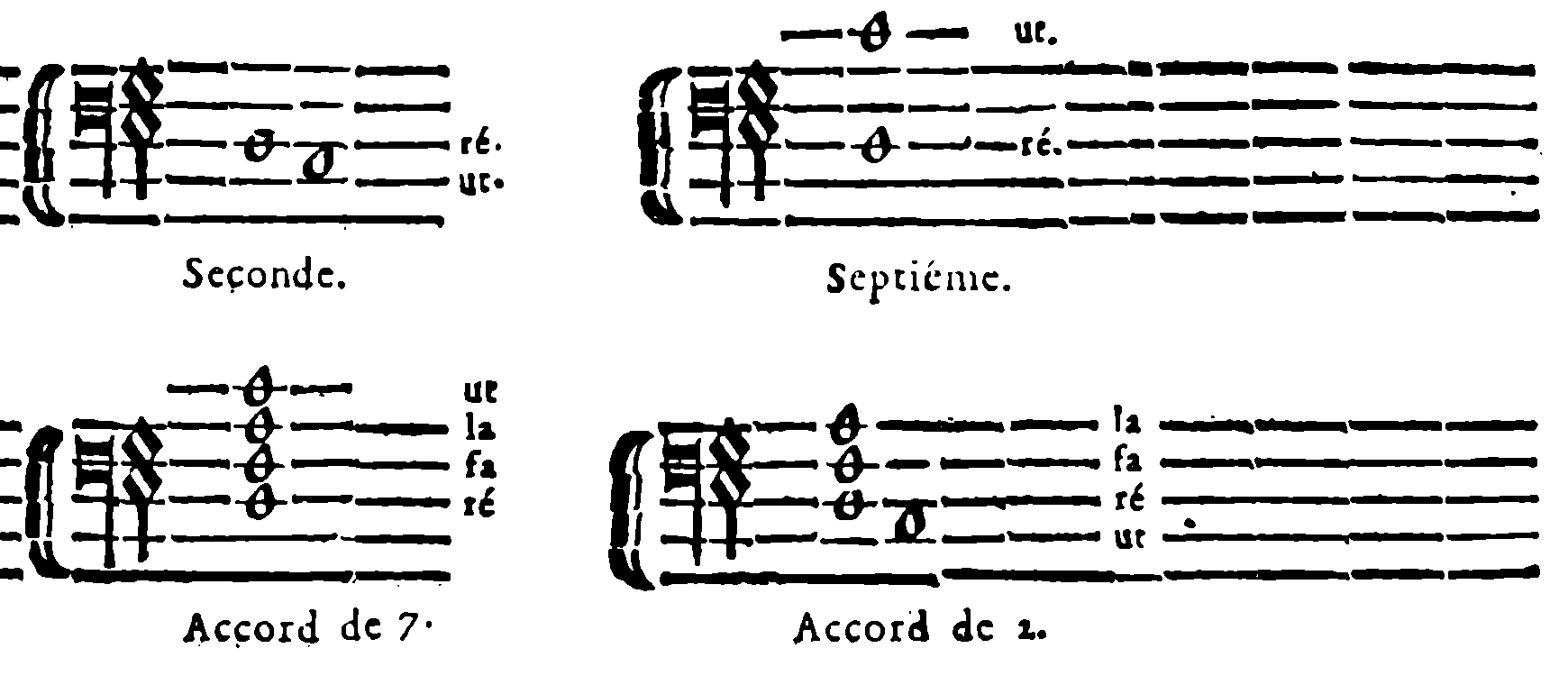
This inversion brings about a corresponding reversal in the preparation and resolution of these dissonances.
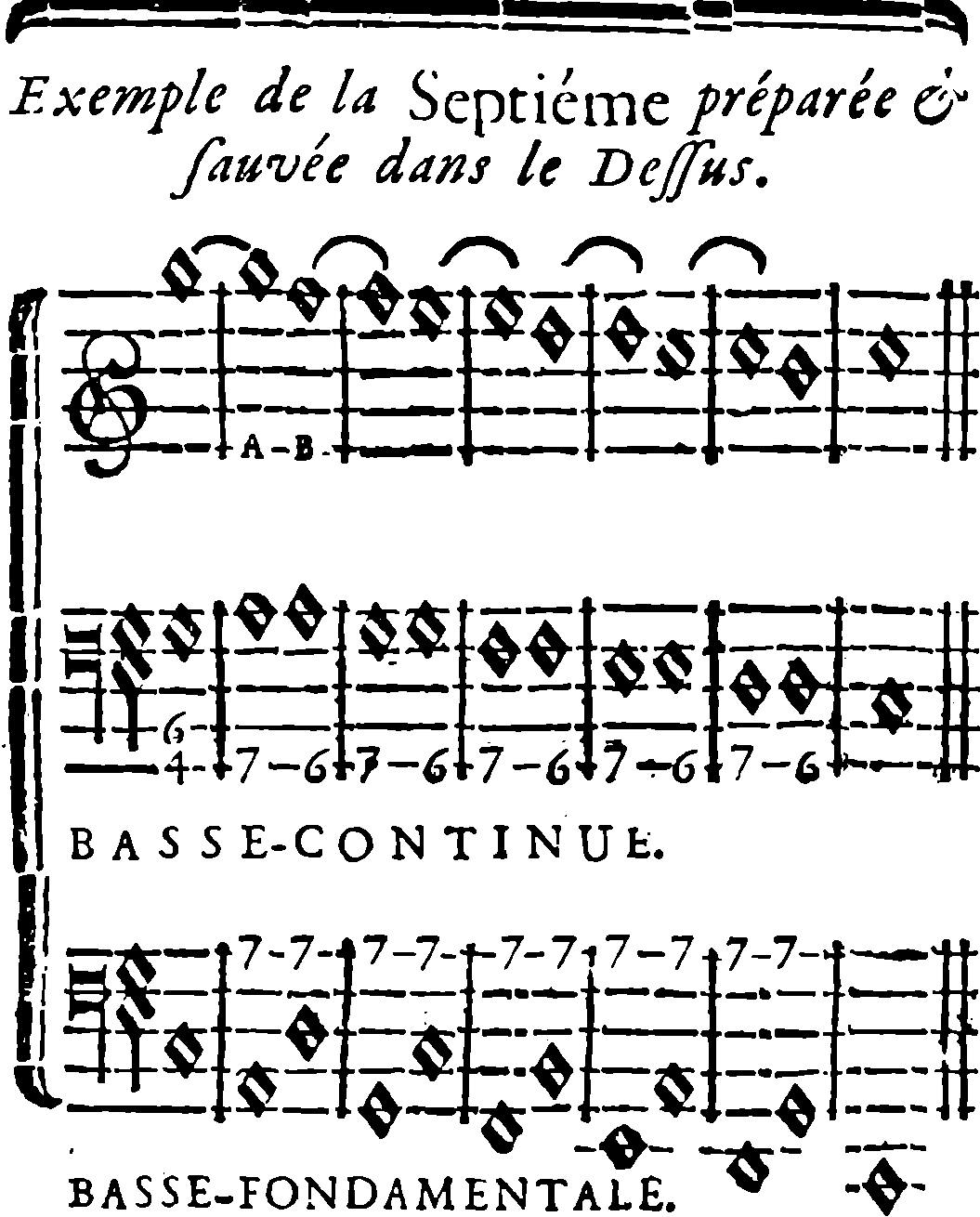
Whereas all minor dissonances must be prepared and resolved in the upper part, the second, by contrast, places the minor dissonance in the bass. It must therefore be prepared and resolved in that bass, according to the movement prescribed for a minor dissonance. Thus, on the bass's second beat, sound the note above which you intend to make a second on the first beat of the following measure. That note must then descend. As long as we continue moving the bass in this way, we can give each note a chord like those in the following example, until the major dissonance appears, after which a consonant chord follows.
Take particular care: in a harmonic progression like this example, the major dissonance may appear without requiring our attention if the bass melody continues through the same degrees, passes onto the mediant without making a close there, and reserves that close for the tonic, which appears only one or more measures later, either in actual form or in its derivatives. This can be observed in the following example. In this case the major dissonance, not following its natural movement, is treated as minor. This is tolerated only because of the modulation, in which we wish to delay the close for a time. Nevertheless, it is always better, after the leading note, to come to rest on the tonic's perfect chord or the mediant's sixth chord.
Example of the seventh prepared and resolved in the upper part.
Example of the second prepared and resolved in the bass.
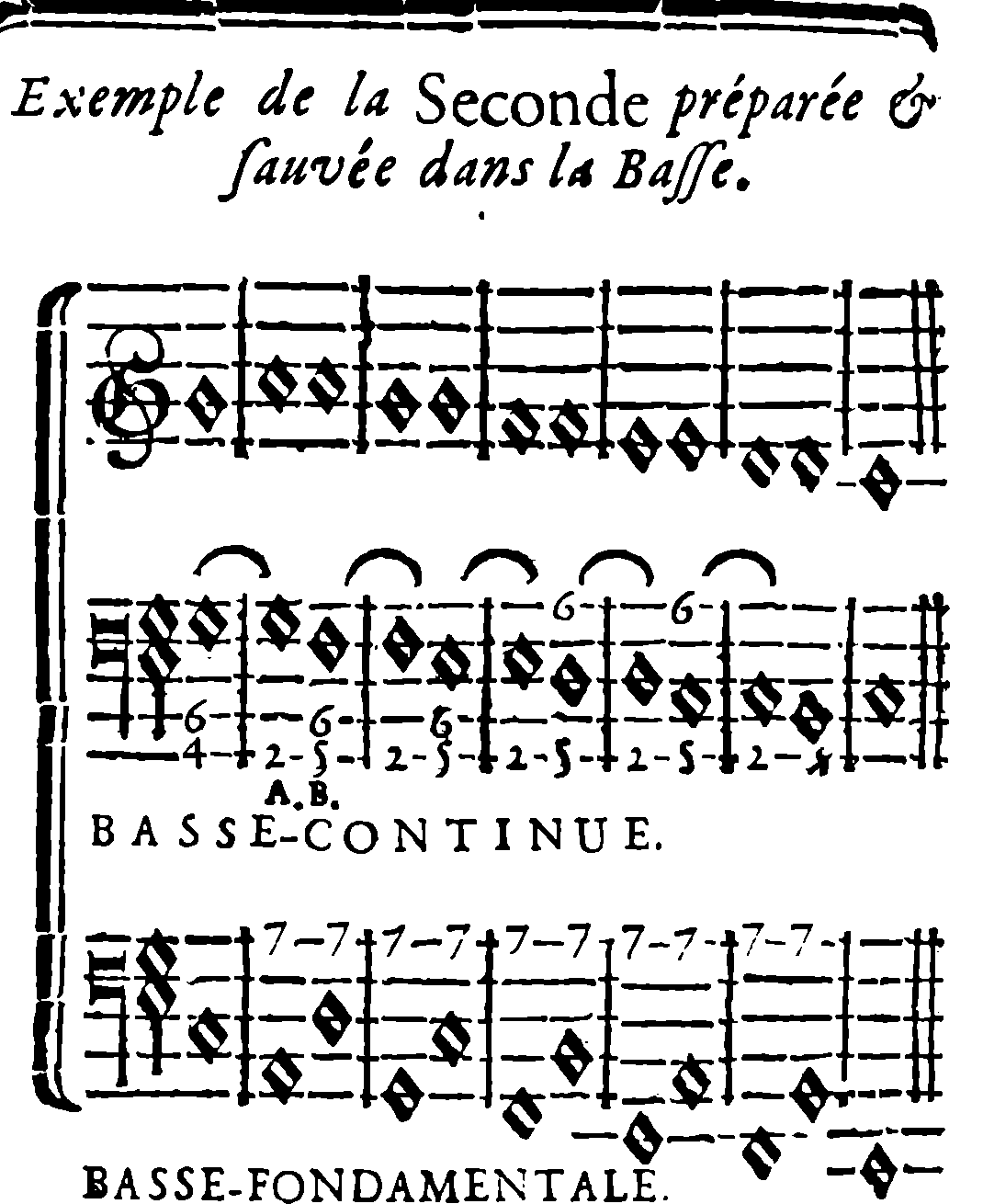
You see that the second is prepared and resolved in the bass just as the seventh is in the upper part at A and B. The fundamental bass shows that the chords on both sides consist of the same sounds.
To know which chords to choose from these two examples, whose bass progressions are almost alike—both descend diatonically and sound each note twice on the same degree—observe that on one side the two notes fall within the same measure, whereas on the other they are separated by a barline. Whenever your bass resembles either of these, you can use chords like the ones shown there. Be assured that following this rule will never mislead you.
If some basses in the preceding chapter's example do not conform to these progressions in the chords they bear, it is because they represent upper parts only. Otherwise, do not depart from our rule if you wish to proceed correctly.
The second absolutely requires preparation by the third, although it may be prepared in the upper part by any consonance; as for the bass, it must always be syncopated in this case.
Observe now that different bass progressions allow dissonances to be prepared and resolved by any consonance. To avoid error, always place a fundamental bass beneath your composition. There you will see that the minor dissonance, which always makes a seventh against this bass, is never prepared by anything but the octave, fifth, or third, and never resolved by anything but the third. Otherwise your composition will be neither correct nor regular.
We repeat that the first dissonance, preceded by a consonant chord, may indeed be prepared by the octave, fifth, or third of the fundamental note. At the same time, those immediately succeeding the first must be prepared by the third of that note rather than by any other consonance, because the resulting harmonic succession is the most natural. Nevertheless, variety sometimes prompts us to prepare a seventh by the fifth or octave of the fundamental note, even when that seventh occurs in the middle of, or after, several others. Note carefully that this is done only to vary the melody or harmony. It should therefore be practised rarely, or at least judiciously. What we say of the seventh applies to every other minor dissonance when referred to its foundation, where the seventh always governs.
Although we say that the seventh must never be resolved except by the third of the fundamental note, this does not mean that it cannot also be resolved by the fifth, or even the octave. These are licences, however, to be used only after one has thoroughly mastered everything else; we shall therefore not discuss them yet.