 Playable Books
Jean-Philippe Rameau · section 67 of 109
Chapter twenty-four
Read and hear this section in the playable edition →Continuation of the Rules Contained in the Preceding Chapter
It is first through cadences that one learns to change key. These cadences introduce a certain repose in the course of a piece, after which one passes into whatever key one wishes, sounding another cadence in that last key, and so continuing the chain; for one is free to pass to any chord one wishes after the perfect chord that ends every cadence.
Sometimes the tonic note on which a cadence has been made is repeated, and this repeated note is given a chord appropriate to the key one wishes to enter.
Giving this repeated note a seventh chord or a sixth–fourth chord makes it a dominant, A.
Giving it the tritone chord or the great-sixth chord makes it a fourth note, B.
Giving it a sixth chord makes it a mediant, C, or a sixth note when it ascends to the leading note, D.
Giving it the small-sixth chord makes it a sixth note when it descends to the tonic dominant, F, and sometimes a second note, G.
One may also raise this tonic note by a semitone instead of repeating it, giving a diminished-fifth chord to the raised note, which then becomes the leading note, H.
When the tonic note bears the major third, it can become a dominant without any change, J.
Turn the page for the following example.
Example
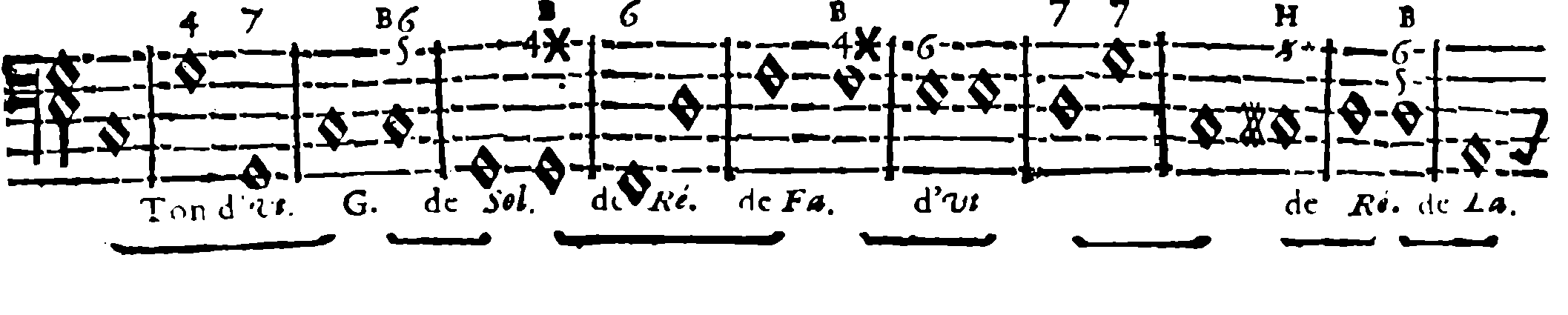
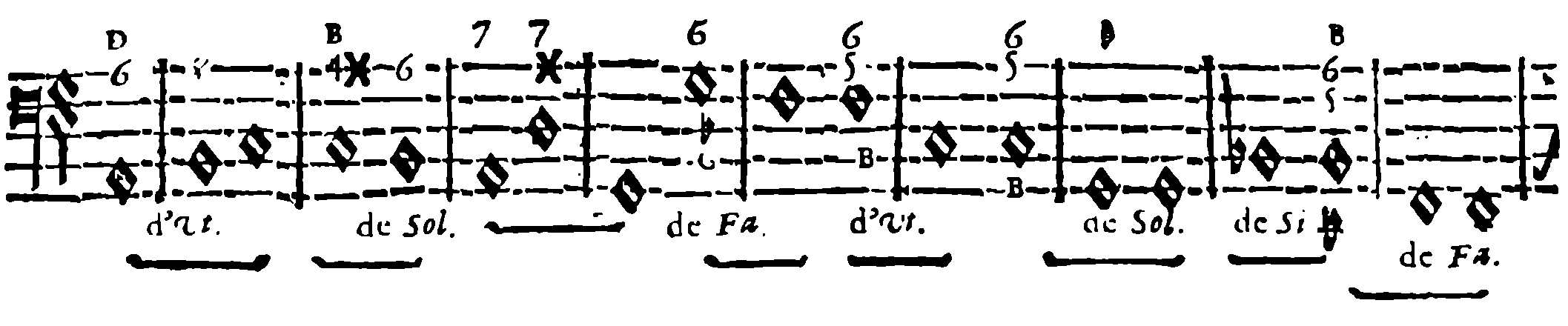
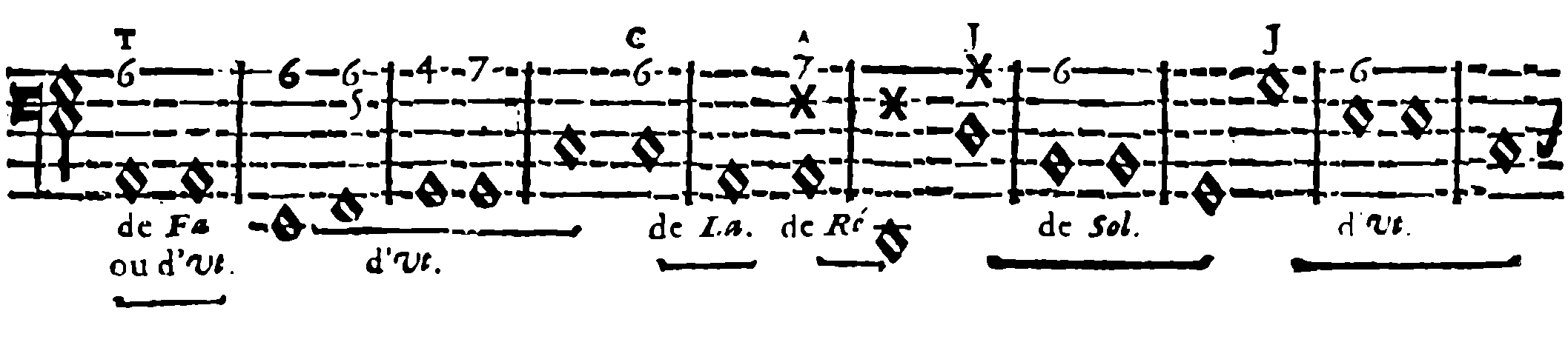

One may simply give the perfect chord to all the notes figured thus, (6/5), above which there is a B, because the irregular cadence that sounds a mediant can become a sixth note, just as a sixth note can become a mediant, as could be observed in part in the preceding example, at the place marked T.
Example

The note A, which is the sixth of C, becomes the mediant of the key of F, S.
The note A, which is the mediant of F, becomes the sixth of C, T, without the chord changing on either side. This note, which can be either a mediant or a sixth note, always lies between two keys a fifth apart and divides that fifth into two thirds, as between F and C, with A in the middle.
One may also change key by means of 7, 7 and 6, 2, 4♯, 6/5, and barred 5. Thus, after making one or more bass notes proceed under chords of these kinds, one need only introduce an interval of a tritone or diminished fifth into them to determine the key one wishes to enter, observing that this tritone or diminished fifth must be formed by the major third and seventh of a tonic dominant.
Example
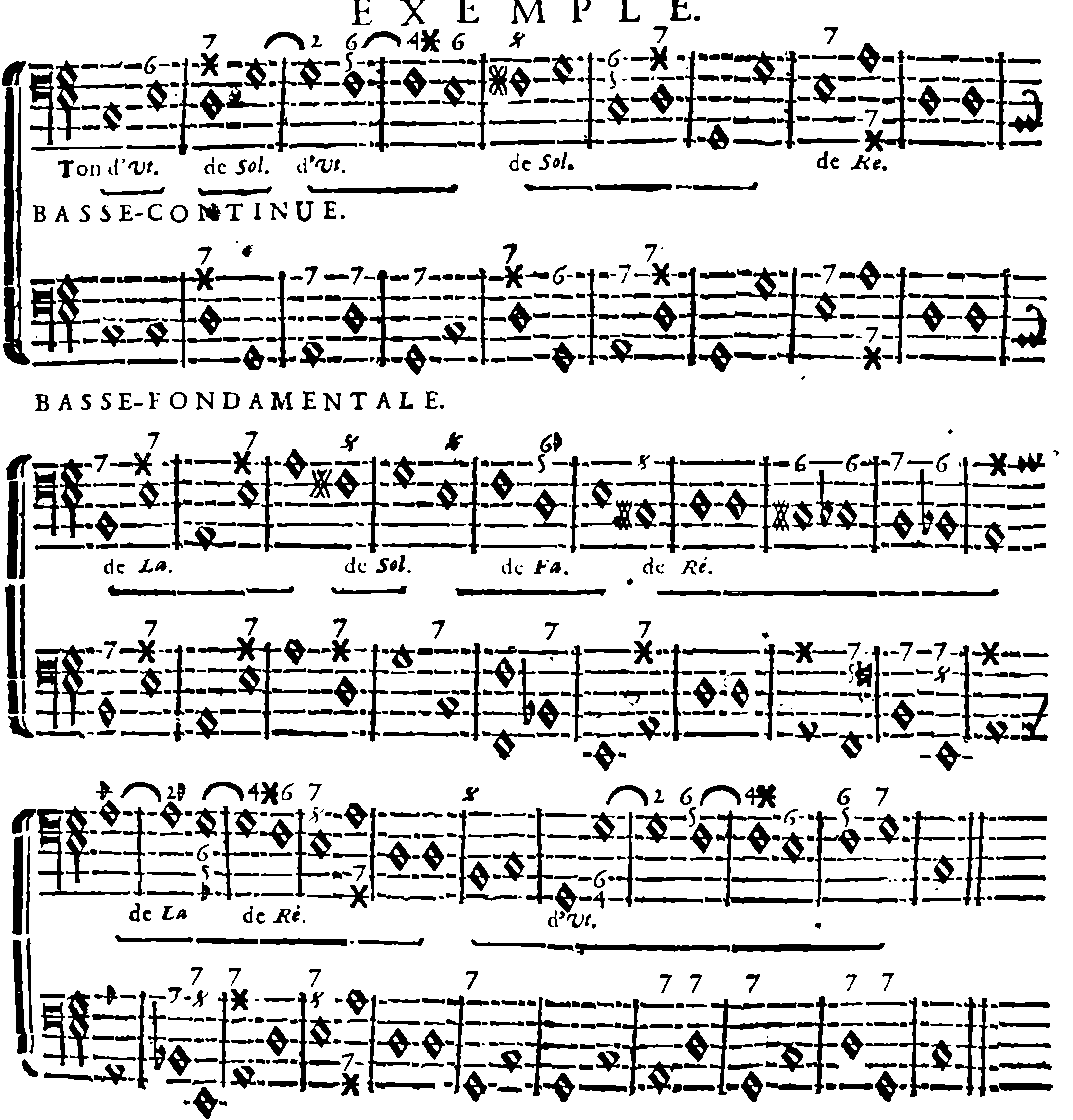
Observe that the dissonance through which one enters another key must always be prepared by a consonance of the chord on which the key being left ends.
This should help you compose a bass in accordance with the chords you wish to employ in it. But we shall now approach the matter in another way, leaving you free to compose a bass as you please, whose progression will tell us which chords it must bear.