 Playable Books
Jean-Philippe Rameau · section 84 of 109
Chapter forty-one
Read and hear this section in the playable edition →How to Compose a Continuo Bass Beneath an Upper Part
The true continuo bass should be the fundamental bass. But custom gives that name to the bass dictated by good taste according to the paths of the other parts above it. We therefore distinguish it from the fundamental bass by the epithet “continuo.”
At the beginning of the preceding chapter we said that people of cultivated taste naturally sense the bass best suited to every kind of air. Yet without knowledge to support this natural gift, it is difficult not to stray from the truth; and knowledge alone cannot achieve perfection unless good taste assists it. Freedom to choose chord sounds for a bass beneath an upper part does not tell us which fit best. We have no rule for good taste other than variety in composition. This, therefore, must be our aim, observing the following.
1. Now one must attend to avoiding consecutive octaves and fifths, strictly observing the rules for consonant and dissonant succession given in Chapters XIV, XVIII, XX, XXI, and XXX.
2. Once the fundamental bass is composed, consider the upper part’s design, the air it expresses, its tempo, and every distinctive feature. Try to reproduce those expressions in the new bass. Avoid final cadences where the melody does not require them by selecting suitable sounds from the fundamental chord that agree fully with the upper part under the rules of consonant and dissonant succession. Any dissonances must be prepared when required and carefully resolved according to the prescribed motion of each seventh-chord sound. For variety, seek different consonances or dissonances between the parts. The upper part is fixed, but you may choose another appropriate chord sound for the bass. Here you used a sixth followed by another consonance or a dissonance; there, though the same is possible, turn the bass differently: sometimes a tritone resolving to a sixth, sometimes a diminished fifth resolving to a third, sometimes a seventh resolving to a sixth, third, or fifth, according to the bass motion available. Or sound only the consonances contained in a seventh chord—octave, fifth, third, or by inversion sixth or fourth. You may also use chords by supposition or borrowing where the bass’s diatonic progression leads to them. That progression is always the most singable and should be used as much as possible, especially where no conclusion appears. Remember that all minor dissonances in a chord by supposition must be prepared by a syncopated upper part while the bass ascends; if it descends, it may do so only by leaps. Every chord containing the major dissonance requires the precautions prescribed in the octave succession or in Chapters XI, XXII, XXXI, XXXIV, and XXXV, where we discussed the augmented fifth, augmented seventh, tritone, and augmented second. The second must be prepared by a syncopated bass. Finally, where the melody can end, follow the fundamental bass’s progression. Your bass will thus be composed with art and taste.
Example
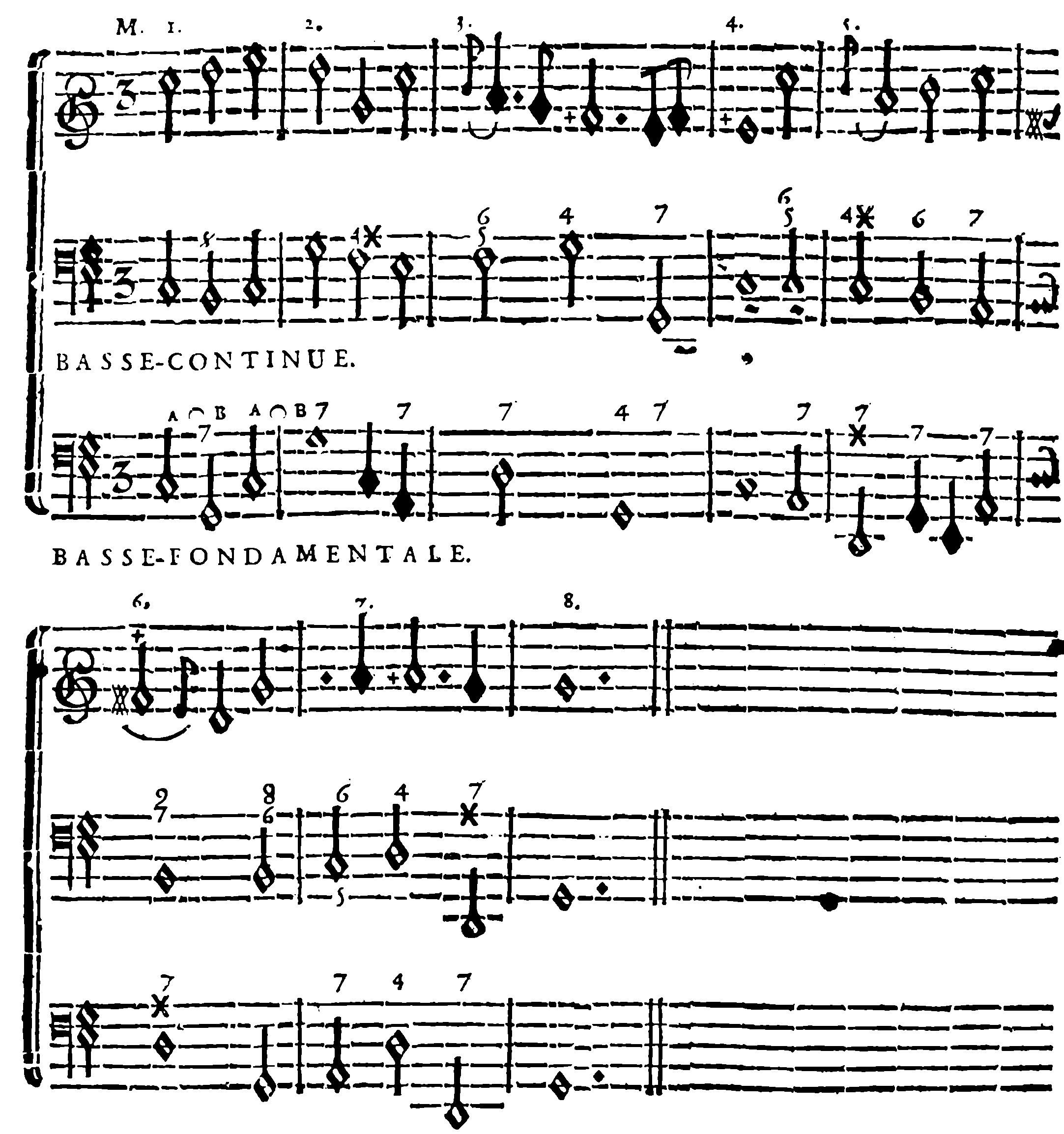
First observe that in the fourth measure I could have changed the perfect cadence in C into an irregular cadence in A, as the continuo-bass cue signs show. Variety even calls for this here.
In the fundamental bass’s first and second measures I see two identical progressions, A and B. I therefore reserve the progression most closely related to the cadence for the second measure, where a cadence is ordinarily felt. Here it is irregular; in the fourth measure it is perfect. Returning to measure one, I give the continuo a diatonic progression agreeing fully with the upper part. To continue it in measure two, I put the second beat on a note forming a seventh with the fundamental bass and resolving through the third of that bass, still agreeing with the upper part. I maintain this diatonic progression until the perfect cadence, where I follow the fundamental bass. I seek diatonic movement again afterward: the final note of measure four may stay to form a third with the fundamental bass and an octave with the upper part; then in measure five it forms a sixth with the upper part and a seventh with the fundamental bass. Finally I find a ninth in measure six, and follow the fundamental bass’s progression only at the final conclusion. The intervals the continuo forms with the fundamental bass also tell me its required chords. A well-composed fundamental bass bears only perfect or seventh chords; therefore notes forming thirds, fifths, or sevenths above its notes can bear only the corresponding derived chords. I could likewise figure the upper part if I wished to use it as bass. The same reasoning makes me figure a ninth on the first note of measure six: it lies a third below or sixth above the fundamental-bass note, and can therefore enter the harmony only by supposition. The fundamental bass’s seventh chord shows that this note can bear only the ninth chord, though the ninth itself does not appear in the upper part. The fifth heard there belongs to that ninth chord, and the implied ninth is prepared and resolved according to every rule.
We would never finish if every possible way of varying a continuo bass had to be reasoned through like this. But make the necessary observations on the examples in this treatise, applying to each the points you wish to clarify, and consult the works of skilled masters for the same purpose. You will soon rise above all these difficulties.