 Playable Books
Jean-Philippe Rameau · section 83 of 109
Chapter forty
Read and hear this section in the playable edition →On Making a Fundamental Bass Beneath an Upper Part
The fundamental bass is the surest means of finding a bass suited to an already composed upper part when taste is not sufficiently developed to sense that bass while composing the upper part. Every melody has its natural bass, better suited than any other, which anticipates our thought. With even a little sensitivity to perfect harmony, we naturally sing the bass of every cadence on hearing its upper part. This already tells us the key in which we sing. Thus, from cadence to cadence, perfect or irregular—for an interrupted cadence does not differ from a perfect one in the upper part—we recognize key changes. The fundamental bass, allowing only perfect or seventh chords, determines them still more quickly.
EXAMPLES. Different Upper-Part Progressions in Cadences
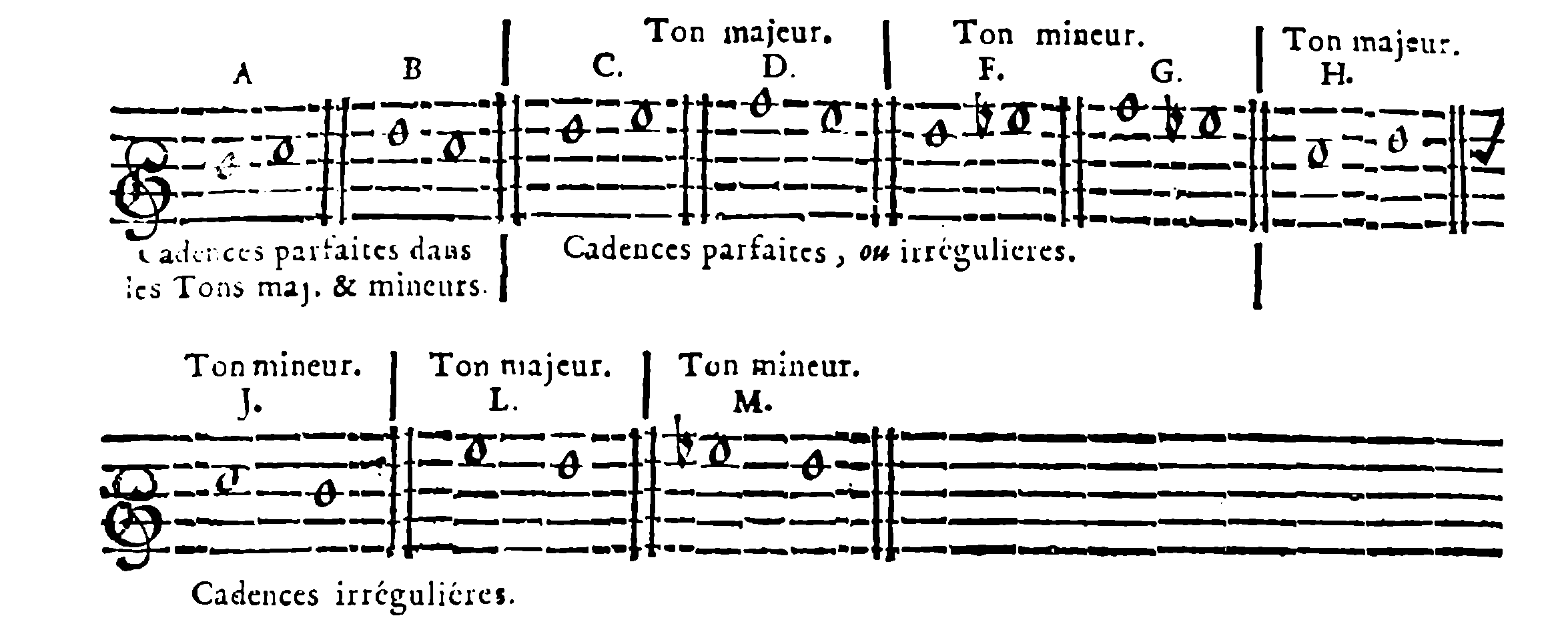
All these cadences are established in C alone, although they relate to other keys.
Perfect cadence A ascends from the leading note to the tonic in major and minor keys, although it could ascend from the second note to the mediant in minor keys, as in example F.
Perfect cadence B descends from the second note to the tonic in major and minor keys, although in minor it could descend from the fourth note to the mediant, as in G. Thus C major and A minor have much in common in these first two cadences. More generally, both cadences occur equally in a major key and a minor key whose tonics are a minor third apart, as with C major and A minor, F major and D minor, G major and E minor, and so on.
Cadences C, D, F, and G may be perfect or irregular, distinguished only by the freely chosen bass motion: ascending a fourth to the tonic for a perfect cadence, or descending a fourth to that tonic or the dominant for an irregular cadence. “Or the dominant” assumes that these cadences may represent keys other than C. C and D can be irregular cadences in D, and D also in F; F and G can be perfect cadences in E-flat, and G also irregular in A-flat. But the true irregular cadences on C’s dominant are H, J, L, and M. Nevertheless, H may represent a perfect or irregular cadence in B-flat; J an irregular cadence in A minor; L a perfect cadence in D; and M an irregular cadence in B-flat major, G minor, or either major or minor E-flat. Here is the use we may make of these cadences whose upper parts admit different interpretations.
1. Compose the upper part only in C major or D minor if other keys are not equally familiar. To know whether it truly belongs to one of those keys, since it may begin only on the octave, third, or fifth, observe where the first cadence ends, ordinarily in the second or fourth measure. If you began with C, E, or G, the octave, third, and fifth of C, a first cadence ending on D does not put you in D: you would have had to begin with D, F, or A, its octave, third, and fifth. Moreover, if melodic taste leads to semitones requiring sharps or flats, those signs immediately determine the key as explained in Chapters XXIV and XXV. An opening C is the minor third of A and fifth of F as well as the octave of C; only sharps, flats, or cadences distinguish the key. If the air is composed with natural taste, however, one need only consult the final note, which should naturally be the tonic.
2. Once certain of your key, assign to it every cadence that can belong to it. If foreign cadences appear, compare them with those in the preceding example, observing the following.
1. The upper part must always form the third, fifth, octave, or seventh with the fundamental bass.
2. Always prefer the most perfect fundamental-bass progressions: a descending fifth over a fourth, a fourth over a third, and a third over a seventh. Remember that ascending a second amounts to descending a seventh, and so forth. If a descending fifth in the bass cannot agree with the upper part, seek agreement through a fourth, third, or seventh, always preferring the most perfect.
3. Do not figure the upper part when seeking thorough practice in fundamental bass, since figured melody only confuses beginners. Each upper note must therefore last at least one beat.
4. Begin by composing characteristic airs such as gavottes and sarabandes, because their cadences are nearly always perceptible every two measures, deciding the matter more quickly. See Book II, Chapters XXV, XXVI, XXVII, and XXVIII, for their tempo, required number of measures, suitable verse forms, and rules for setting words to music.
5. If your air contains cadences foreign to its key, observe whether they end the melody, which the meaning of the words will clarify. If they do, the key changes, ordinarily to the dominant, mediant, fourth, or sixth of the key just left. Compare these cadences with the preceding example. If one ends thus:

represents a perfect cadence in one of these keys, just as this one
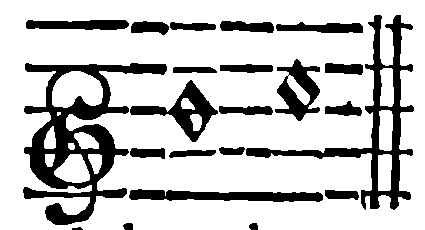
represents one in C; likewise with other proportionally related cadences. But if the melody has not fully ended, let the bass follow its natural course, preferring the most perfect progressions as far as possible, as already stated.
6. As long as the upper part forms the third, fifth, or octave of a bass note already in place, that note need not change, unless a change can be made without interrupting the natural bass progression. Variety, one of harmony’s principal beauties, then calls for it.
7. Always regard the first beat of each measure as principal. If a bass note intended for another beat also suits the preceding or following first beat, it is better to advance or delay it so it sounds on that first beat. Observe two things. First, if the note after the first beat could also serve on the first, sound it there rather than waiting. Second, if a note on a weak beat is the same as the one immediately following on the next first beat, with no other notes possible between them, it is better to retain the bass note from the previous first beat if possible, or find another different from the note about to sound on the next first beat.
Example
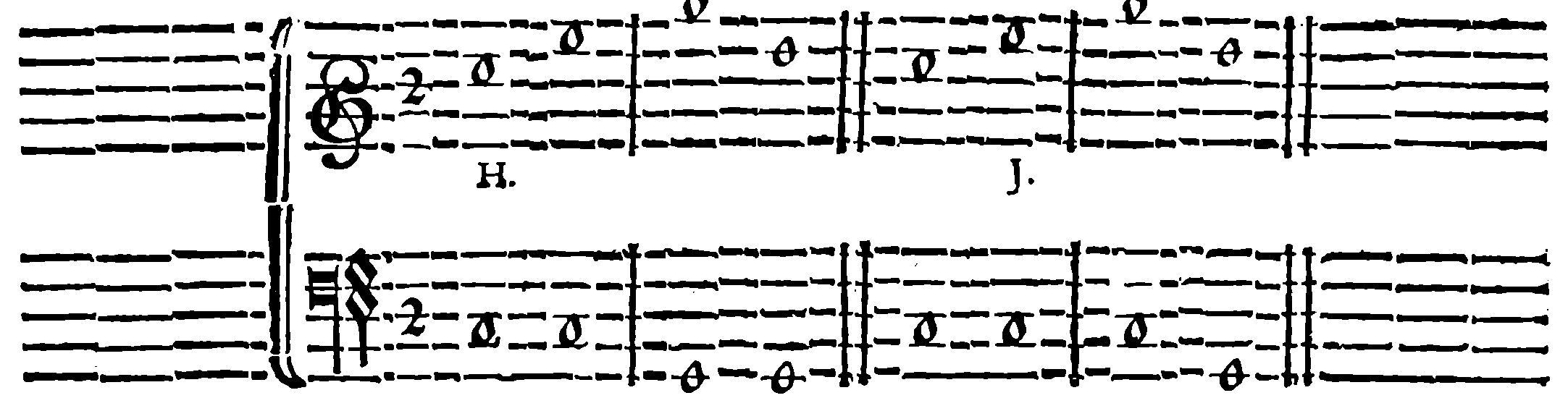
Example H is better because the note heard on the second beat of the second measure can serve on that measure’s first beat and should be preferred there.
Another example
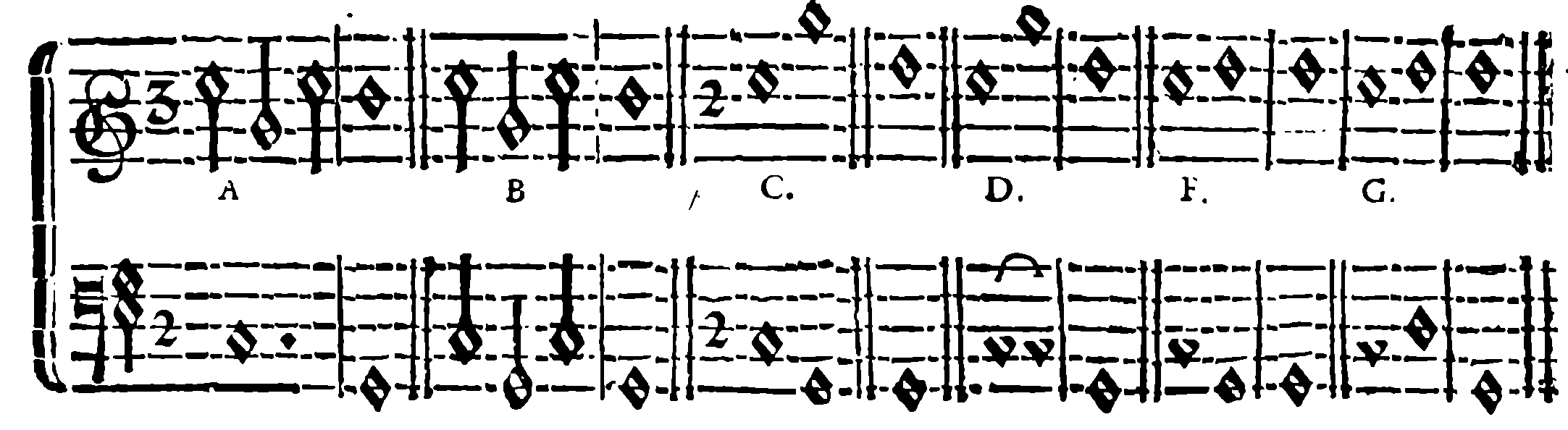
I cannot hold the same bass note throughout the first measure of A, although I may change it as in B, because I can place another note between the second beat of the first measure and the first beat of the second. In C and F, however, I must not use the second bass note of the first measure, since it must sound immediately afterward on the next measure’s first beat. Thus at D I use the note already heard on the first beat of the first measure, since it still agrees with the second beat; at G I choose another, since the first cannot agree with the second beat there.
8. It is often necessary to divide an upper note into two equal durations so that two different bass notes, both agreeing with it, may sound beneath it. This preserves consonant bass motion and places the most perfect progression between the second of those bass notes and the one following.
Example
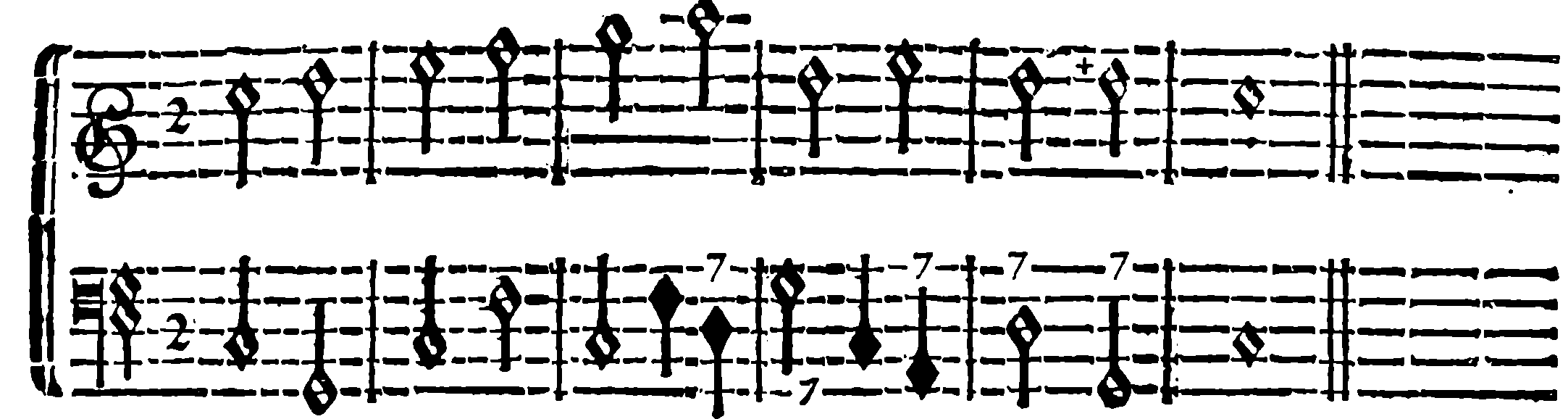
This division also places the notes most suitable to the key on the fundamental bass’s principal beats: tonic, dominant, fourth, sixth, and sometimes second, in that order of perfection. The mediant is rarely used, and the seventh never, on any beat of the measure. If it cannot be avoided, the key certainly changes, as sharps, flats, or foreign cadences reveal.
9. Principal beats are where the first prepared dissonance must sound. If several occur consecutively, consider only the first. An unprepared dissonance is allowed only in a diatonic upper progression through three degrees downward, or upward and immediately downward, while the bass ascends a third or fifth and then descends a fifth. The dissonance then occupies the middle of those three degrees.
Example
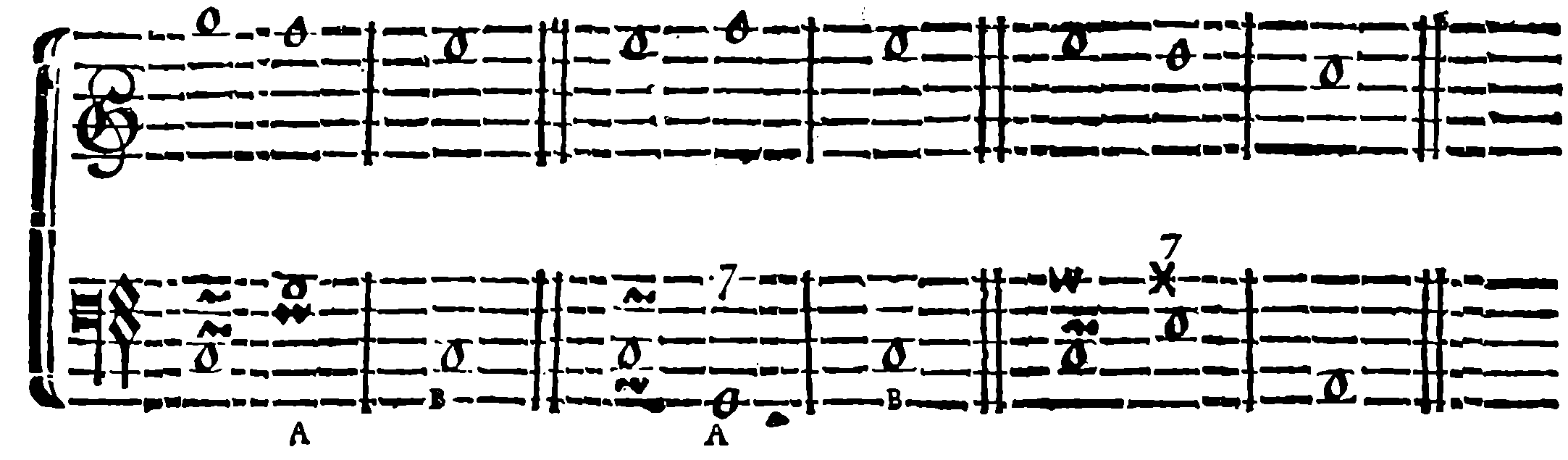
Instead of first making the bass ascend a fifth here, it may ascend only a fourth, removing the dissonance. This changes a perfect cadence into an irregular one or vice versa. See A and B: another note may replace A at the cue sign. A and B form a perfect cadence; A moved to the cue sign forms an irregular cadence with B.
The cue signs above the first bass note show other possible bass progressions in this situation, by moving that first note to either cue sign.
Remember that the seventh is the only dissonance against the fundamental bass. Other dissonances arise only by inversion, taking as bass one of the notes belonging to its required seventh chord. Observe all we said in Chapters XVII, XVIII, XX, XXI, XXII, and XXVI.
Sometimes an unprepared seventh sounds well against the fundamental bass even when the upper part leaps. The bass note heard before the seventh must then stay in place. Such a seventh is always good provided the upper part descends diatonically immediately afterward and the bass can then rise a fourth to form a third with the upper part after the seventh.
Turn the page for the example.
Example
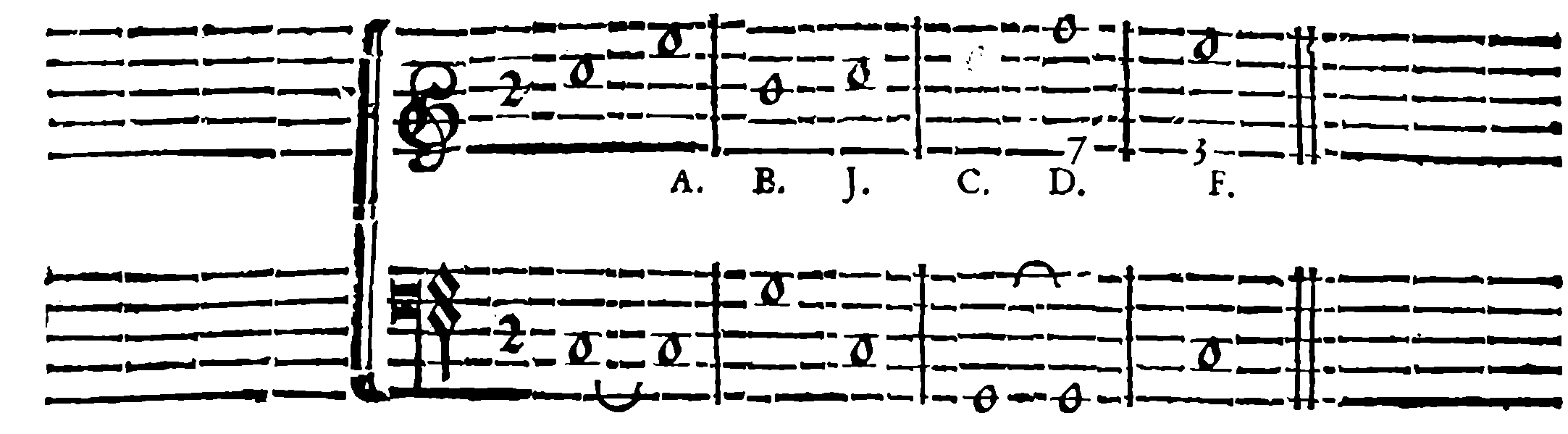
The upper part leaps from A to B, where a seventh would sound if the first bass note remained. But the upper part does not descend after B; nor could that retained bass note rise a fourth to form a third with J. Therefore the bass must change as shown, favoring its most perfect progression. What is absent at A, B, J is found at C, D, F, according to the preceding explanation. This was also called supposition, or dissonance for melodic taste. Yet the dissonance is present from the first upper note while the bass remains to receive it when it appears later, as one may hear by sounding the complete seventh chord on the first bass note struck with C. Consequently the upper part may move after that seventh to other notes of the same chord, but will always return to a note forming the third of the bass note that rises a fourth at G, or at least to a note forming its octave.
Example
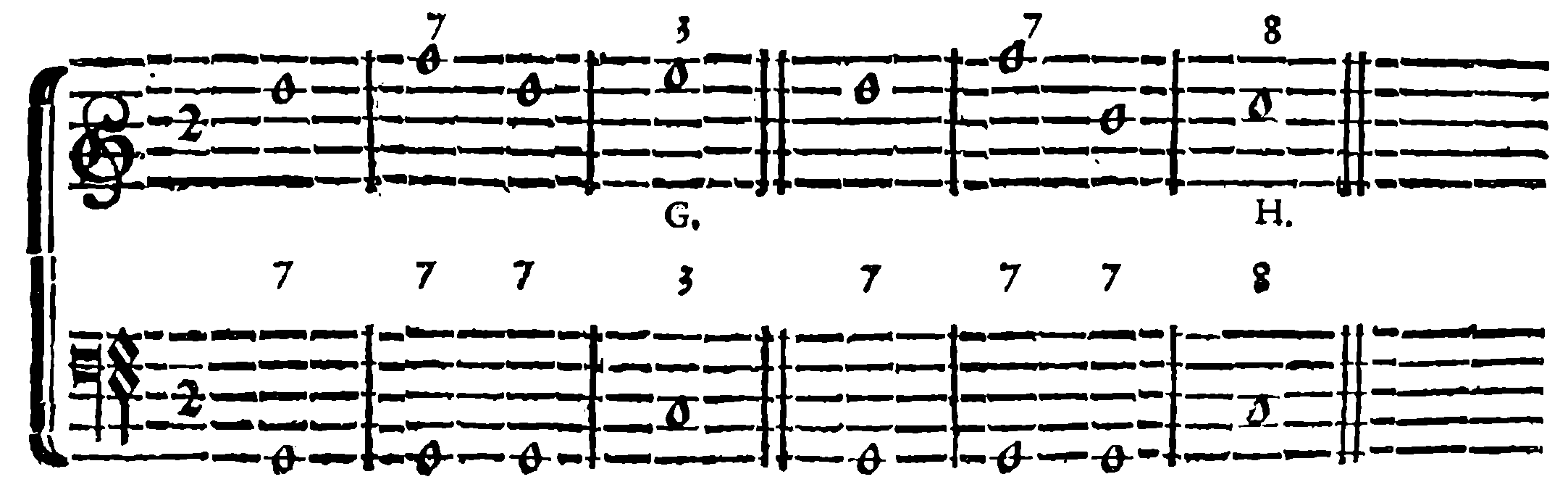
Instead of ascending a fourth, the bass might rise only one degree to form an interrupted cadence. But this can occur only in a borrowed bass or one inverted from the fundamental. It depends on the composer’s taste only within a piece, provided that bass does not form two consecutive fifths with the upper part.
10. When several cadences of the same kind occur in one key, look for one within the air that does not establish an absolute conclusion and may relate to a cadence in another key. That foreign cadence would then be suitable for harmonic variety. An air becomes languid when the same cadences recur continually. If taste prevents varying the upper part, at least vary the bass within the air, especially at cadences that do not determine a complete conclusion.
In a major key, such related foreign cadences may be taken only from the minor key whose tonic lies a minor third below. In a minor key, they may come only from the major key whose tonic lies a minor third above. This difference may appear in the bass alone, since the upper melody need not change.
Example
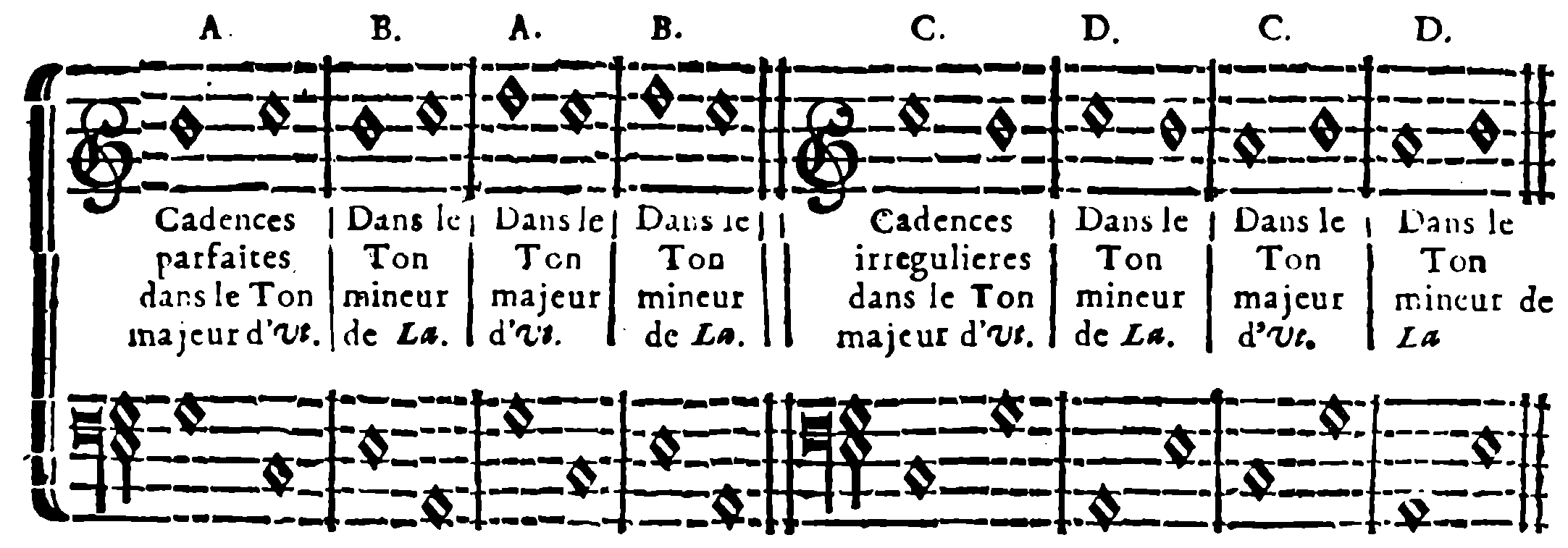
The upper part’s perfect cadences A and B and irregular cadences C and D occur naturally in either C major or A minor. In either key, you may therefore use one of these cadences for the other: the same cadence serves A minor from C major, or C major from A minor. The same applies to similarly related keys, such as D minor with F major, and G major with E minor.
This transfer of a cadence from one key to another is also very useful when making a definite key change.
The interrupted cadence may also be used in either case.
11. Irregular cadences are excellent within an air. If it has two sections, they may often end the first, but do not make a habit of this. Prefer them in the second, sixth, and tenth measures rather than the fourth, eighth, and twelfth, where perfect cadences are more appropriate. A perfect cadence in the sixth or tenth measure may be replaced by an interrupted one.
12. In transferring a cadence between keys, it is sometimes appropriate to prefer less perfect fundamental-bass progressions to more perfect ones. All must be done with judgment and discretion.
13. People composing a melody freely do not attend to whether it is figured, tied, or always stepwise. If figured, they may lack the skill to distinguish notes forming harmony with the bass from those serving only melodic taste. If it leaps, they fear consecutive fifths or octaves with the fundamental bass, not knowing that the melody then follows the fundamental bass’s natural route. This is precisely why another bass must be composed, different from the fundamental, to agree fully with the existing part. Once the fundamental bass reveals the chords required throughout the air, one can easily choose notes from them for another bass agreeing harmonically and melodically with that part. It is useful to know that consecutive octaves or fifths do not destroy harmony’s foundation; they are forbidden only to avoid dry, tedious monotony in chord succession. Having established harmonic rules on the most natural bass and upper-part progressions, we see that the bass cannot maintain its natural course once the upper part is allowed to borrow it. We must therefore establish other rules for the reciprocal movement of parts heard together, adapting the part composed second to the existing one. These new rules nevertheless remain founded on the first ones, where the parts’ natural order produces neither consecutive octaves nor fifths, and every dissonance resolves properly, prepared or unprepared according to the most perfect bass progression.
We also often depart from natural bass motion to avoid the frequent conclusions suggested by its most perfect progression. From each chord forming such conclusions, choose a chord note for the bass instead of its natural note. This maintains the melodic and harmonic suspense required by the subject, since absolute conclusions suit only completed meanings. The next chapter will clarify this.