 Playable Books
Jean-Philippe Rameau · section 86 of 109
Chapter forty-three
Read and hear this section in the playable edition →What to Observe in Composition for Two, Three, and Four Parts
It is difficult to succeed perfectly in two- and three-part pieces unless all parts are composed together, because each must have a flowing, graceful melody. A skilled musician scarcely composes one part without simultaneously sensing the effect of those that will accompany it.
1. Although one ordinarily chooses a part in which to place all the beautiful melody imagination supplies, called the subject, its beauty diminishes if the other parts lack a proportionate share. Only in recitative should the bass and other parts merely sound the harmonic foundation. Otherwise the melodies of two or three parts should be almost equal. Hence the apt saying that a well-singing bass promises beautiful music.
The fewer the parts, the more varied the chords must be. This rule therefore demands the strictest observance in two-part pieces.
2. In three-part composition, make the chords as complete as possible. The best rule for this is always to sound thirds or sixths between at least two parts. Use the octave rarely, unless the design,* fugue, or beautiful melody leads to it, especially in perfect cadences where every part ordinarily ends on the tonic.
* We discuss design and fugue in the final chapter.
Example
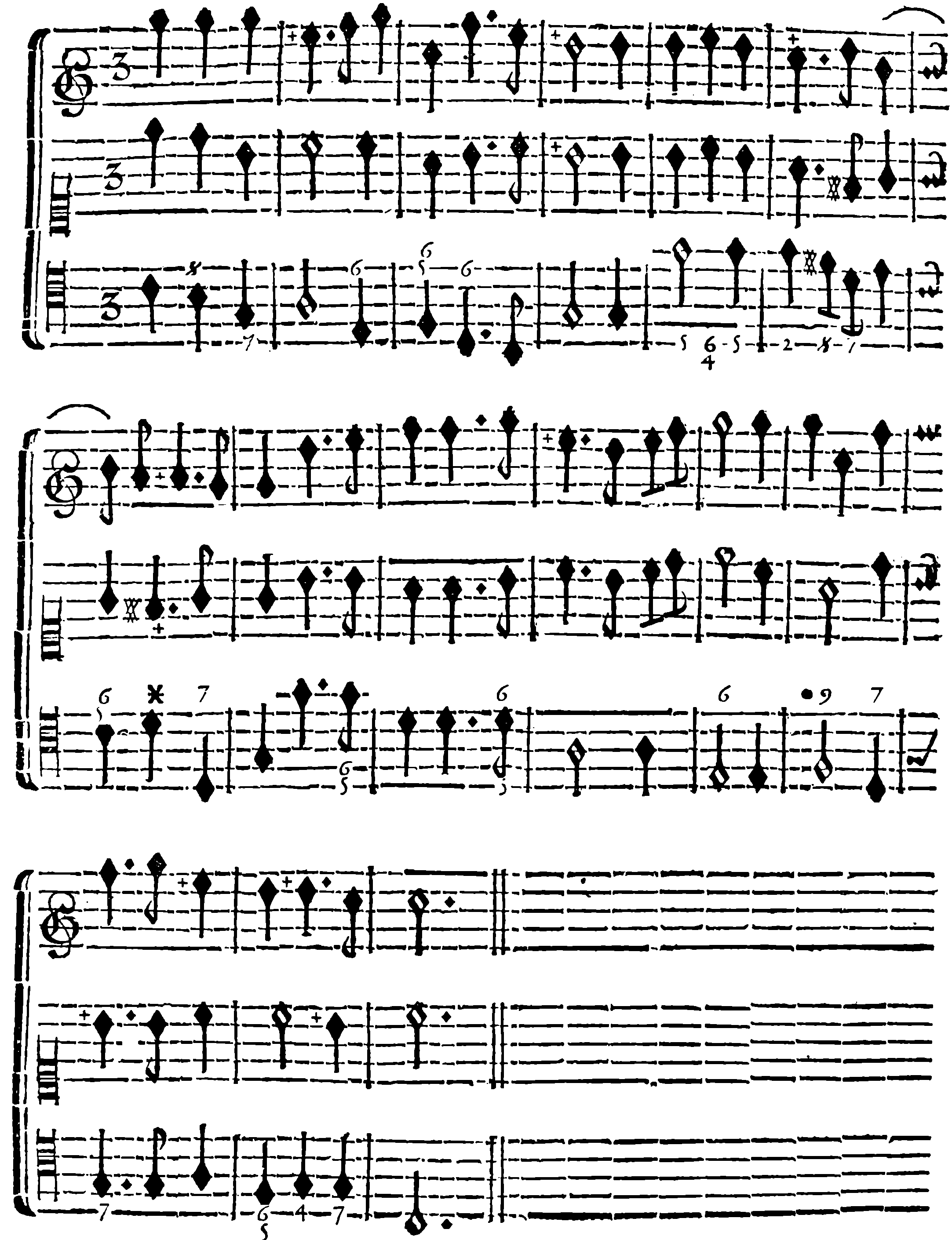
Pieces in four or more parts take the form of choruses, quartets, quintets, and so forth. A quintet or canon appears in the final chapter. In choruses each part may be multiplied by as many voices as desired; quartets and quintets ordinarily use only one voice per part. Since it is difficult to give each simultaneous part a beautiful, natural melody, at least let such melody prevail in the bass and highest part, especially in choruses. It may nevertheless be given to any part, or passed now to one, now to another, always preferring the highest vocal part, or instrumental part if there are no voices, since attention naturally turns toward the most penetrating sounds. We do not mean to include the bass in this comparison: it must take precedence and always guide us in pieces of this kind.
However difficult it may be to fill every part of a quartet or quintet with beautiful melody, every effort must be made. Perhaps fugue was invented chiefly for such pieces. They have little charm without it; moreover, the fugue’s return in one part after another pleasantly surprises the listener and draws attention away from parts temporarily lacking melody toward the one taking up the fugue. Thus one may skillfully attract listeners by fixing their attention on what strikes them most. The fugue’s melody, its accompanying parts, and the rests introduced where a part’s melody would lack grace all depend on our taste. We must choose well for a successful result; this is the next chapter’s subject. Only choruses can please without fugues, because the beautiful melody that must then prevail in the leading parts occupies the listener sufficiently. The same holds for duets and trios.
Composition may exceed five parts, but this belongs only to great masters who know how to double consonances appropriately, give them opposing progressions, and vary the whole with melodies figured to different degrees.