 Playable Books
Jean-Philippe Rameau · section 87 of 109
Chapter forty-four
Read and hear this section in the playable edition →On Design, Imitation, and Fugue
In music, design generally means the subject of everything intended: a skilled composer must first choose a tempo, key or mode, melody, and harmony suited to the subject to be treated. See Book II, Chapter XXX. Here, however, the term applies more precisely to a particular melody intended to prevail through a piece, whether to fit the meaning of words or because taste or fancy prompts it. Design is then distinguished as imitation or fugue.
Imitation has no special feature requiring attention. It consists simply of repeating a particular melodic passage as desired in any chosen part, without further regularity.
Like imitation, fugue consists of a particular melodic passage repeated as desired in any part, but with greater care, according to the following rules.
In imitation, a melody of one or several measures, or even the whole air, may be repeated in one or all parts at any pitches. In fugue, by contrast, the melody must alternate between the two principal parts, upper part and bass, or another chosen part may replace the upper part as the subject’s carrier. In a piece with several parts, it is more perfect still when the fugue passes alternately through every part. Moreover, its pitches are not freely chosen; proceed as follows.
1. Until fully sure of your practice, prefer the tonic and dominant as the fugue’s first and last notes. Its melody should be contained within the key’s octave; if it exceeds these bounds, notes above or below are to be regarded like their equivalents within that octave.
2. If one part begins or ends on the tonic, the other must begin or end on the dominant, and similarly for corresponding notes within the key’s octave. Notes between tonic and dominant must answer proportionally in each part: the second note, immediately above the tonic, answers the sixth, immediately above the dominant. Likewise, notes a third, fourth, or fifth above or below the tonic correspond reciprocally to those the same distance above or below the dominant, as the melody ascends or descends. The correspondence required of opening and ending notes must govern the entire fugue melody.
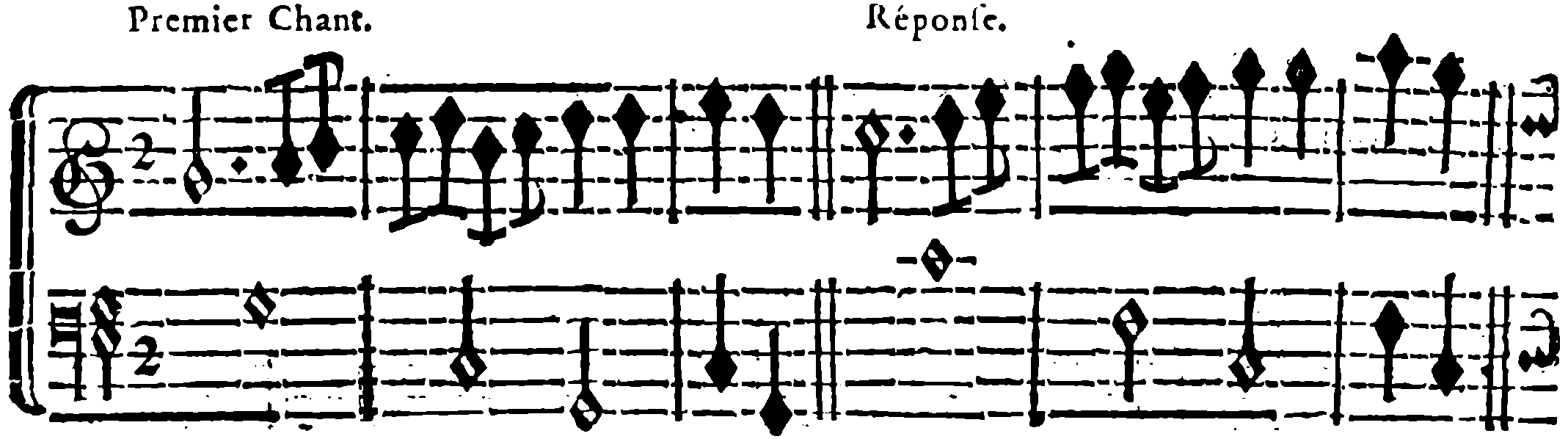
3. Diatonic motion from tonic to dominant and back, upward or downward, contains one more or one fewer note. Especially within the subject, either of two adjacent notes in the longer progression may therefore correspond to the unavoidable note of the shorter one. For example, descending from tonic to dominant, I can use only the sixth and seventh between them; descending from dominant to tonic, I can use the fourth, third, and second. Of these last three I should choose those nearest the ending tonic so the melody resembles the first as closely as possible. Conversely, if I began with the progression containing more notes, I adapt the shorter one to it, always seeking correspondence toward the end rather than the beginning. An example will make this clearer.
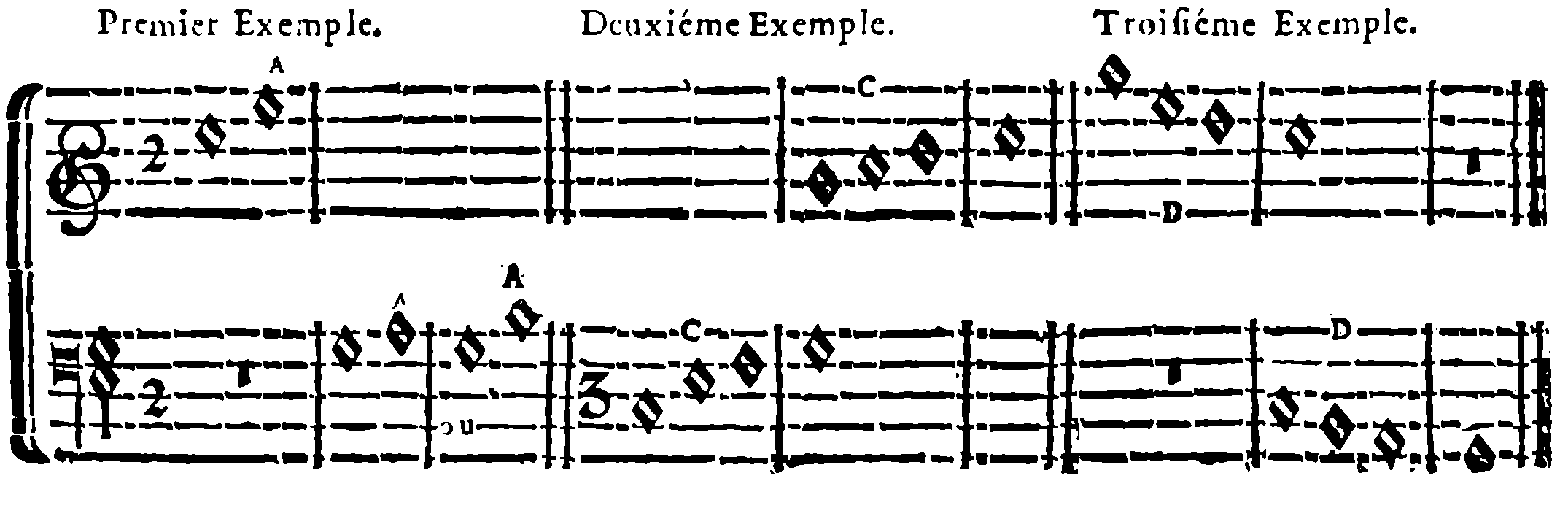
In the first example, the sixth or seventh note answers the mediant at A.
In the second, the sixth answers the mediant at C.
In the third, the seventh answers the mediant at D.
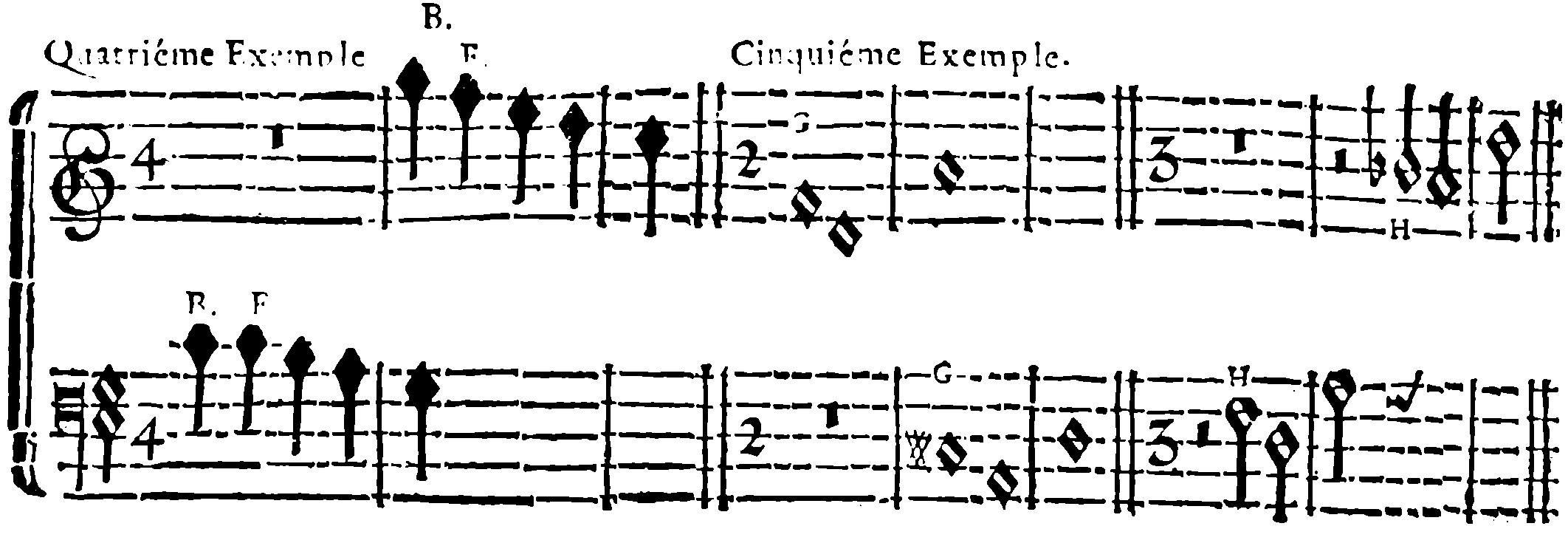
In the fourth, the dominant at B or fourth note at F answers the tonic at B and F.
In the fifth, the mediant answers the seventh at G or sixth at H.
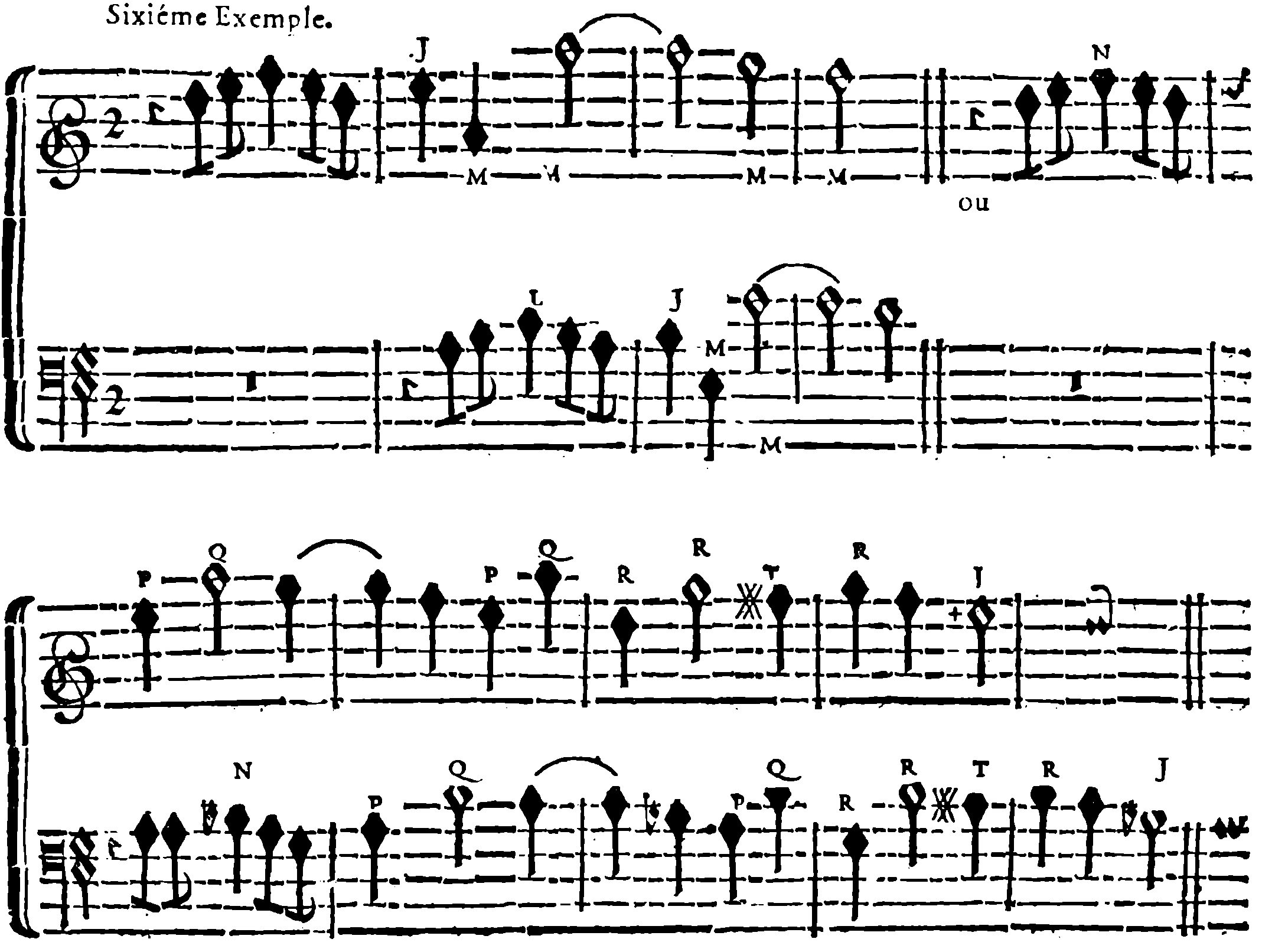
In the sixth, the mediant answers the seventh at L or sixth at N; the second answers the sixth at J or dominant at P; the dominant answers the second at M or tonic at Q; and the tonic answers the fourth at R.
Much must be observed to avoid error in this free choice among the five notes from tonic up to dominant, when forming a melody corresponding to one heard among the four notes from dominant up to tonic. Whether the fugue ascends or descends, there are always five notes on one side and four on the other. Sometimes one must even borrow the second or fourth note to obtain five notes from dominant up to tonic, or equivalently tonic down to dominant. Writers on fugue have neglected these observations; it is therefore appropriate to state what experience teaches us.
1. The dominant must always answer the tonic, and vice versa, at the fugue’s first and last notes. Only within the melody may this rule be broken, substituting the fourth for the dominant and the second for the tonic to obtain a closer melodic correspondence. There are then only four degrees from the second up to the dominant or the fourth down to the tonic, allowing a melody close to that within the four degrees from dominant up to tonic or tonic down to dominant. The same borrowing gives five degrees from second down to dominant or fourth up to tonic, corresponding to the five from dominant down to tonic or tonic up to dominant. We say “close” because an exact match is impossible owing to each mode’s diatonic degrees, whose notes may not be altered by any new sharp or flat. Minor keys are excepted: add a flat to the descending sixth and a sharp to the ascending leading note. Sometimes a sharp may also be added to the mediant of minor keys and the fourth of any key when answering the leading note, as at T in the sixth example, provided these notes form a major third or major sixth with the bass.
Do not invent a melody for a fugue without simultaneously imagining its bass and answer, for variety arises from that answer. Afterward one is free to begin either with the invented melody or with its answer.
3. Once the fugue’s bass is found, seek the two or three other parts that could accompany the melody and bass. Notice that this bass and the other parts will follow approximately the same progression with the invented melody and its answer. If well imitated, the bass will bear the same chords in both. These bass and accompanying parts thus provide a means of sounding several fugues together or composing another kind called canon, discussed later.
4. A fugue melody may admit several basses, and may itself suit the bass better than any other part. This makes no difference, since inversion offers several ways of composing a bass or using a melody as bass that would better suit an upper part. Alternating these different accompaniments of an upper or bass part is especially pleasing in fugue, where variety can be felt only in the accompanying parts. Our statement that a fugue’s bass could remain approximately the same and should then bear the same chords was only intended to clarify how its melody should be imitated; the correspondence of chords alone suffices as proof.
5. To choose notes within the span from tonic up to dominant or dominant down to tonic, keep the tonic and dominant as guiding principles, since the fugue usually ends on them. Yet they must not prevent matching the answer’s intervals to the invented subject, especially internally. A third, fourth, fifth, sixth, or seventh within the first melody should be answered by the same interval at the corresponding place. This rule is not universal: yield to diatonic progression or the mode’s principal notes, giving greater weight to what follows than what precedes, and to the tonic or dominant usually opening and closing the subject than to exact interval matching. A fourth must therefore often answer a fifth, and vice versa. Moreover, if one or more diatonic intervals follow a consonant one, locate the tonic so the diatonic progression from the consonant interval’s final note to that tonic may be regularly imitated toward the dominant. If the progression leads to the dominant, imitate it toward the tonic, especially when it ends in a cadence. The fugue’s final cadence must always fall on tonic and dominant, although an internal cadence may substitute the fourth for the dominant and sometimes the second for the tonic.
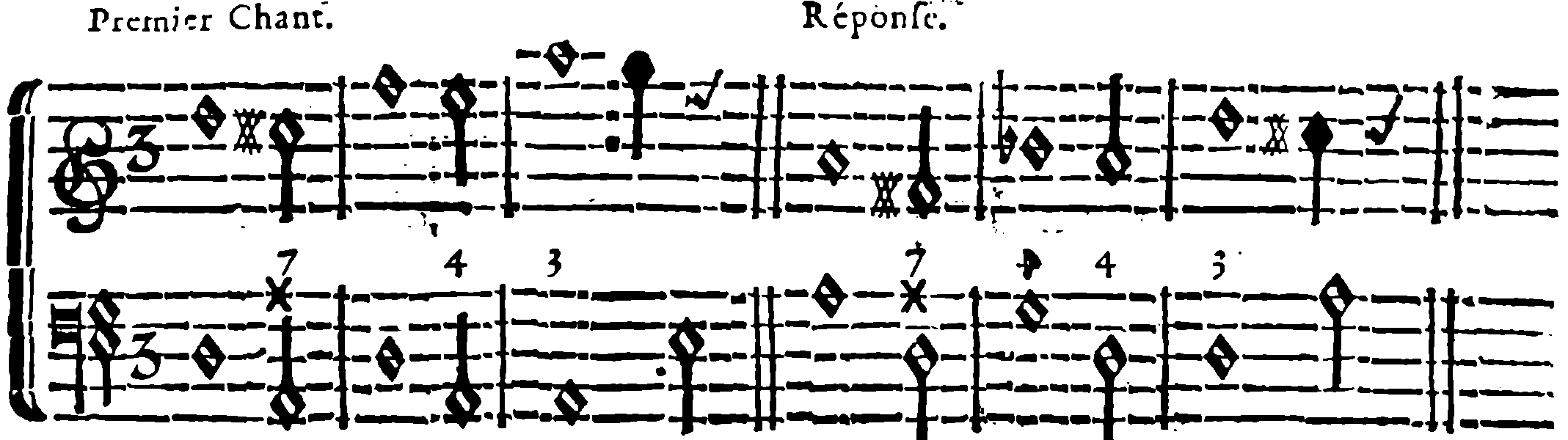
Fugues rarely begin or end except on tonic, dominant, or mediant. The mediant must then be answered by the sixth or seventh, as in the fifth preceding example. Attend to what follows rather than what precedes, and to the correspondence of chords above the bass used for subject and answer, and mistakes will be unlikely.
Example
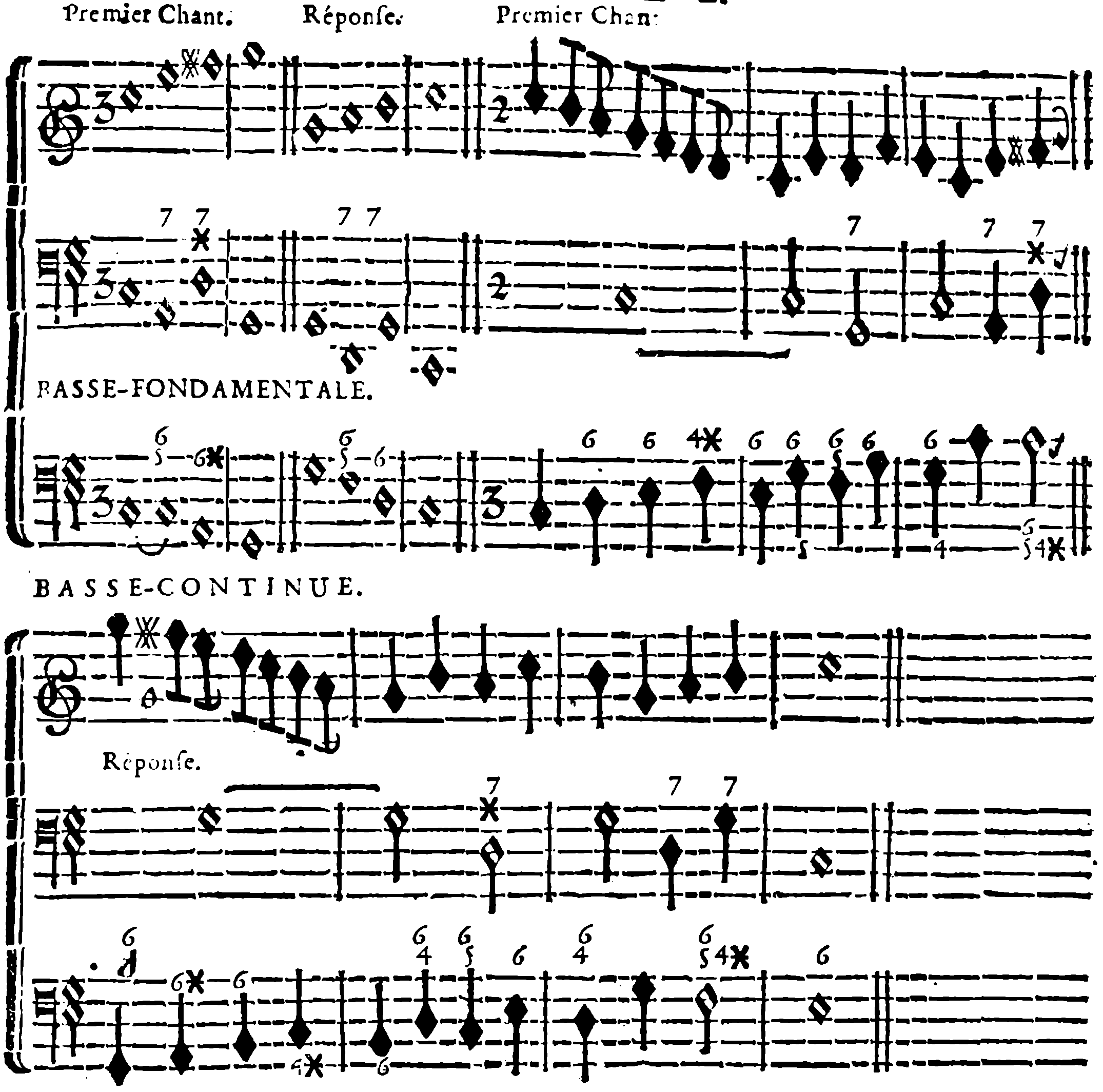
This continuo bass is included to show that any imagined bass beneath a proposed melody may display the same correspondence by always bearing the same chords. The fundamental bass is nevertheless better for this purpose.
6. A fugue melody must contain at least half a measure. If longer than four measures, its answer must be able to begin during the fourth. Even then the tempo must be somewhat lively for so long a melody without harmony to please.
7. The fugue may begin on any beat but should naturally end on the first; the third beat of a four-beat measure can stand for the first. An ending on another beat ordinarily follows a feminine rhyme, whether actual words are set, such a rhyme is imagined in the melody, or fancy dictates it. Novelty sometimes requires breaking rules based only on taste, such as these. The surprise of fugues ending contrary to the rule can please when handled with judgment and discretion. They may then end on notes other than tonic and dominant.
Examples
8. Imitate the fugue melody in every respect as far as possible. The same number of whole notes, half notes, and so forth within a given beat must occur wherever the fugue is heard.
9. Each part may enter at the first part’s unison or octave, but successive entries at the fifth or fourth are still more pleasing. Any part may begin or repeat the fugue throughout the piece. To change key, observe each subject note’s rank in the present key and take the corresponding rank in the new one. Change neither each note’s relation to the tonic, nor the kinds and quantities of notes, nor the beats on which the fugue begins and ends.
10. Each part may wait until the entire fugue melody ends before entering. Some designs, however, allow entries midway through them, with very good effect, provided nothing else changes as just stated. The sixth example demonstrates this.
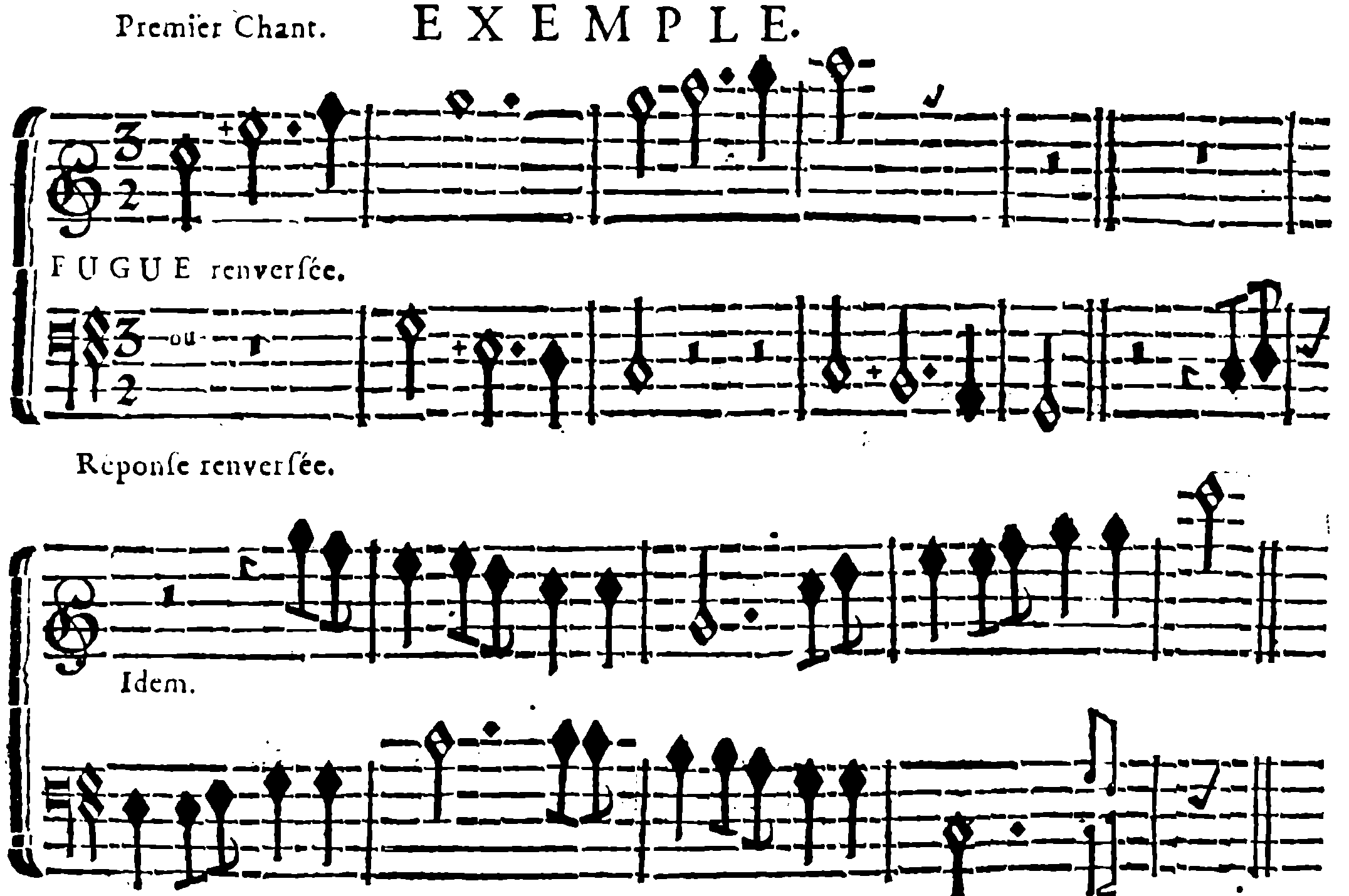
11. Inversion, the key to all harmonic variety, adds further graces to fugue. Invert a design so that ascending intervals descend and descending ones ascend, changing nothing else, as stated in Article IX.
12. Several different fugues may sound together or successively. As far as possible, they should not always begin on the same beat or in the same measure, especially at their first appearances. Their progressions should be opposite and their characters distinct: if one uses whole notes, the other may use halves, quarters, and so on, at the composer’s discretion. If they cannot be heard together in full, at least part of one should sound with part of another. An example will clarify this.
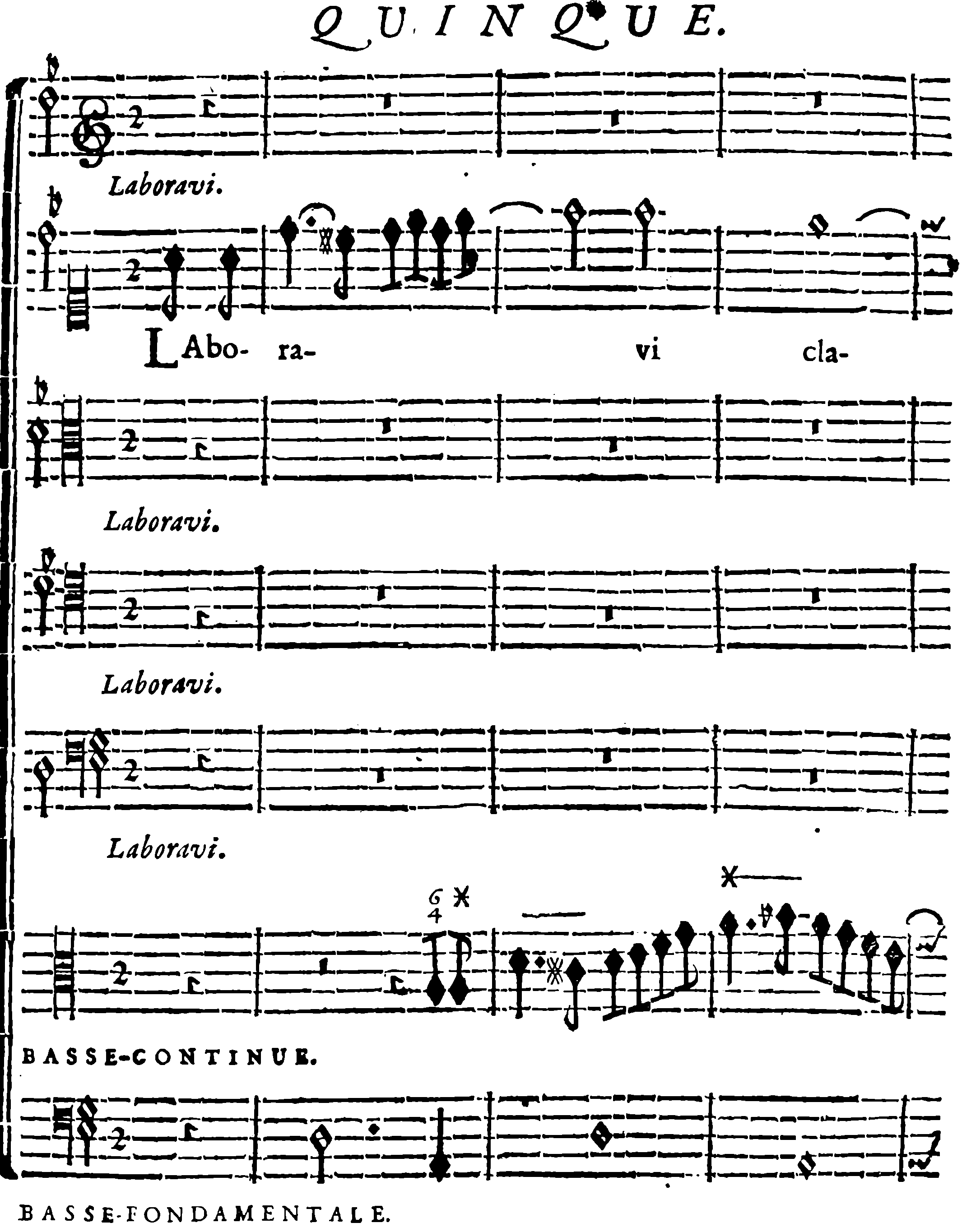
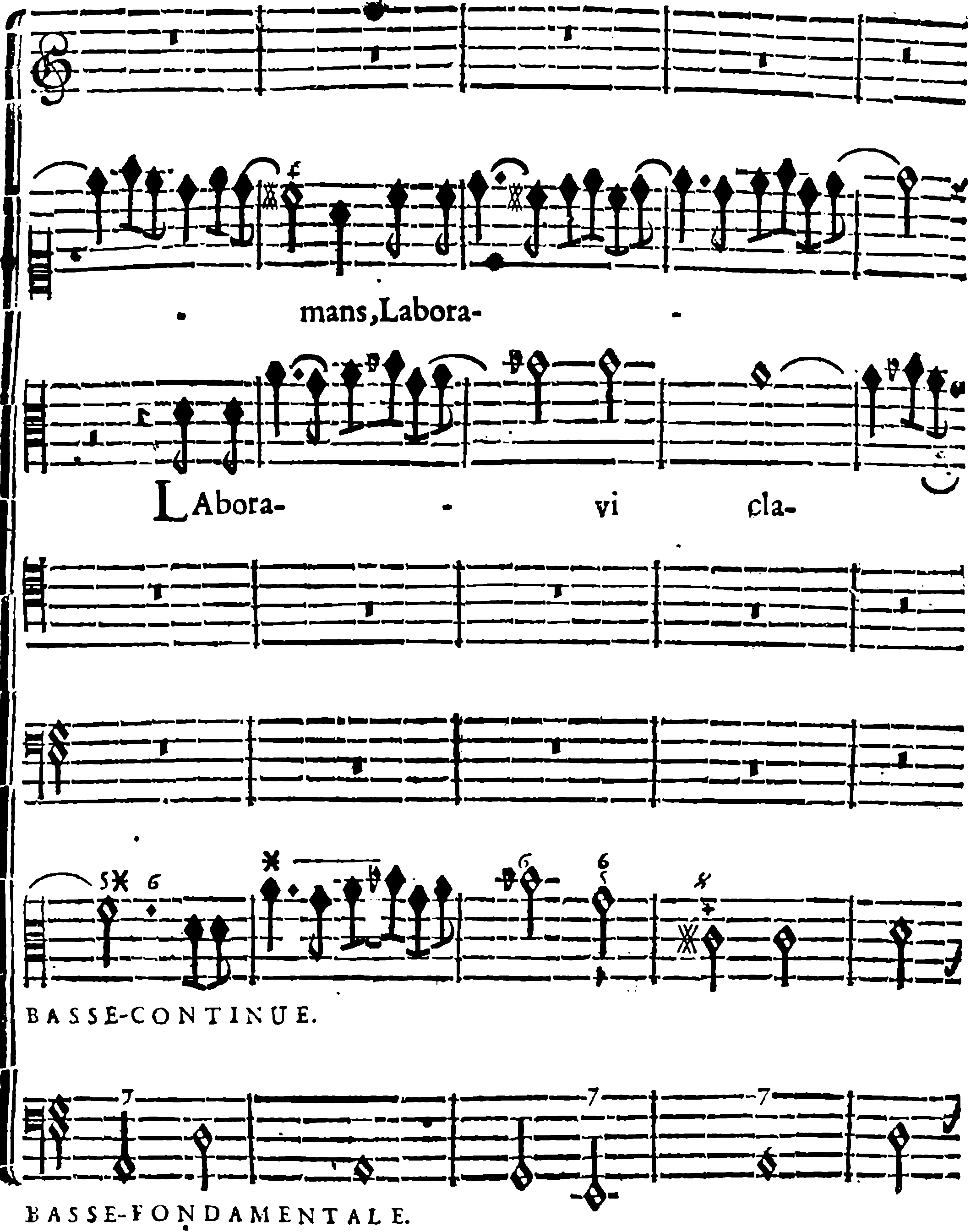
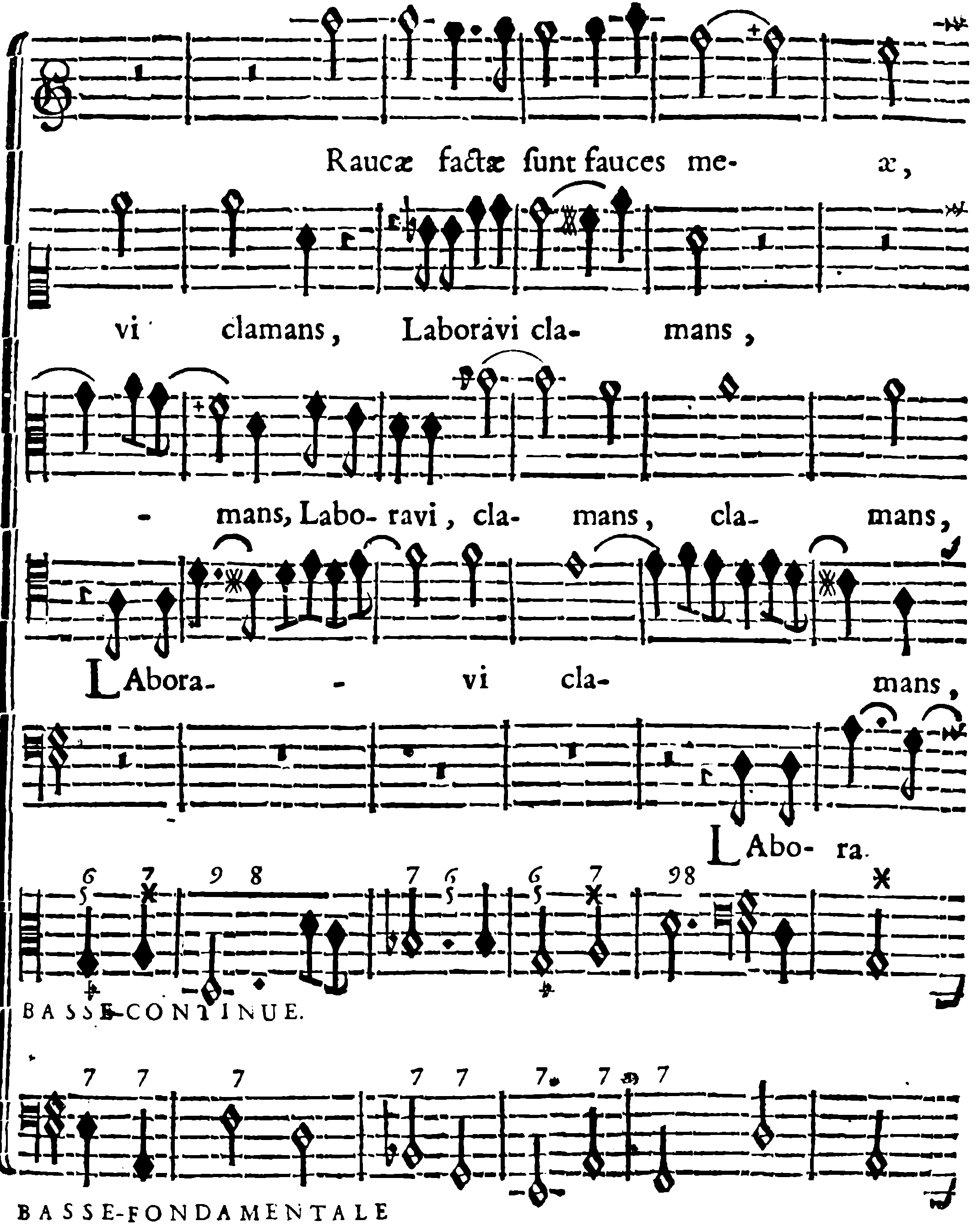
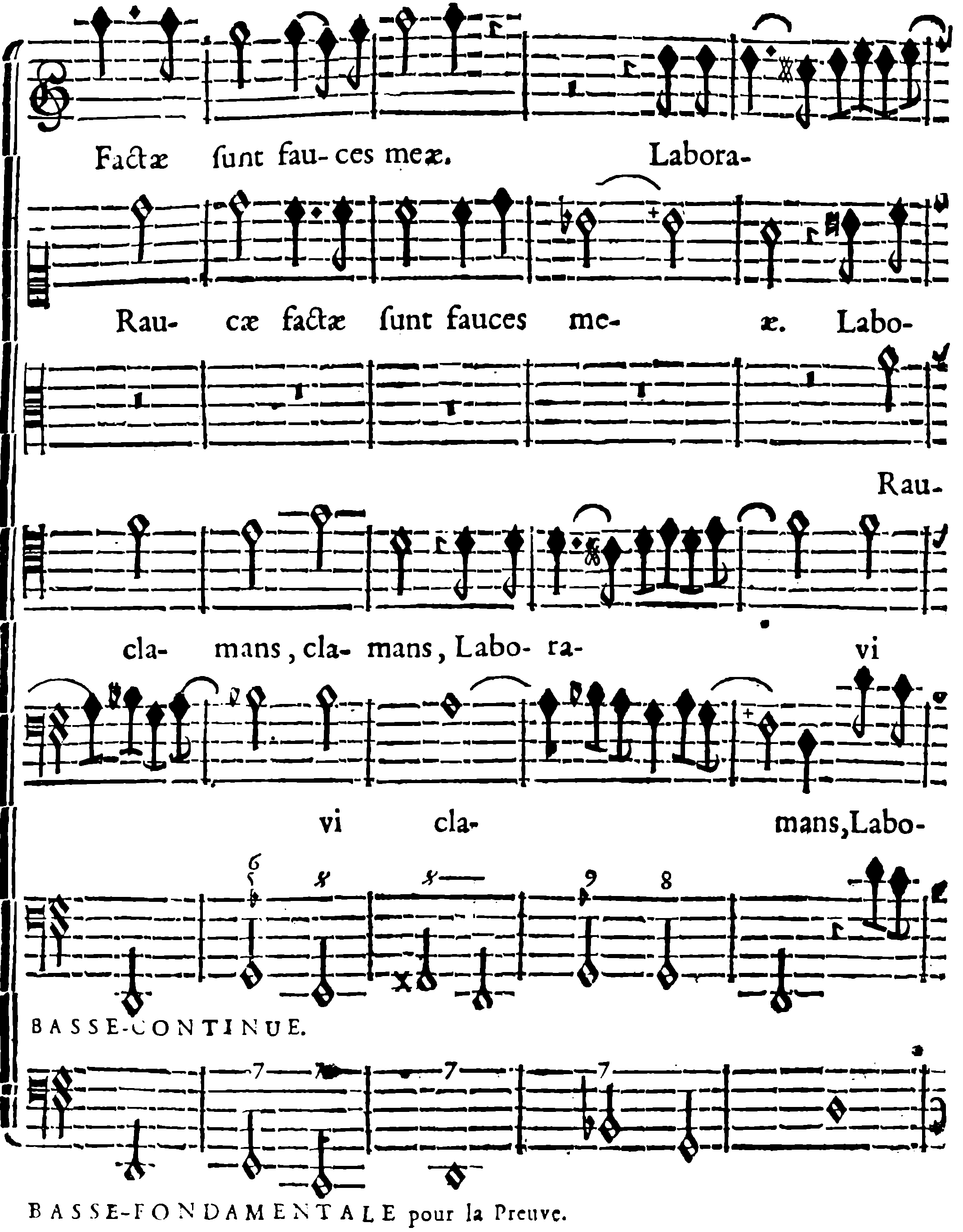
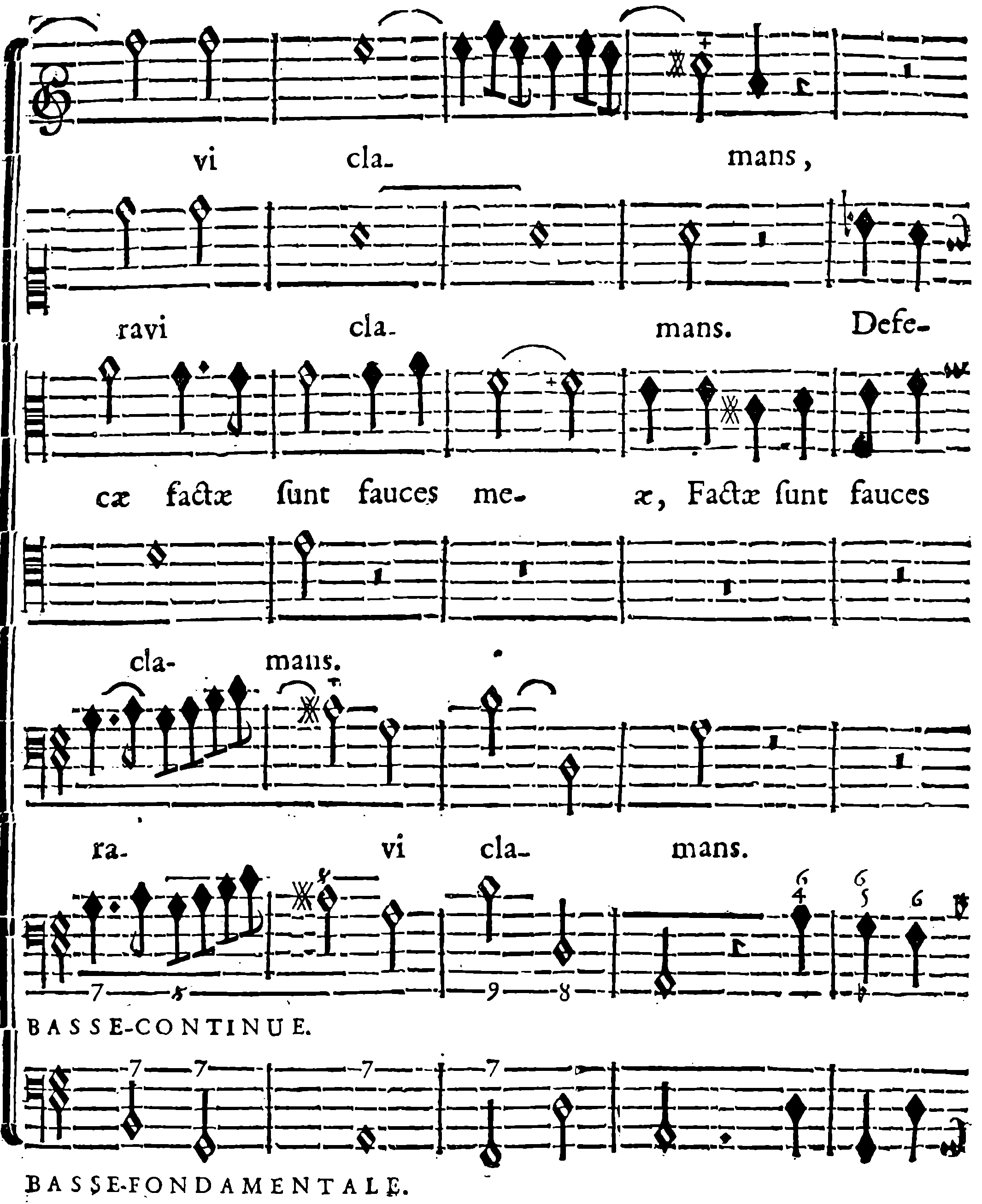
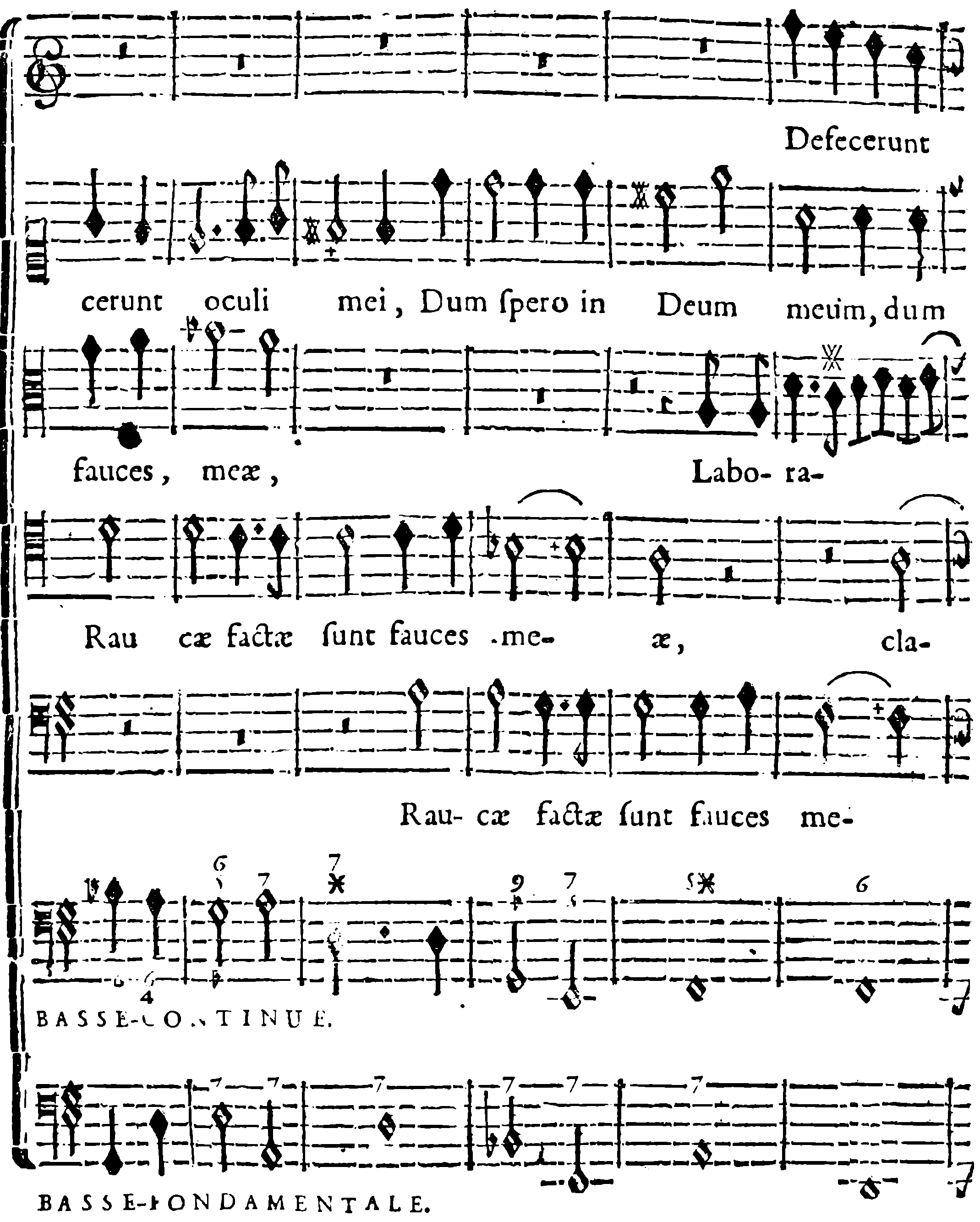
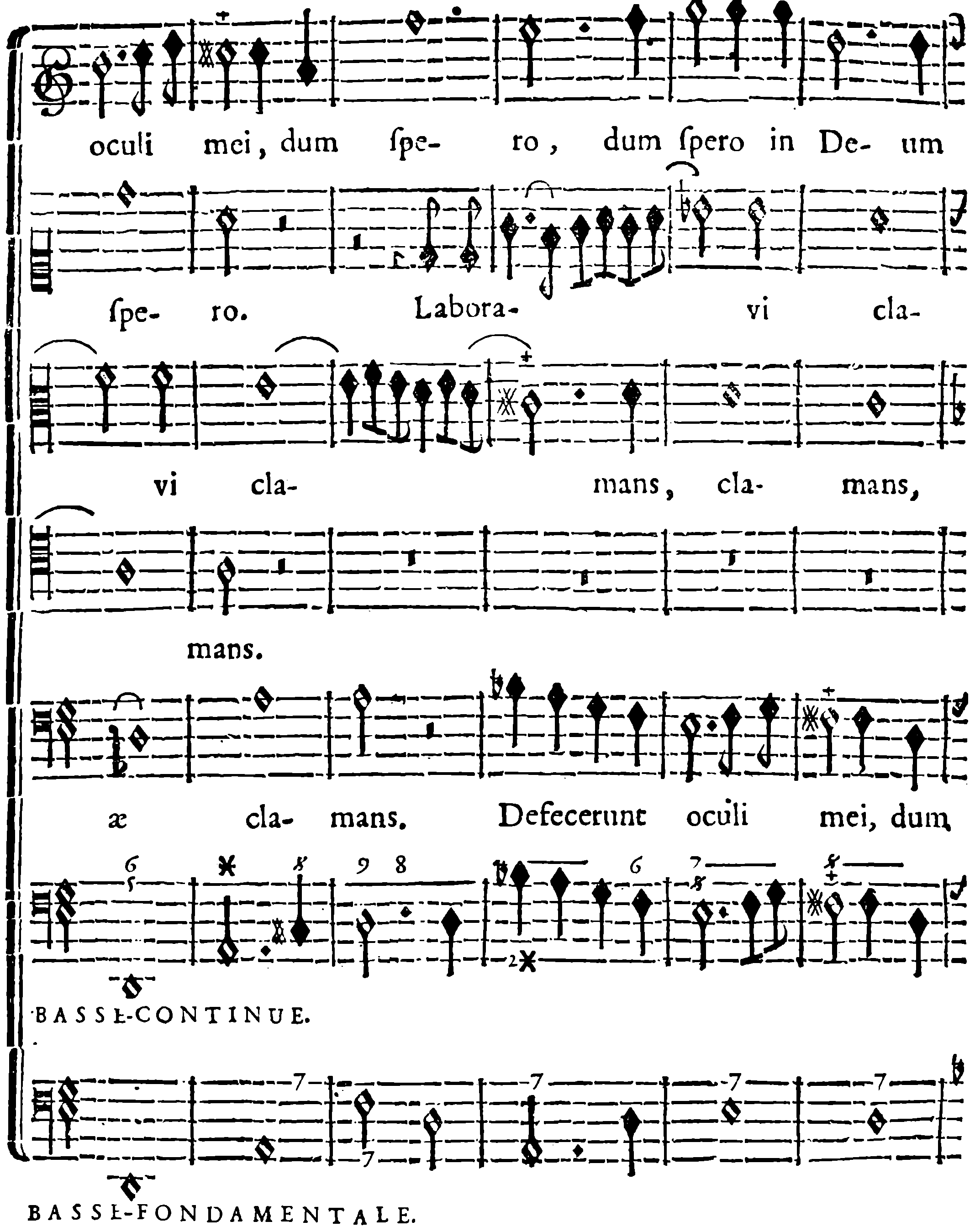
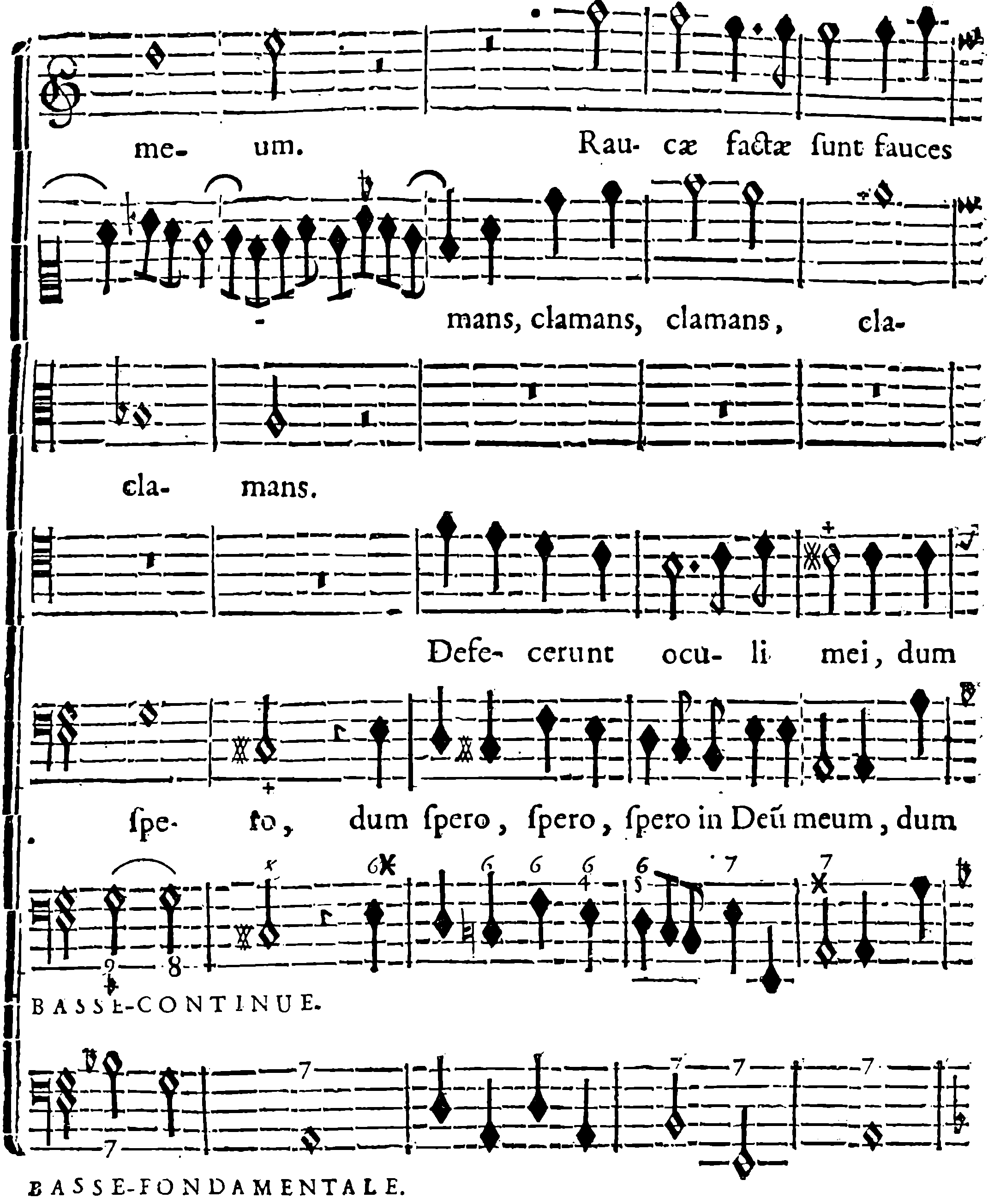
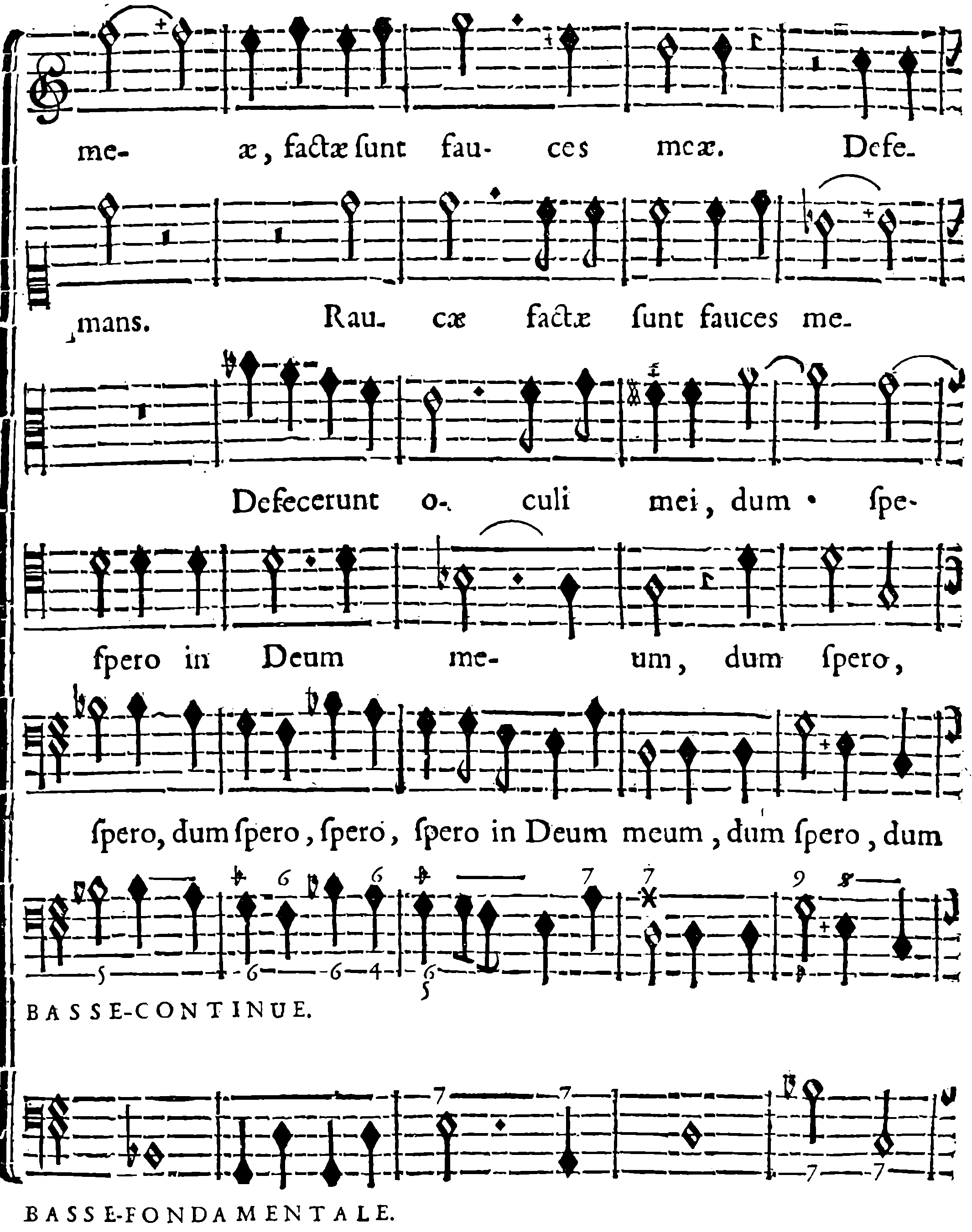
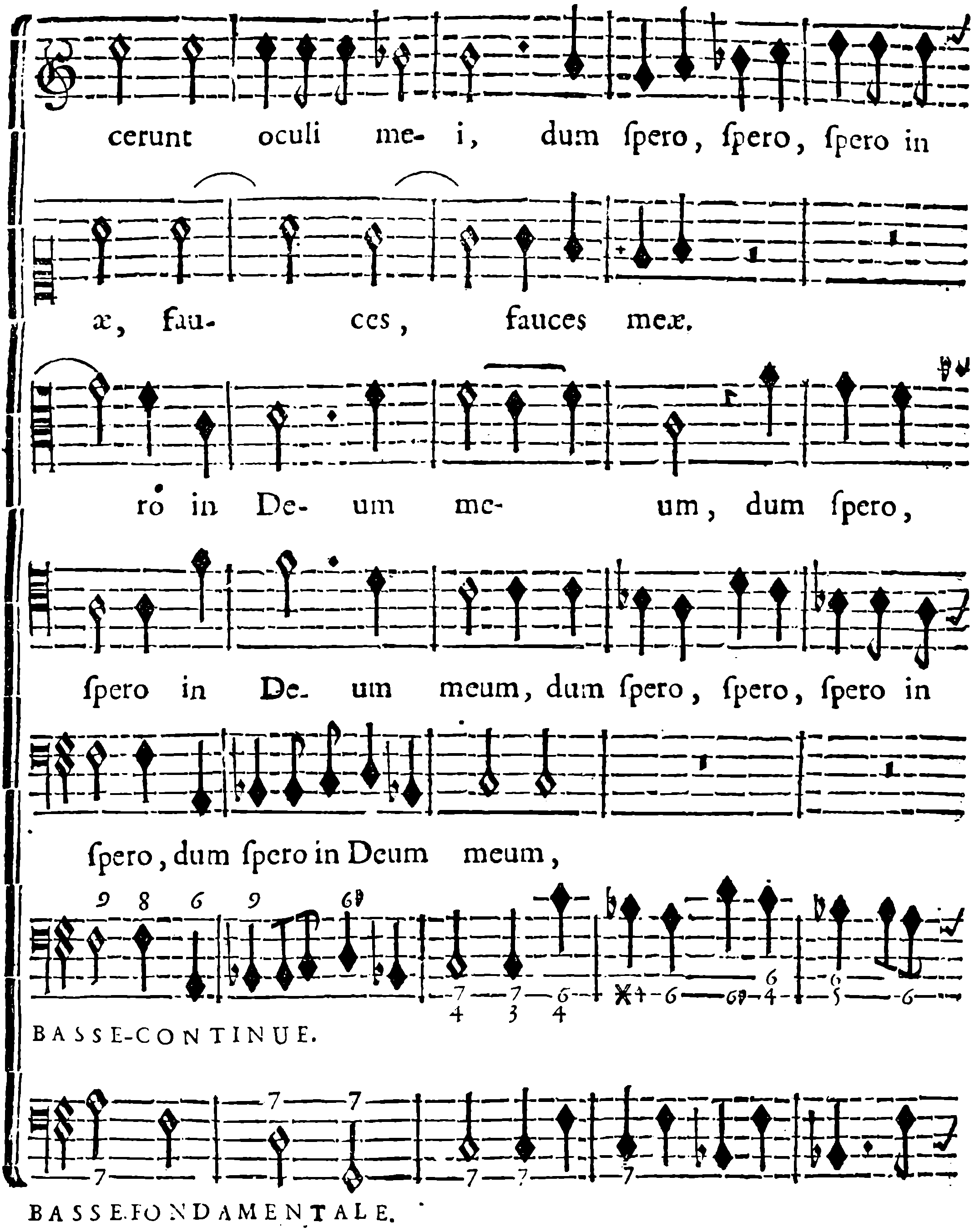
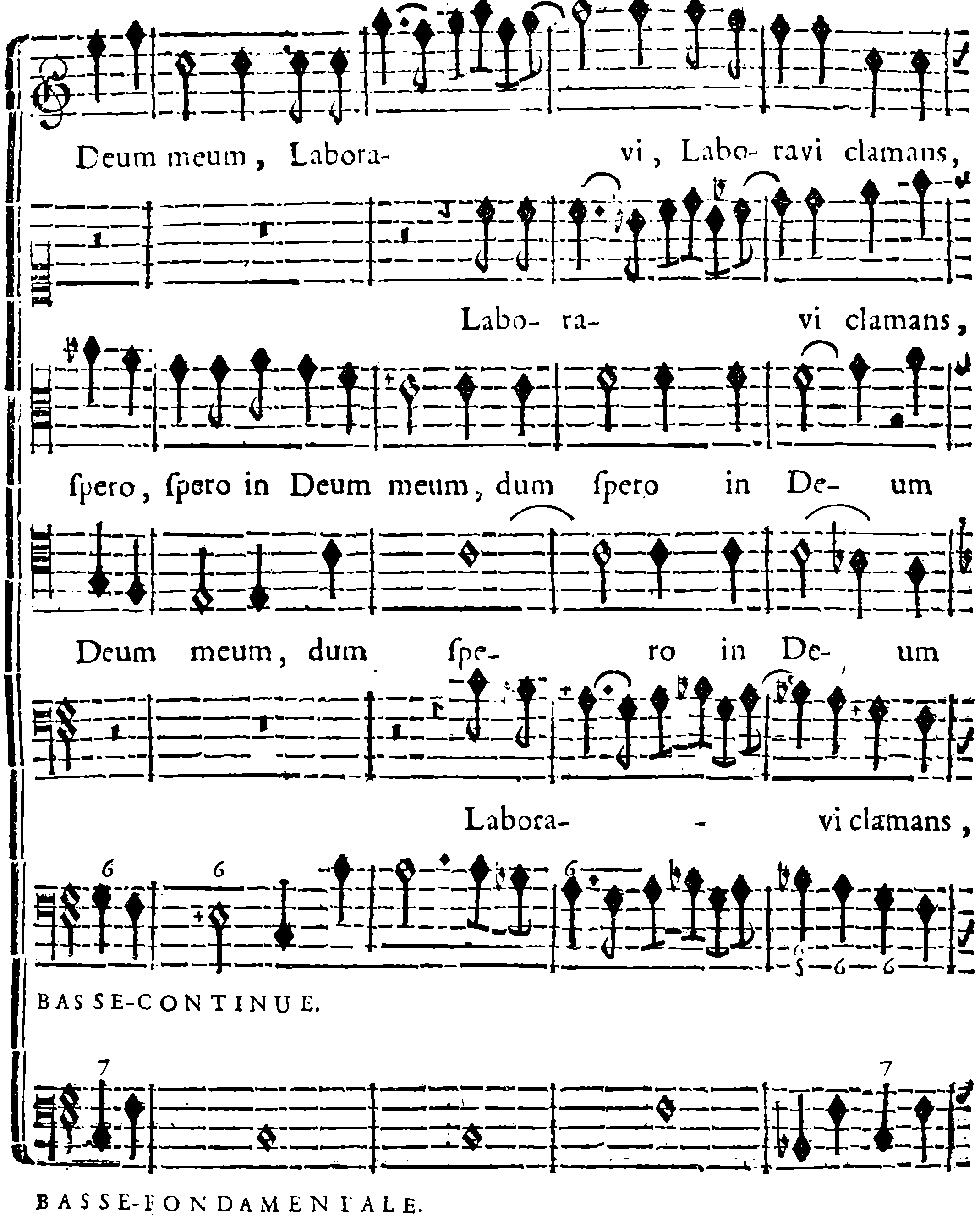
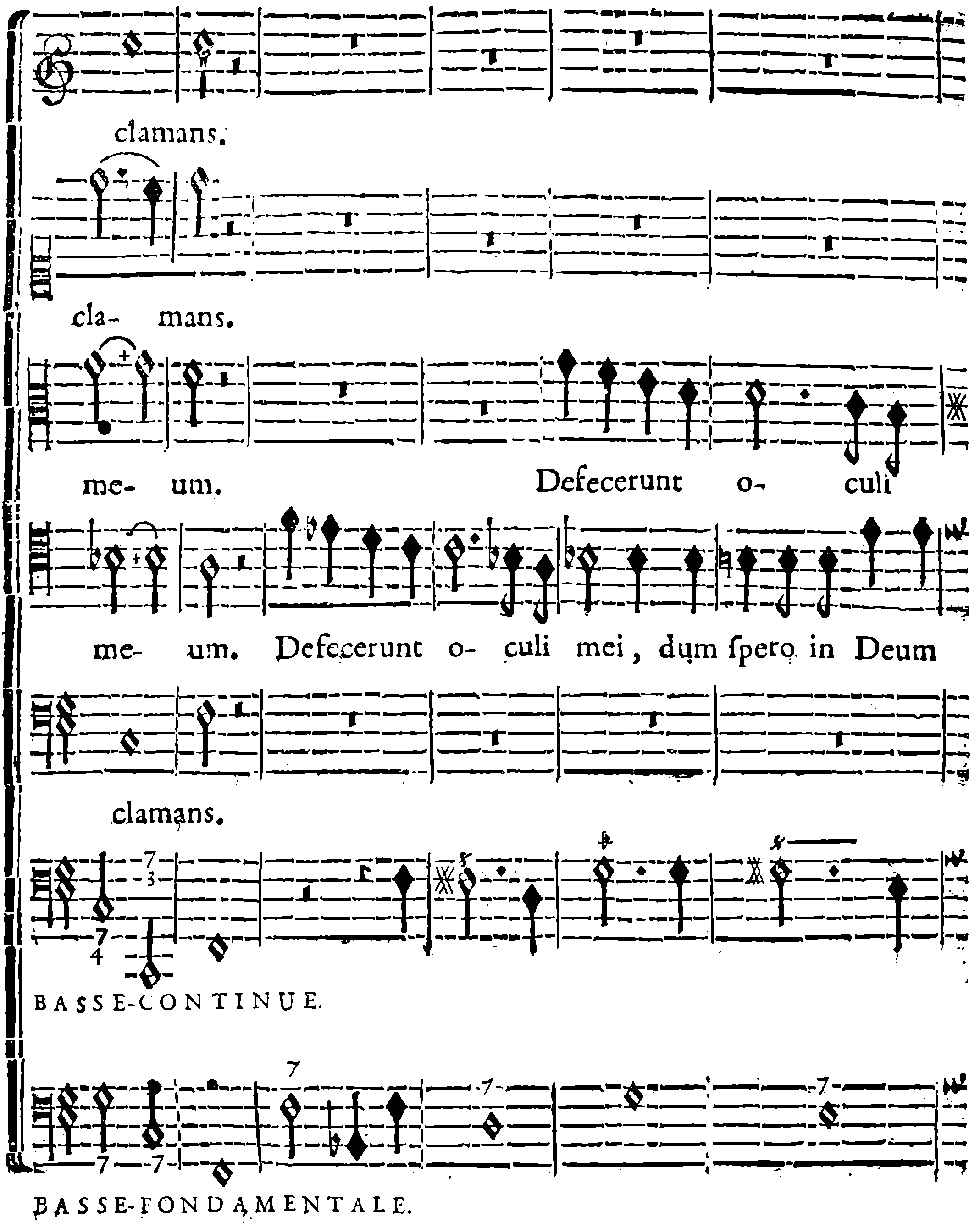
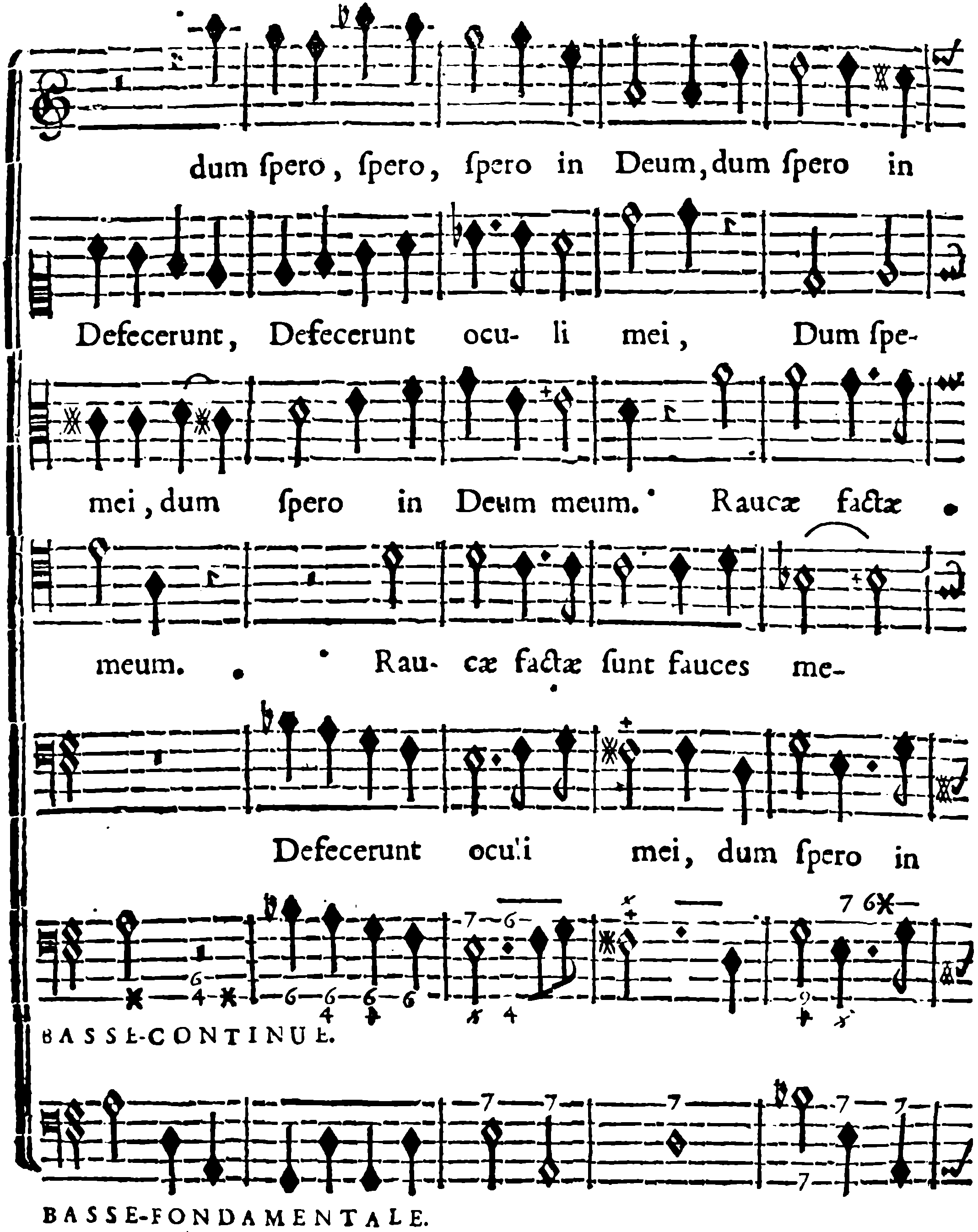
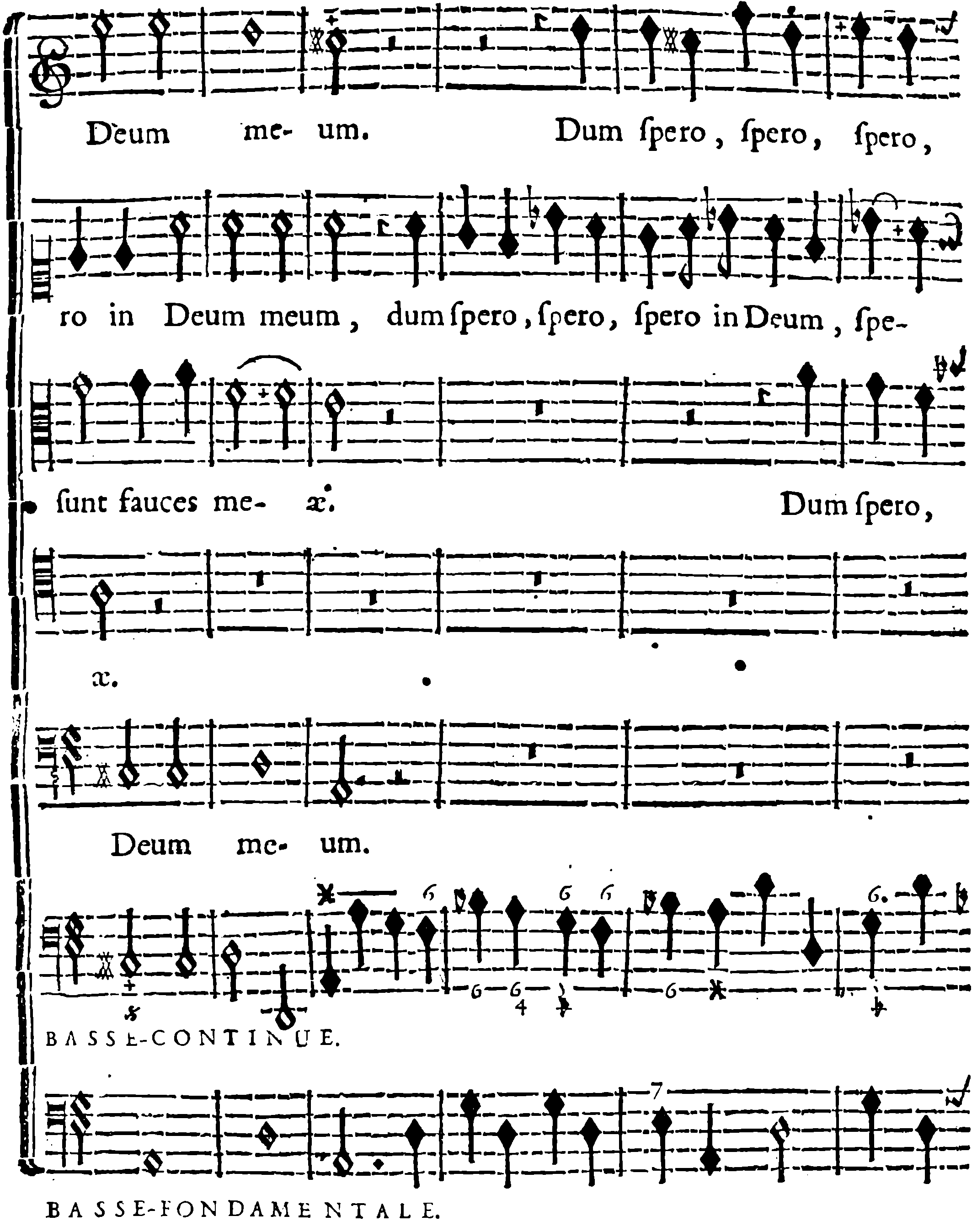
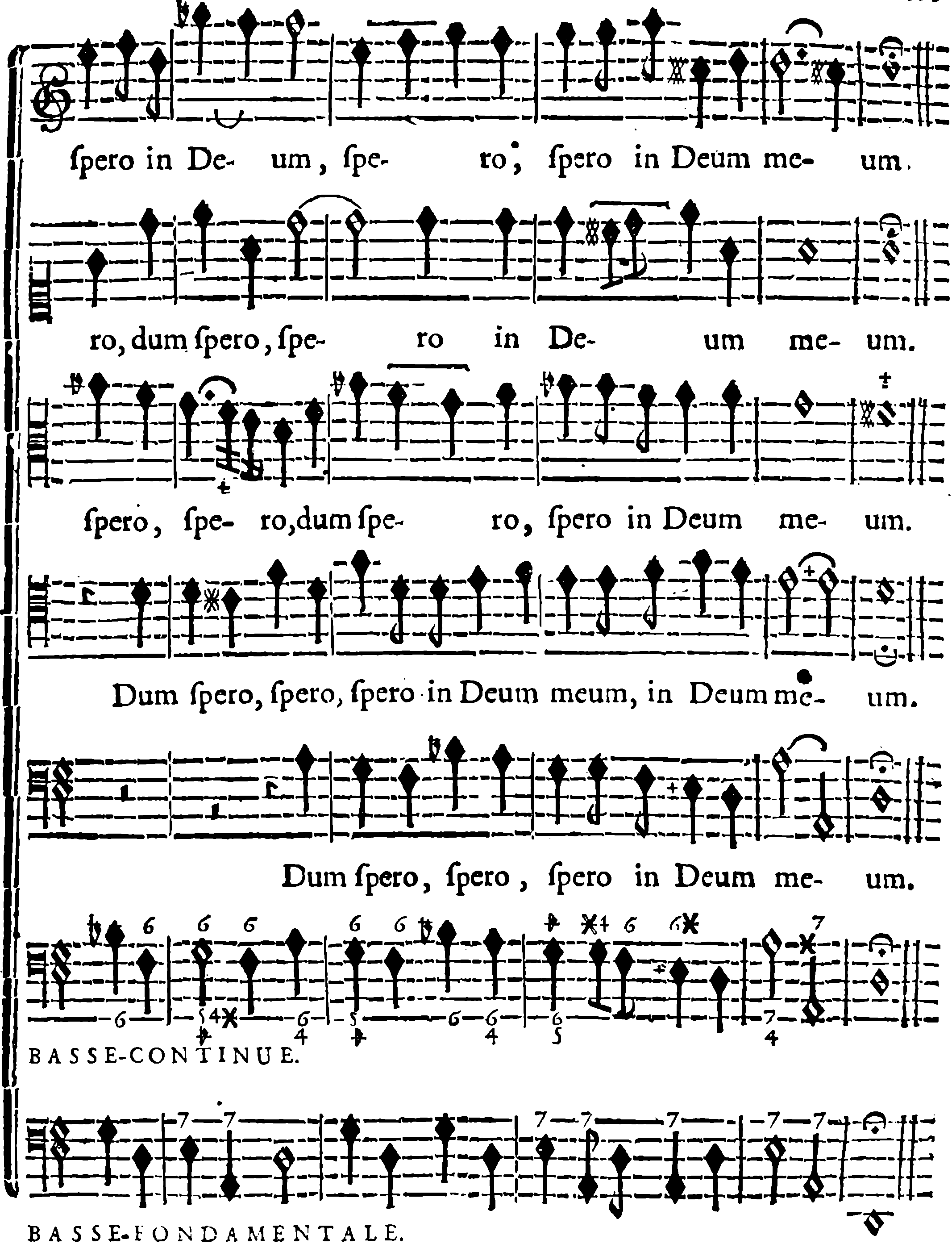
This example contains four different fugues, and scarcely any music has more at once. Often one or two suffice; they may also be inverted, contributing considerably to the work’s perfection.
The fugue on “Raucæ factæ sunt,” whose answer to the dominant ends almost everywhere on the second note, would be more perfect if it ended on the tonic, as when the bass sings it. Yet this second note substituted for the tonic is tolerable, especially when other fugues beginning or ending with it can agree only with that second note. Chord succession or even good taste sometimes leads us to interrupt the fugue’s true melody. This often reflects the composer’s skill in introducing variety, but should be allowed only after the subject’s entries have been heard sufficiently.
Remember the freedom to pass several notes between beats for melodic taste. To distinguish them, examine the fundamental bass, which then forms no harmony with those notes.
The fundamental bass is joined to the other parts only to prove that the entire piece contains perfect or seventh chords alone, and that everything derives from the rules established on those two chords. Do not therefore judge its consonant and dissonant order or progression against the rest; consider only chord foundations. The order and progression are observed only among the five upper parts and continuo. The fundamental bass supplies the chord foundations and nearly all the different progressions from which our rules were drawn. The other parts form only its octave, fifth, third, or seventh, except in irregular cadences and chords by supposition or borrowing, as sufficiently explained in Book II.
As many fugues may be found as there are different melodies; their number cannot be exhausted. Leave the choice to good taste while observing the rules already given for beginning, ending, and answer. When several fugues sound together, one must always guide us, and any may be chosen. Thus, if a fugue melody pleases, add three or four parts and find the new fugues within them. But different fugues beginning and ending together with identical numbers and values of notes become insipid, seeming merely accompaniments to one another. Avoid this by remembering the rules preceding the last example. Prose words, almost never equal in quantity, naturally lead to the variety we should always seek. Equally measured verse requires care: begin or end one fugue before or after another, and insert runs where possible for further variety, but without confusion. Each entry must be distinct, none obscuring another. Let a part rest appropriately before taking up a fugue, and allow this silence only on a consonance. At its first appearance, a fugue must not continue the preceding melody directly, although that can work successfully after it has been heard at least once in every part.
All entries of the first fugue may be heard before any others appear; then introduce the second, third, and so on, mingling earlier fugues with new ones. Or present each independently and combine them afterward. Simultaneous first entries of different fugues in different parts risk confusion: one design often makes the other forgotten, though listeners must retain both. Distinct designs, opposing motion, entries in different “tones” of the measure, and so forth make each perceptible. Often one part sings two successive fugues that initially seem one and later divide into two, another very pleasing effect. The second part taking them up should then enter precisely where they may divide, although the entry may be advanced or delayed by several beats or even more than a measure.
The same number of quarter rests or measures observed by the first part answering a fugue must be observed by those following it. If the first answering part waits one measure after its predecessor, for example, every later part must wait the same interval after the immediately preceding one. Yet this rule may sometimes be broken, especially after the subject has sounded in every part. We believe the third entering part may be advanced or delayed by one measure, but not a quarter or half measure, nor more than one measure. If the second part waited two measures, the third may wait one or three after it; likewise for later parts repeating at the third part’s unison or octave after their immediate predecessor. Since dominant answers tonic, second answers sixth, and so forth, what agrees on one side after one or two measures may fail on the other after the same interval. Restricting a composer to the original limits would unduly constrain invention. Whoever denies this will encounter a thousand designs, perhaps none able to bear that restriction.*
When all parts stop together to give a new fugue greater clarity, the melody must never seem completely finished. As far as possible, always make listeners desire what is being prepared for them. Such silence should therefore occur only at interrupted or irregular cadences; if the cadence is perfect, it must at least be in a key foreign to the current one, as we have observed wherever such silences occur.
Fugue is a musical ornament grounded only in good taste. Even the general rules just given cannot guarantee complete success. Different feelings and events expressible in music continually create novelties that cannot be reduced to rules. Perfect knowledge of harmony reveals all possible paths, but taste chooses among them. That taste requires experience acquired only through repeatedly seeing and hearing the works of the most skilled composers in this genre.
* On this subject, see the fugues on “Raucæ factæ sunt” and “Defecerunt oculi mei” in the preceding example.
Another kind of fugue is called perpetual fugue, or canon. It consists of an entire air whose melody all the parts must repeat with strict regularity.
The commonest canons are at the unison or octave, according to the range of voices or instruments. Compose a melody as desired and add as many parts as wanted. Then combine all these parts into a single air, making each part’s melody follow the other agreeably. One part begins this air; another follows immediately when the first has just finished the originally composed melody. Each part thus follows in turn. On reaching the end, the first begins again and the others follow as before, provided each entered at the proper time. See the example alongside.
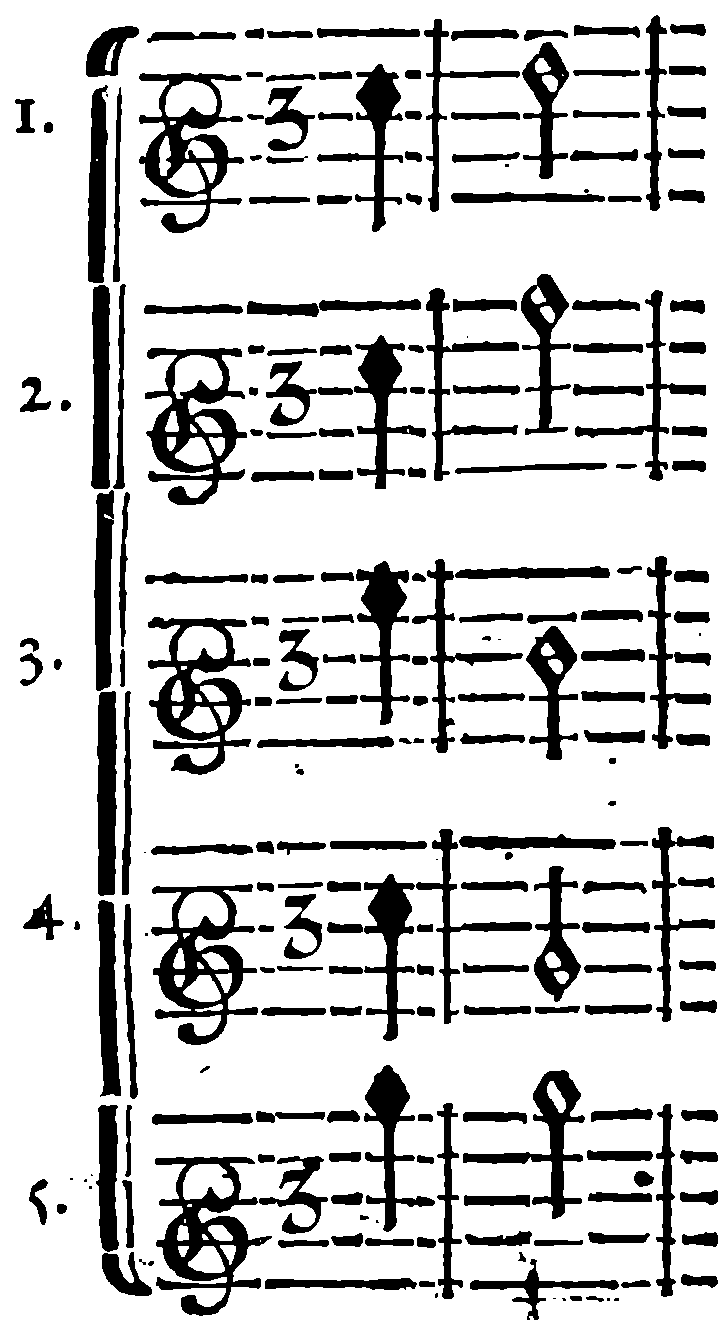
Suppose one of the melodies in these five parts has been invented; the others are easily added. Then form from them as flowing an air as taste can dictate. This is the whole difficulty of the canon, whose air follows.
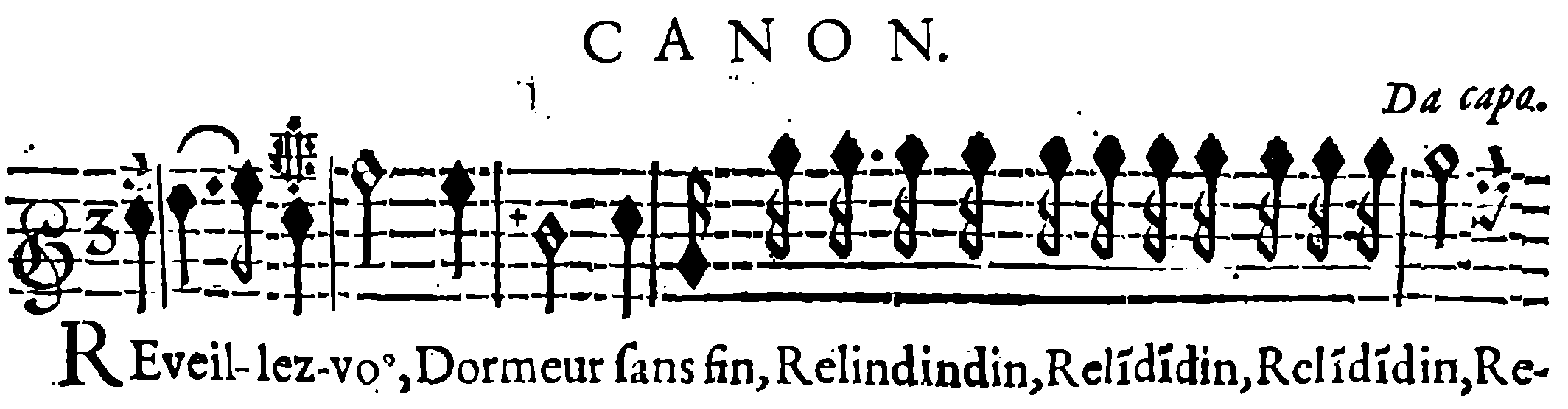
Each of the five parts’ melodies is easily recognized in this canon, to which we added a few small notes for melodic taste. Each part must begin the air successively when its predecessor reaches the note or beat marked thus: [repeat sign].
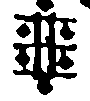
This canon may continue as long as desired, since the first part may begin again on reaching the end, as shown, and the others follow in the same way.
Perpetual fugue may also be taken at the fifth or fourth, each part sounding the same melody. Here the entire air must be conceived, adding sharps or flats as needed to notes whose natural degrees would prevent the answering parts from matching the original melody exactly. Consider melody alone, without regard to modulation. This greatly increases the difficulty, since each new entry begins in a new key a fifth away for a canon at the fifth or a fourth away for one at the fourth. Although the preceding canon has no limit on its number of parts, we do not believe more than four can be used here; indeed, none of this kind in four parts has yet appeared.
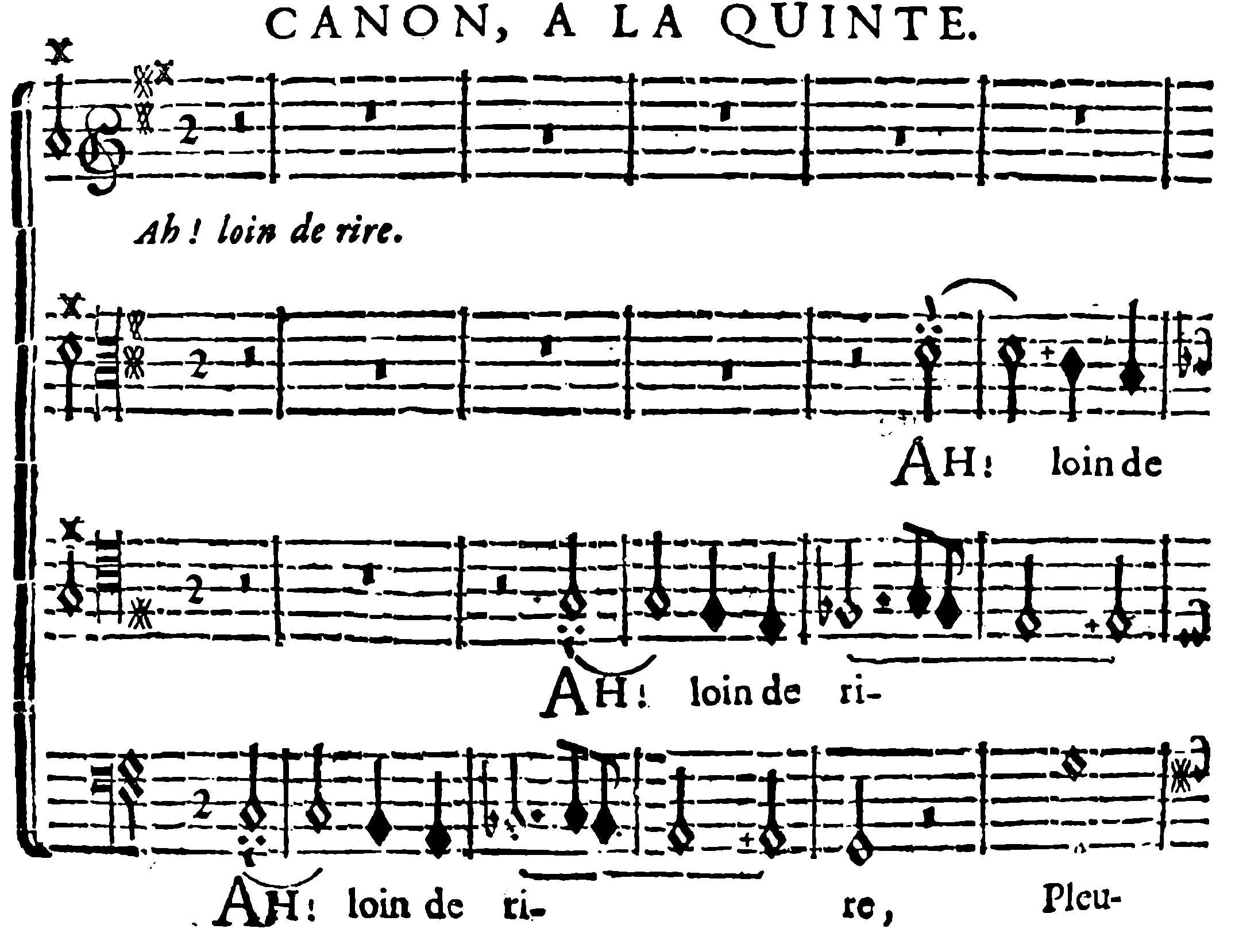
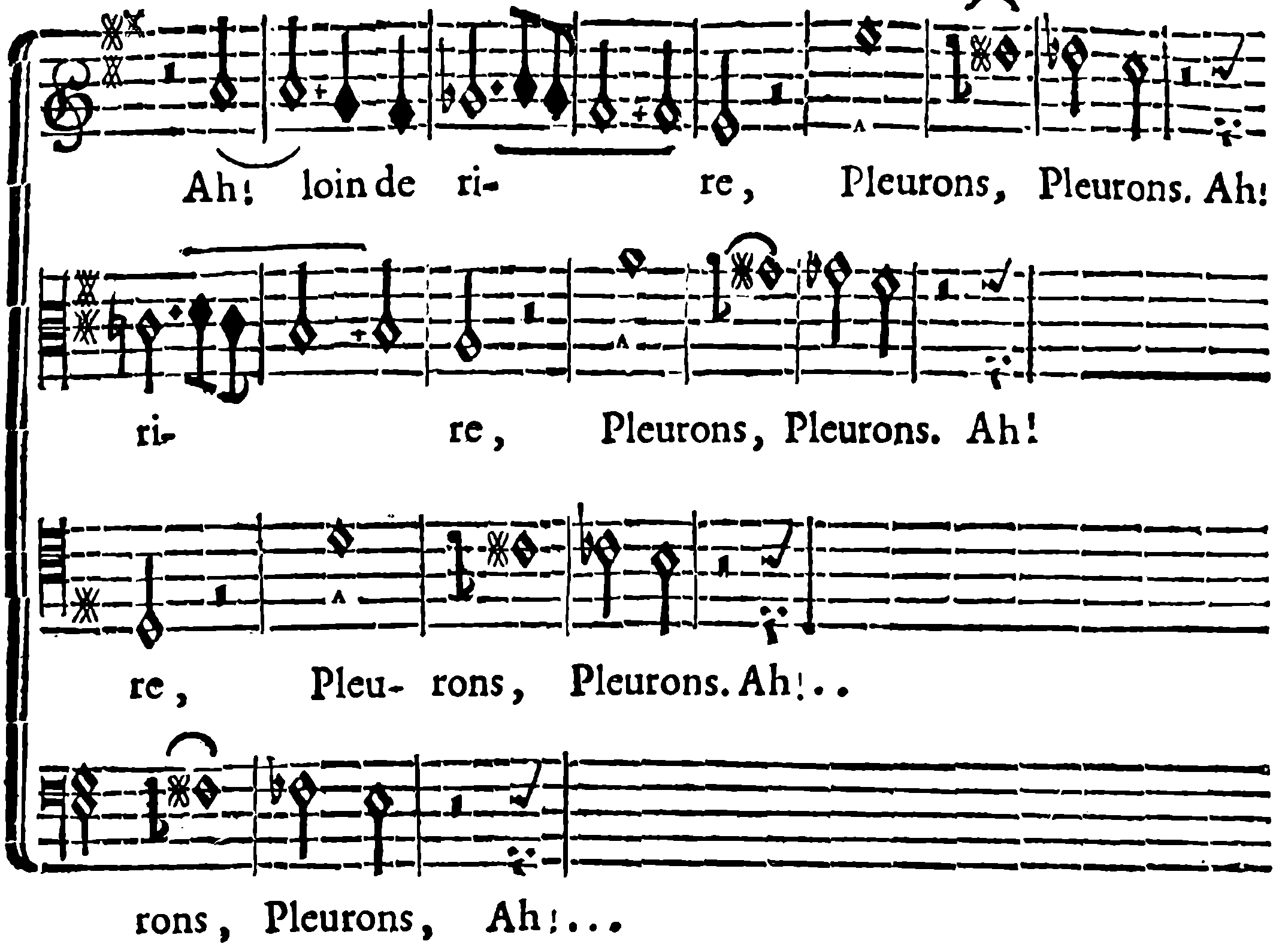
If the voice cannot make the octave at A, simply take the unison of the preceding note.
A canon “at the fifth” means a fifth above. Thus a fifth above and a fourth below are equivalent, and this should be allowed especially to accommodate vocal ranges.
We have written the four parts together because the result would otherwise be difficult to judge, though it would suffice to say that each enters a fifth above its predecessor after two complete measures. Although the cue signs [cue sign] showing where to restart are not on the line leading back to the place marked [repeat sign], continue at the pitch indicated by the cue sign. Imagine a new clef, or rather imagine that the key has changed, as it actually has, while the melody’s modulation at the return remains the same. Thus one may continue as long as desired.


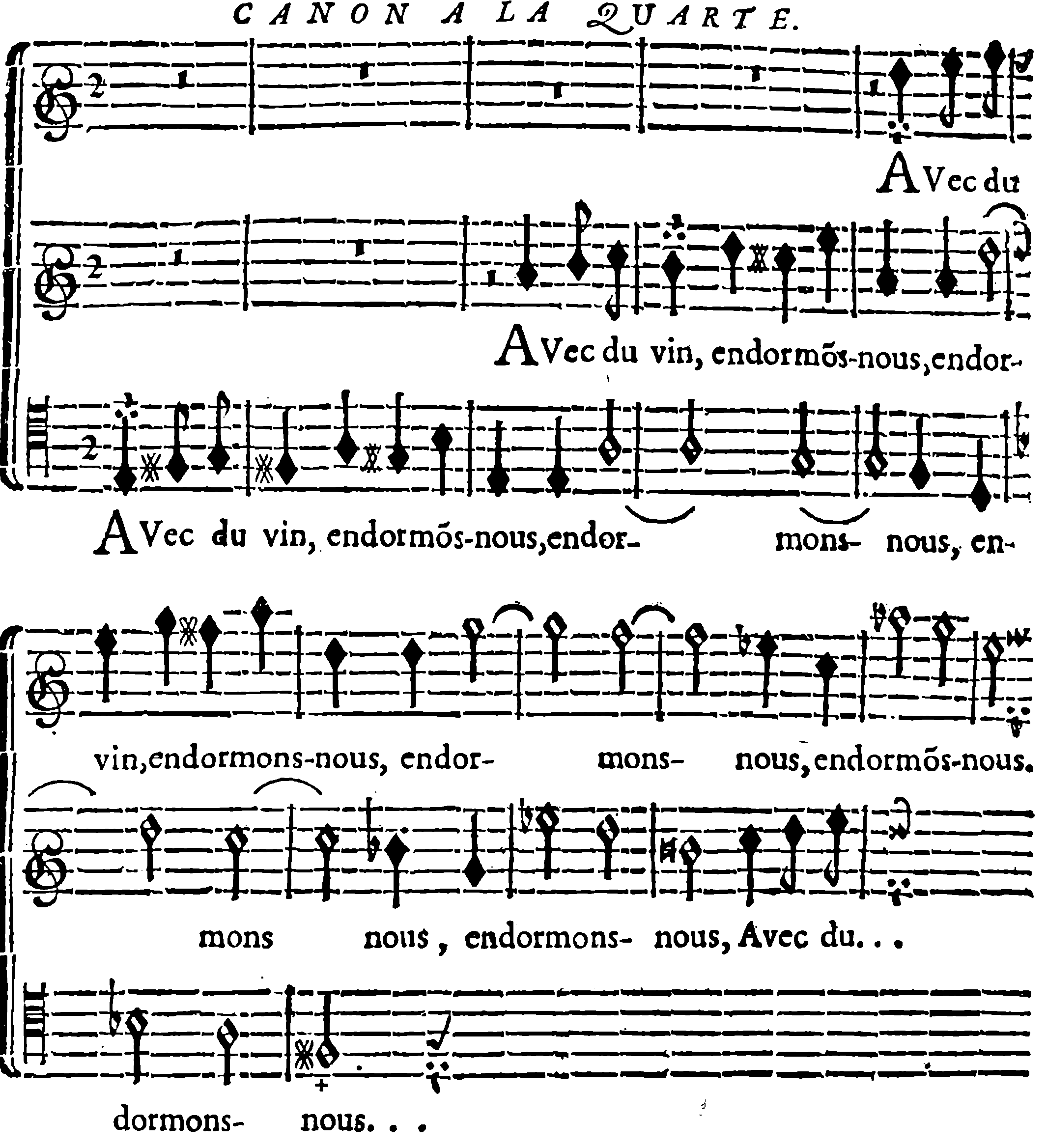
These last two kinds of canon can scarcely succeed without a perfect understanding of inversion. Avoid sounding the fifth, fourth, and eleventh in them as far as possible.
To succeed perfectly and quickly in composition, with even a little cultivated taste, one need only master modulation and fundamental harmony. These are the principal and sole foundations of all the variety obtainable by inverting that fundamental harmony, whose modulation never changes.