 Playable Books
Jean-Philippe Rameau · section 89 of 109
Chapter two
Read and hear this section in the playable edition →On the Difference between Major and Minor Intervals, and between Perfect, Augmented, and Diminished Intervals
Thirds and sixths are distinguished as major and minor.
Fifths and sevenths are distinguished as perfect, augmented, and diminished.
Fifths and sevenths are distinguished as perfect, augmented, and diminished.
Seconds and fourths are distinguished as perfect and augmented.
The diminished fourth has no place in accompaniment or harmony, nor does the diminished second.
Some authors distinguish seconds, sevenths, and ninths as major and minor, but improperly. Thus, if the proper proportion assigned to one of these intervals sometimes varies by a semitone, no attention need yet be paid to it.
For now, concentrate only on distinguishing thirds from sixths, and major from minor, since the sharps or flats attached to notes forming augmented or diminished intervals identify those intervals for us. Once we know which key forms the third, fourth, fifth, or sixth of another, we need only count the whole tones or semitones separating them to determine whether the interval is major, minor, perfect, augmented, or diminished.
Example of the Whole Tones and Semitones Composing Each Interval
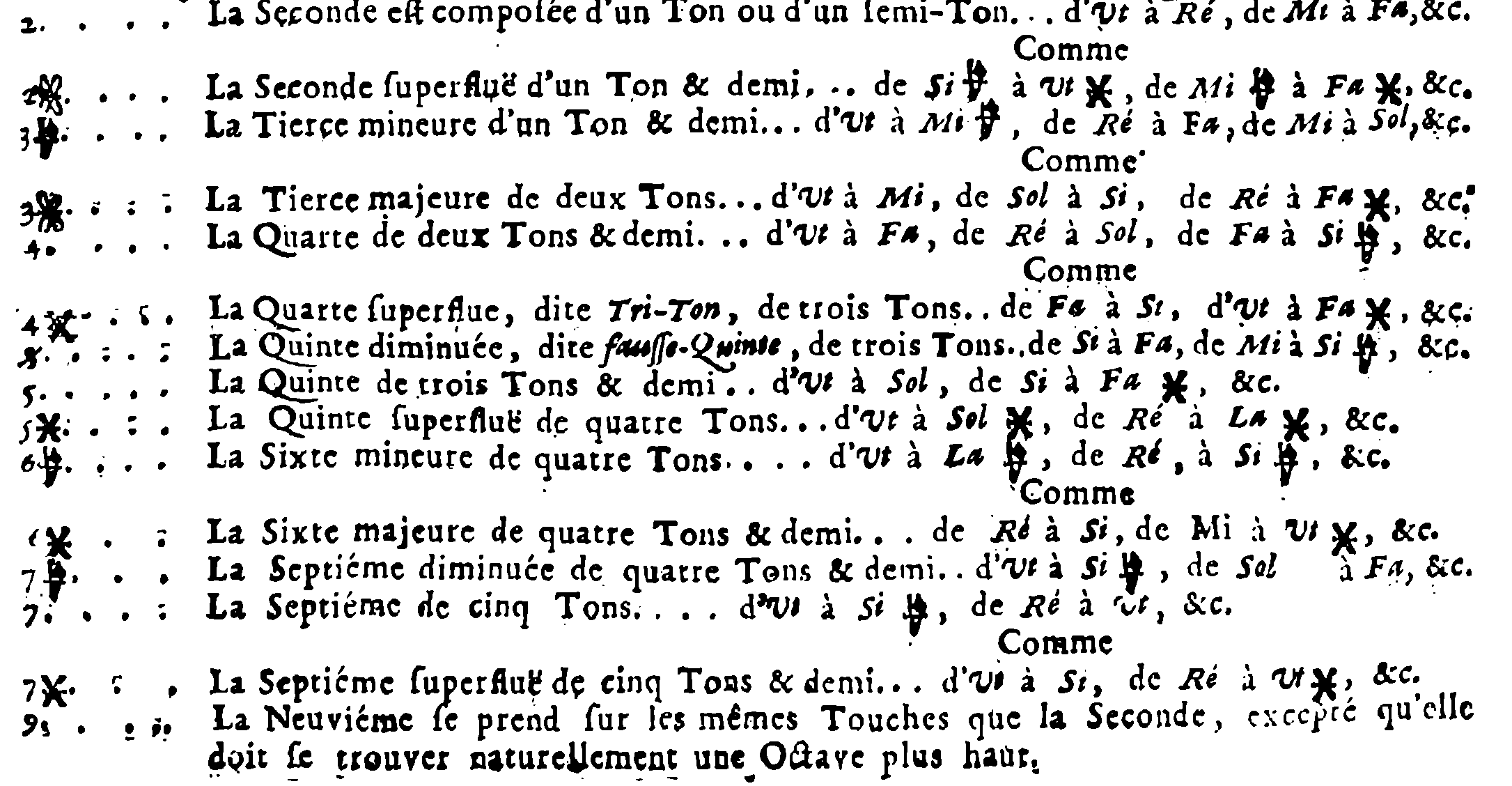
Intervals that differ in name yet contain the same number of whole tones here are distinguished otherwise in theory. This knowledge is unnecessary in practice; elsewhere we shall see the sole distinction made between them with regard to a ♯ or ♭.
Example

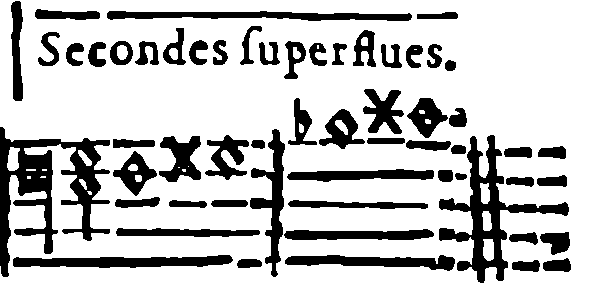
![Minor Thirds [Row without a Printed Title].](/rameau/assets/IV.02-016.png)












Now that the nature and different kinds of every interval have been explained, anyone wishing to learn accompaniment must practice finding on the keyboard every interval above every note or key, in all its forms. This knowledge must become so familiar that, whatever starting note or key is imagined, its minor or major third, sixth, tritone, perfect, diminished, or augmented fifth, seventh, and so forth can immediately be named and played.
1. To achieve this more easily, first learn the thirds and fifths of each key. Fourths and diminished fifths lie between the third and fifth; augmented fifths and sixths lie immediately above the fifth; sevenths below the octave; seconds and ninths above the note taken as the first degree or above its octave.
2. Some keyboard keys, though a fourth, fifth, or seventh apart by name, do not give those intervals in their prescribed proportions. It is nevertheless enough to find the correct note name; then substitute its sharp or flat. For example, the fifth of B is F, but it lacks the required number of whole tones. Replace F with F♯ to obtain the fifth sought. Similarly, if the fourth of F is B on the keyboard, take B♭, as counting the tones of a fourth will show. The same applies to other intervals.
3. To remove every difficulty, know that harmony has two immutable consonances, the fifth and fourth, apart from the octave. Thus, if the proposed key is sharp or flat, its fifth and fourth must be likewise. F is therefore reckoned flat, since in musical terminology all flats are called “fa”; B is reckoned sharp, since all sharps are called “si.”
There are also three dissonances that may be called immutable: seventh, second, and ninth. The seventh naturally lies a whole tone below the octave, and the second a whole tone above. Exceptions occur only in certain circumstances not yet appropriate to discuss.
4. The note name required to form a given interval never changes. If F's major third is A, its minor third must be A♭, not G♯. The key ordinarily known as G♯ loses that name here and becomes A♭, for G cannot form a third with F.
It follows that every note has its sharp and flat. Thus B's major third must be D♯, not E♭, although they are the same key. G♯'s major third must be B♯, not C; its major sixth must be E♯, not F, and so forth. Every keyboard key takes the note name naturally required by the numerical order of the intended interval. Hence an augmented second and minor third use the same keys, as do 7♭ and 6♯, 5♯ and 6♭, diminished fifth and tritone, and so forth. Therefore, if D's tritone is G♯, its diminished fifth is A♭, although G♯ and A♭ are one key. To avoid confusion, remember that every fourth must span a fourth by name, as D to G, and every fifth a fifth, as D to A, and similarly for the rest.
Example


To find a diminished interval easily, choose a sharp rather than flat key as the first degree; do the reverse to find an augmented interval.
The diminished fifth and tritone divide the octave into two equal parts in practice, as the following example shows.

This helps find either interval once the other is known: simply take either key forming one of the intervals as the first degree.
A similar relationship holds between the major third and minor sixth.
Between the minor third and major sixth.
Between the fourth and fifth.
Between the second and seventh.
And between the augmented second and diminished seventh.
Example

Observe carefully: once any interval has been found, raise the key serving as its first degree to the octave above to find the related interval. All that has been explained must be thoroughly familiar before proceeding.