 Playable Books
Jean-Philippe Rameau · section 88 of 109
Book four
Read and hear this section in the playable edition →Principles of Accompaniment
Chapter one
How Intervals Are Distinguished through the Arrangement of the Keyboard
The first chapter of the preceding book is absolutely necessary for understanding what follows, up to the discussion of clefs and vocal ranges, which is unnecessary for accompaniment.
The harpsichord or organ contains every sound that can enter a musical composition. Their differences are easily noticed by playing each key in succession: moving from left to right, the sounds continually rise; moving from right to left, they descend.
Regarding each keyboard key as a different sound, observe that greater or smaller distances between keys give greater or smaller intervals. The smallest interval, called a semitone, lies between two keys from the lower of which one can ascend to the other only by a movement indivisible in performance, as from E to F, with no intervening key. Between F and G, by contrast, is a whole tone, since a sharp lies between them. Thus all consecutive keyboard keys, white and black, stand a semitone apart.
Turn the page for the example.
Example
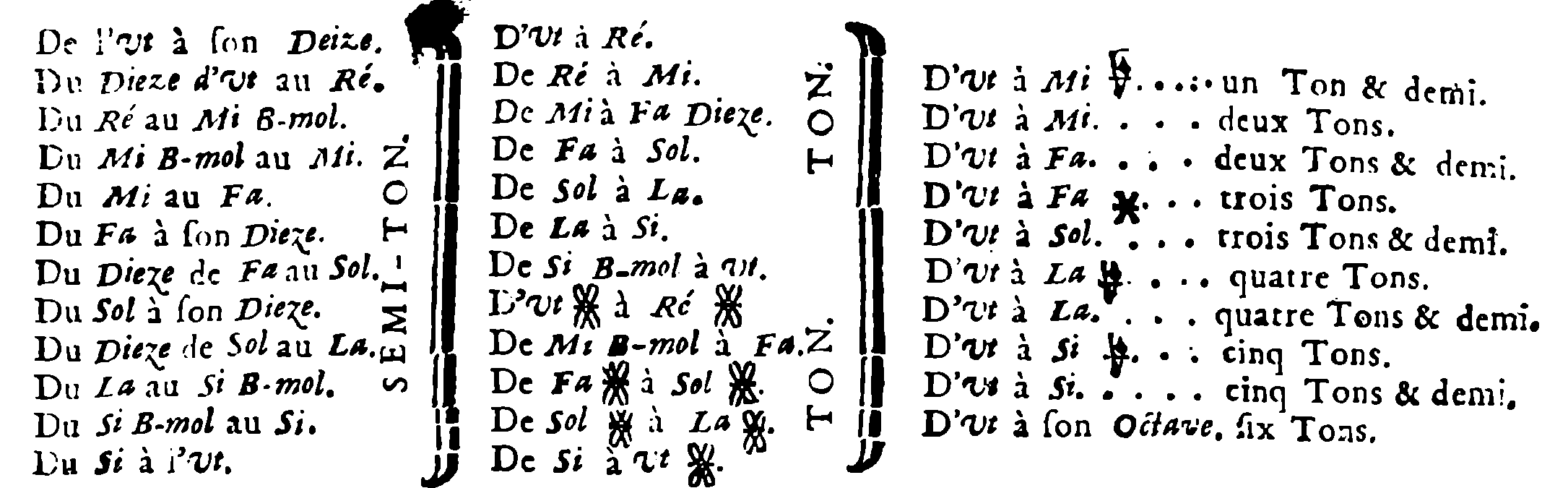
These whole tones and semitones are of different kinds, but this need not concern those interested only in practice.
Take D or any other note as the first degree, as we took C. You will discover how many whole tones or semitones separate that first note from any note compared with it by counting semitones from each note or key to its nearest neighbor.
Since practical accompaniment can be acquired only through thorough knowledge of the keyboard and music, we assume this knowledge in those wishing to put these principles into practice. They will therefore find it easy to distinguish intervals on the keyboard, performing on the keys the same operation we perform on the scale by means of numbers. See Book III, Chapter I.
The seven notes C, D, E, F, G, A, B are used incomparably more often than the others and are regarded in music as the only notes entering composition. We shall therefore always base our rules on these seven notes, taken on the keyboard's natural keys. The sharps and flats separating those keys need be considered only when absolutely necessary to form the intended interval.
To form a second, third, fourth, fifth, and so forth, let the key chosen as the first degree represent 1. The next natural key above it, the second key, forms a second with it; the third key forms a third, the fourth a fourth, and so on. This deserves close attention, since the entire art of accompaniment depends chiefly on knowing these intervals. They are always taken above the note serving as the first degree or foundation, never below it.
Example
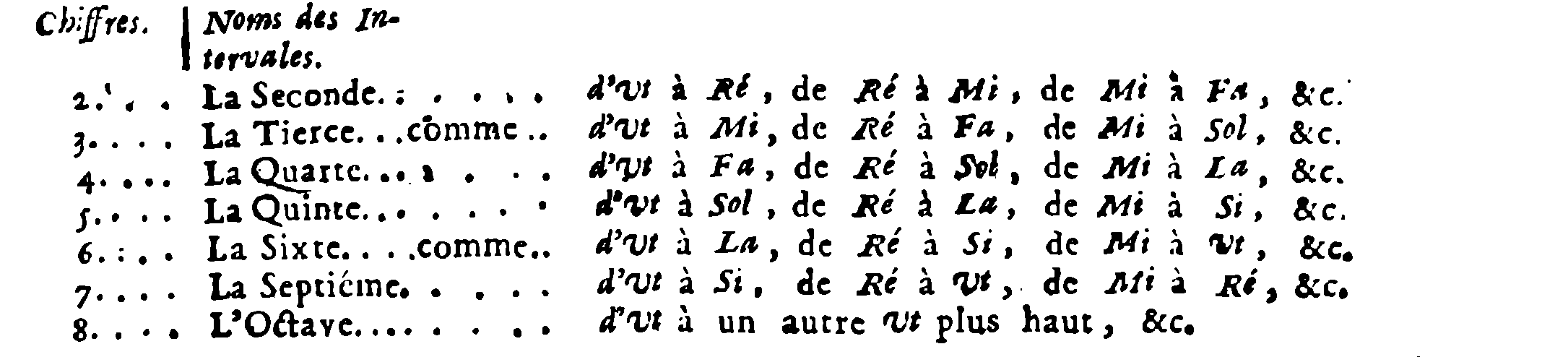
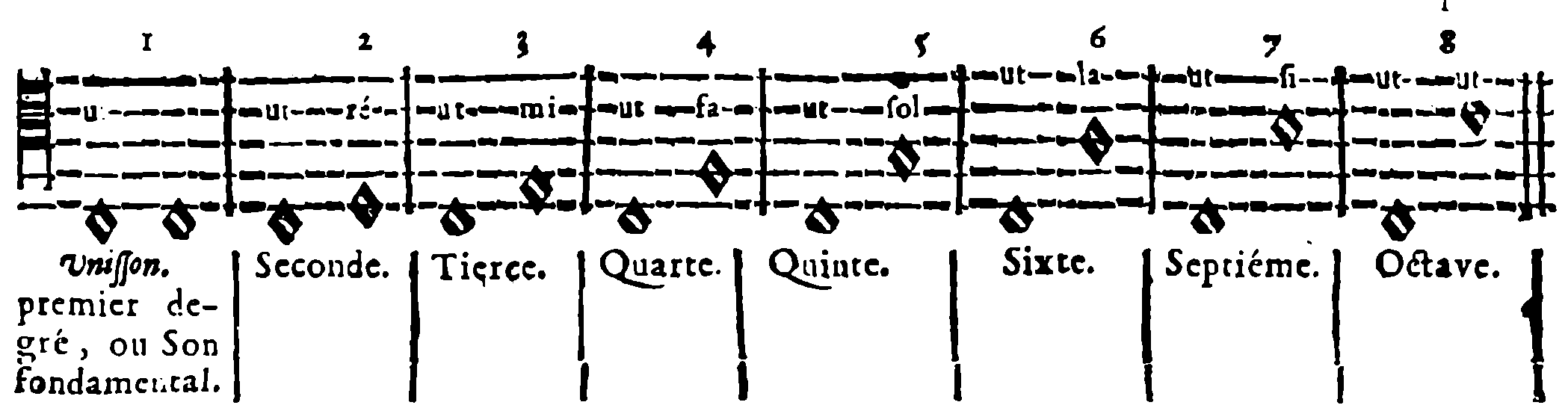
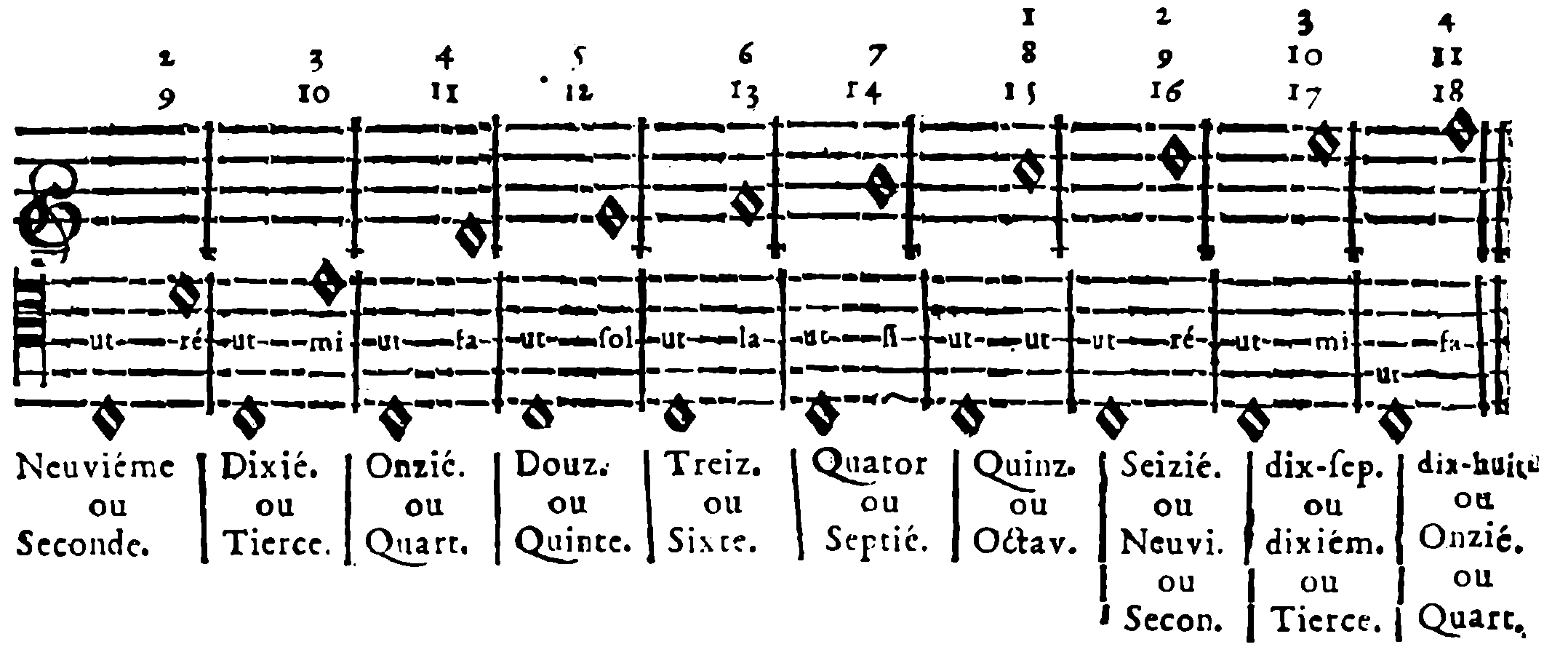
Observe that every harmonic interval lies within the octave, and intervals exceeding it are merely replications. The note names prove this: the seventeenth and tenth have the same note name as the third, and so with the others. Once we know that the fifth of C is G, therefore, it does not matter where that G is played, provided it is always above that C. The comparison made with C must be repeated with every other key, so that intervals become familiar regardless of the key chosen as the first degree.