 Playable Books
Jean-Philippe Rameau · section 98 of 109
CHAPTER XI. Sixth chords
Read and hear this section in the playable edition →We often find basses that proceed diatonically and bear only sixth chords. Following the next example will make their practice very easy.
Example
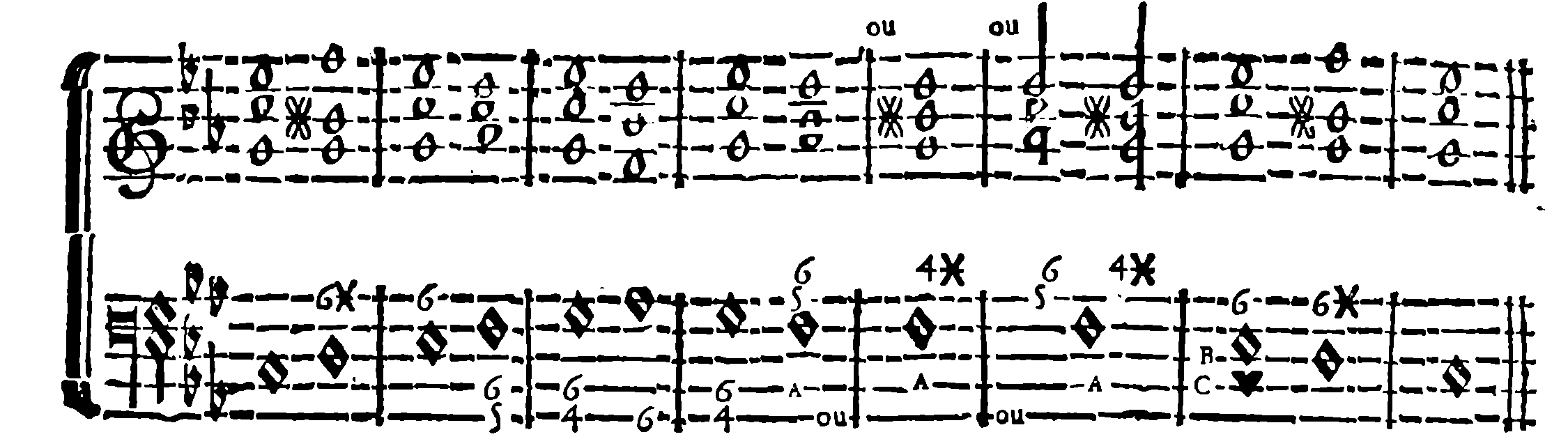
If we recall what was said in Chapter VIII—that the great-sixth chord may lead to the sixth chord of the mediant, the sixth–fourth chord of the dominant, or the perfect chord of the tonic—we shall find nothing new here. [The punctuation of this list follows the author's correction in the supplement.] Nevertheless, this succession of chords should be practiced, because it is very frequent. The example serves all minor keys, taking account of the flat we have added; it can also serve all major keys if the flats are removed.
Notice that the fourth note (A), when descending to the mediant (B) or even to the tonic (C), may bear the great-sixth chord, the tritone chord, or both in succession, provided the great-sixth chord comes first.
This last rule comes from the irregular cadence. This would also be a suitable place to discuss the perfect, imperfect and interrupted cadences, but these are included within our other rules. For example, a seventh chord followed by a sixth–fourth chord on a tonic dominant represents an imperfect cadence. The perfect cadence must always proceed from dominant to tonic, as all our octave examples in Chapter VI show. Thus the sixth–fourth chord borne by the dominant represents the perfect chord that the tonic should naturally have borne after the dominant's seventh chord. Consequently, the dominant may also pass to the mediant without changing the underlying harmony of the two chords in question. Likewise, the rule in Chapter VIII allowing diatonic ascent from a seventh chord to a perfect chord or another seventh chord comes from the interrupted cadence. Nevertheless, consult our discussion of all these cadences in Book III, Chapters XIII, XVI, XXV and XXVIII. It can shed considerable light on inversion and on recognizing keys, and consequently on the notes that can or must bear particular chords, as well as on the different bass progressions that lead us to this knowledge.