 Playable Books
Jean-Philippe Rameau · section 99 of 109
CHAPTER XII. The augmented-second chord and its derivatives
Read and hear this section in the playable edition →The augmented-second chord, figured 2♯, is accompanied by the tritone and the major sixth. It is used only on the sixth note of minor keys.
To find this chord, simply form the seventh chord of a tonic dominant and raise that dominant by a semitone to the sixth note. Thus, if E is the dominant, we play its major third, fifth and seventh in the right hand, and F instead of E in the left. The same applies to the other tonic dominants.
Example
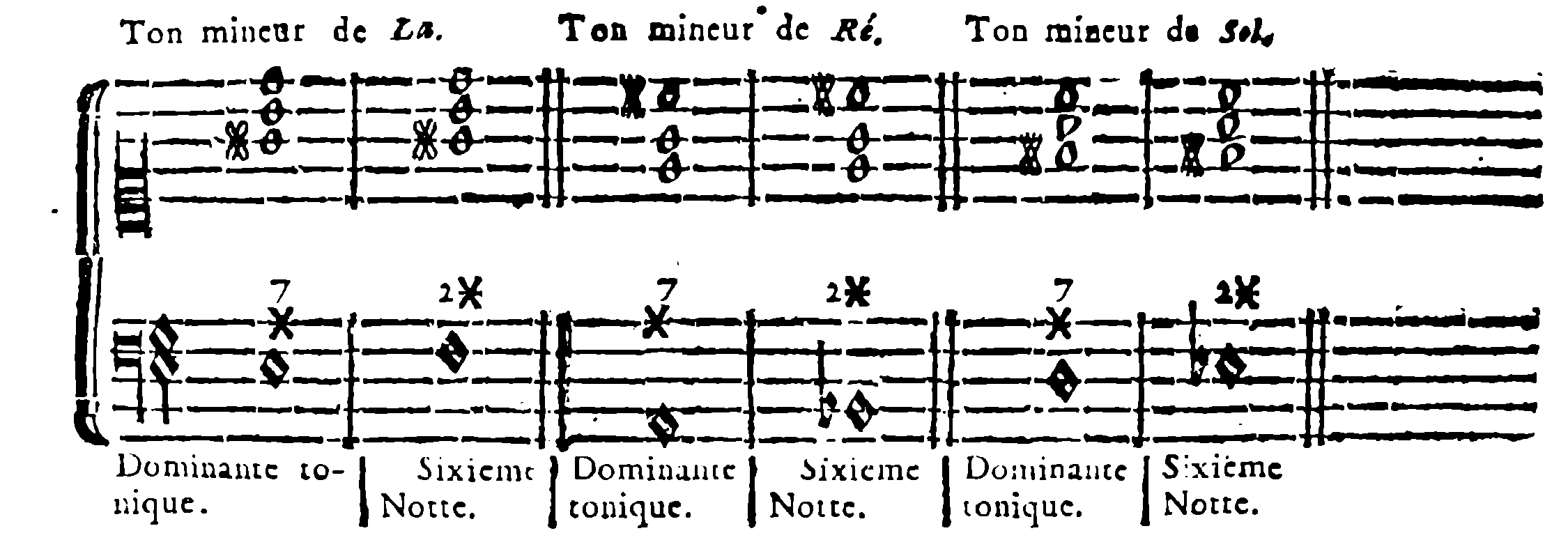
This transfer of the tonic dominant to the sixth note causes a similar change in all the chords derived from that dominant's seventh chord, as the following example shows.
Example of chords derived from the 2♯ chord
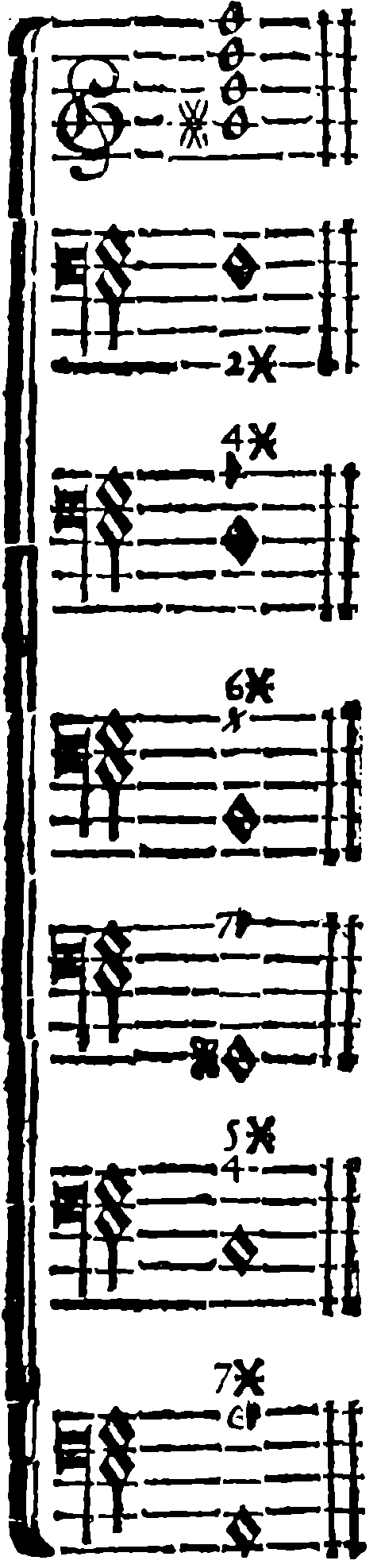
Notice that all the sounds of this chord are always separated by thirds, wherever on the keyboard they are played.
Sixth note: it ordinarily bears the small-sixth chord when descending to the dominant. The only difference between that small-sixth chord and the augmented-second chord is the third in place of the augmented second.
Fourth note: it ordinarily bears the tritone chord, here accompanied by a minor third instead of the second.
Second note: it ordinarily bears the small-sixth chord, here accompanied by the diminished fifth instead of the fourth.
Leading note: it ordinarily bears the diminished-fifth chord, here accompanied by the diminished seventh instead of the sixth.
Mediant: it sometimes bears the augmented-fifth chord, here accompanied by the fourth instead of the third.
Tonic note: it sometimes bears the augmented-seventh chord, here accompanied by the minor sixth instead of the fifth.
See Book III, Chapter XXXIII, on this subject.
These small-sixth, diminished-fifth, tritone, augmented-fifth and augmented-seventh chords, derived from the seventh chord of a tonic dominant, may share in the change caused by transferring that dominant to the sixth note, as you see. Practice all these chords in every minor key, accompanying them in turn in the two different ways available to them. Notice the notes of each key on which they can occur, for this gives a more accurate understanding of them.
The last two basses show chords to which you should give attention only after reading the next chapter, where they are discussed.
Remember to omit the octave of the bass from every chord in this last example when putting them into practice.