Nikolai Rimsky-Korsakov · seção 71 de 96
Princípios Gerais Leia e ouça esta seção na edição reproduzível →
Tradução automática da leitura em inglês. Rascunho; ainda sem revisão por um falante nativo.
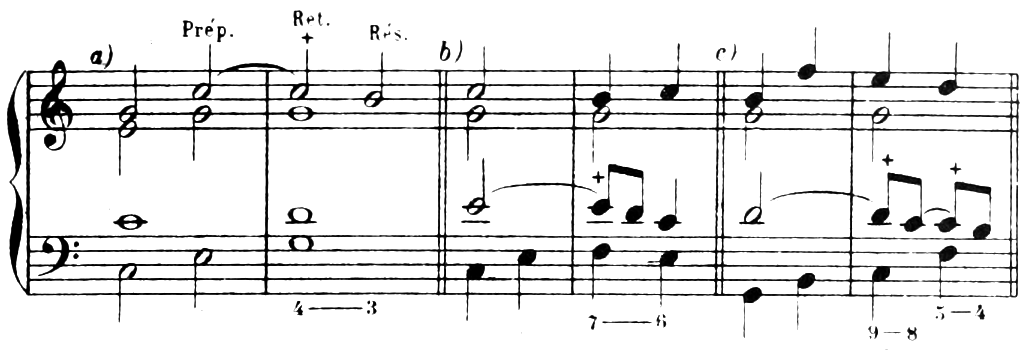
§ 69. — 1) Quando uma voz, ao passar de um acorde a outro, interrompe momentaneamente seu movimento por grau conjunto e adia sua entrada no segundo acorde, produz o recurso chamado de retardo ou suspensão.
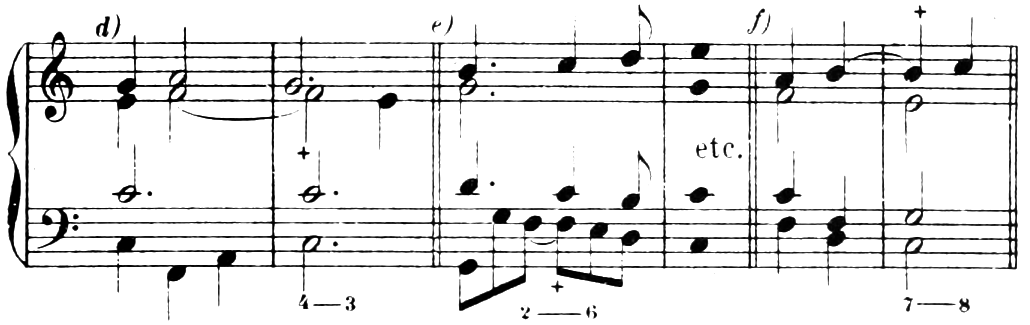
Conforme o movimento da voz, o retardo pode ser ascendente ou descendente. O retardo deve sempre cair no tempo forte do compasso ou na parte forte de um tempo; a preparação pode estar no tempo fraco ou no tempo forte do compasso anterior, e a resolução no tempo fraco seguinte.
Em um compasso de três tempos, a resolução cai no terceiro tempo, e também no segundo se o terceiro contiver um novo acorde:
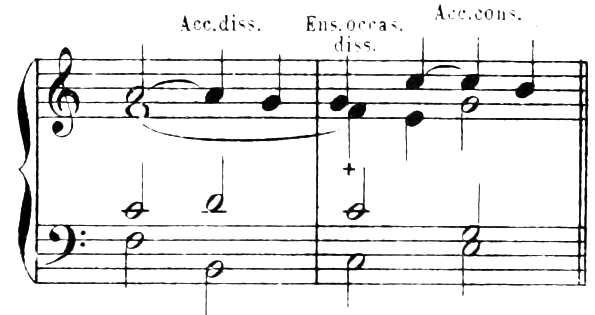
Fig. 283 · Ver no leitor Fig. 284 · Ver no leitor 2) O retardo deve formar um acorde dissonante ou uma combinação ocasional. Em seus exercícios, o aluno fará bem em abster-se de retardos consonantes.
Fig. 285 · Ver no leitor 3) A preparação não deve ter duração menor que a do retardo.
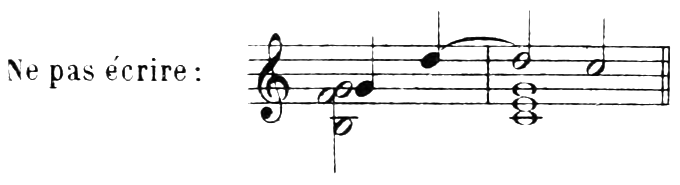
Fig. 286 · Ver no leitor 4) O retardo não oculta quintas e oitavas paralelas.
Fig. 287 · Ver no leitor Fig. 288 · Ver no leitor ← A Bordadura Todas as seções Retardos Descendentes → Mais Playable Books Tchaikovsky, Guide to the Practical Study of Harmony Tchaikovsky’s Moscow Conservatory harmony course, with playable examples. Fux, Gradus ad Parnassum Learn how independent voices work together, one species at a time. Goetschius, Exercises in Elementary Counterpoint Build independent melodies through graded exercises, with 471 recorded examples. Goetschius, Counterpoint Applied Study imitation, canon, and fugue with 393 recorded examples. Prout, Analysis of J. S. Bach’s Forty-Eight Fugues Follow Prout through all 48 fugues of the Well-Tempered Clavier, every example playable. Rameau, Treatise on Harmony Explore the foundations of harmony, composition, and accompaniment. Fenaroli, Partimenti Six books of partimenti, with playable basses, contrapuntal exercises, and bilingual rules. Reger, Supplement to the Theory of Modulation Explore Reger’s modulation method with 100 analyses and 102 playable examples. Schoenberg, Theory of Harmony Read all 22 chapters, with the original German beside a new English translation. Rimsky-Korsakov, Principles of Orchestration Discover instrumental colors through scores and orchestral recordings. Forsyth, Orchestration A witty, thorough guide to every orchestral instrument, with the original pages. Berlioz, Treatise on Instrumentation Berlioz’s treatise on the orchestra, revised by Richard Strauss, with the original pages. Sanganeria, Arrival Build jazz lines that land, with 30 original playable examples. Bona, Complete Method for Rhythmical Articulation Practice rhythm through 120 graded studies, with playable notation and original scans. ← Todos os Playable Books  Playable Books