 Playable Books
Nikolai Rimsky-Korsakov · section 5 of 96
Triads
Read and hear this section in the playable edition →

§ 1. A triad (chord of three notes) is one formed of a root, a third and a fifth. According to the make-up of these intervals, triads fall into four kinds:

a) A triad formed of a major third and a perfect fifth — that is, a major third with a minor third above it — is called a major triad (accord parfait majeur).
b) A triad formed of a minor third and a perfect fifth — a minor third with a major third above it — is called a minor triad (accord parfait mineur).
c) A triad formed of a minor third and a diminished fifth — two minor thirds — is called a diminished triad (chord of the diminished fifth).
d) A triad formed of a major third and an augmented fifth — two major thirds — is called an augmented triad (chord of the augmented fifth).
These last two chords, which contain the dissonant intervals of the diminished and augmented fifth, are called dissonant.
Remark. Because the augmented triad is very dissonant and indefinite in character, we shall not deal with it as an independent chord until Chapter V (altered enharmonic chords and successions between keys). Likewise, the seventh chord with an augmented fifth will be treated as an incidental combination rather than as an independent chord.
§ 2. Every triad has two inversions: the chord of the sixth (first inversion), figured 6, and the chord of the fourth and sixth (second inversion), figured 6/4.
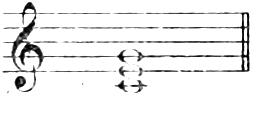
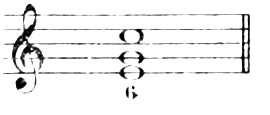
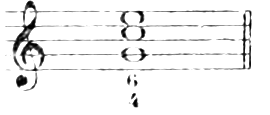
The name of an inversion depends on the bass note and does not change, however the upper notes are arranged. Thus a chord of the sixth is one whose bass is the third of the root. (By the root we mean the bass note of a chord in root position.)
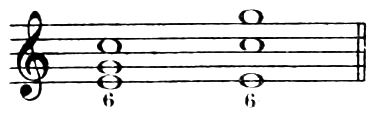
A chord of the fourth and sixth is one whose bass is the fifth of the root.
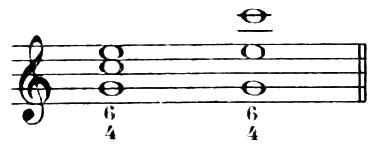
The notes of each inversion keep the same names and character as in the root-position chord. Thus in every inversion of the triad
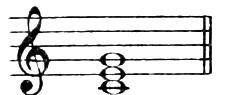
the note [C] is always called the root, the note [E] the third of the root, and the note [G] the fifth of the root.
The inversions of a chord belong to the same degree as the chord in root position. For example, in C major the chord of the sixth [E–G–C] is the chord of the sixth on the first degree, and the chord of the fourth and sixth [D–G–B] is the chord of the fourth and sixth on the fifth degree, and so on.
The first inversion, or chord of the sixth, is made of a third and a sixth above the bass. For example, the chord of the sixth [E–G–C] consists of a third [E–G] and a sixth [E–C]; it can also be seen as a third and a fourth [E–G, G–C].
The second inversion, or chord of the fourth and sixth, is made of a fourth and a sixth above the bass. For example, the chord of the fourth and sixth [G–C–E] consists of a fourth [G–C] and a sixth [G–E]; it can also be seen as a fourth and a third [G–C, C–E].