 Playable Books
Pyotr Ilyich Tchaikovsky · section 8 of 36
Chapter VI. The Harmony of the Minor Scale
Read and hear this section in the playable edition →

monic minor scale“ and consists of the same notes asits parallel major scale, with the exception that the 7-th step is raised by half'a tone. This is done in order to establish a leading-tone, which, as the pupil will perceive later, is indispensable to the cadence **). Hence arises the characteristic interval of
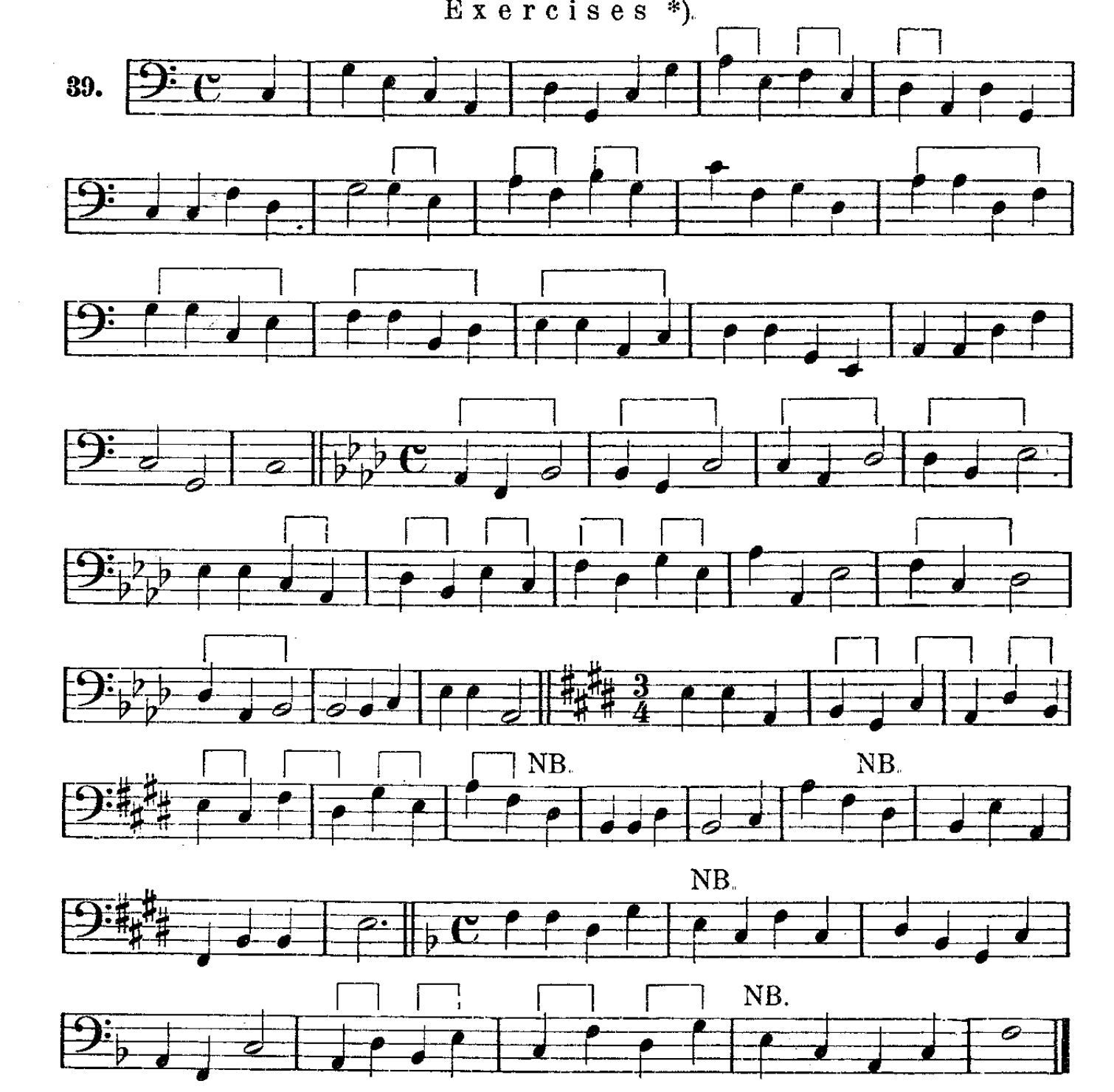
*) At the bracketed places sequences are to be constructed as in the examples. **) Each composition is closed by a cadence, which ists of the Dominant triad and the tonic. We refer to it later on.
the minor scale; namely the augmented second between the 6-th and 7-th steps,
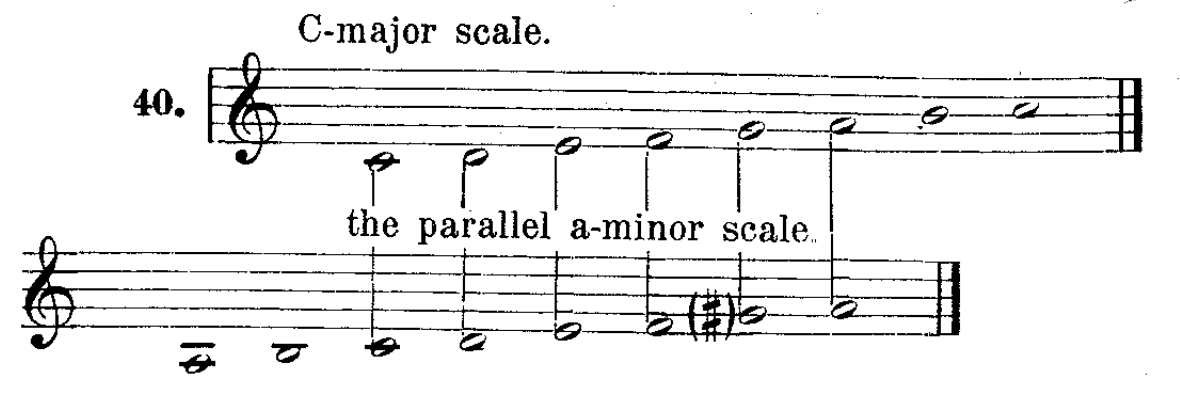
C-major scale.
the parallel a-minor scale.
The other minor scale—called the melodic, has no significance in Harmony; for as its name implies, it is merely a melodic variation of the harmonic scale, made in order to avoid the dissonant step of the augmented second.
§ 19. If we construct triads on the steps of the minor-scale, we obtain only four consonant chords: two small or minor triads (on the tonic and sub-dominant) and two great or major triads (on the dominant and the 6-th step).
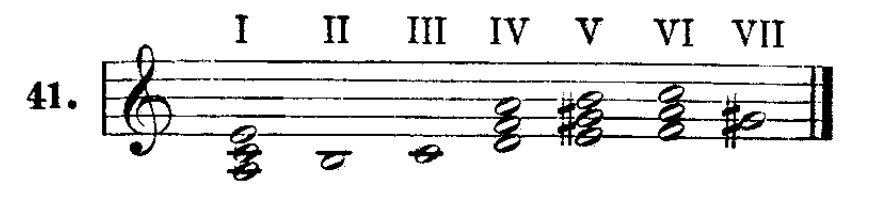
In the remaining triads we find dissonant intervals’ — diminished or augmented Fifths.
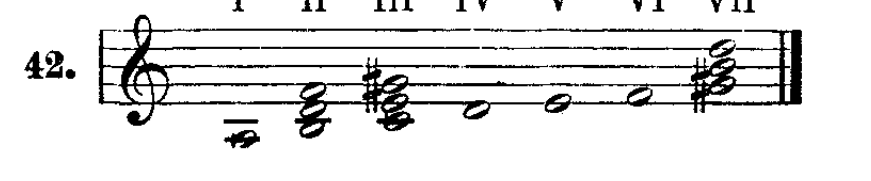
Since, as we have remarked before, the real essence of harmony lies in chords that are euphonious, complete in themselves and consonant, there is no need of demonstrating that the harmony of the minor-scale is not so rich in material as that of the major.
§ 20. In connecting the consonant triads in minor we will follow the rules laid down in the preceding chapter. Regarding the use in minor of the two diminished triads on the 2-nd and 7-th degree and the augmented triad (so-called, because of its augmented fifth) on the third degree, we must first make several observations.
We know that a dissonant chord demands support, which may consist either in a correct outward connection with its two neighbouring triads, or in its internal relationship to them—as in the carrying out ofa motive (e. g. in a sequence).
Since, however, harmonic sequences, which justify the use of the diminished triad in major, are not quite practicable in minor because of the many dissonant chords, let us see, if diminished and augmented triads cannot be used otherwhere than in a sequence, perhaps by invariably placing them between two consonant chords.
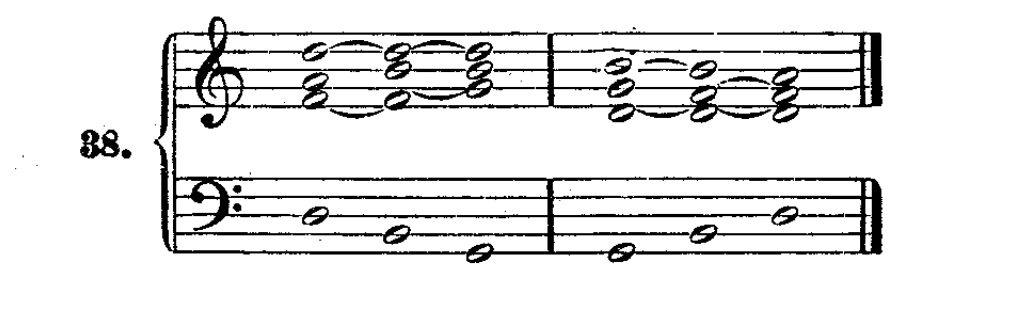
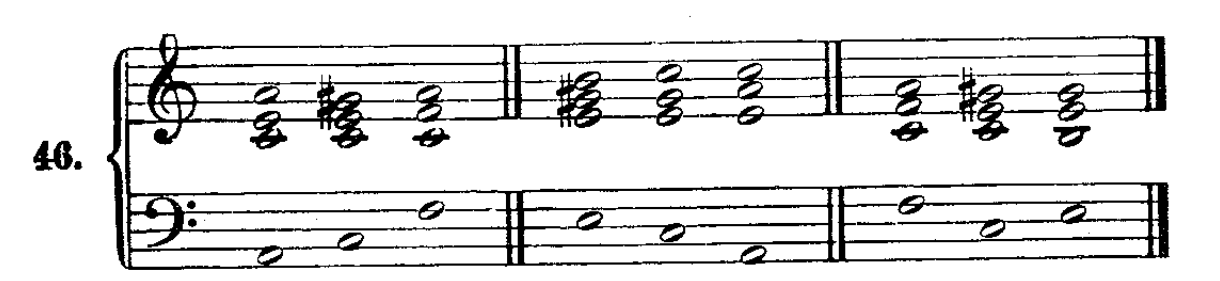
1. The diminished triad on the 7-th degree is related to the triads on the 2-nd, 4-th and 5-th degrees; still it can be properly connected only with the Dominant triad, as the connection with the other two would call for a step of an augmented second, which sounds very unpleasant and is always to
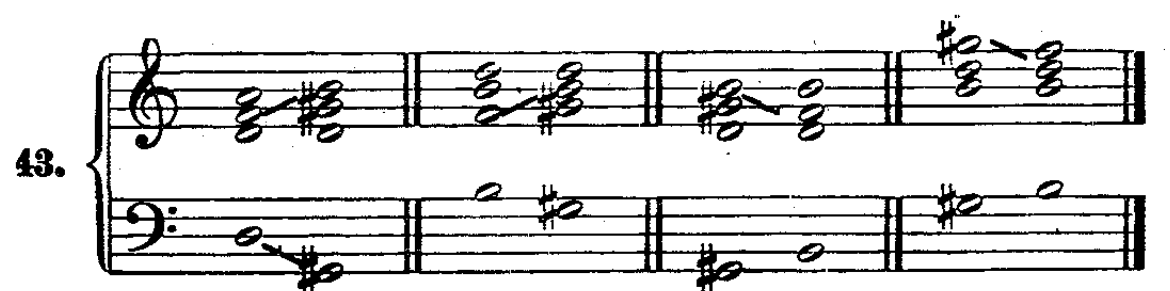
This triad then can be connected only with the Dominant triad, the two common tones being kept in the same voices.
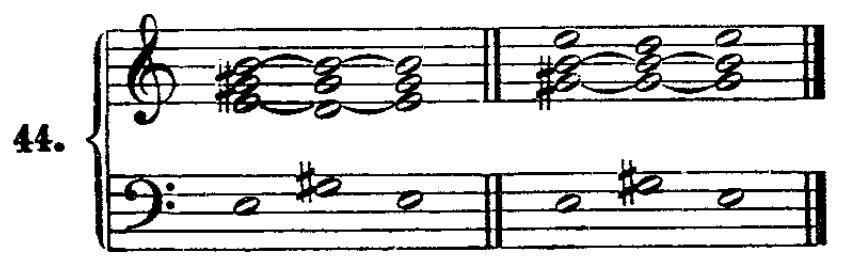
This succession of chords—it must be observed—while being possible, is extremely rare.
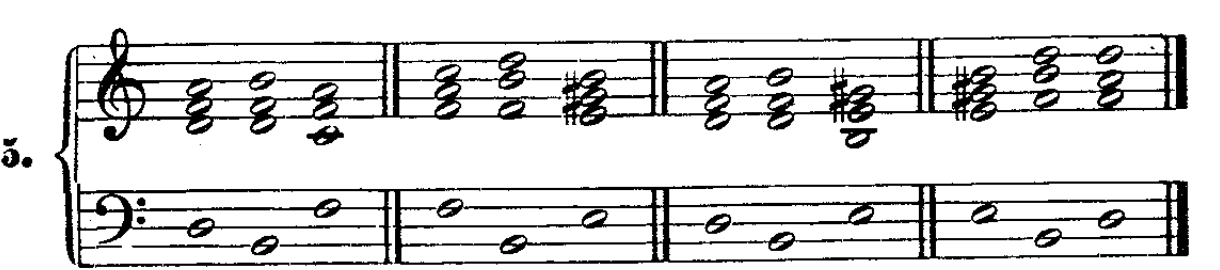
ll. The diminished triad on the 2-nd degree can be connected with the triads on the 4-th, 5-th and 6-th degree. Avoid however:
a) concealed Octaves and Fifths b) the step of the augmented second.
The latter disappears, if, in connecting the diminished with the dominant triad, contrary motion is employed.
Ill. The augmented triad (on the 3-rd degree) can without difficulty be connected with the triads on the 1-st, 5-th and 6-th degrees. This triad is but seldom used as a diatonic chord; as a chromatic or altered chord, however, it is much applied—as we shall see later on.
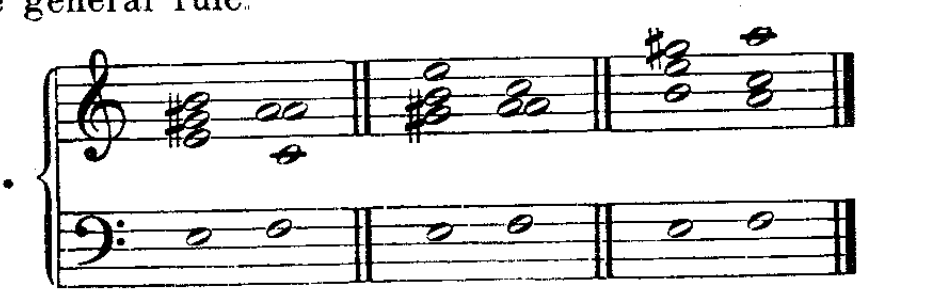
§ 21. In the preceding paragraph it was remarked, that the step of the augmented second should be avoided at all times. For this reason the leading-tone (third of the dominant triad) is led upwards in joining the triads on the 5-th and 6-th degrees. The triad on the 6-th degree then appears with doubled third and an arrangement of the voices, which deviates from the general rule.
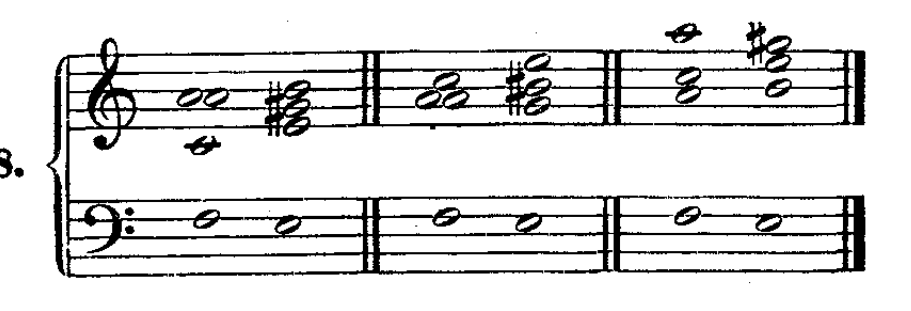
When these two triads succeed each other in opposite order to the above, which indeed seldom occurs, the third of the triad on the 6-th degree must be doubled for the same reason.
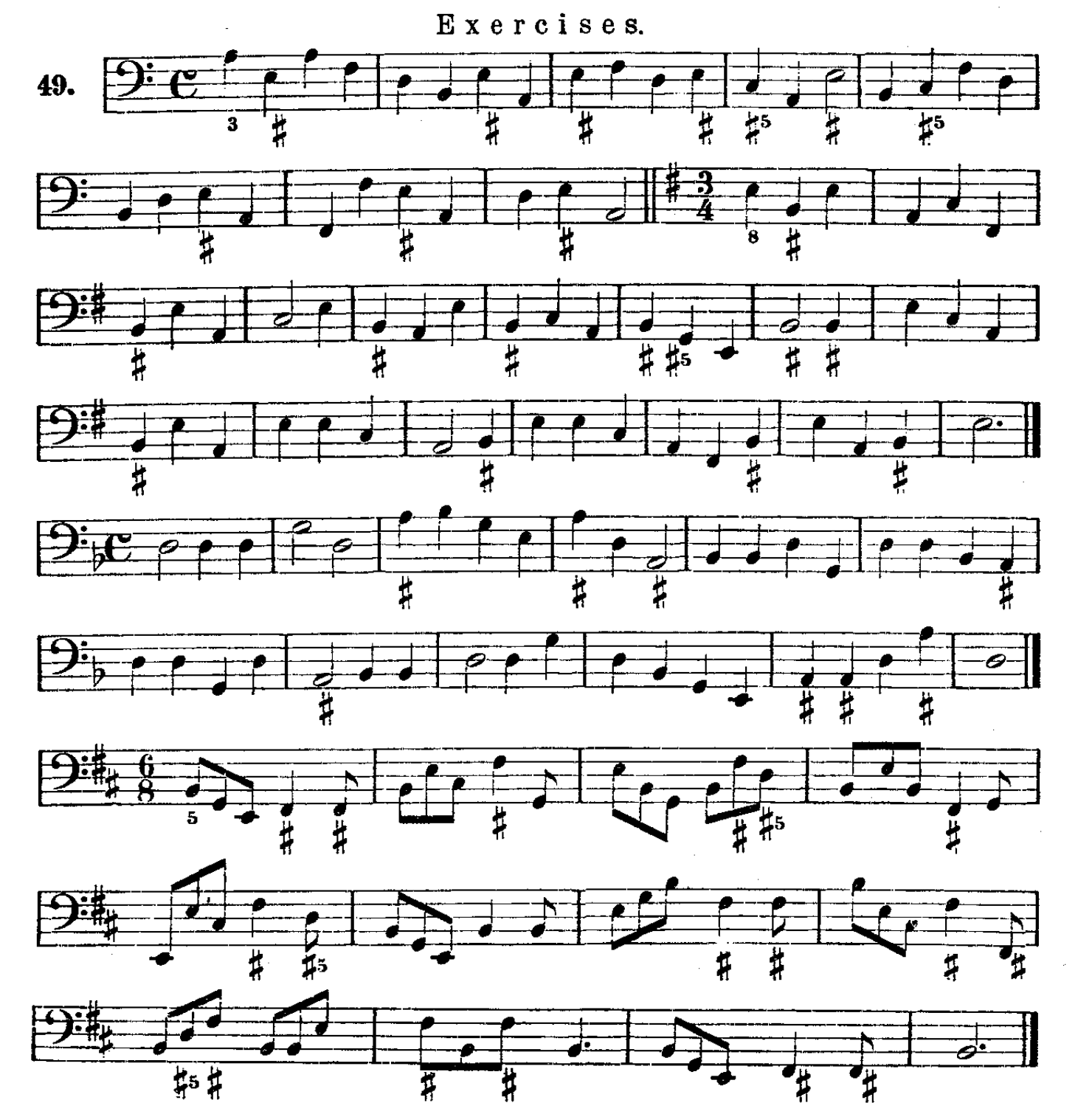
Remark. The figures and accidentals below the notes in these examples are the signs of the so-called figured Bass. These signs, which indicate the Harmony, are placed above or below the Bass—notes. In this connection observe the following rules:
a) The triads in their fundamental form (others are unknown to us for the present) are designated by figures corresponding to their intervals:
3: & 8: 3. 5. Except in a few cases these figures are not employed; so that bass-notes without figures below them signify the fundamental form of the triad. Single figures as 3, 5, 8, refer to the position of the triad:
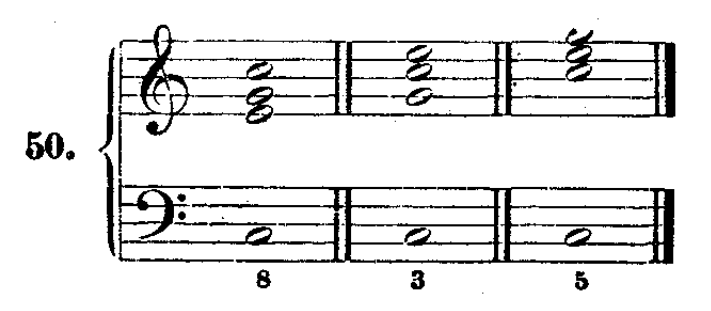
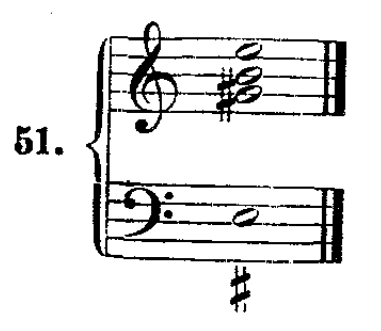
b) Accidentals not occurring in the signature of the key, as well as naturals must invariably be given in figured—Bass. Note here, that an accidental unaccompanied by any figure always refers to the third of the chord. Should the accidental be meant for a different interval, the figure designating that interval must be placed to the right of the accidental.
Accordingly the accidental referring to the third of the dominant triads in the above bass are unaccompanied by any figure:
while the accidental referring to the fifth of the augmented triad has the figure 5 next tg it: