Leaving aside the seventh chords that contain an augmented fifth — those on the fourth and sixth degrees of the harmonic major mode and on the first and third degrees of the harmonic minor mode — there are nine different seventh chords in the two major modes and nine in the two minor modes.
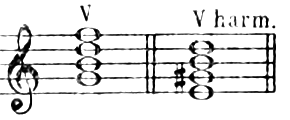
The seventh chords on the fifth degree of the natural major mode and of the harmonic minor mode are called dominant seventh chords, or seventh chords of the first order.
§ 7. The triads on the first and fourth degrees of the natural major mode are major.
The triads on the first and fourth degrees of the harmonic minor mode are minor.
The triads on the dominant of both modes, major and harmonic minor, are major.
Dominant seventh chords consist of a major triad and a minor seventh.
Apart from the first-order triads of the major and minor modes and the dominant sevenths, all other triads and seventh chords are called chords of the second order.
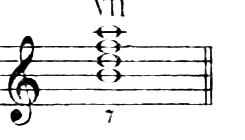
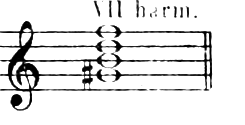
Among the second-order seventh chords, those on the leading notes of the natural major mode and the harmonic minor mode are called leading-note seventh chords.
Minor leading-note seventh chord (half-diminished):
Remark. For progressions among the first-order degrees we use the natural major mode and the harmonic minor mode; the latter is chosen because it contains the leading note, which the natural minor lacks. For progressions among chords on all degrees, the natural minor and harmonic major modes are used as well.
 Playable Books