Playable BooksREADING EDITIONS
Rimsky-Korsakov, Practical Manual of Harmony in English

Nikolai Rimsky-Korsakov · section 59 of 96

Assignments

Read and hear this section in the playable edition →

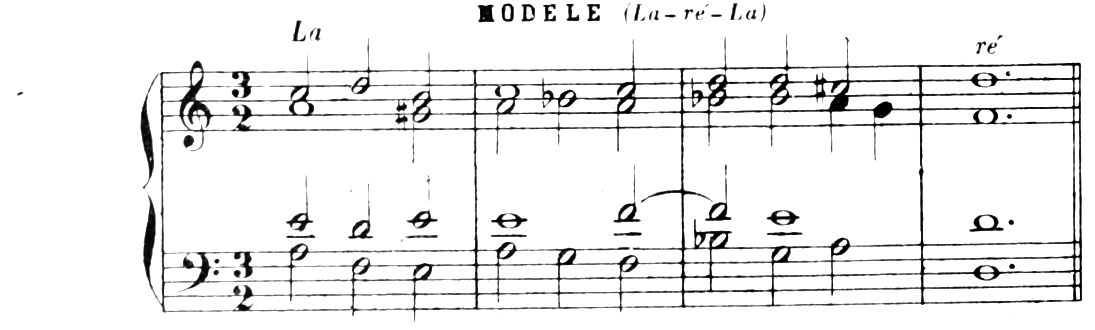
a) Write modulating phrases of four bars, firmly confirming the following key and marking the preceding key more or less strongly.

Model (A minor – D minor – A minor): a four-bar modulating phrase in four parts, 3/2 time, from A minor to D minor.
Fig. 232 · See it in the reader
Model (C major – F major – C major): an eight-bar modulating period in four parts, cut time, from C major to F major and back to C major.
Fig. 233 · See it in the reader

c) Compose phrases and periods of eight bars without returning to the preceding key, but establish that key clearly at the beginning and give a complete affirmation of the following key.

Model (A minor – G major): an eight-bar period in four parts, cut time, from A minor to G major without return.
Fig. 234 · See it in the reader

d) Compose periods of eight bars, modulating transiently to the neighbouring keys once the preceding key has been stated, or after the return to that key in order to establish it firmly.

Model (A minor – E major): an eight-bar period in four parts, 3/2 time, passing through neighbouring keys ("tons de passage", "ton de passage") before reaching
Fig. 235 · See it in the reader

REMARK. — Chromatic modulation, through its clarity and brevity, is especially applicable to transient modulation. To establish the following key firmly it is customary to modulate transiently to the subdominant keys, and also to the key of the IInd degree in the major mode and to the key of the VIth degree in the minor mode: C–d–C and a–F–a.

After the deceptive cadence one usually modulates transiently to the subdominant keys of both modes:

Example: in A minor, a deceptive cadence (V7–VI) followed by a transient modulation to D minor, the subdominant key ("ton de passage"), and a return to A minor.
Fig. 236 · See it in the reader

NOTE. — Before a modulation from a major key to the key of its minor subdominant (C–f), and after a modulation from a minor key to the key of its major dominant (a–E), it is better not to modulate transiently to the neighbouring keys, because of the contradiction that results between the chords of the passing keys and those of the following or the preceding key:

Bad: a) C major with a transient modulation to D minor ("ré", bracketed), back to C, then to F minor; b) A minor to E major, then a transient modulation to F♯ m
Fig. 237 · See it in the reader