§ 73.— 1) Passing notes, neighbour notes and suspensions are used to embellish a melody and, in general, the parts of harmonic progressions.
This embellishment of the harmony is called melodic ornamentation. All these devices may alternate within a single part or in several parts at once.
2) The consonant notes of the chords, and the minor seventh formed freely without preparation and without resolution, which serve as a kind of support for the movement of the parts, also provide the means of forming suspensions or passing notes where at first this seems impossible.
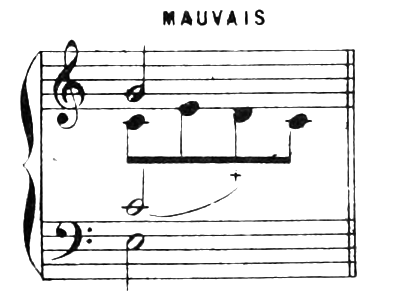
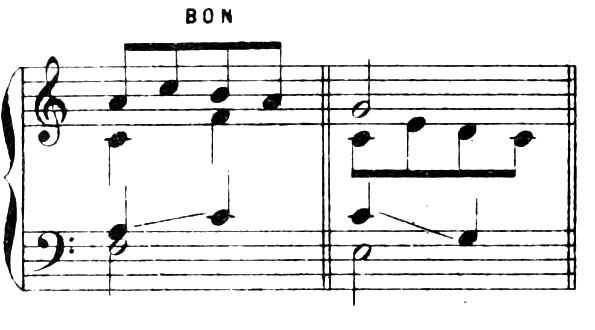
Disjunct motion of the parts does not allow suspensions to be formed, just as conjunct motion gives no occasion for passing notes. Both are obtained by means of a leap in one of the parts to one of the consonant notes of the chord:
3) Passing notes and neighbour notes may also occur on the strong part of the bar or on the strong part of a beat, provided that no new chord arises at that moment.
7) The descending suspension may be ornamented with the lower auxiliary of the delayed note, and the ascending suspension with the upper auxiliary; both are taken at the third from the suspension:
 Playable Books
![[Example]](/rimsky-harmony/images/rh-089-ex01.png)
![[Example]](/rimsky-harmony/images/rh-089-ex02.png)
![[Example]](/rimsky-harmony/images/rh-089-ex03.png)
![[Example]](/rimsky-harmony/images/rh-089-ex04.png)
![[Example] etc.](/rimsky-harmony/images/rh-089-ex05.png)
![[Example]](/rimsky-harmony/images/rh-090-ex01.png)
![[Example] a) b) c)](/rimsky-harmony/images/rh-090-ex03.png)
![[Example] d) e) f)](/rimsky-harmony/images/rh-090-ex04.png)
![[Example] a) b) c)](/rimsky-harmony/images/rh-090-ex05.png)
![[Example]](/rimsky-harmony/images/rh-090-ex06.png)