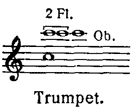
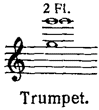
Doubling the horns in octaves by clarinets, oboes or flutes often replaces the combination
1 Trumpet 1 Horn (or 2 Horns) | ] | 8.
This is done when it is a question of introducing a rich tone into the upper octave which the trumpet is not capable of imparting. If a single horn is used, the upper part is allotted to 2 clarinets, 2 oboes, or 2 flutes. But if there are two horns playing the lower octave in unison, three or four wind instruments will be necessary above, especially in forte passages:
8 | [ | 2 Ob. or 2 Cl. or 2 Fl. 1 Horn | as well as | 2 Ob. + 1 Cl. 1 Horn | ] | 8; | 2 Fl. + 2 Cl. 2 Horns | ] | 8.
To double a trumpet in the upper octave three or four wind instruments are required, but in the top register two flutes will suffice.
 Playable Books