It is evident that the quartet of horns presents every facility for four-part harmony, perfectly balanced in tone, without doubling the bass in octaves:
Note. In the diagrams of the present section the actual sounds of horns and trumpets are given, as in a piano score, for the sake of simplicity.
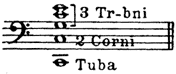
When it is found necessary to double the bass in octaves, the too resonant trombone and tuba are seldom used, the duplication being effected by the bassoon, as explained further on. The quartet of trombones and tuba is not often employed in close four-part harmony; the third trombone and the tuba usually form the bass in octaves, and the three upper parts are generally allotted to the two remaining trombones reinforced by a trumpet or two horns in unison, so as to obtain a perfect balance of tone:
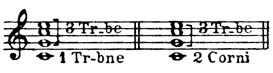
I have often adopted the following combination of brass instruments, and consider it eminently satisfactory: 2 horns and tuba to form the bass in octaves, the three other parts given to the trombones:
In the higher registers, four-part harmony, of which the two upper parts are given to the trumpets, may be completed by two trombones or four horns in pairs:
 Playable Books