 Playable Books
Nikolai Rimsky-Korsakov · section 51 of 100
Duplication in the brass
Read and hear this section in the playable edition →Duplication in the brass group is most frequently effected by placing a chord for horns side by side with the same chord written for trumpets or trombones. The soft round quality of the horns intensifies the tone, and moderates the penetrating timbre of the trumpets and trombones:

Similar juxtaposition of trumpets and trombones:
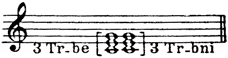
is not so common, as this unites the two most powerful agents in the group.
In handling an orchestra the brass is frequently employed to sustain notes in two or three octaves; this sphere of activity must not be ignored. The tenuto is generally given to two trumpets, or to two or four horns in the octave, (in double octaves). The octave is sometimes formed by trumpets and horns acting together:

The trombone with its ponderous tone rarely takes part in such combinations. Sustained notes in double octaves are usually apportioned thus:
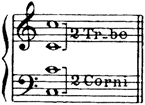
The imperfect balance arising from the duplication of the middle note is compensated for by the mixture of timbres, which lends some unity to the chord.
Examples of harmony in the brass:
a) Independent chords:
Snegourotchka 74—3 Trombones, 2 Horns.
"140—3 Trombones, 2 Horns. Chords in different groups alternately (cf. Ex. 244).
"171—Full brass; further on 3 Trombones (cf. Ex. 97).
"255—4 Horns (stopped).
No. 129. Snegourotchka, before 289—4 Horns.
"289—Full brass.
* Sadko, before 9—Full brass (enclosure of parts).
No. 130. Sadko 175—Mixed timbres (juxtaposition) 3 Horns + 3 Trumpets.
"before 338—Full brass except Tuba.
No. 131."191-193 (Full brass).
No. 132. The Christmas Night, before 180—Full muted brass.
"""181—4 Horns + 3 Trombones + Tuba (cf. Ex. 237).
* The Tsar's Bride 178—Strings and brass alternately (cf. Ex. 242).
* No. 133. Tsar Saltan 102, 7th bar.—2 Trumpets, 2 Trombones + 4 Horns (juxtaposition).
""230—Full brass, thickly scored (cf. Table of chords No. II at the end of Vol. II, Ex. 12).
* Servilia 154—Various brass instruments.
* Legend of Kitesh 130—3 Trumpets, Trombone and Tuba.
No. 134. Legend of Kitesh 199—Short chords (juxtaposition).
* No. 135. The Golden Cockerel 115—Horns, Trombones (enclosure).
b) Harmonic basis:
No. 136. Snegourotchka 79, 6th bar.—4 Horns.
"231—3 Trombones, soft and sweet (cf. Ex. 8).
Antar 64-65—4 Horns; later 3 Trombones (cf. Ex. 32).
* Shéhérazade, 1st movement, A, E, H, K, M—Harmonic bases of different power and timbre (cf. Ex. 192-195).
No. 137. Servilia 93—Full brass.
* No. 138. Tsar Saltan 127—4 muted Horns + 3 Trombones and Tuba con sord. pp.
""before 147—Full brass ff (the 2 Oboes and Eng. horn are of no particular importance).
* Pan Voyevoda 136, 9th bar.—4 Horns, then Trombones, 2 Horns.
* No. 139. Legend of Kitesh 158—Trumpets, Trombones.
No. 140."""248—3 Trombones.
"""before 362—Full brass.