 Playable Books
Arnold Schoenberg · section 6 of 66
The Major Key and Its Diatonic Chords
Read and hear this section in the playable edition →Our major scale, the series of tones c, d, e, f, g, a, b, whose tones also underlay the Greek modes and the church modes, can be explained as having been discovered through imitation of nature; intuition and combination helped reconceive the most important property of the tone—its overtone series, which we imagine arranged vertically, like everything sounding simultaneously—in the horizontal dimension, in what is not simultaneous, in what sounds successively. The natural model, the tone, displays the following properties:
1. A sound is composed of a series of tones sounding along with it, the overtones; thus it forms a chord. For a fundamental C, these overtones are

2. In this series c sounds most strongly, because it occurs most frequently and because, as the fundamental, it also sounds actually—that is, in its own right.
3. After c, g sounds most strongly, because it occurs earlier, and therefore more often, than the other tones.
If we imagine this g realized in sound (as indeed happens in the horizontal manifestations of the overtone series, when, for example, the fifth of a horn tuned in c is blown), then this g, as an actually sounding tone, itself has overtones, namely:

with C, the fundamental of the horn, being the prerequisite for this g together with its overtones. Thus a situation arises in which the overtones of the overtone also begin to take effect.
It follows, then:
4. An actually sounding tone, g, presents itself as dependent on a tone C lying a fifth below it.
This permits the conclusion:
This tone C is likewise dependent on a tone F lying a fifth lower.
If we now take C as the center, the situation of C can be represented by two forces, one pulling downward toward F, the other upward toward G:
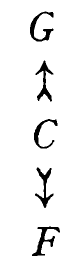
Here the dependence of G on C, which, strictly speaking, also acts in the same direction as the force of F, should be conceived like the force of a person holding on to a beam and thereby counteracting gravity with bodily strength. The person pulls on the beam in the same way and in the same direction as gravity pulls on the person. But the effect is that the person’s strength works against gravity, and this justifies representing the two forces as acting in opposite directions.
I shall speak of this peculiarity again from time to time and draw various conclusions from it. For now, what matters is to establish that these three tones stand in a very close relationship to one another, that they are related. G is the first overtone of C apart from c, and c is that of F. Such an overtone is the one most similar to the fundamental, after the octaves, and thus contributes most to the character of the sound, to its pleasing quality.
If we are justified in assuming that the overtones of G can be realized in sound, we may by analogy apply this assumption to F as well. For F stands to C as C does to G. This explains how the series that could finally be discovered is composed of the most important constituents of a fundamental and its nearest relatives. These nearest relatives are what make it a fixed point in the first place, by maintaining its equilibrium through their forces acting in opposite directions. This series presents itself as a distillation of the distinctive properties of the three factors, as a vertical projection, as an addition:
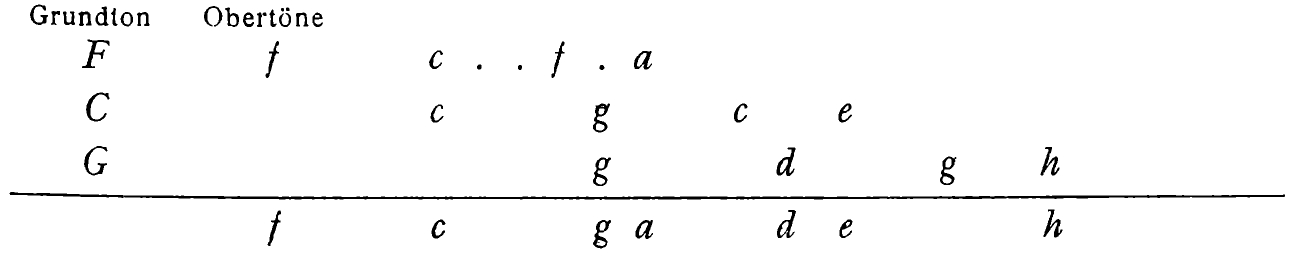
Adding the overtones, with repetitions omitted, yields the seven tones of our scale. Here they are not yet arranged in a series. But that too results if we assume that the more distant overtones also take effect. And this is surely not merely permissible; it is necessary. The ear could also have determined the relative pitch of the tones discovered by comparing them with stretched strings, which become longer or shorter as the tone is lower or higher. But it could also rely on guidance from the more distant overtones. The addition yields:
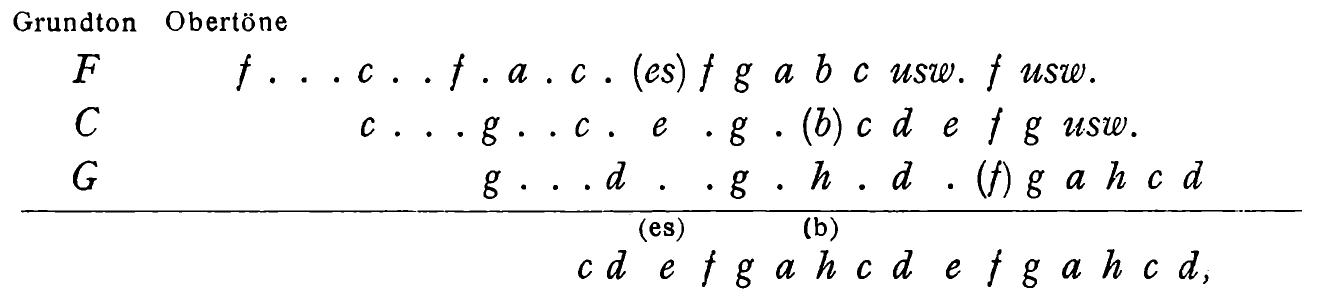
our C-major scale.
An interesting subsidiary result emerges here.
The two tones e and b appear in the first octave clouded by e-flat and b-flat respectively. This explains why it could be doubtful whether the third is consonant, and shows why b-flat and b-natural—German b and h—occur in our musical alphabet. The first octave left one in doubt about which tone was the right one*). The second octave, in which the overtones of F and C must already sound more weakly, decided in favor of e and b-natural.
Whether the pioneers of the art of music discovered this series through intuition or through combination is beyond our judgment and is also immaterial. Nevertheless, one may object to theorists who formulate complicated doctrines that those who made the discoveries must be credited with reflection as well as instinct. It is therefore by no means impossible that the right solution was discovered here by reason alone, and that a share of the credit thus belongs not only to the ear but also to combination. We are not the first to think!
*) This perhaps also explains why there were church modes: people felt the effect of a fundamental but did not know which tone it was, so they tried them all. And the accidentals may be accidents of the chosen key, but not of the natural, underlying one.
The discovery of our scale was a stroke of good fortune for the development of our music: both with regard to its success and in the sense that we might just as well have discovered a different series, as did, for example, the Arabs, the Chinese and Japanese, or the Gypsies. That their music has not developed to such a height as ours need not necessarily be the consequence of their imperfect series of tones; it may also lie in their imperfect instruments or depend on some other accident that must escape judgment in this context. In any case, we do not owe this development to this series of tones alone. And above all: this series of tones is not the ultimate thing, the goal of music, but a provisional stopping place. The overtone series, which led the ear to it, still contains many problems that will require us to come to terms with them. And if we still escape these problems for the moment, we owe that almost entirely to a compromise between the natural intervals and our inability to use them: that compromise called the tempered system, which represents an armistice concluded for an indefinite period. Yet this reduction of the natural relationships to manageable ones will not be able to hold back development in the long run; and the ear will have to occupy itself with the problems because it wants to. Then our scale will be absorbed into a higher order, just as the church modes were absorbed into the major and minor keys. Whether quarter tones, eighth tones, third tones, or, as Busoni thinks, sixth tones will then come, or whether we shall pass directly to a scale of 53 tones calculated by Dr. Robert Neumann,* cannot be predicted. Perhaps this new division of the octave will even be untempered and have little left in common with our scale. In any case, attempts to compose in quarter tones or third tones, such as are undertaken here and there, seem pointless at least as long as there are too few instruments capable of playing them. Probably, when the ear and imagination are ripe for them, the series and the instruments will appear at a single stroke. It is certain that this movement exists today, certain that it will lead to a goal. It may be that many detours and errors will have to be overcome here too, and that these too will lead to exaggerations or to the delusion that something final and unchangeable has now been found. Perhaps here too people will arrive at establishing laws and scales and ascribe to them an eternally valid aesthetic significance. For the farseeing person, even that does not mean the end. He recognizes that any material can be suited to art if it is sufficiently clear that one can work it in accordance with its presumed nature, yet not so clear that no room remains for the imagination in the unexplored regions to establish contact with the universe through mysticism. And since we retain the hope that the world will remain a riddle to our understanding for a long time yet, the end of art has surely not arrived, despite all the Beckmessers.
*) Dr. Robert Neumann tells me, among other things, the following about this: “As more and more of the possible combinations of our 12 tempered degrees are perceived and used as harmony, the stock of unused possibilities gradually becomes exhausted, and finally the need for ever new harmony (and melody) will break through the bounds of the system. New systems of temperament with narrower steps would then probably arise, later perhaps even an independent freedom in the use of every conceivable interval or ratio of vibrations. The division of the octave into 53 equal parts would be one example of a new system of temperament that might one day come into practical consideration: namely, if, when music has developed so far that a need has arisen for a system containing about four times as many tones as the present one, the need should also still exist—or more correctly, exist again—for the purest possible sound of the basic intervals determined by the first overtones, while at the same time one should not wish to forgo the convenience of a temperament. As intermediate stages between the divisions of the octave into 12 and 53, only divisions by multiples of 12 would come into consideration, thus into 24, 36, and 48 parts, since all other numbers of divisions would fail to give a sufficiently accurate fifth. The most immediate prospect, in any case, is a division of each semitone into two equal parts, dividing the octave into 24 parts. A further division in two could then yield 48 parts. 1/48 of an octave and 1/53 are almost the same size, but the 53-part temperament is superior to the 48-part one through the much greater purity of its consonances. The system of 48 naturally has the same basic intervals as our system of temperament in 12 parts, from which it derives. Now our tempered fifth is indeed pure as it stands, but that of the system of 53 is about 28⅔ times purer; the third of the latter is about nine times purer than ours and thus purer than our fifth, which is only seven times purer than the third.”
The average musician will laugh at such reflections and refuse to see their purpose. It is clear that the overtones, just as they led to the division into 12 of the simplest consonance, the octave, will one day also bring about a further differentiation of sound. Music such as today's, since it has not listened to the nature of sound to the very end, will then seem as imperfect to our descendants as music would have to seem to us that does not yet even differentiate within the octave; or, to use a comparison that one need only think through to see how well it fits: like music whose sounds have no depth, no perspective, just as Japanese painting, for example, looks primitive beside ours because the absence of perspective leaves it lacking depth. One day this will change, although not as soon as some think; and in a different way, and not from reasons but from causes: it will come from within, not from without; not by imitating any models and not as a technical achievement. For it is far less a matter of material than a spiritual matter, and for this the spirit must be ready.
The fashion of recent years—playing off the culture of older, Eastern, and exotic peoples against that of Europe—seems to be about to spread to music as well. Whether the achievements of these peoples are in themselves equally great or greater, they nevertheless represent either the higher cultivation of a lower stage of development or the lower cultivation of a higher one; and the true relationship of these cultures to the European, and vice versa, may be compared to the relationship of mounted couriers to optical telegraphy and of the latter to wireless telegraphy. Just as the most primitive form of the second surpasses the highest form of the first in speed, so the most primitive form of the third is superior to the highest form of the second. But whereas technical achievements can almost always be adopted without further ado, and spiritual and cultural ones perhaps sometimes, in the field of music the first difficulty one encounters is the question of what the criteria of a higher culture would be here.
If one assumes that a scale with more degrees signifies a higher stage of development, the greater number of degrees produces so many more possibilities for melodic formation that in all probability the amount of time by which such music is older than ours is quite insufficient to progress much further than the development of combinations in a single voice. Thus any music in several voices there signifies, at best, an unresolved initial stage, comparable to that in which our music stood several centuries ago. Meanwhile our music has exploited the relationships arising from seven tones fairly exhaustively, not only in one voice but also in several voices, while simultaneously developing motivic logic, and is just now on the point of attempting the same with 12 tones. It may readily be conceded that more primitive combinations can express the same thing as more advanced ones. But then this must hold for us too, and then only an expansion of the sphere of ideas could bring us further development. Certainly it should not be overlooked that a succession of tones is already, to a certain degree, a musical idea, and that the number of such ideas is greater the more tones are available. Yet 12 tones, squared through the second dimension, that of several voices, presumably yield as many combinations as 24 tones combined only in one voice, in one dimension. At any rate, they still yield enough to prevent the need for a greater number of scale degrees from arising for the time being.
The matter looks different again, however, if one regards the higher stage as consisting, not in a greater number of scale degrees, but in a greater number of voices: the enlistment of several voices to present the idea and its ramifications. One will have to admit without further ado that such a presentation is at least more concentrated, because, by sounding things simultaneously, it transfers into space at least a part of what is to be presented, for which a single voice also requires time.
If, however, one considers that, besides the requirements of nobility—distinction, uncommonness, and truthfulness—intensity alone can count as a criterion of true art, it becomes clear that one may also dismiss without concern those who have recommended that painting and sculpture imitate exotic and primitive art, down to Black sculpture and children's drawing; and especially those who, lacking all understanding and all concepts, want to turn language too, stripped of concepts, into a quarter-tone art. All such people may be dismissed: they are certainly modern (for they do not know what matters), but they do not belong to the future. For the right moment matters even more to what belongs to the future than to what is modern. Someone who predicts rain and gets the time wrong is a poor prophet; and a doctor who has someone buried before he is dead, or a woman who gives birth to a child before it can live, runs ahead of the times in a manner that sets no example. It is not only tone but also tempo that makes music, and the typical mark of dilettantes in every field and direction is that they are denied all feeling for at least one of the two—tone or tempo.
If the scale is the imitation of the tone horizontally, in succession, then chords are its imitation vertically, in simultaneity. If the scale is analysis, then the chord is synthesis of the tone. A chord is required to consist of three different tones. The simplest such chord is naturally the one that most resembles the simplest and clearest effects of the tone: the major triad, consisting of fundamental, major third, and perfect fifth. It imitates the euphony of the tone by strengthening what is nearer while neglecting what is more remote. It undoubtedly resembles the tone, but no more closely than, for example, Assyrian portrayals of human beings resemble their models. Whether the use of such triads was arrived at by discovering the possibility of having first the fifth and then also the major third sung with the fundamental, thus in a manner of speaking harmonically, or by leading voices so that they came together only on such chords, can hardly be established with certainty any longer today. It is likely that such combinations of sounds were already perceived as euphonious before polyphonic writing could make use of them. Nevertheless, the reverse is not impossible: that single-voiced melody and scales existed before chords, and that the step from one voice to several was made not by placing a chord beneath a tone or a succession of tones in the melody as an accompaniment, but by singing two or three melodies simultaneously, one of which might be the principal melody. However things may have been at music's very beginnings, for our music today both methods, the harmonic and the polyphonic, have driven development equally for at least four hundred years. It is therefore hardly acceptable to build chords on just one of the two principles and present them as though they had developed through self-fertilization, as is usually done in the teaching of harmony; or to explain polyphony purely as voice leading that, within certain limits drawn only by the taste of the time, disregards the meeting of voices in chords, as is done in counterpoint. Rather, the truth is that melodic principles have not merely substantially influenced but often actually determined the development of harmonies, just as harmonic principles have determined the development of possibilities of voice leading. Any consideration that invokes only one or the other principle, however, will encounter events that cannot be accommodated within its system. That is how the many exceptions arise. That is how the many places arise where the teacher must revoke a prohibition incautiously given by granting permission unwillingly. And the many places where the teacher must say, “That is simply how it is and not otherwise,” without being able to give any reason why. Where the pupil must accept as given what the teacher forces upon him and may ask “by name,” but not “by nature.”
At first glance it looks as though this contradicted what I say in the introduction about the task of teaching harmony and in the chapter on “Nonharmonic Tones.” But the contradiction is only apparent. For when I indicate that this or that chord progression is to be explained by melodic causes, that is still very different from a procedure that instructs the pupil to carry something out only melodically because it originated melodically. This is what happens with passing and neighboring notes, which would long since have been regarded as constituents of chords if the system of nonharmonic tones were not so much more convenient.
Considering and judging harmonic events requires a clearly organized classification. This classification will be the more perfect the more legitimate demands it fulfills. Now I find that the long-established method of instruction, if one disregards the fact that it is not a system and can lead only up to a certain point, meets most of the requirements one may reasonably make, and I therefore construct my own considerations in the same way. By first dealing with the diatonic triads, it does indeed start from the simplest structures, and it develops this system appropriately when it follows them with the remaining diatonic chords, those of four and five tones, and then, after showing through the cadence one way of using the diatonic chords, proceeds to the chromatic ones and shows ways of using them too, in modulation and so forth. I shall show later what objections I have to this method. But up to a certain point it is serviceable, and that far I intend to follow it.
The harmonic meaning of a key can be understood in its full extent only in connection with the concept of tonality, which must therefore be explained first. Tonality is a formal possibility arising from the nature of the tonal material: the possibility of achieving a certain completeness through a certain uniformity. For this purpose it is necessary to use, in the course of a piece of music, only such sounds and successions of sounds, and both only in such an arrangement, that their relation to the fundamental of the piece's key, to the tonic, can readily be grasped. I shall also have to come to terms with tonality in several senses as we proceed, so here I can confine myself to setting out just two points: first, that I do not consider it what apparently all theorists before me have considered it—an eternal law, a natural law of music—although this law corresponds to the simplest conditions of the model given by nature, the tone and the fundamental chord; but second, that it is indispensable for the pupil to become thoroughly acquainted with everything upon which this effect rests and with how it is achieved.
When, in a self-contained piece of music, all the chords appear in successions that can be related back to a common fundamental, one may speak of an extension of the idea of sound, conceived vertically, to the horizontal course of events. Everything that follows springs from the fundamental premise, relates back to it even as its opposite, supplements and develops it, and leads back to it, so that it is treated in every respect as the center, as the germ. Even someone who does not believe that such a method of presentation is an unconditional requirement of all presentation whatsoever cannot overlook its value. Thus, for example, not every life story has to begin with the birth or even the ancestors of its hero and end with his death. Such completeness is not indispensable and may immediately be dispensed with when the presentation serves a different intention, such as showing a particular characteristic period of a life. Whether relating all events to the fundamental premise, the fundamental chord, must be described as an inescapable constraint because, as stated, it ensures a good effect through formal completeness and corresponds to the simplest conditions of the material may well be doubted, once the question is raised whether it does not correspond merely to the simpler conditions; and especially whether it still corresponds to the more complicated ones as well. To form a judgment about this, it is not yet necessary, nor is it sufficient, to think of the development sections of sonatas and symphonies, or even of the relationship of harmonies in through-composed operas. One need not even take today's music into account. It is enough to look at a piece of writing by, say, Wagner, Bruckner, or Hugo Wolf to raise the doubt whether, in view of the abundance of factors pointing just as readily elsewhere, the rigidly principled retention of the same fundamental at the beginning and end of a piece is still organic; whether this traditional artistic device is used here merely because it is traditional; whether a formal advantage has thus turned into a formalistic mannerism; whether tonality perhaps signifies the purely outward acknowledgment of a right acquired by long possession more than it springs from a constructive necessity.
But this is what happens to rights acquired by sitting in possession: eventually they are sat through and worn out. Did tonality fare any differently in the church modes? It is easy for us to say today, “The church modes were unnatural, but our keys agree with nature.” In their day, people presumably believed that the church modes agreed with nature too. Besides, how far do our major and minor agree with nature, since they are, after all, a tempered system? And what about those parts that do not agree? Those are precisely where revolutionary change begins. In the church modes there were factors of this kind that pressed toward dissolution; we can easily recognize them today. For example, the circumstance that the final chords were almost always major chords, although in Dorian, Aeolian, and Phrygian, minor chords would have been diatonic. Does it not look as though at the end the fundamental freed itself from the unnatural constraint imposed upon it and, by asserting its overtones, recalled its natural euphony? Perhaps it was this phenomenon that effaced the differences between the individual church modes so far that only two principal characters remained, major and minor, containing everything that constituted the distinctive character of the seven series. We have similar phenomena in our major and minor. Above all, in every key, under the pretext of a digression, one can introduce almost everything that is diatonic in other, very remote keys—this is called extended tonality. Indeed, one can express the key almost exclusively through chords other than its diatonic ones without therefore regarding tonality as suspended. But does it then really still exist? “Real, that is: effective,” as an effect of the fundamental? Or is it not in fact already suspended by this?
Nevertheless, as I have said, it is necessary for the pupil to learn to handle the artistic device by which tonality is established. Not only has development not yet advanced so far that one could already speak of the deposition of tonality; the necessity of explaining its conditions also arises from the need to recognize its effects in the creations of earlier art. Even if the present allows us to glimpse a future that has freed itself from the restrictive constraint of this principle, it nevertheless remains one of the most important artistic means even today, and much more so in our art's past. It is one of the means that contribute most to securing for works that order appropriate to their material which so greatly facilitates the undisturbed enjoyment of the more essential beauties they contain. One of the noblest tasks of teaching is to awaken a sense of the past and at the same time open a view of the future. In this way it may be historical: by establishing connections between what has been, what is, and what presumably will be. The historian can become productive when he offers an understanding of history rather than historical dates, when he does not confine himself to simple enumeration but strives to read the future from the past.
Applied to our case, this means: let the pupil learn the laws and effects of tonality as though they still ruled today, but let him know of the movements that lead to its suspension. Let him know that the conditions for the dissolution of the system are contained within the conditions by which it is founded. Let him know that everything living contains what changes, develops, and dissolves it. Life and death are contained equally in the germ. What lies between is time. Thus nothing essential, but merely a measure, which nevertheless necessarily runs its course. Let him learn from this example to recognize what is eternal: change; and what is temporal: persistence. He will thus come to see that much of what has been taken as aesthetic—that is, as the necessary foundation of the beautiful—is by no means always grounded in the nature of things. That it is the imperfection of our senses that forces us into those compromises through which we achieve order. Because order is demanded by the subject, not by the object. That the many laws that would gladly pass themselves off as natural laws therefore arise from the endeavor to work the material correctly as a craftsman. And that trimming what the artist really wants to present, reducing it to those bounds which enclose form, artistic form, is conditioned solely by our inability to comprehend what cannot be surveyed, what is unordered. The order that we call artistic form is not an end in itself, but an expedient. As such it is certainly justified, but it must be rejected entirely where it claims to be something more: aesthetics. This is not to say that a work of art may ever lack order, clarity, and comprehensibility, but rather that it is not only what we understand as such that deserves these names. For nature is beautiful even where we do not understand it and where it seems unordered to us. Once one is cured of the delusion that the artist creates for the sake of beauty, and recognizes that only the need to produce compels him to bring forth what may afterward be called beauty, one also understands that comprehensibility and clarity are not conditions the artist needs to impose on the work of art, but ones the observer wishes to find fulfilled. Even the unpracticed observer finds them in works that have long been familiar to him, such as all the older masterpieces; here he has had time to adapt. With newer works, initially unfamiliar, he must be given time. But since the distance between the genius's anticipatory, clairvoyant insight and that of others, although relatively very great—that is, in relation to his contemporaries—is absolutely very small in relation to the development of the human mind, that connection which brings the once incomprehensible closer is always established in the end. Once one has understood, one searches for the reasons, finds the order, sees the clarity. It is there incidentally, not by law, not necessarily. And what we seek to recognize as its laws may perhaps be only laws according to which we recognize, without therefore being the laws that the work of art would have to fulfill. And our belief that we see them in the work of art may be like our thinking we see ourselves in a mirror, although we are not inside it. The work of art can reflect what one sees in it. The conditions that our faculty of comprehension imposes, a reflection of this constitution of ours, may be visible in it. But this reflection shows not the work of art's plan of orientation, but the plan of our method of orienting ourselves. Now if the work of art stands in the same relation to its creator, if it reflects what he sees in it, then the laws he believes he perceives may likewise be only those that were present in his imagination, and not those peculiar to his work. And his statement about his formal intentions could be relatively insignificant. It may be subjectively correct, but not necessarily objectively so. One need only look into the mirror with a different circle of ideas to be able to believe once again that its reflection is the image of the work of art, whereas it is that of the observer, but a different one from before. Although one may now assume with certainty that the observer will not see something wholly different in the work of art from what is in it, since there is interaction between object and subject, the possibility of deception is still too great for us to relinquish every doubt whether the supposed order is not that of the subject. Yet one can at least recognize the observer's condition from it.
It certainly cannot be maintained that the fulfillment of such laws, which may moreover correspond only to the observer's condition, guarantees the creation of a work of art. This is also because these laws, even if they are the right ones, are not the only ones the work of art obeys. But even though following them cannot help the pupil attain clarity, comprehensibility, and beauty, it will nevertheless enable him to avoid obscurity, incomprehensibility, and ugliness. The positive achievement of a work of art depends on conditions other than those expressed in the laws as well, and cannot be attained by way of the laws. Yet even something negative is a gain, since avoiding circumstances that presumably prevent artistic values from arising is suited to providing the pupil with a foundation. Not one that promotes creation, but one that can regulate it, if it can be regulated! And teaching achieves one other thing when it proceeds in this way: it leads the pupil through all those errors that the striving for knowledge has brought with it, past errors, perhaps also past truths. In any case, however, it acquaints him with the way the search was conducted, the methods of thought, the kinds of errors, the way small truths of locally limited probability became absolutely untrue when stretched into a system. In a word, all that constitutes our manner of thinking. Through this, teaching is able to teach him to love even the errors, provided they have accomplished work of thought, exchange, intellectual metabolism. And in this way he learns to love the work of his forebears, even if he cannot apply it directly to his own life, even if he has to transpose it to achieve some distant practical application. He learns to love it, whether it be truth or error, because he finds necessity in it. And he sees beauty in that eternal struggle for truth, recognizes that fulfillment is always the goal of longing, but could easily be the end of beauty; understands that harmony—equilibrium—is not the immobility of inactive factors, but a balance of forces strained to the utmost. Teaching should introduce him to life, in which such forces and such struggles exist. To portray life in art with its mobility, its possibilities and necessities of change, to acknowledge development, change, as the sole eternal law, must have a more fruitful effect than assuming an end to development because that rounds off the system.
I therefore approach the presentation of harmonic relationships by respectfully following the errors of the ancients along their paths, conscious that discussing even concepts whose application is receding into the background today will be useful to the pupil in the sense set out above. In what follows, therefore, I shall, for example, strive for tonality with every conceivable means, and I hope to be able to name some means that perhaps have not been mentioned before.