Playable Books
Arnold Schoenberg · section 39 of 66
Meter and Harmony
Read and hear this section in the playable edition →Up to now we have carried out the exercises without regard to division into bars. At bottom I should have liked best to continue the work in the same way; for there are only a very few directions, even in the older theory of harmony, that relate to rhythm, and even these hardly apply any longer to the music of Johann Sebastian Bach—at least for the most part. But in the music of, say, Beethoven, or still more of Schumann or Brahms, the very opposite of what these laws demand is true. Obviously, however, it cannot possibly be the task of a harmony textbook of today to set up new laws. At most one could try to arrange according to common characteristics the many, the countless many ways in which harmony and rhythm enter into relation with each other. Whether a unified principle could emerge from that I must doubt. I believe it would be just as hard as if someone wanted to find a key to all the possibilities of the light and shadow relations of a particular object, at all times of day and seasons of the year, taking into account every conceivable form of cloud, and so on. And just as superfluous! Most of the rhythmic laws of the old theory are restrictions, never encouragements; they never show how one should combine, only how one should not. And these restrictions have almost exclusively the purpose of avoiding or concealing certain harshnesses of harmony (which, however, are no longer harshnesses for us). Sometimes also the opposite purpose: to place a harshness so that it produces an accent. In preserving old laws that have had even the slightest influence on our music of today I have certainly been somewhat pedantic. But these laws have for the most part disappeared or been turned into their opposite. So away with them.
Harmony textbooks probably call in the division into bars in order to be able to set those familiar tasks according to which a harmonic skeleton is to be clothed with passing notes, changing notes and other ornaments. This method recalls the kind of master-builder architecture that, in imitation forgetful of all meaning—for the technical reasons and the imagination of the masters whose models it apes are foreign to it—plasters every smooth, straight surface with cheap factory-made stucco merely because it cannot bear what is smooth and straight; naturally I shall not recommend this method to the student. When I come to speak of non-harmonic tones, embellishments and the like in this theory of harmony, it will be in an entirely different sense. The notion that one may obtain moving voices in such a way has, for anyone accustomed to thinking in independent voices, something so ridiculous about it that I could not bring myself to this exercise even if it brought some advantage. But should someone find that one does not, after all, compose by sketching roots and then setting harmonies over them, this objection is disposed of by the undoubted unpretentiousness of our exercises, which in no way invite comparison with composing. Their resemblance to composing does indeed consist only in this, that here as there chords are strung together; and they, just like the ornamentation of voice leading, differ from creative activity as what is calculated differs from what is invented; but our exercises nevertheless stand morally higher. For, to return to our comparison, they are of similar value to an architect's practising the drawing of ground plans, in which he trains himself in a suitable way for his principal task; in the other exercise, however, the student resembles an architect who, in an empty space, wherever he finds the slightest opportunity, puts down some ornament or other that has stuck in his memory, without asking about meaning or occasion. The recognition that the only occasion, the only motor for independent movement of the voices may be solely the driving force of the motive, and not the cheap pleasure in cheap ornament, in cheap decoration, compels me to condemn a task whose solution at best achieves that kitschy sham art which everyone who strives for truthfulness must hate. The art of those who always find out so quickly "how it is done", but never "what it is". But apart from that, this does not belong in the theory of harmony but—if it belongs in art and its teaching at all—in counterpoint. Yet, characteristically, it is not taught there. It looks as though someone who teaches counterpoint cannot, after all, be so lacking in seriousness as someone who merely writes a harmony textbook, and the very occupation with this much more serious subject brings with it that the idea that one may produce the semblance of moving voices in this way—that one may produce a semblance at all—is suppressed from the outset. That is probably why, and because they want to help people acquire an examination certificate, all harmony textbooks do it. Not all counterpoint books refrain from it, to be sure, but almost all do; but some authors—I will not name them, so that one may have the chance of soon forgetting them—cannot rest because of the teaching and other success of their pedagogical colleagues on the lower level; they cannot see why counterpoint should not be taught just as badly as harmony, and so these authors teach—so far can things go when all meaning evaporates from the essence—how to present a sham life with sham voices over sham harmonies*).
*) To what extent people are losing the awareness of meaning can be attested by the following two examples, picked at random. The first: a Straße (road) is the overland connection between two enclosed places. But ever since, in keeping with the volume of traffic, the ways in the city have been made longer and wider, the designation Gasse (street, lane) has been disappearing more and more and will soon no longer appear in the Germans' dictionary.—The second: people criticize young cities because their Straßen, properly Gassen, run in straight lines and meet at right angles: that, they say, is not beautiful. But Gassen do not aim to be beautiful; they are the successive intervals between rows of houses and serve to provide a connection from every house to every house and to give access to every house. Where one can—on level ground—one lays out Gassen in straight lines, for the straight line is the shortest distance between two points in our earthly geometry. That saves time, money and labour. Where one cannot—on undulating, hilly ground, when the municipality cannot raise the money for levelling—the Gasse follows not so much the former footpaths as the carriage roads, and reaches the summits in the way the lungs of people and horses require, by gradually making wide curves around every considerable rise. This is how the beauty of the townscape comes about in old cities. I am as far from disputing this beauty as the opposite beauty of the young cities. Both are beautiful in the same respect; those who laid them out fully did their duty by doing the practical thing without other consideration. As a reward for this the Lord God granted the beholder the ability to forget what is meaningful and to find the practical beautiful. But, for all the pleasure in this beauty: how far may that forgetting go? I often had to go, and in great haste, to a centrally situated house in a new villa quarter (Cottage) of a large German city, and saw my patience put to a severe test: this house could be reached only by long detours. The Gassen (called Straßen, of course) were laid out roughly like the paths in a park from the time of "Louis XIV". The culture to which the second generation rises through much reading, with the help of the first generation's money, is certainly remarkable; but I fear that the first, which read less, will have complained as often as, because of the many detours, it reached the stock exchange a few minutes too late.
The preceding investigations yield no motive that could induce me to consider the relation between meter and harmony in more detail. Add to this that music is on the same path in rhythm as in harmony. In the last 150 years it has not been content to let its wisdom derive from caution, but has preferred to extend its knowledge through bold discoveries. As a result the distance between harmonic and rhythmic understanding has changed in exact proportion to the one that already existed earlier, and has become exceedingly great: if the theory of harmony, starting from a much higher level, could not keep up with the rapid development, the theory of rhythm naturally fell behind to a considerably greater degree.
What the tasks and prospects of theoretical investigations in the field of rhythm can be may be illuminated by the following consideration:
Division into bars corresponds to something natural that has been developed further by art. It is most natural insofar as it imitates the rhythm of speech or of other natural sounds. It becomes artificial (and thereby soon unnatural) where the laws of the system, breeding in and in, split off new laws out of themselves; where pure mathematics begins. Of course, the artful also arises in this way. But as soon as the system presumes to be the standard also for the artful that newly arises from the rhythm of nature, one is entitled to extinguish the feeble spark that indicates the life of this sham being. And this spark is indeed feeble. For if one asks why we measure time for music at all, the only possible answer is: because otherwise we could not represent it. We measure it in order to make it more like ourselves, in order to limit it. We can reproduce only what is limited. But the imagination can conceive the unlimited, or at least the seemingly unlimited. In art, therefore, we always render something unlimited by means of something limited. Add to this that the musical method of measuring time is extremely inadequate: it works, so to speak, by eye. This, admittedly, is a defect that is almost capable of correcting the first. The fluctuation of our counting units, which are measured by feeling, approaches, if in a clumsy way, that freedom of the immeasurable. Perhaps because it is measured by feeling. And we correct in the same way through accents, accelerations, slowings, displacements and so on. But we nevertheless believe too firmly in the rigid line of the arbitrarily chosen standard to be able to do justice to the irregularity of free, natural rhythm, or to its probably much more complicated regularity, which may well be composed according to higher numerical laws. It is understandable that combination should take possession of the simple numerical ratios of our standard; it is probable that it thereby even comes closer to free rhythm. But let it beware of holding its meagre foundations to be sufficient and of proclaiming that all music must rest on them. Musical division of time would remain primitive in relation to its models even if it rested on more complicated arithmetical premises. How much more so, since until recently multiples of 2 and 3 still sufficed it for combination. For it is not long since 5 and 7 have occurred, and 11 and 13 do not exist yet. But—and this cannot be emphasized enough—however suitable the use of unusual meters may be for creating an aura of originality, true novelty can by no means be attained by that alone. An eighth note more or less does not make a worn-out idea fit for use again; rhythmic originality, on the other hand, can exist in ordinary four-four time.
It is certainly to be expected that we shall not stop at the numbers 2, 3, 5 and 7. Especially not, since the last twenty years have shown what the sense of measure grows accustomed to, how quickly almost every musician learns the most complicated divisions, and how much such things are taken for granted by listeners and players today. The productive mind sets out on a search in the field of rhythm too, and strives to represent what nature—its own nature—gives it as models. That is why our divisions into bars, their primitive imitation of nature, their simple method of counting, have long ceased to satisfy our rhythmic needs. Our imagination disregards the bar lines: through displacements of accent, through stringing together different meters, and the like. And yet an author cannot give a performable picture of the rhythms he really has in mind. The future will bring something different here too. The old system still binds, to be sure, but today it no longer simplifies the notation; it makes it more complicated. Anyone who looks at the rhythmic notation of a modern composition can convince himself of this.
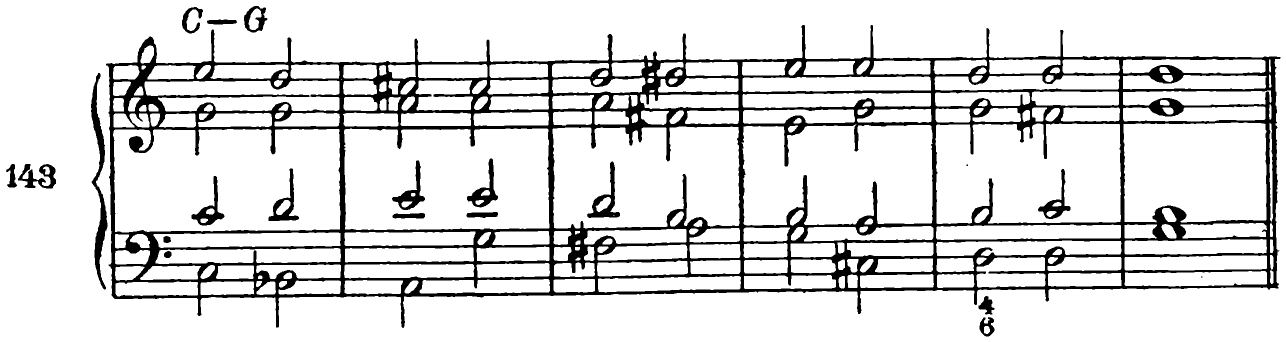
It will be evident that there is not much to say about laws relating to rhythm; that it is enough to deal with two rules which were still half alive in the nineteenth century and are therefore suited to furthering the formal effect of our examples. The one law concerns the pedal point; this will be discussed only in the next chapter. The other concerns the six-four chord that appears in the cadence as a retardation before the dominant seventh chord. This should be placed only on the good (accented) beat*). The dominant seventh chord then comes on two, the final chord on one. Admittedly the final chord often enough appears on a light beat as well.
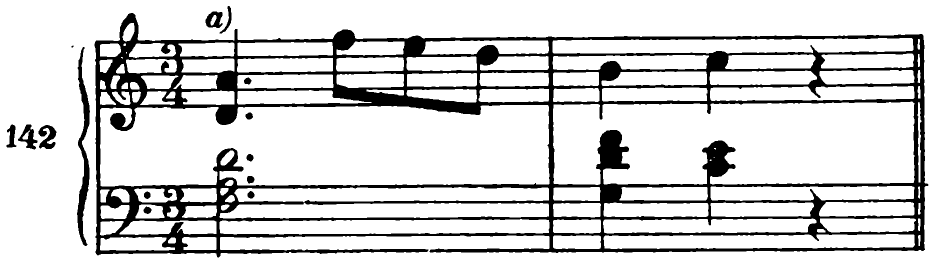
*) In every meter the first beat is accented (good, strong, heavy); in duple meters the second, in triple meters the second and third, are unaccented (bad, weak, light). In compound meters (4/4, 8/4, 6/4, 6/8, etc.) and in the subdivision of the larger values, the relation of accents is governed in the same way by whether two or three form a unit, or respectively whether the division is by two or by three.
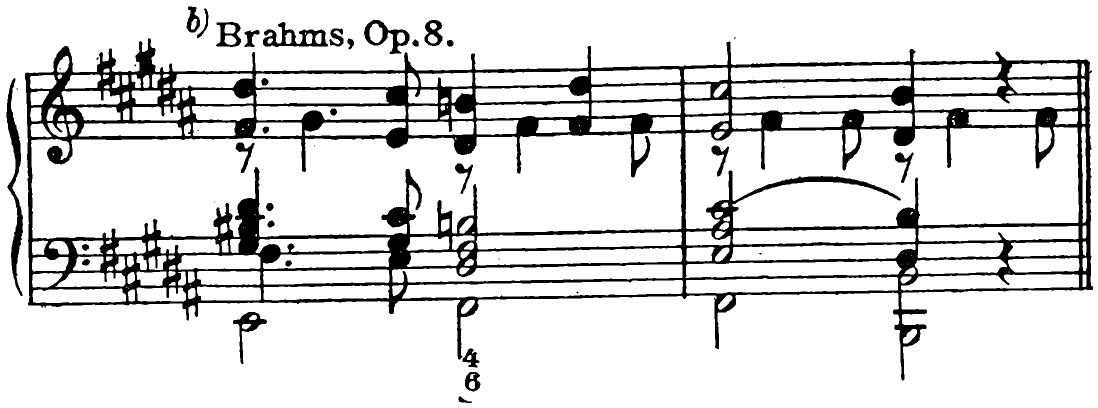
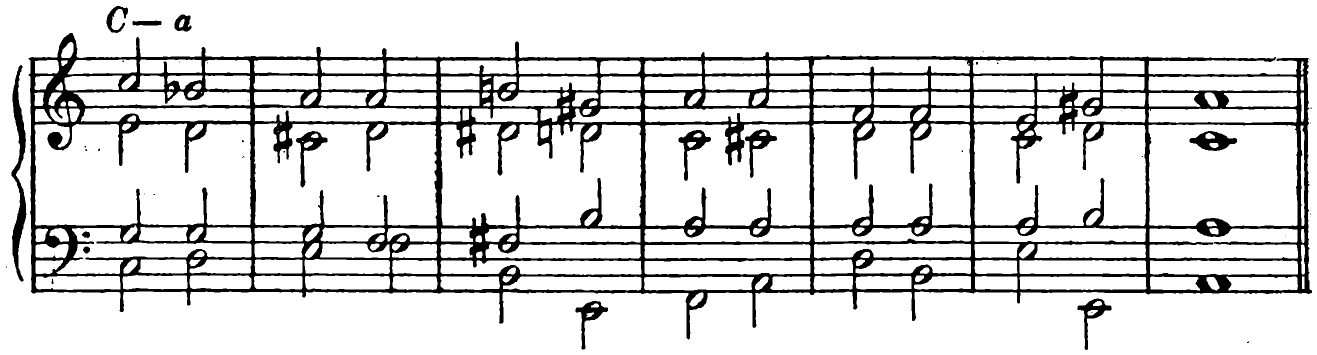
In such cases, and in other cases of rhythmic displacement and change of accent where the bar is often no more than a method of counting, it then sometimes happens that the six-four chord stands on the light beat as well. So this is not a universally valid law. But insofar as the six-four chord is used at all in modern music, it is almost universally valid. As I said, it is a matter of the six-four chord in the cadence. The other six-four chord, the one that occurs in passing, is naturally free and can stand on one as well as on two. For the student, however, it is advisable to avoid the passing six-four chord on one, so as to avoid confusions from which he cannot yet draw any artistic benefit. For the rest I can dispense with giving other rhythmic laws, and the student can now do his exercises with division into bars. Best of all—since for us it is a matter not of rhythmic effects but only of harmonic ones—by writing a half note for each harmony and putting two such half notes in a 4/4 bar.