 Playable Books
Mayank Sanganeria · section 6 of 12
Chapter 5 — Outlines
Read and hear this section in the playable edition →An outline is an arpeggio that starts on an arrival and ends one step from the next. In this book's terms it's a 4-slot unit: an arrival on beat 3 plus a 3-slot cell built from chord tones and tensions. Ligon's key insight is that the best bebop arpeggios are chosen for where they end, not where they start.
Four core outlines
Each outline is named for the chord degrees it starts and ends on. All four put chord tones of the current chord on beats 3 and 4 and color on the upbeats, so the grid and the voice-leading agree without any extra rule.
Ex. 5.1 — Four outlines, each shown from beat 3 to the next downbeat. The slur marks the gesture crossing the bar line.

3-to-9 (Dm7 to G7). F A C E is 3, 5, 7, 9 of Dm7. The 9 sits a half step under F, so the line resolves up to the 7th of G7, an octave above where it started. It's Strand A at both ends, with an octave in between.
3-to-♭9 (G7 to Cmaj7). B D F A♭ is 3, 5, 7, ♭9 of G7. Those four notes form a diminished seventh chord, so the line implies G7♭9 without the rhythm section changing anything. A♭ falls a half step to G, the 5th of C. Landing on the 5th is the exception to the 3-and-7 preference, and this outline is the main reason it's common.
1-to-7 (G7 to Cmaj7). G B D F is the plainest outline and the clearest lesson. The 7th sits in the pickup slot and falls to the 3rd across the bar line: Ligon's guide-tone resolution riding Galper's pickup-to-arrival rhythm.
3-to-♭5 (G7 to Cmaj7). B A♭ F D♭ is a D♭7 arpeggio played downward from its 7th. Over G7 it reads 3, ♭9, 7, ♭5: the tritone substitution, delivered entirely in the line. D♭ falls a half step to C.
Phrase across the bar line
Phrase each outline from beat 3 through the next beat 1 as one gesture. The common mistake is hearing it as the end of the current bar, a flourish that trails off. Heard Galper's way, it's the start of the next bar. Breathe before beat 3, not after it.
Chaining outlines
Outlines link through arrivals. Between them, use a 3-slot cell or a runway.
Ex. 5.2 — Outlines chained through a ii–V–I. Bar 1: an arrival on D, a 3-slot cell into F, then the 3-to-9 outline. Bar 2: an arrival on F, a runway down to B, then the 3-to-♭9 outline into G.
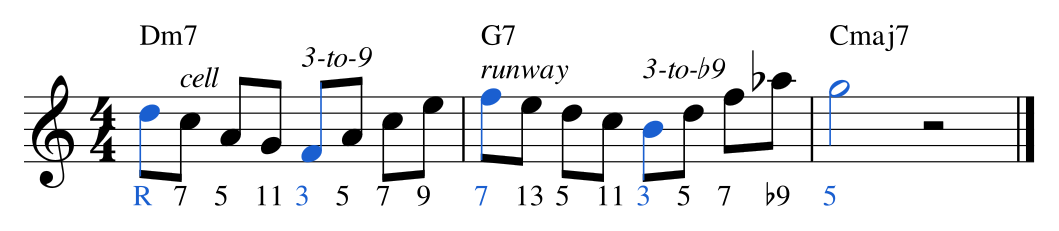
The arrivals spell D, F, F, B, G. Bar 1 begins on the root and reaches Strand A by beat 3. Bar 2 carries Strand A on beat 1 and Strand B on beat 3, and the final outline delivers the 5th of Cmaj7. Every note between the blue notes exists to connect them.
The outline is also where the slot budget earns its keep. In bar 1 the budget is 3 + 3, and the line spends the first three slots on a cell and the second three on the arpeggio's upper notes. In bar 2 it spends the first three on a runway. The same bar could be filled a dozen other ways; the arrivals would stay put.
Drill
Learn each outline in 12 keys, then chain them in pairs through ii–V–I. For the first month, never start an outline on beat 1. Starting on beat 3 forces you to feel it as a pickup into the bar line, which is the whole point.