 Playable Books
Mayank Sanganeria · section 5 of 12
Chapter 4 — Approach Grammar
Read and hear this section in the playable edition →A cell is a pickup gesture that ends in an arrival. Ligon catalogs these figures by pitch shape; this book indexes them by span, the number of eighth-note slots they occupy before the target. Span is the bridge between the two axes. The grid gives you a budget, and the budget tells you which cells fit.
Spelling shapes
Shapes are spelled relative to the target: + is above, − is below, d is a diatonic step (the next scale tone, whole or half step) and c is a chromatic half step. "+d −c" means the scale step above the target, then the half step below it, then the target. That's the classic enclosure.
When the target sits a half step below the next scale tone (E under F, B under C), the diatonic step above is already a half step, so +d and +c are the same note. Spell the shape by direction and let the key decide the interval.
In the examples below, each fragment shows beats 3 and 4 of a G7 bar, then the next downbeat. B, the 3rd of G7, sits on beat 3 so that only the cell changes from fragment to fragment. The target is always E, the 3rd of Cmaj7.
Span 1: one note
A single upbeat on the & of 4. It's the lightest approach and the most common.
Ex. 4.1 — Span-1 cells into E: chromatic below (−c), step above (+d) and step below (−d).
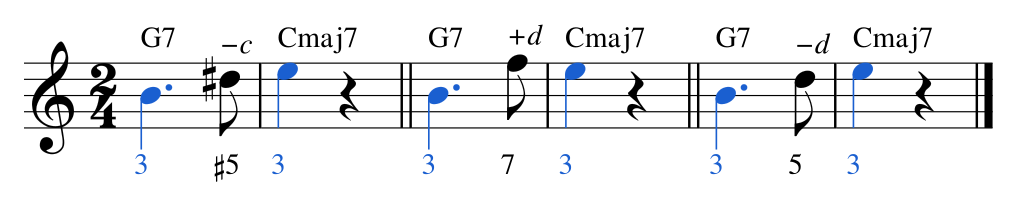
The chromatic approach from below (D♯) is the strongest: a half step aimed upward at the target. The step above (F) is the guide-tone resolution itself, the 7th of G7 falling to the 3rd of C. The step below (D) is the weakest. It's a whole step, and as the 5th of G7 it doesn't lean anywhere.
Span 2: two notes
Two notes starting on beat 4. This is enclosure territory.
Ex. 4.2 — Span-2 cells into E: two enclosures, a double approach from below and a chromatic descent from above.

The enclosures (+d −c and −c +d) surround the target from both sides, so the ear knows where the line is going before it gets there. The double approach (D–D♯) climbs into the target. The chromatic descent (F♯–F) falls into it, passing through F♯, the major 7th of G7. That clash is fine because the note is moving, not landing: any pitch is acceptable on its way to an arrival.
Span 3: three notes
Three notes starting on the & of 3.
Ex. 4.3 — Span-3 cells into E: an extended enclosure, a chord-tone lead into an enclosure and a three-note chromatic descent.

The extended enclosure (F–D–D♯) circles the target: above, a step below, then a half step below. The chord-tone lead (G–F–D♯) starts on the root of G7, then encloses. The chromatic descent (G–F♯–F) is the most bebop-sounding of the three, with F, the 7th, falling on beat 4.
Why spans stop at three
A 4-slot cell would start on beat 3, and beat 3 is an arrival. So anything longer than three slots isn't a cell at all. It's an arrival followed by a 3-slot cell. That is exactly what Ligon's outlines are (Chapter 5), and what scale runs become once they're aligned (Chapter 6).
This gives the whole system a recursive shape. A line is arrivals joined by cells of span 1 to 3, nothing more. Longer figures are several arrivals and cells chained together.
Cells double as tensions
Every cell note sounds against the chord playing at that moment, usually the V. Read the numbers in Ex. 4.1–4.3: D♯ over G7 is ♯5, F♯ is Δ7, and in Ex. 4.4 below, A♯ is ♯9. Chromatic approach tones aren't wrong notes made right by resolution. They're altered-dominant color with a resolution built in. This is why bebop lines sound harmonically rich without the player thinking about altered scales at all.
Held targets
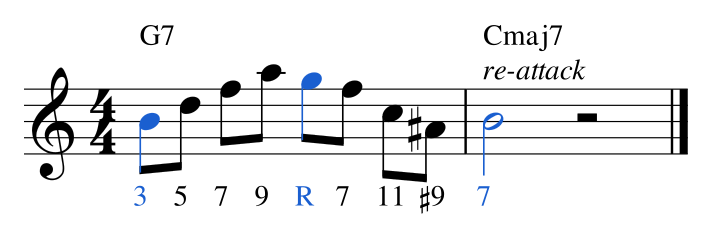
Strand B holds B from G7 into Cmaj7. A held target still gets a cell: re-attack it.
Ex. 4.4 — B, the 3rd of G7, re-attacked as the 7th of Cmaj7. The enclosure C–A♯ tells the ear the function has changed even though the pitch hasn't.
Drill: the cell matrix
Over G7 to Cmaj7, put B on beat 3, then play all ten cells into E. That's one fixed arrival, one budget and ten ways to spend it. Then change the target to G, then to B re-attacked, and work through 12 keys. Finally, mix spans: one chorus of span 1, one of span 2, one of span 3, then free choice.