 Playable Books
Mayank Sanganeria · section 7 of 12
Chapter 6 — Scales as Runways
Read and hear this section in the playable edition →A scale run is a runway: a stepwise stretch that has to touch down on chord tones at the right moments. Galper's alignment rule and the bebop scales are the same idea stated two ways, and a single rule produces both.
Why plain scales misalign
A seven-note scale over a four-note chord mostly alternates chord tone, non-chord tone. At eighth-note speed, starting on a chord tone on a beat, that puts chord tones on every beat until the run reaches the one place where two chord tones sit a step apart. There the alternation flips, and every beat after it lands on a tension.
Ex. 6.1 — G Mixolydian descending from G, plain and plugged. Plain: the beats carry R, 13, 11 and 9, and the run lands on F, the 11th of Cmaj7. Plugged: F♯ between G and F keeps R, 7, 5 and 3 on the beats, and the run lands on G.
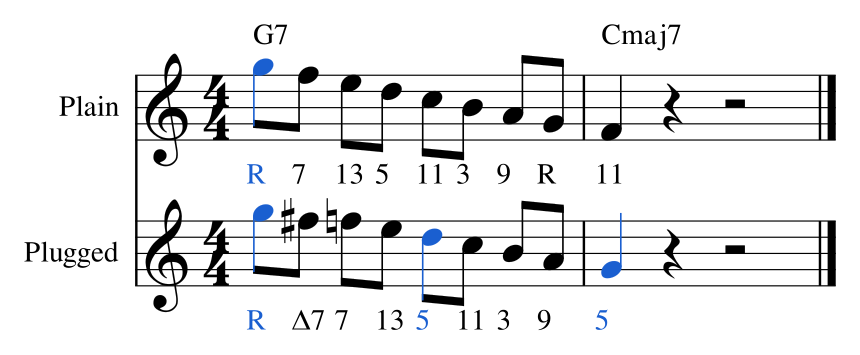
In the plain version, the step from G to F (root to 7th, both chord tones) pushes everything off the beat from the second note on. The run sounds aimless and arrives on the avoid note of Cmaj7. One chromatic passing tone fixes all of it.
The gap rule
Find the adjacent chord-tone pair in the scale and plug the gap with a chromatic passing tone. A run that starts on a chord tone on a beat then stays aligned for a full bar, in either direction.
The Cmaj7 row explains a design choice that usually goes unexplained. The major bebop scale is built on the 6 chord because a major 7th chord has no whole-step gap between adjacent chord tones, so there's nowhere to put a plug.
Ex. 6.2 — Three plugged runways: D Dorian descending (C♯ between D and C), C6 bebop descending (A♭ between A and G) and dominant bebop ascending (F♯ between F and G).
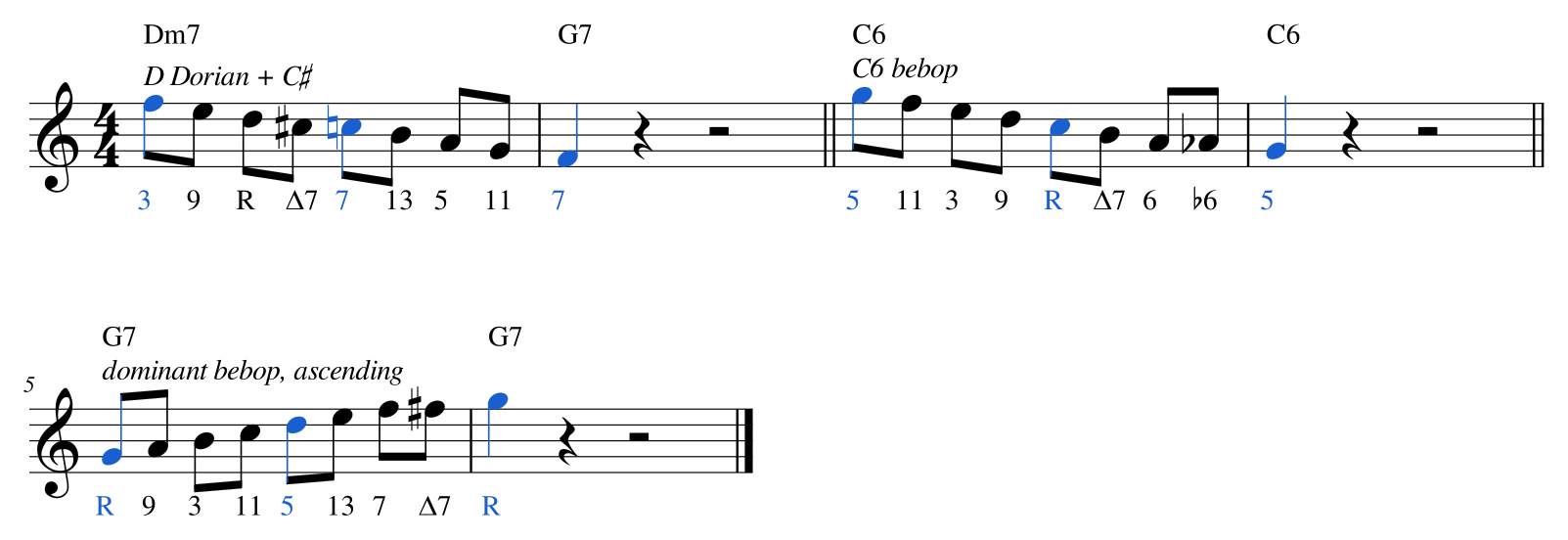
Look at the ascending dominant run. Starting on G on beat 1, the plain scale is aligned until the very end, where F and G collide. The F♯ goes on the last upbeat, which makes it a perfect pickup into the next bar's G. Here the plug and the pickup are the same note.
Other ways to re-align
The plug costs nothing rhythmically, which is why bebop players leaned on it so hard. The alternatives each shift the line by one slot:
- Reverse direction on a chord tone.
- Skip a scale tone with a leap of a third.
- Fit in a triplet to absorb an extra note.
- Hold one note for a quarter.
Learn all of them. A line that plugs every gap the same way sounds like an exercise.
Runways and the slot budget
A runway's length is set by the budget. From F on beat 1 of G7 down to B on beat 3 is four slots: F, E, D and C, then B. Before you play a runway, count the chord tones along the path, because each one needs a beat. If the count is wrong, shorten the run, lengthen it or plug it.
On the time axis, a runway is just a long pickup. Aim it at where it touches down, not where it takes off.
Deliberate misalignment
Start a run on an upbeat and the chord tones fall on upbeats. The line floats against the time: right notes, wrong places, on purpose.
Ex. 6.3 — A run that starts on the & of 1 floats, with chord tones (F, D, B) on the upbeats and tensions on the beats. A♭, the ♭9 of G7, works as a passing tone on the last upbeat and snaps G onto beat 1 of Cmaj7.
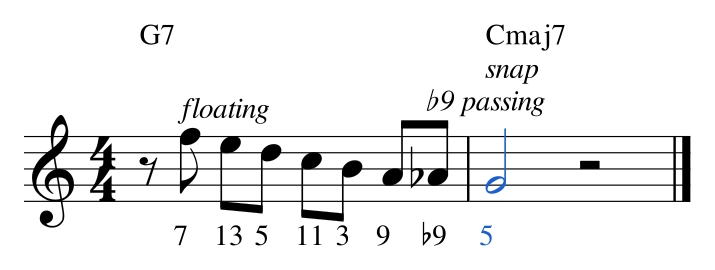
Note that A♭ isn't a gap-rule plug. G7's only gap is between F and G. It's a chromatic passing tone used for a different job: shifting the line by one slot so the next chord tone lands on a beat. Use this kind of float for a few beats, then snap back. The snap is what makes it sound intentional. Chapter 7 turns the idea into a phrasing tool.
Drill
For each chord type, run from every chord tone on beat 1 for a full bar, descending and then ascending, plugging the gap wherever it falls. Say the notes on the beats aloud as you play. Keep at it until misalignment sounds wrong before you can name the note.