 Playable Books
Mayank Sanganeria · section 8 of 12
Chapter 7 — Phrase Architecture
Read and hear this section in the playable edition →Phrases begin on upbeats and end on arrivals. A phrase that starts on beat 1 opens with a landing and has nowhere to go. A phrase that starts on the & of 4 opens with momentum.
Where phrases start
The entry point sets the character of a phrase before its main body has started.
Ex. 7.1 — Four entries into the same arrival, F on beat 1 of Dm7: a one-note pickup, a two-note enclosure, a three-note cell and a half-bar outline (1-to-7 over A7).
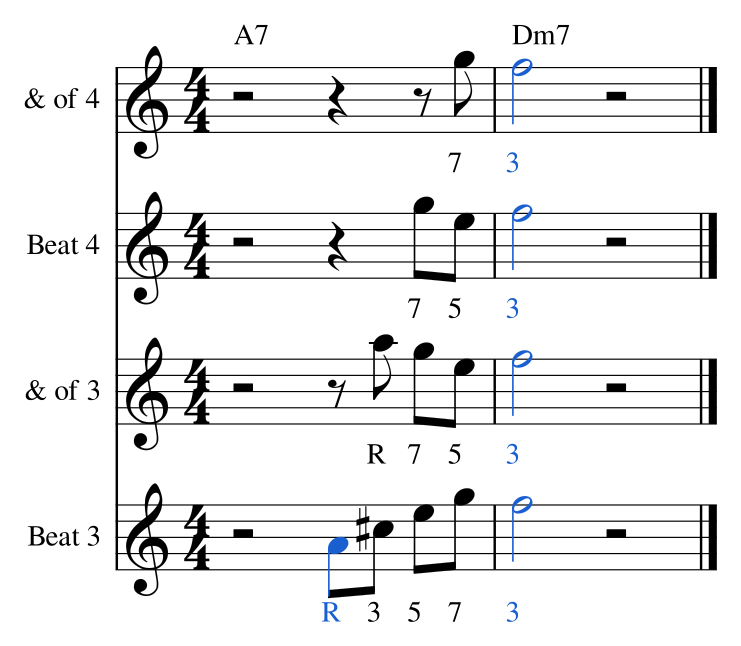
Vary entries on purpose. A solo where every phrase starts on the & of 4 sounds as mechanical as one where every phrase starts on beat 1.
Where phrases end
There are two endings. The long arrival lands on beat 1 or 3 and holds for a quarter note or more, often on the 3rd or 9th. The clipped ending lands on the downbeat, then adds one short, accented note on the next upbeat, a step or third away.
Ex. 7.2 — The same G7 bar ending two ways: a long arrival on E, and a clipped ending, E followed by a short accented C.
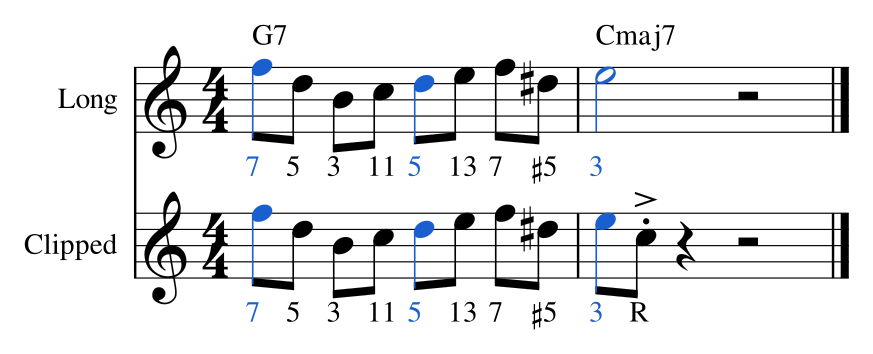
In the clipped ending the arrival still carries the harmony; the clip is punctuation, a full stop. Either way, silence follows. The ear needs a moment to register the landing.
Two- and four-bar arcs
Treat phrases as two- or four-bar units that lean into a final arrival. A two-bar ii–V phrase usually looks like this:
1. A pickup on the & of 4 before bar 1.
2. Bar 1: an arrival on beat 1, a cell or runway, an arrival on beat 3, an outline.
3. Bar 2: an arrival on beat 1, a runway, an arrival on beat 3, a cell.
4. A landing on beat 1 of the next bar, held, then at least two beats of rest.
In a four-bar arc, put the highest note around the three-quarter point and the final arrival on beat 3 of bar 4 or beat 1 of bar 5.
Ex. 7.3 — A four-bar arc over Dm7–G7–Cmaj7–A7, landing on Dm7. The line climbs from F to its peak, B in bar 3, and falls back to F.
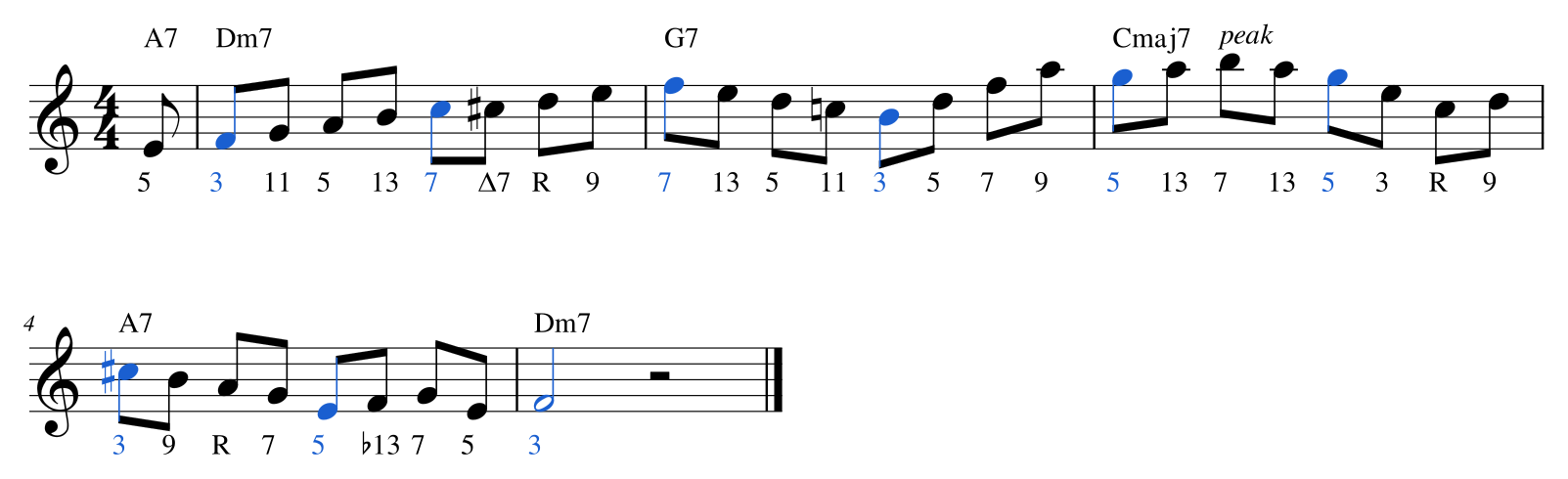
Trace the contour. A one-note pickup leads into a Dorian runway that rises through the C♯ plug. Bar 2 turns at the top, runs down to B and climbs again. Bar 3 reaches the peak and turns down. Bar 4 descends through A7 and ends with an enclosure, G above and E below, into F. Under all that motion, the arrivals never stop: F, C, F, B, G, G, C♯, E, F.
Displacement
Shift a cell and its arrival one slot later and the arrival lands on an upbeat.
Ex. 7.4 — The 1-to-7 outline, aligned and displaced by one eighth. Displaced, F lands on beat 1 of Cmaj7 as an accented 11th and resolves to E one slot late.
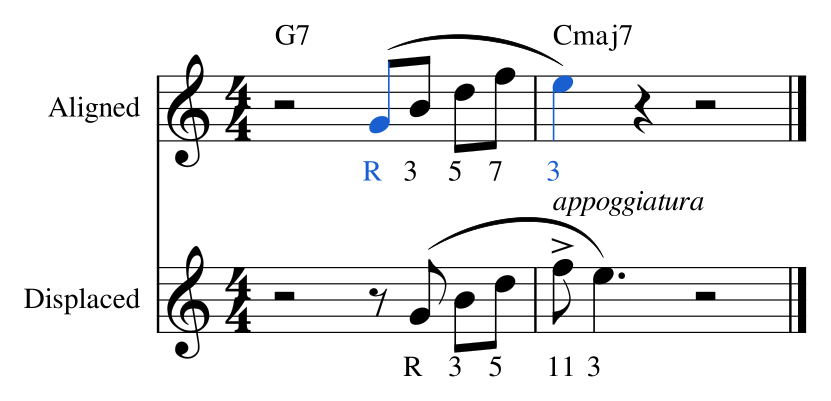
The displaced F is a non-chord tone on the strong beat, resolving down by step: an appoggiatura. Tension on the downbeat, resolution on the upbeat. Use it once a chorus and it sounds intentional. Use it constantly and the time sounds lost.
Groups of three
Repeat a three-note group in eighth notes, and its first note alternates between beats and upbeats.
Ex. 7.5 — The group E–D–C repeated over Cmaj7. Accents mark each group's first note. The cycle starts on beat 1 and returns to a beat 12 slots later, on beat 3 of bar 2.
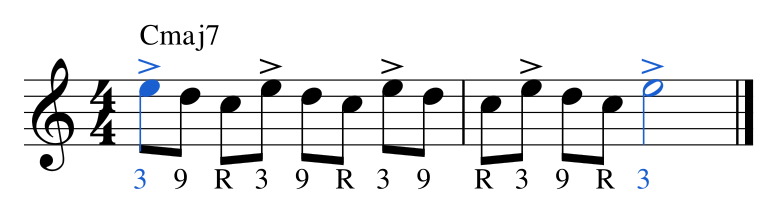
Against the half-note grid, the pattern cycles every 12 slots, a bar and a half. Start the cycle on an arrival and end it on one; everything in between floats. Every pitch here is safe over Cmaj7 (R, 3, 9), but the accents fight the meter, and that's the point. The arrival grid is suspended for six beats, then restored by E on beat 3 of bar 2.
Drill
Take the chained line from Chapter 5. Play it from each of the six entry points, adjusting the pickup to fit. End it once long and once clipped. Then displace its final outline by one slot and let the appoggiatura resolve.