 Playable Books
Mayank Sanganeria · section 9 of 12
Chapter 8 — Time Feel and Articulation
Read and hear this section in the playable edition →Articulation is how the listener hears your arrival grid. The same notes, articulated downbeat-heavy, sound like an exercise. Articulated toward the arrivals, they sound like jazz.
Two pulses at once
Feel the half note and the backbeat at the same time. The line lands on 1 and 3; the rhythm section pushes from 2 and 4. That friction is much of what swing feels like from inside the line. Feel only 2 and 4 and your lines drift toward landing there. Feel only 1 and 3 and you sound square. Feel both.
Articulation rules
- Pair each upbeat with the beat after it. Attack the upbeat and connect it into the beat. Every pair is a miniature pickup and arrival.
- Accent the last pickup before a Level 1 or 2 arrival, usually the & of 4. It throws weight onto the landing.
- Ghost the beats inside runs that aren't structural arrivals, usually beats 2 and 4. They're scenery.
- Accent contour peaks, even on upbeats. The top of a line is heard as an event wherever it falls.
- Land arrivals with a lighter attack and a fuller length. An arrival settles; it doesn't hit.
Ex. 8.1 — A ii–V–I line articulated this way: a slur from each upbeat into the next beat, ghosted notes (in parentheses) on non-structural beats, and accents on the & of 4.

The slurs here mark connection, not phrasing. Tongue or attack the first note of each slur and connect into the second. Horn players will recognize the standard swing tonguing pattern. Pianists and guitarists get the same effect by playing upbeats slightly louder and releasing beats slightly early.
Placement
Practice every line three ways: on top of the beat, centered and laid back. Keep the arrivals consistent and let the pickups breathe. A line that rushes its pickups but places its arrivals cleanly still swings. The reverse never does.
Swing ratio
The long–short ratio of swung eighth notes depends on tempo. It's clearly uneven at medium tempos, roughly a triplet, and flattens toward even as the tempo rises.
Ex. 8.2 — Written eighth notes (top) and their approximate medium-tempo performance (bottom): a triplet quarter and eighth per beat.
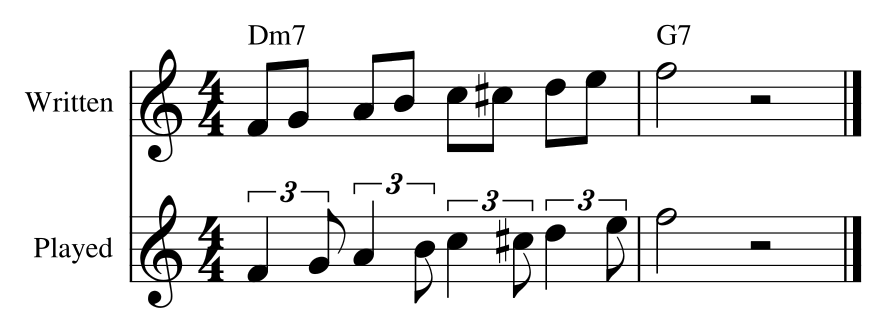
The triplet is only an approximation. Real swing ratios vary by player, tempo and context, and are often closer to even than a strict triplet. The arrival grid never changes with the ratio; only the placement of the upbeats moves.
Metronome ladder
Each stage moves the click away from the arrivals, so the grid has to live in you.
1. Click on 1 and 3. Arrivals land with the click; pickups fill in between.
2. Click on 2 and 4. Same lines; now arrivals land between clicks.
3. One click per bar, on beat 4. The click is the pickup, and you supply the landing.
4. One click every two bars, on beat 4 of the second bar. Hold the whole phrase shape internally.
Stay at each stage until you can play a full chorus without drifting, then move on.