 Playable Books
Mayank Sanganeria · section 10 of 12
Chapter 9 — Applying the System
Read and hear this section in the playable edition →Three settings, three different slot budgets. The ii–V–I shows the whole toolkit in one line. The blues gives you room for outlines. Rhythm changes takes that room away.
A complete ii–V–I line
Ex. 9.1 — The line from Ex. P.1, labeled by technique.
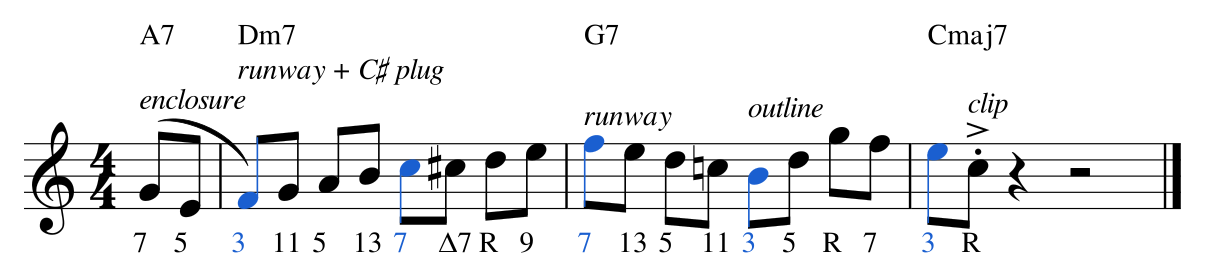
- Pickup: a two-slot enclosure, G and E around F.
- Bar 1: an arrival on F, then a rising D Dorian runway. The C♯ plug keeps F, A, C and D on the beats, and the last upbeat, E, steps into F.
- Bar 2: an arrival on F, a runway down to B on beat 3, then an outline, B–D–G–F. F, the 7th, sits on the & of 4 and falls to E across the bar line.
- Bar 3: a clipped ending. E arrives on beat 1, and C is the punctuation.
The skeleton is Strand A on every beat 1 (F, F, E), with Strand B (C, B) on beat 3. Every chapter's tools appear once: enclosure, runway, gap rule, outline, phrase entry and ending.
Jazz blues in F
In a jazz blues, most chords last a full bar, so the budgets are 3 + 3 or 7 slots: room for outlines and longer runways.
Ex. 9.2 — A guide-tone skeleton for a 12-bar blues in F, starting from the 3rd of F7.
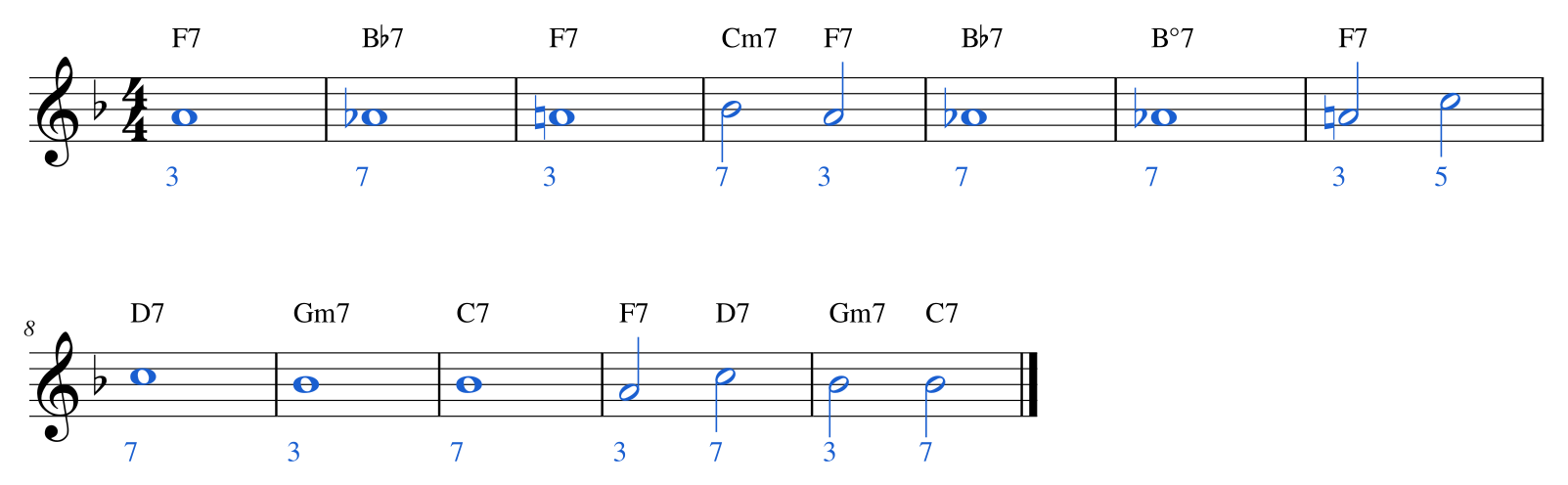
The A ↔ A♭ shuttle in bars 1–3 and 5–7 is the blues' guide-tone signature: the 3rd of the I chord falls a half step to the 7th of the IV chord, and back. From bar 7 the skeleton climbs. A rises to C, which becomes the 7th of D7, falls to B♭, the 3rd of Gm7, then holds B♭ as the 7th of C7. Bars 11 and 12 repeat the same move in half the time. Build the other strand yourself, starting on E♭, the 7th of F7.
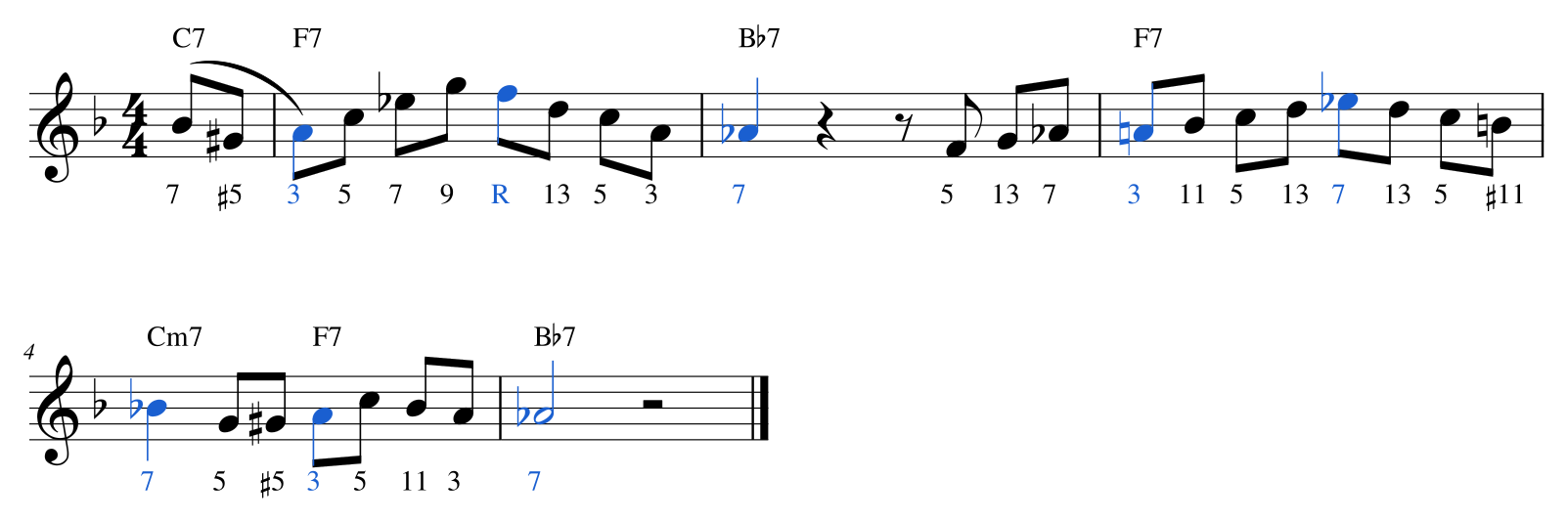
Ex. 9.3 — Bars 1–4 elaborated to Level 3, landing in bar 5. Every blue note matches the skeleton in Ex. 9.2.
Walk through it bar by bar.
- Pickup: B♭ and G♯ enclose A.
- Bar 1: a 3-to-9 outline from A (A, C, E♭, G), then F on beat 3 and a descending cell that ends on A. That last A falls a half step to A♭, making the guide-tone shuttle audible.
- Bar 2: A♭ holds for a beat, then a rest. The second phrase enters on the & of 3 with a three-note cell, F–G–A♭, climbing back into A.
- Bar 3: a runway from A up to E♭ on beat 3 and back down, ending on B♮, which steps into B♭ on the Cm7.
- Bar 4: B♭ lands, G and G♯ climb chromatically into A on the F7, and a two-slot chromatic descent, B♭ then A, falls into A♭ in bar 5.
Notice the phrase structure. One phrase runs from the pickup to beat 1 of bar 2, and a second runs from the & of 3 in bar 2 to bar 5. Both start on upbeats, and both end on long arrivals.
Rhythm changes in B♭
In the A section of rhythm changes, the chord changes on every beat 1 and beat 3, so every budget is exactly three slots.
Ex. 9.4 — A guide-tone skeleton for the A section of rhythm changes in B♭, one arrival per chord.
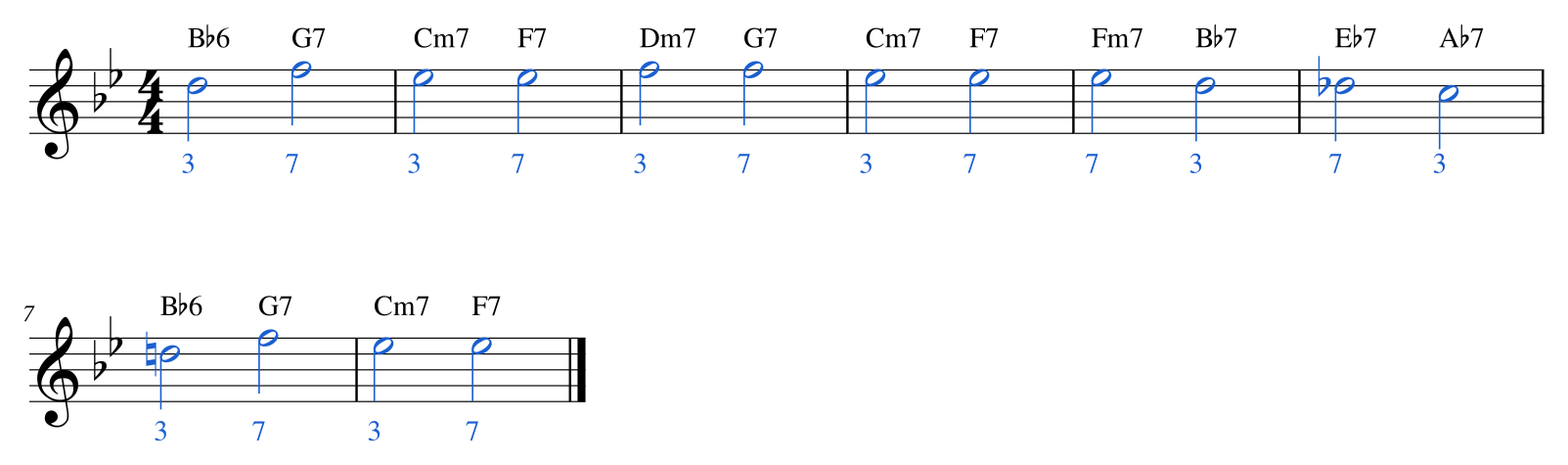
The skeleton barely moves. Through the first four bars it stays between D and F, a minor third, and each G7 hands its 7th (F) down a step to the 3rd of Cm7 (E♭). That's typical of fast changes: the guide tones hardly move, so the line's interest has to come from the cells.
With every budget at three slots, four-slot outlines don't fit. The fix is the region merge: treat a ii–V as one bar of its V chord. Cm7–F7 becomes one bar of F7, and two three-slot budgets become an arrival, a cell and an outline.
Ex. 9.5 — Bar 1 follows the changes, two three-slot budgets. Bar 2 thinks F7 for the whole bar and plays a runway plus a 3-to-9 outline. Every note still fits the written Cm7 and F7.

Bar 2 starts on E♭, the 3rd of Cm7 and the 7th of F7, so it works either way. The runway E♭–D–C–B♭ reads 3, 9, R, 7 against Cm7, and B♭ falls to A, the 3rd of F7, right on the chord change. You get the freedom of a whole bar without contradicting the harmony.
The line's beat-3 arrivals (B over G7, A over F7) aren't in the skeleton. Like Ex. P.1, the line switches strands between beat 1 and beat 3. That's normal: the skeleton is a single voice, and a real line weaves between voices.
This is also why rhythm changes feels faster than its metronome marking. The arrival grid is twice as dense. Alternate merged and unmerged bars, and the line breathes again.