 Playable Books
Mayank Sanganeria · section 11 of 12
Chapter 10 — The Practice System
Read and hear this section in the playable edition →One hour a day, in the order the book builds. Rotate the key daily through the cycle of fourths, and keep one tune for a week.
The order matters. Blocks 1–2 put the skeleton and the grid in your ear before your fingers start. Blocks 3–6 drill vocabulary against that frame. Block 7 is the only free playing, and it comes last so everything else feeds it.
Constraints for block 7
Pick one per day. A constraint pushes one part of the system into the foreground while the rest runs on its own.
- Every change arrival is a guide tone.
- Only two-slot cells for the whole chorus.
- Every phrase starts on the & of 4.
- Exactly one outline per chord change.
- A full bar of rest between phrases.
Backchaining
This drill turns "think backward" into hearing. Play the target alone. Then the last pickup plus the target. Then two pickups plus the target. Keep adding one slot at a time, always at the front, until the line is a full bar or longer.
Ex. 10.1 — Backchaining into E over G7 to Cmaj7. Each stage adds notes at the front and keeps everything after them.
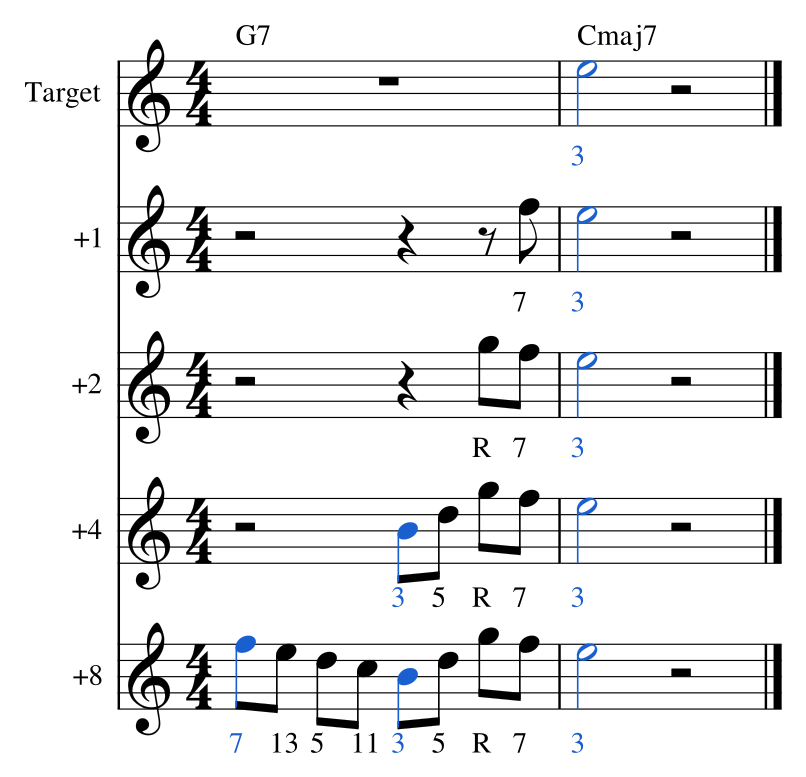
The target never changes, and every stage contains the one before it. By the time you reach the full bar, you've rehearsed the ending five times and the beginning once. That's the opposite of how most people practice, and it's why the method works: runs practiced from the front tend to collapse at the end, while runs built from the end can't.
Transcribing in this book's terms
When you transcribe a solo, annotate it. Mark the arrivals, name the strand, measure each cell's span, and flag the outlines and plugs. After ten solos you'll have your own cell table, ranked by how often the players you love actually use each shape. That table, not this book's, is the one to practice from.