 Playable Books
Hector Berlioz · section 6 of 67
The Viola d’Amore
Read and hear this section in the playable edition →
This instrument is somewhat larger than the viola. It has fallen into disuse almost everywhere. Were it not for M. Urban—the only player of the instrument in Paris—it would be known to us only in name.
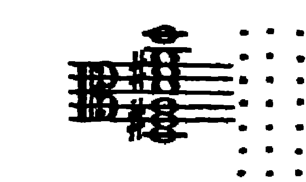
It has seven gut strings; the lowest three are covered with silver wire, like the C and G on the viola. Below the fingerboard and passing below the bridge are seven more strings of metal. They are tuned in unison with the strings above; vibrating in sympathy with them, they lend the instrument a second resonance, full of sweetness and mystery. It was formerly tuned in’ several odd ways. M. Urban has adopted the following mode of tuning, in thirds and fourths, as the simplest and most rational:
The range of the viola d’amore is at least three and a half octaves. It is written—like the viola—in two

As the arrangement of the strings indicates, the viola d’amore is appropriate mainly for chords of three, four or more tones, whether arpeggiated, struck simultaneously or sustained; and above all for melodies in double stops. For chords, a different system has to be used from the one for the violin, viola and violoncello, which are tuned in fifths. One must be careful to avoid greater intervals in chords than thirds and fourths—unless at least the lowest tone is played on an open string. Thus, the A of the second string can be combined with any tone over the entire length of the high D-string.
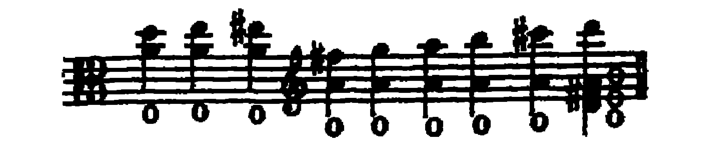
Needless to say, chords of minor
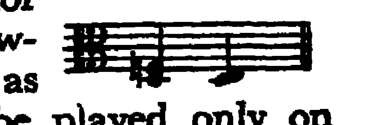
thirds and of seconds over the low- =| est tone of the instrument, such as aie impossible, as the tones can be played only on the D-string. Similar limitations on the lowest strings of the other stringed instruments are easily deterined. Harmonics on the viola d’amore have a wonderful effect. They are obtained in the same way as those on the violin and viola. Since the seven open strings of the viola d’amore form a perfect common chord, it is very easy to produce rather rapid arpeggios of its basic chord, D, in the higher octave:


Actual harmonies
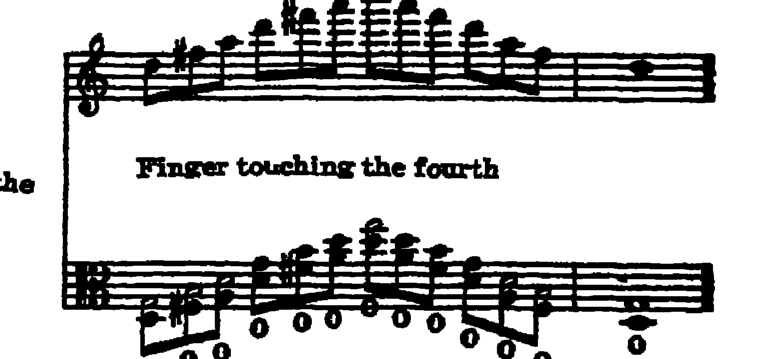


Actual harmonics


These examples show that, if one wants to use these charming arpeggios on the viola d’amore, the keys of D, G, A, F¥ and B offer the best opportunities. But as those three chords (D, A, F#) are obviously not adequate in accompanying a modulating melody without interruption, this could easily be remedied by using several differently tuned violas d’amore, for instance in C or Db, according to the chords required by the composer for his piece. The extraordinary charm of these harmonics on open strings would well justify all possible devices to take full advantage of them. The viola d’amore has a weak and soft tone; it has something seraphic, similar both to the viola and to the harmonics of the violin. It is particularly suitable to the legato style, to dreamy melodies, to the expression of ecstatic or religious sentiments. Meyerbeer used it to advantage in Raoul’s Romance, in the first act of “Les Huguenots” (Example 30). But here-it serves only as a solo instrument. How beautiful would be the effect of a mass of
No. 30. Les Huguenots, Act I
violas d’amore in an Andante, executing a beautiful prayer in several voices, or accompanying in sustained harmonies a melody of the viola, violoncello, the English or French oo the flute in the middle of its range—combined, aps, wi arp arpeggios! It would truly be a pity if this wonderful instrument were lost for practical use, especially since any violinist can learn to play it within a few weeks.
Ha, welch be. sau-bern-des

seigt sich hold mei-nem

