 Playable Books
Hector Berlioz · section 9 of 67
The Double-Bass
Read and hear this section in the playable edition →

There are two kinds of double-basses: those with three, and those with four strings. Those with three strings are tuned in fifths:
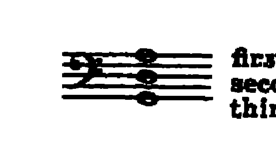
those with four strings are tuned in fourths:
bad fourth string
The actual sound of both is an octave below the written notes. Their range in the orchestra is two octaves and a fourth; but the double-bass with three strings has three toncs Iess in the low range.
Double-bass with four strings

Double-bass with three strings
uding the ch tic intervals

The four-stringed double-bass appears preferable to me; tuning in fourths makes for greater facility of execution because the player is not compelled to shift on the finger-board when playing scales. Furthermore, the three low notes E, F and F%, missing on the threestringed double-bass, are extremely useful; their absence frequently spoils the form of the best-designed bass part by requiring unpleasant and difficult transposition to the higher octave. This deficiency is still more apparent in the English double-basses, which, although ‘tuned in fourths, have only three strings—A, D, G: Bee] A good orchestra should
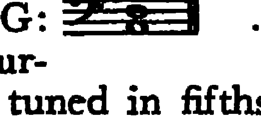
have several four- string double-basses,
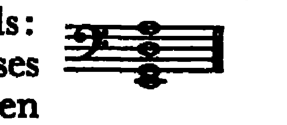
some of them tuned in fifths and thirds:
Together with the other double-basses = tuned in fourths, a combination of open
strings would be available which would greatly increase the sonority of the orchestra:
Double-bass tuned in a third and fifths

In order to extend their lower range, double-basses with five strings have already been used for many years, i.e. a new string was added to the
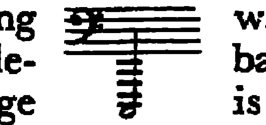
old four-string double- bass. The addition of this low range is doubtless a gain in sonority; but this is counter-balanced by the increased difficulty in pressing down the strings, since with five strings the middle ones are placed very high above the finger-board. Therefore, a four-stringed double-bass with a lever device which easily changes the low E to C is definitely preferable to the five-stringed one.
The device invented by Max Poike and produced by Ludwig Glaesel in Markneukirchen is most satisfactory. It sufficiently extends the E-string and part of the fingerboard to produce the low C
To make the tones below E easily play-
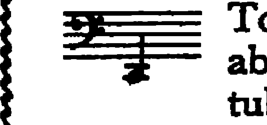
== able, a mechanism of four little brass; tubes with keys for E, Eo, D and Do is attached to the side of the finger-board. When Eb, D, Db and C are not used, the E-key is locked by pushing a lever with the thumb; this key is padded and replaces the nut for the E-string. It is noiselessly released by holding the E-key and pressing the E>-key.
I recommend using double-basses of different } systems wherever possible; among them, in any case, also the three-stringed one, which is far better suited to cantilena than the German double-bass.
To this day, two kinds of bows are used for the
double-bass: those with a curved stick, which are not good in cantilena and produce a harsh and brittle tone; and the enlarged violoncello bow, which permits all the styles of bowing possible on the other stringed instruments. The double-basses in the orchestra take the lowest tones of the harmony. It has been shown above in which cases they may be separated from the violoncellos. The resulting impairment of the bass part can be remedied (to a certain degree) by doubling them, in unison or in the octave, with bassoons, bassethorns, bass clarinets or the lowest tones of ordinary clarinets.* But I detest the practice of some musicians to use in such cases also trombones and ophicleides, whose timbre has neither sympathy nor similarity with that of the double-bass and combines with it very poorly.
Particularly the employment of trombones for reinforcing the bass is to be rejected. Concerning this problem, everything depends on the tasteful manner of using the instruments suitable for doubling the bass. I may be permitted to refer the reader to the application of the various bass tubas in the scores of my “Zarathustra” and “Helden-. leben”.
*Preferably with the double-bassoon.
In large tutti important bass themes of the three, trombones are frequently reinforced by bassoons, violoncellos and double-basses; I myself have made this mistake. This is quite useless: the hard, piercing tone of the three weighty trombones in unison is softened rather than strengthened by this support. Unless one wants to give the bassoons and low string instruments complementary parts or figurations, it is better to omit them in such marcato passages for the trombones, except, of course, when one intends to soften their power.
There are occasions when the harmonics of the
double-basses may be used successfully. The tension
their strings, their length and distance from the fingerboard prevent the use of artificial harmonics. Natural harmonics, however, sound very well, especially those from the middle of the string (which give the higher
octave) upward. They are the same harmonics
those on the violoncello, except that they are one
igs may be used on the double-
bass if unavoidable; however, only chords of two are at most three notes can be used, of which only one
mav be fingered:
Double-basses tuned in fourths:

Double-basses tuned in fifths:

The intermittent tremolo can be produced easily, thanks to the elasticity of the bow, which rebounds several times on the strings after a single rather vigorous attack:

This does not hold good in the following passage:
Allegro moderato.
This can be played only at the point of the bow as a continuous tremolo, and not without some difficulty; it lacks force and elicits but little tone.
The continuous tremolo, however, somewhat less close than in the preceding example, is of excellent
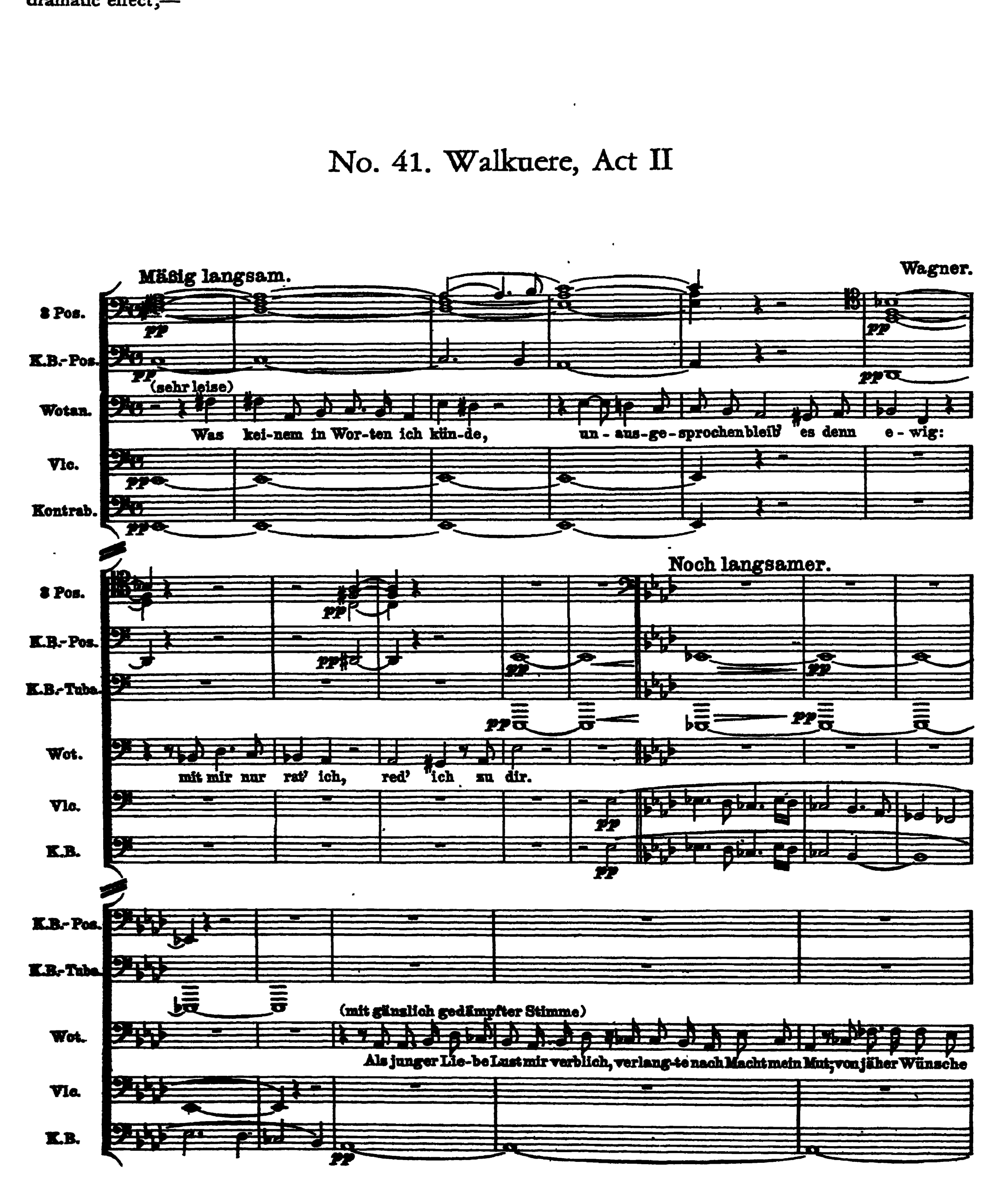
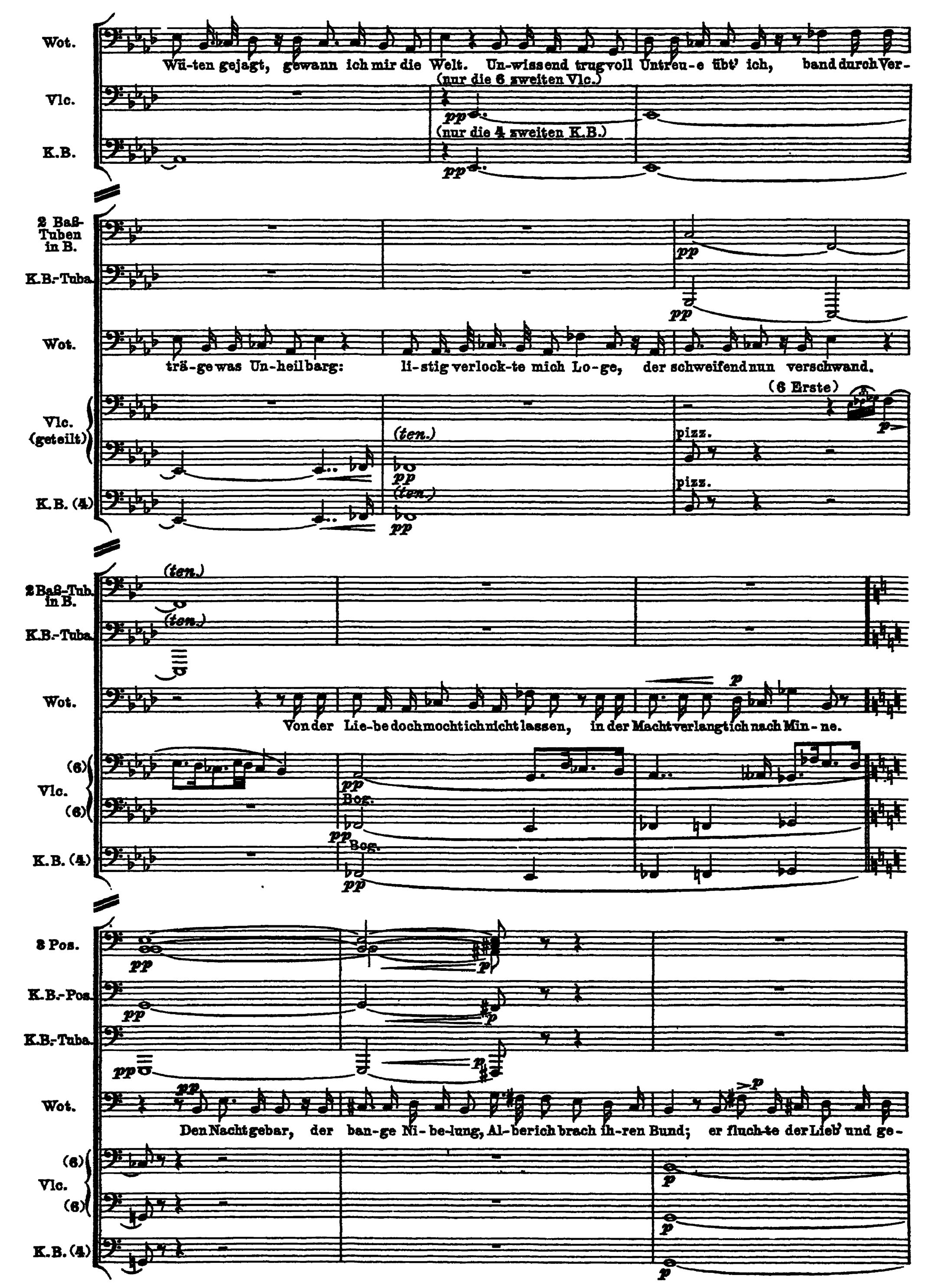
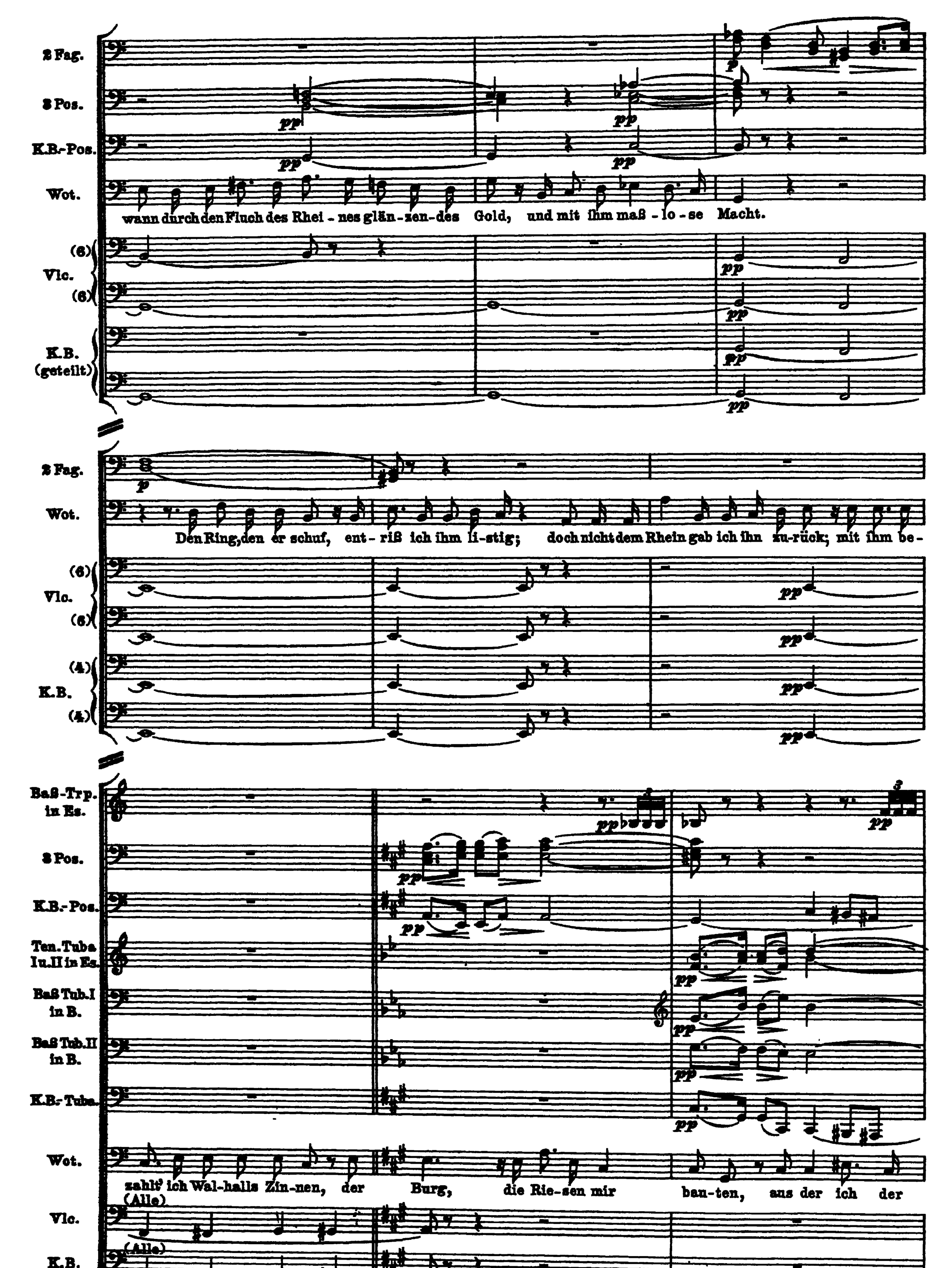
Compare the expression of sublime awe in the Prelude to “‘Parsifal”. A unique application of the lowest instruments in the orchestra is to be found in the second act of “Walkuere”, during Wotan’s narration. (Example 41.)
2 SR SA AS SS SS Sk | ae ON A ON "os SS we
ee, | -v EF a as om oa ia eee, ee” ee Eee eee ee ee ee eee eee eee
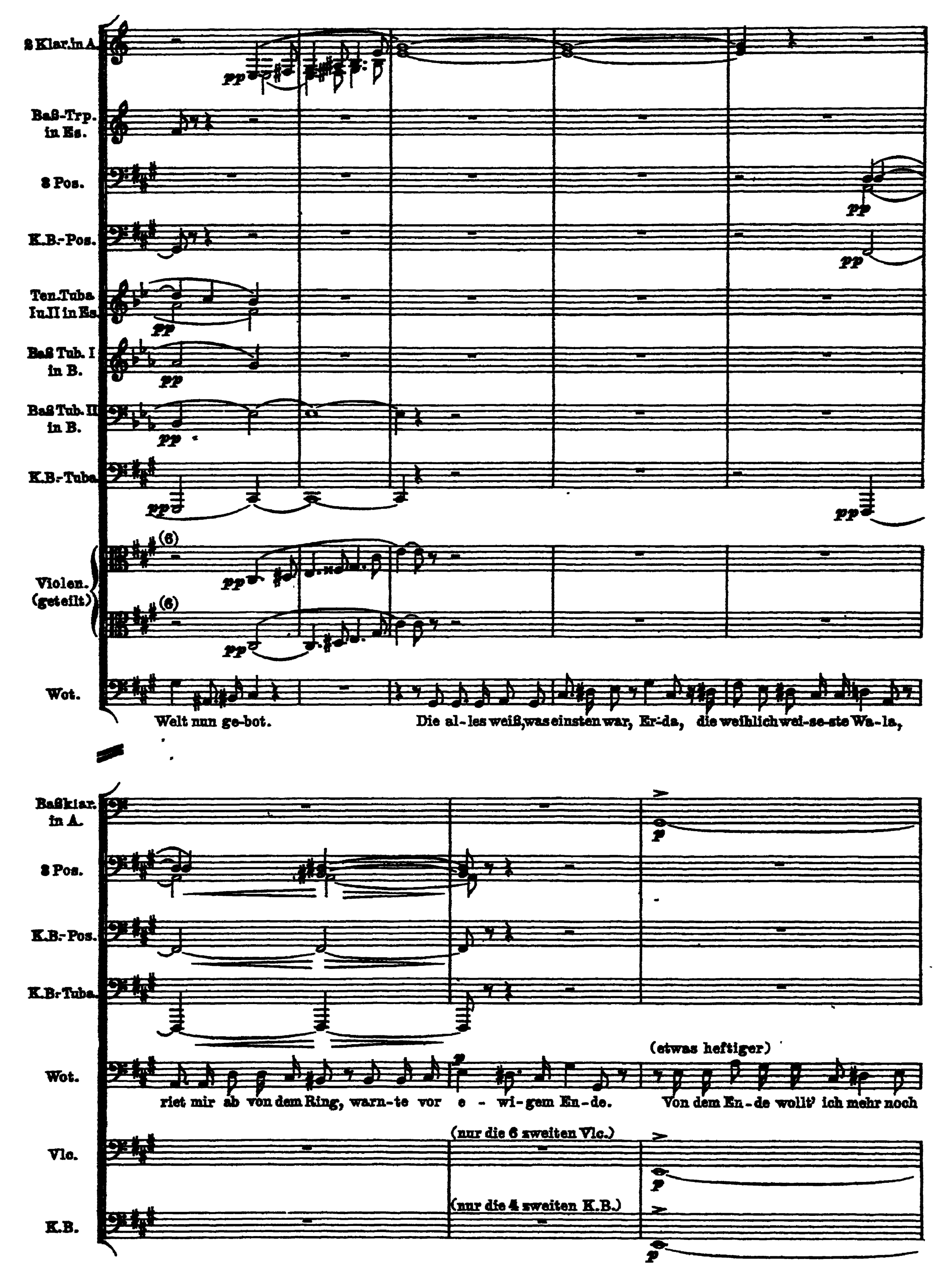
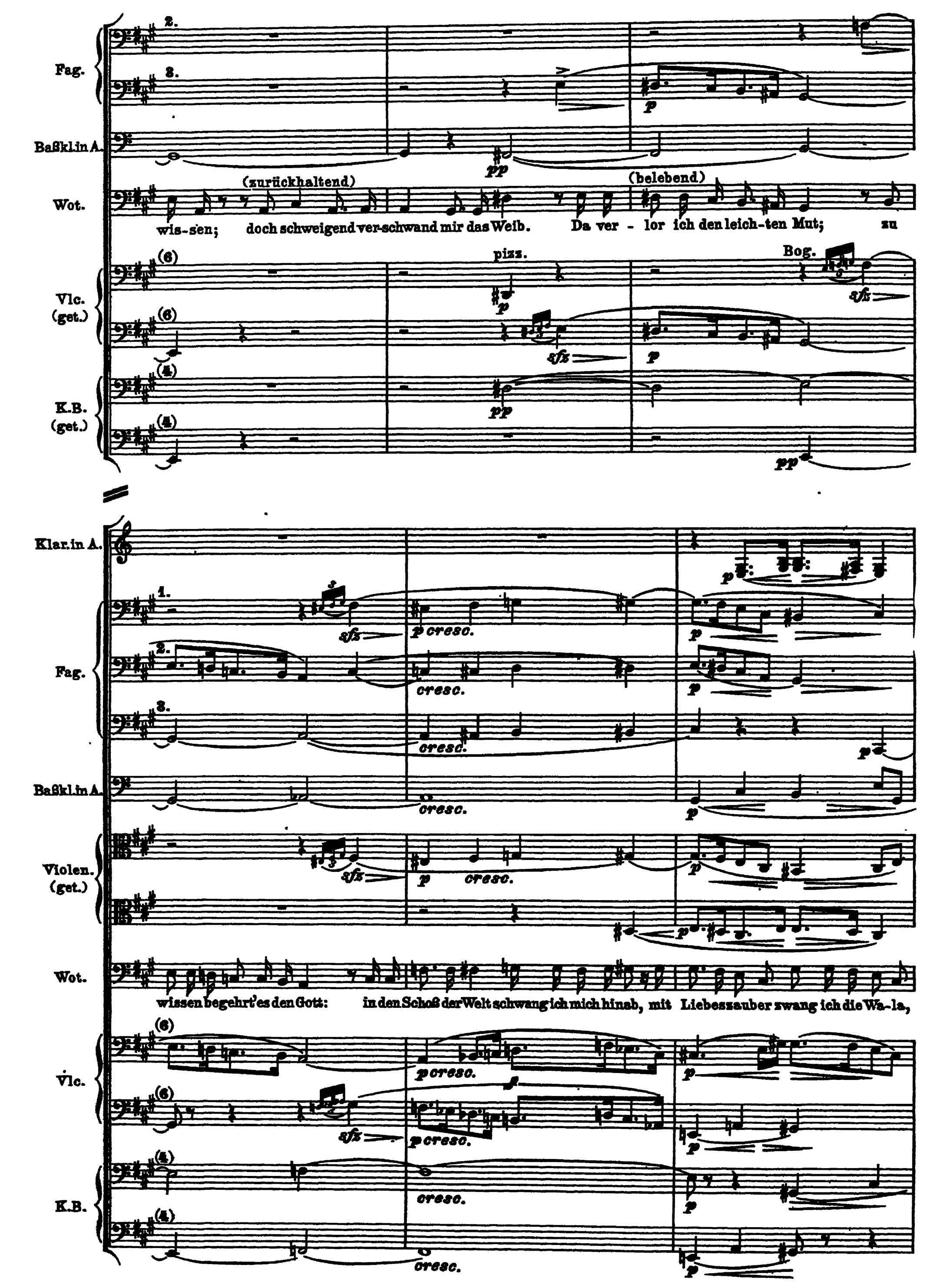
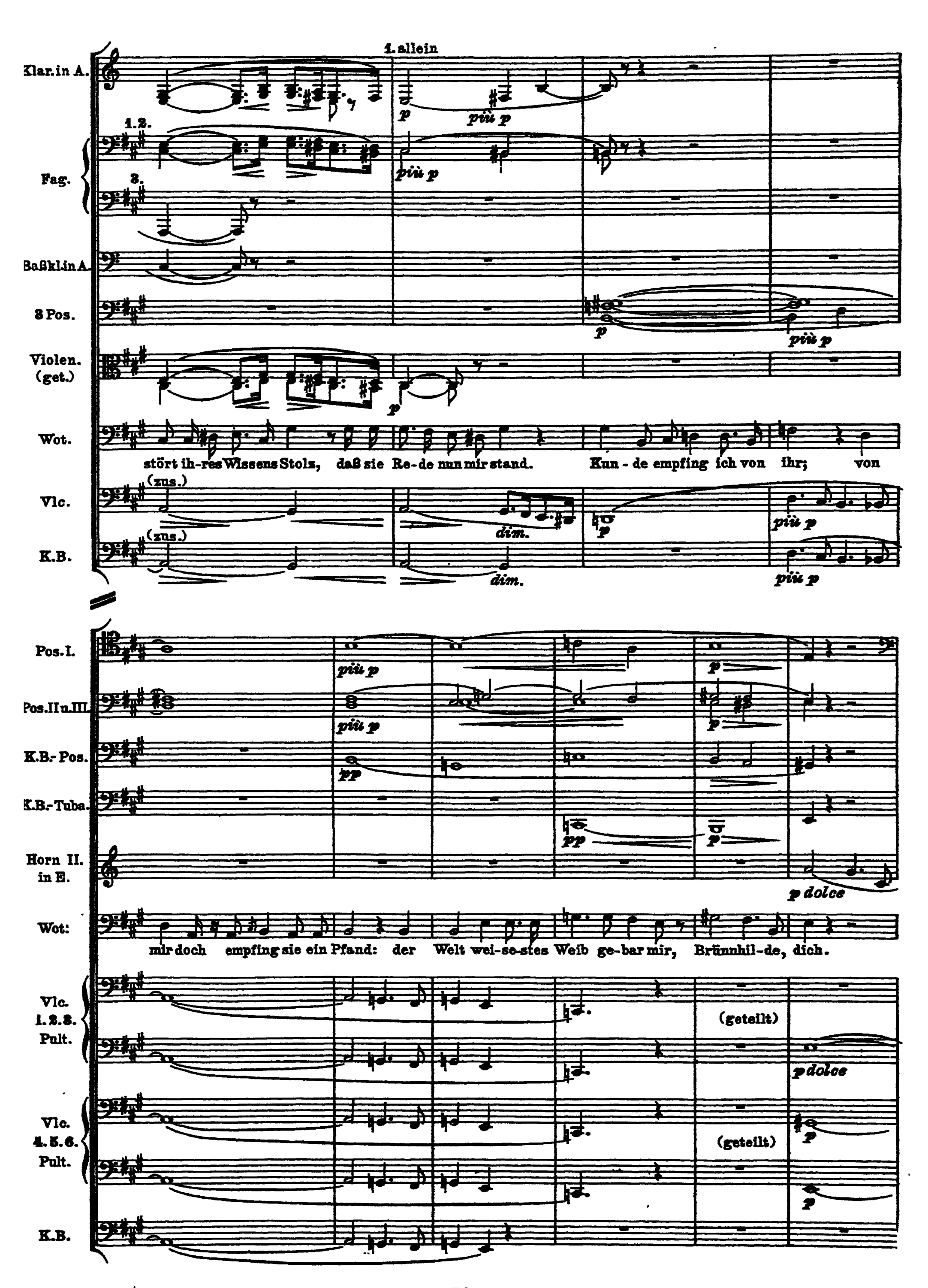
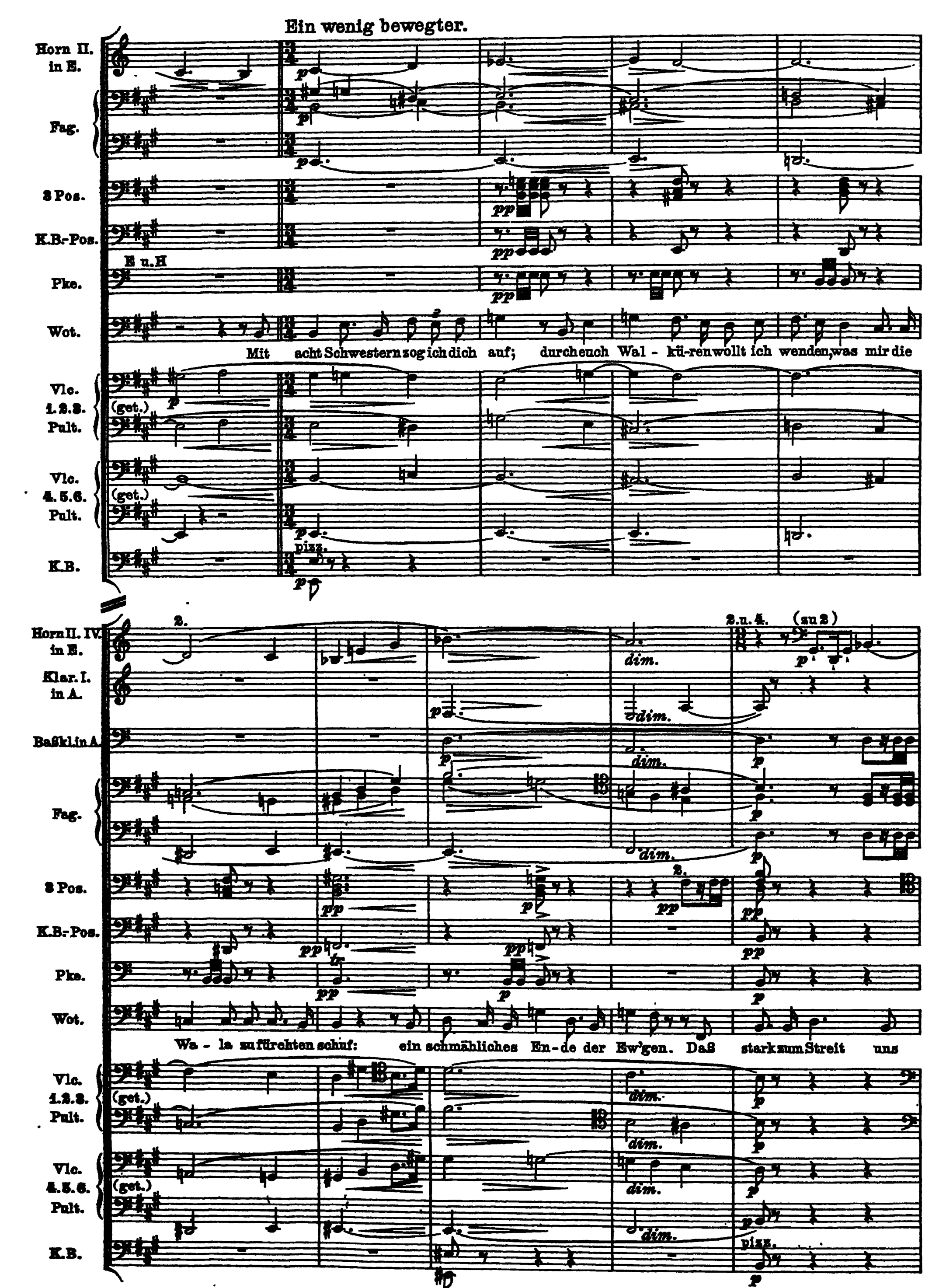
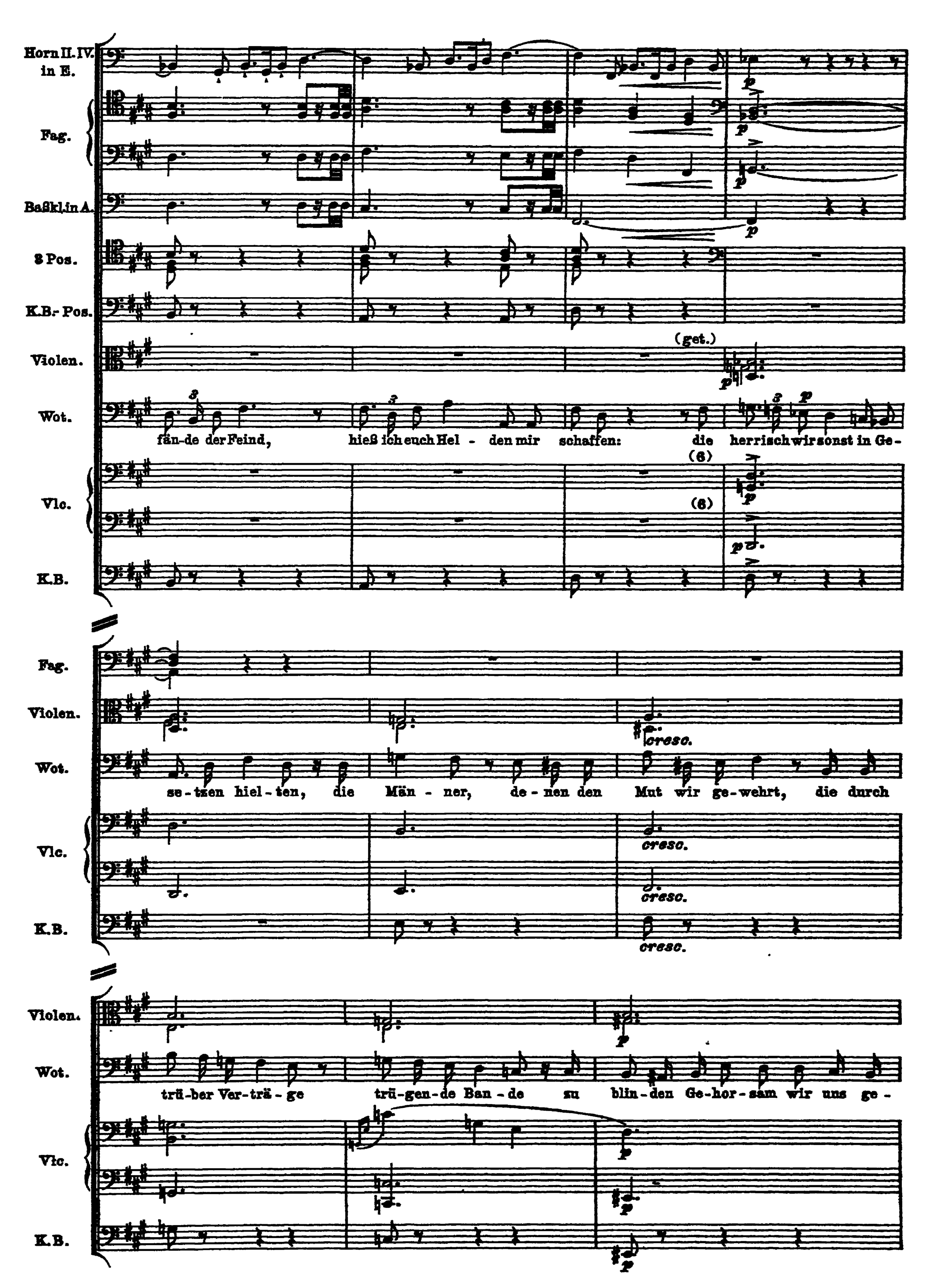

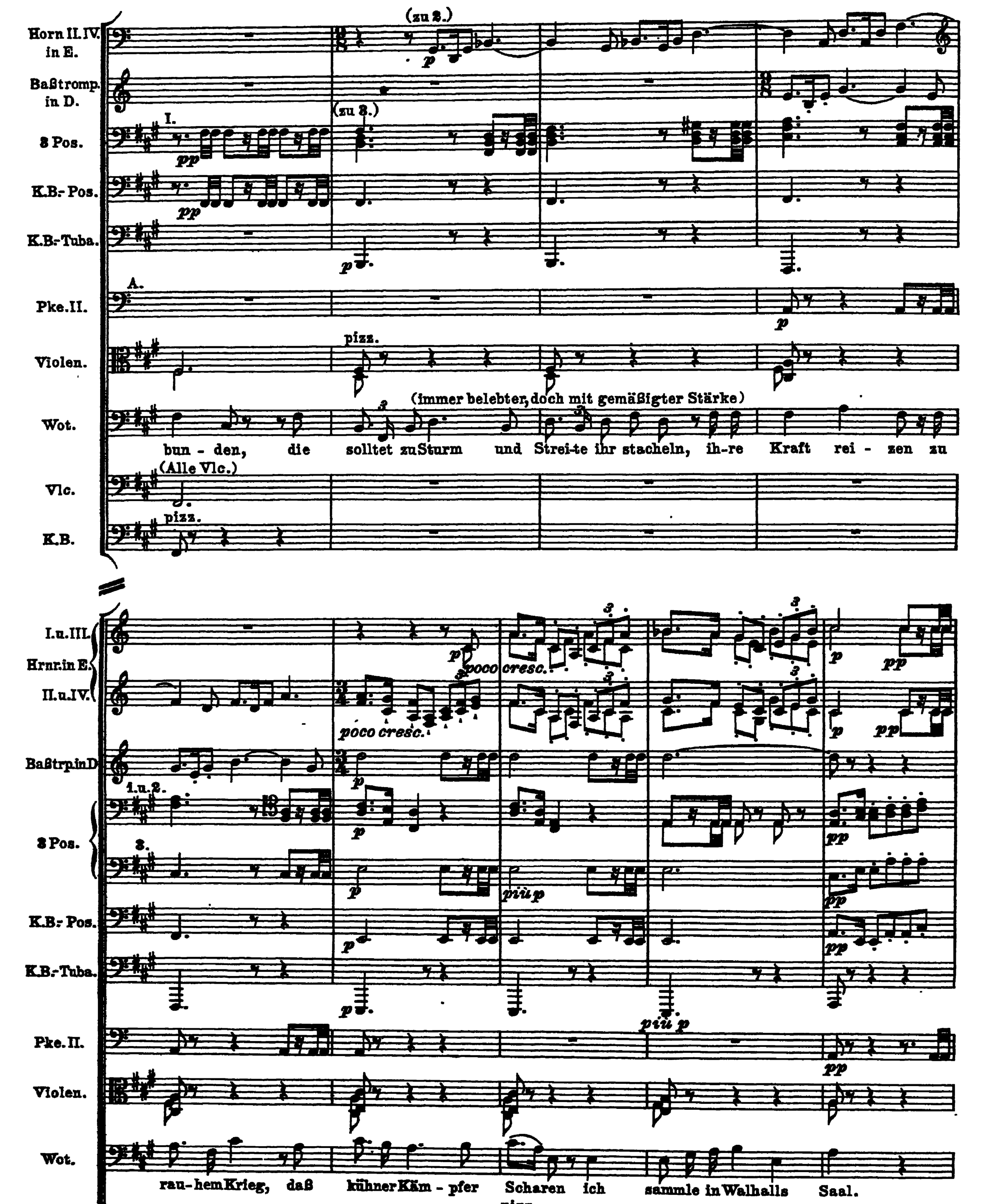
rau-hemErieg, das kiihnerKim -pfer Scharen ich sammle in Walhails Saal. a
iss.
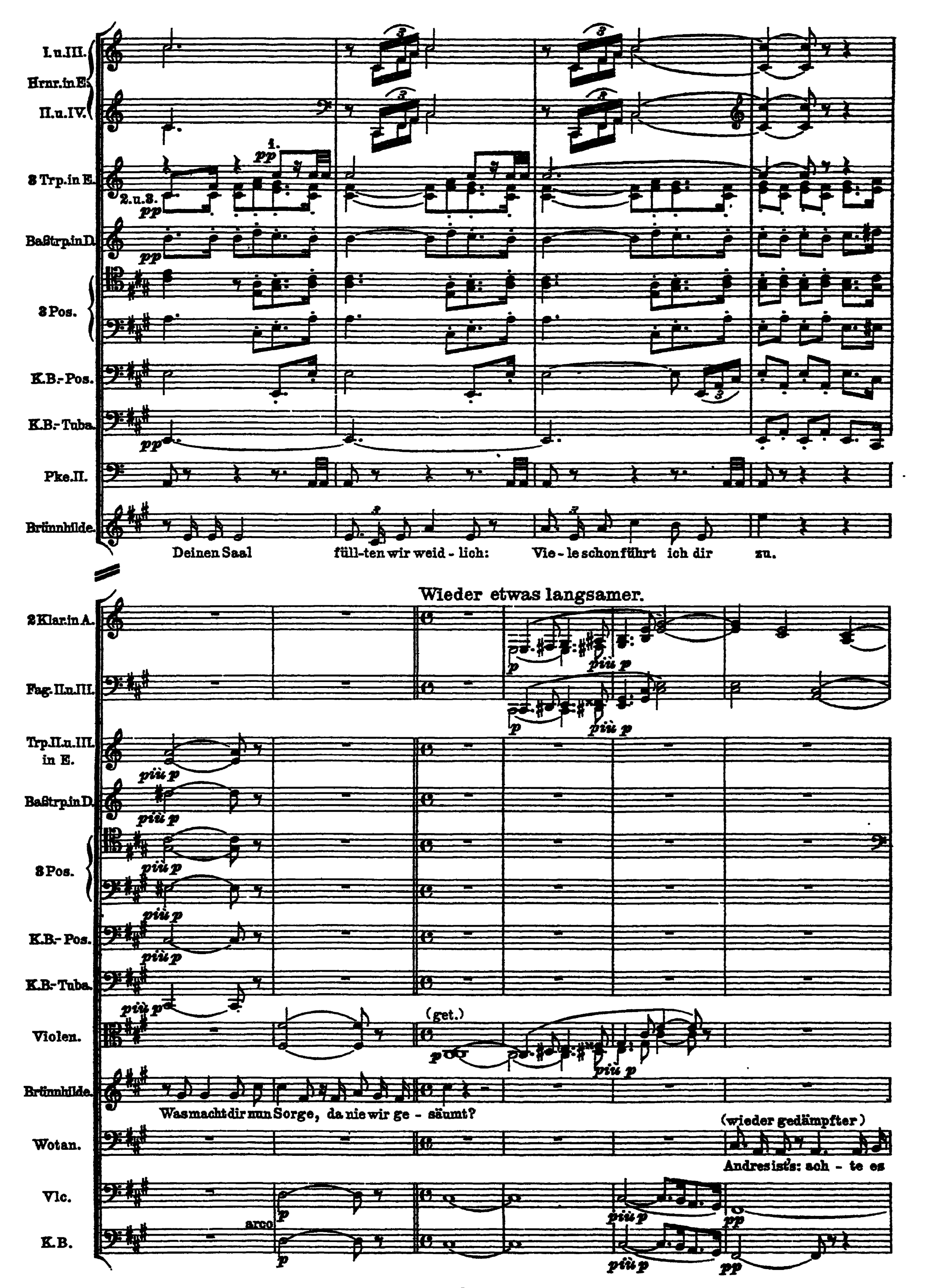
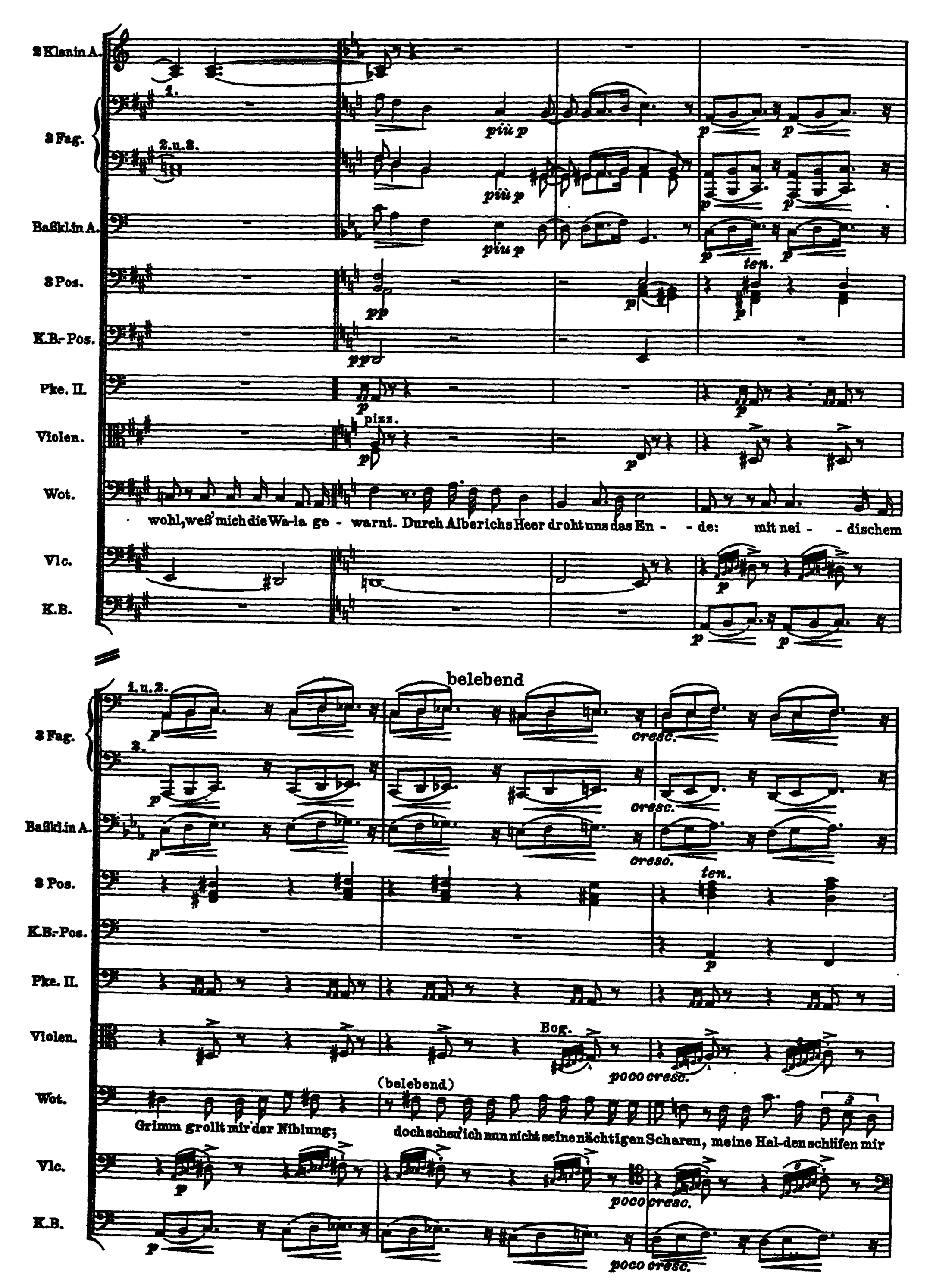
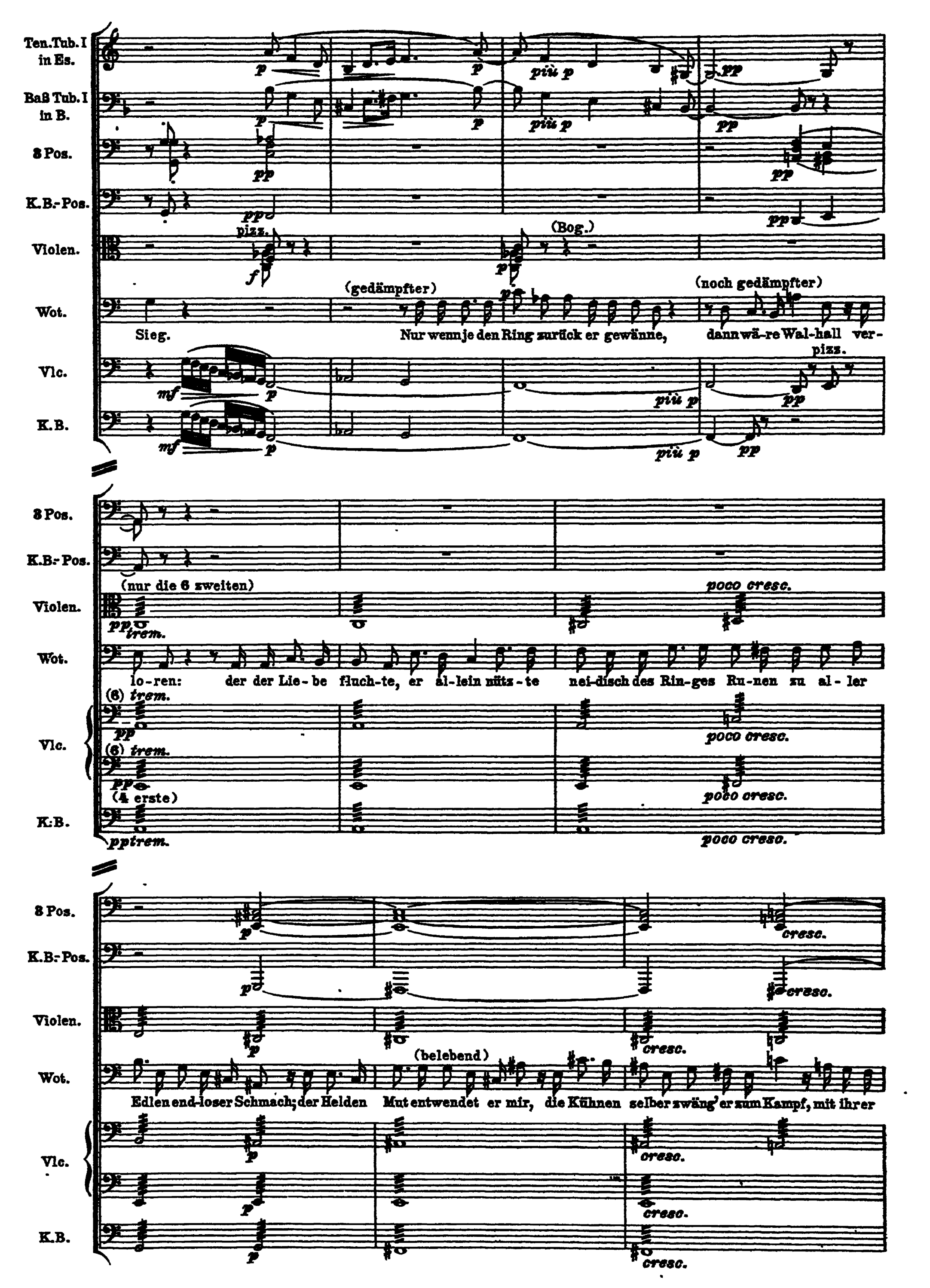
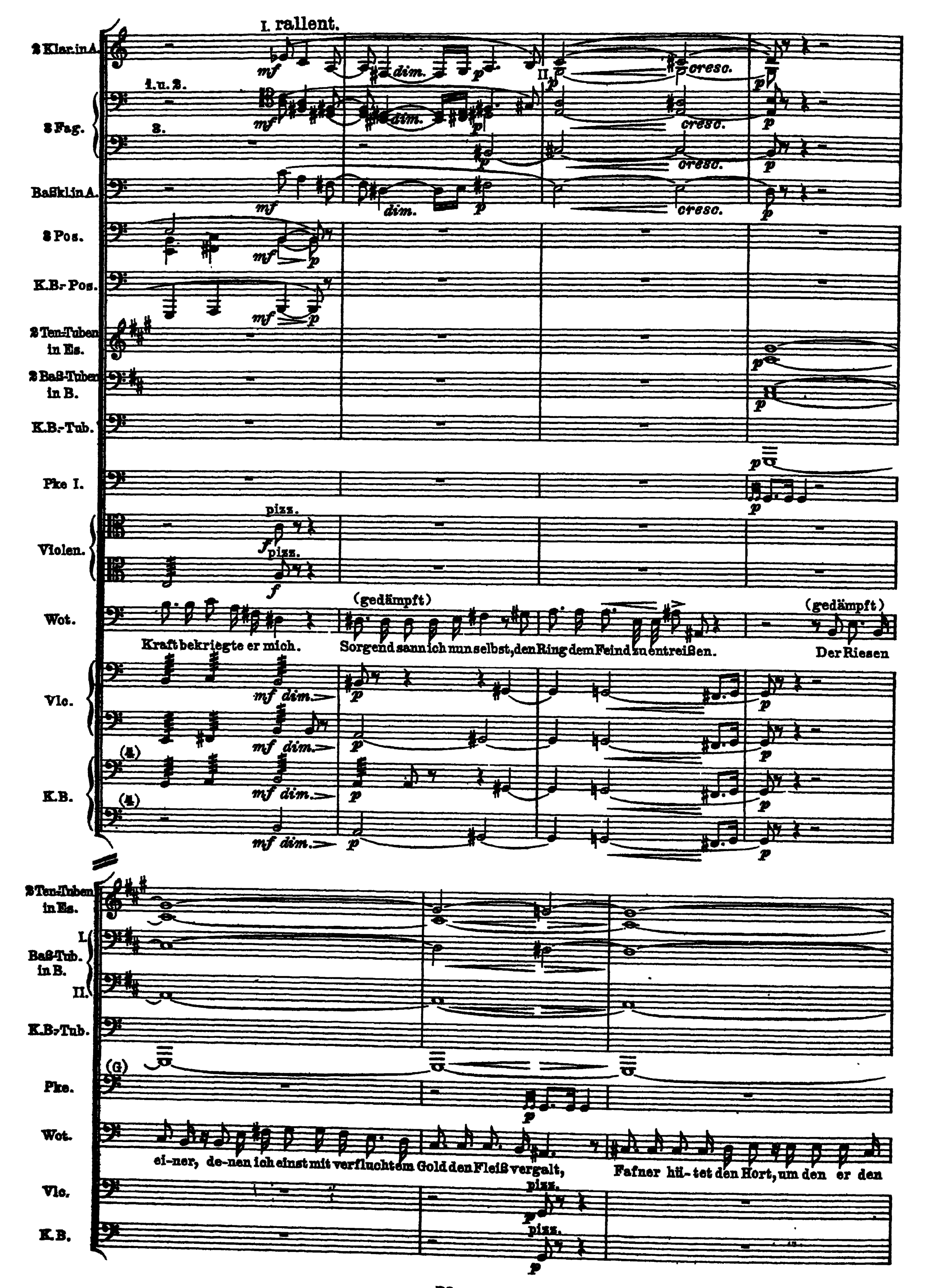
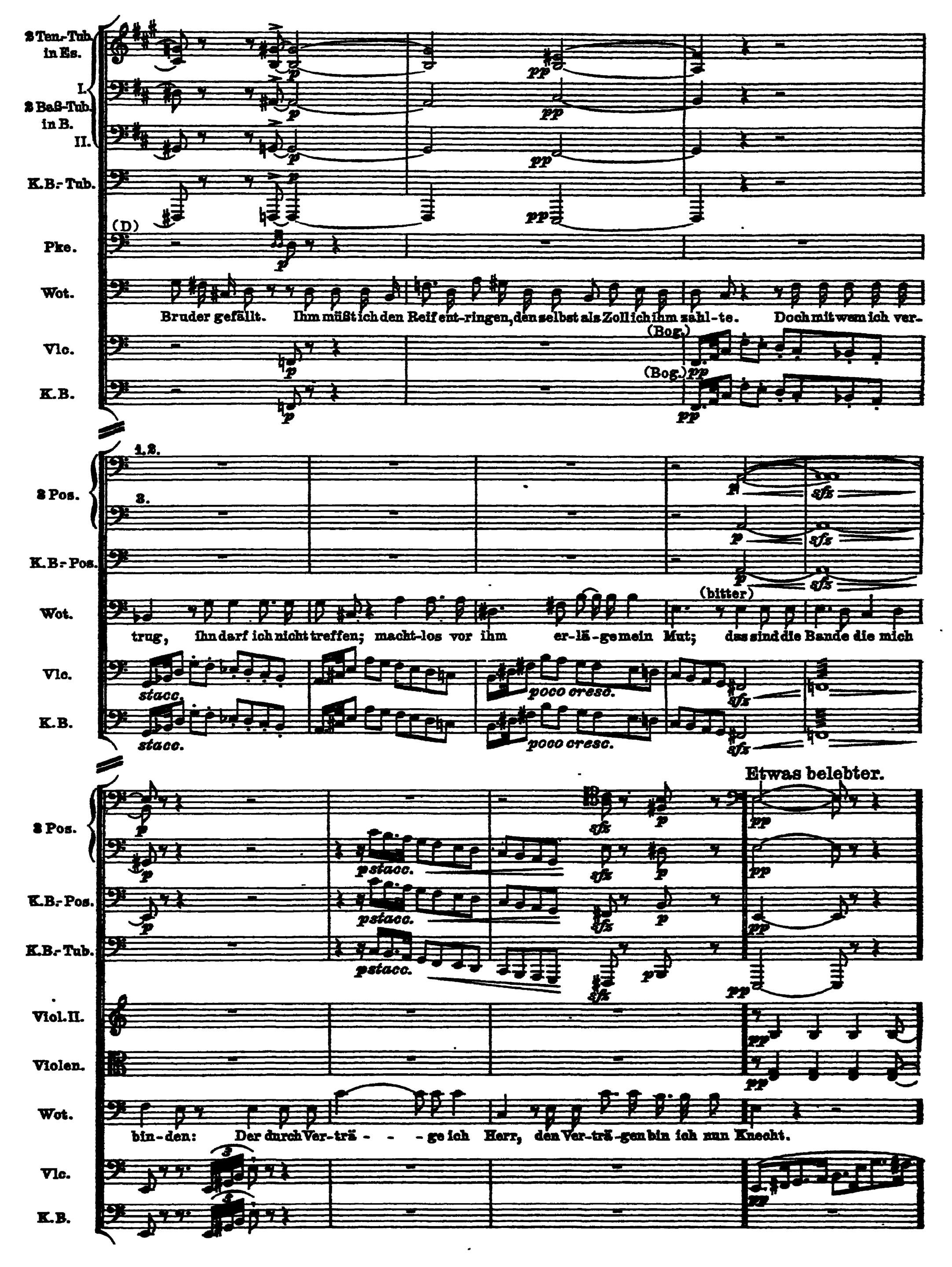
With all its simplicity, this scene is for me the inconceivable miracle of a genius who was able, better than anyone else, to transform all emotions and passions into orchestral sounds which overpower and irresistibly convince all listeners. —Nothing gives the orchestra a more menacing ex-
pression. But it should not last too long; otherwise it exhausts those players who really endeavor to execute it well, and soon becomes impracticable. When it is thus necessary to stir the depths of the orchestra during a longer passage, it is better to divide the double- - basses into two parts. These are given, not a real tremolo, but quick strokes of different rhythm, while the violoncellos execute the real tremolo:
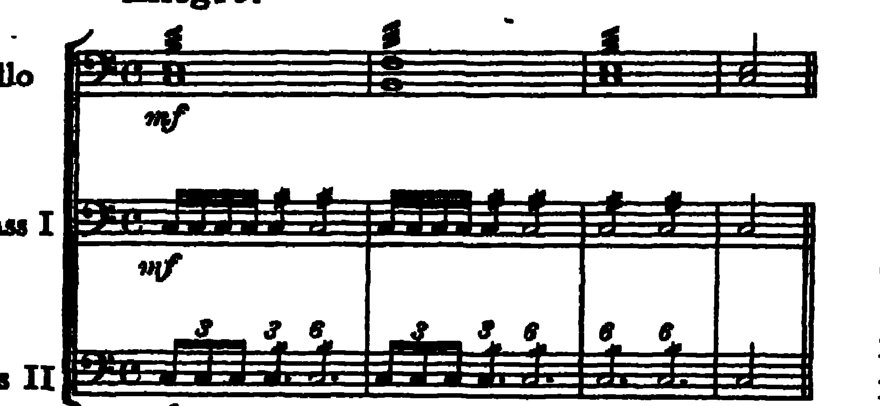
The sixteenths of one part coincide with the triplet eighths of the other only at the beginning of each beat. Thus they produce a vague murmur which comes very close to a tremolo and is a tolerably good substitute for it. I believe that in many cases these
different rhythms.
, simultaneously played, are even
preferable to the tremolo proper.
Rapid diatonic runs of four or five notes often have an admirable effect and are easy to play if they contain at least one open string:

If it is necessary to use more extended rapid runs in the double-basses, it is best to divide them in the fashion indicated above for the violins; but special care should be taken to avoid keeping the first doublebasses too far removed from the second.
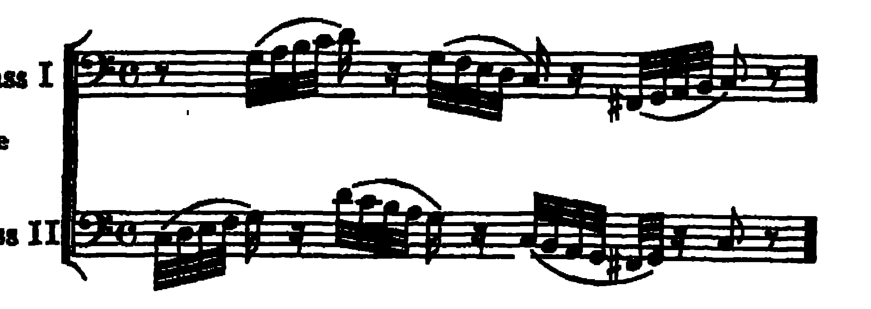
Both at the
It is a current mistake to write for the heaviest of all instruments passages of such rapidity that even the violoncellos would have trouble executing them well. Hence there result serious disadvantages: some double-bass players, too lazy or in tact incapable of tackling such difficulties, give up at once and try to simplify the passage. But each one simplifies it in a different manner, since they do not all have the same ideas regarding the harmonic importance of the different notes; this causes a horrible disorder and confusion. This buzzing chaos of strange sounds and ugly snarls is still further increased by the vain efforts of more zealous or more confident players to master the passage just as it is written.
Composers should therefore take care to ask of double-bass players no more than is practicable. Only in this way can they be sure of an accurate execution; and only this will do away with the old system of simplification by the double-bass players, a system generally adopted in the old instrumental school, and whose danger has just beer: demonstrated. If the composer writes only that which is compatible with the nature of the instrument, the player must execute it literally. But if the composer errs, then he as well as the audience must bear the consequences; the performers are no longer to blame.
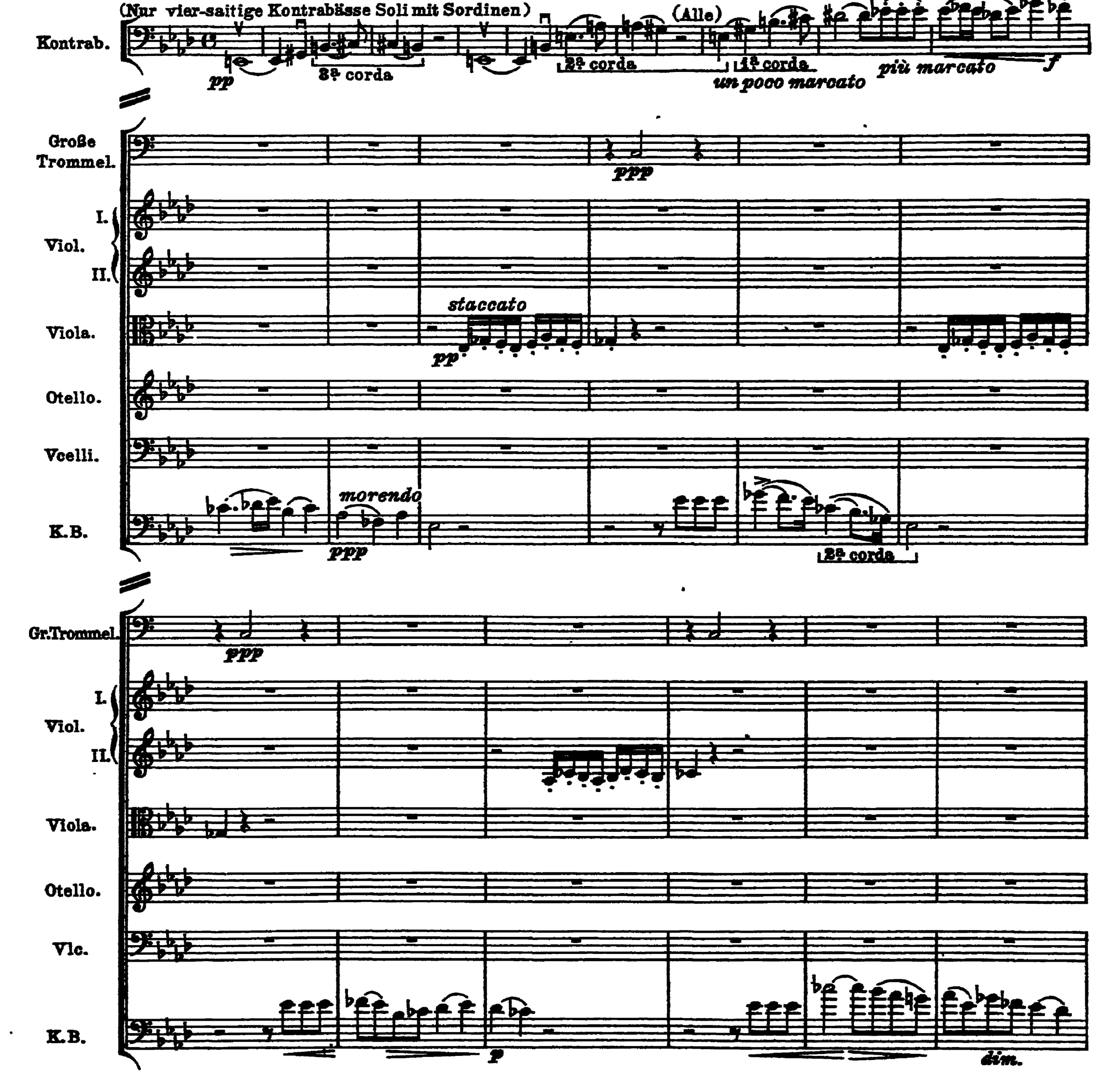
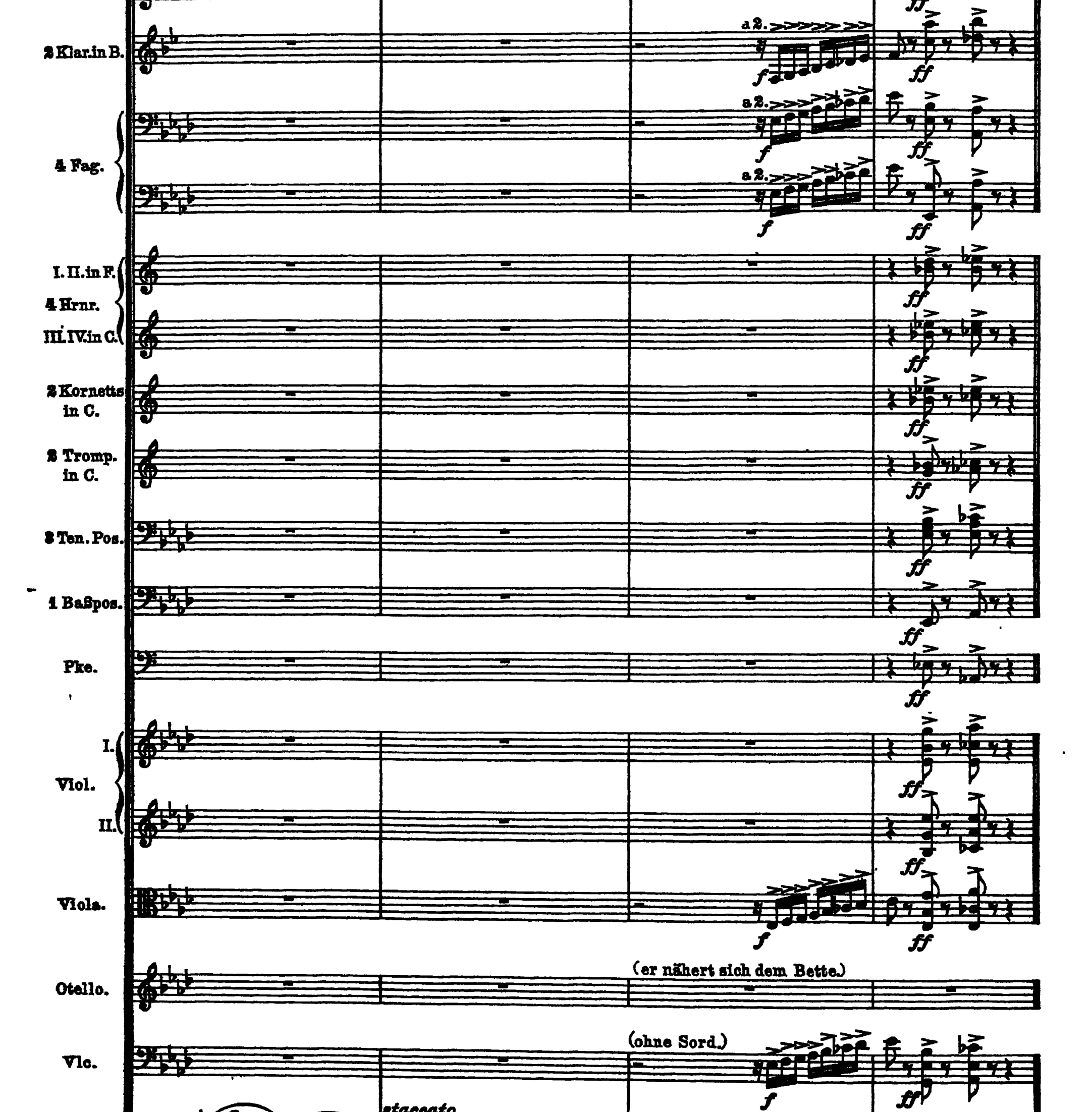
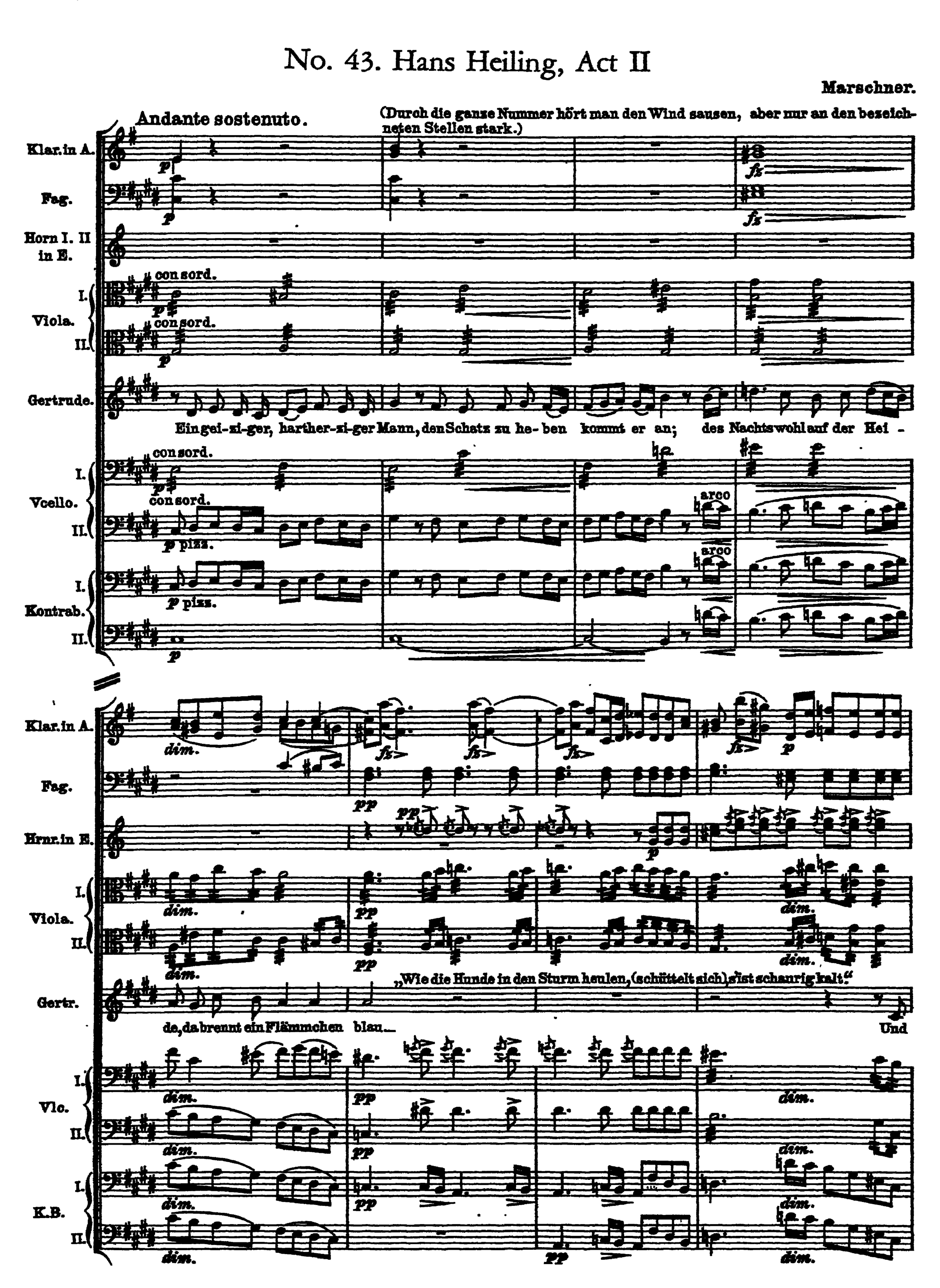
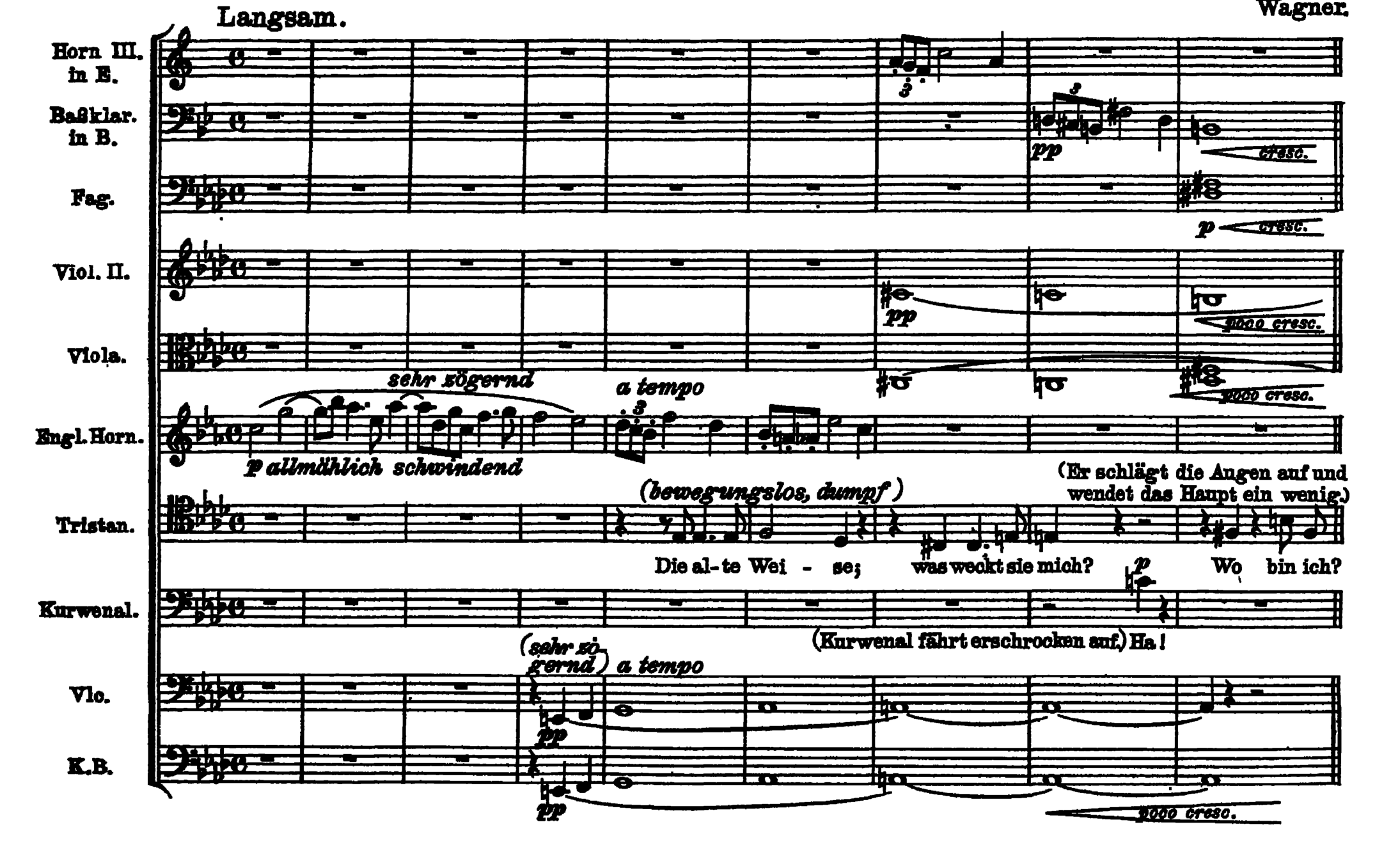
The double-basses are particularly suitable to express gloom, awe, meditation and preoccupation. Out of many examples only the following are quoted: the solo in Verdi’s “Otello”; the old woman’s song in Marschner’s “Hans Heiling”; Tristan’s awakening (third act). (Examples 42, 43, 44.) Also to be mentioned here is the fugue from my tone-poem “Thus spake Zarathustra”.
No. 42. Otello, Act IV
Poco pit mosso.
Otello tritt mit der ersten Note durch eine geheime Tiir in Desdemonas Schlafgemach.
be abode lade _geel £ EEtE A oebe
AQUESHT] AGRE A A A Amer Aba Abt A



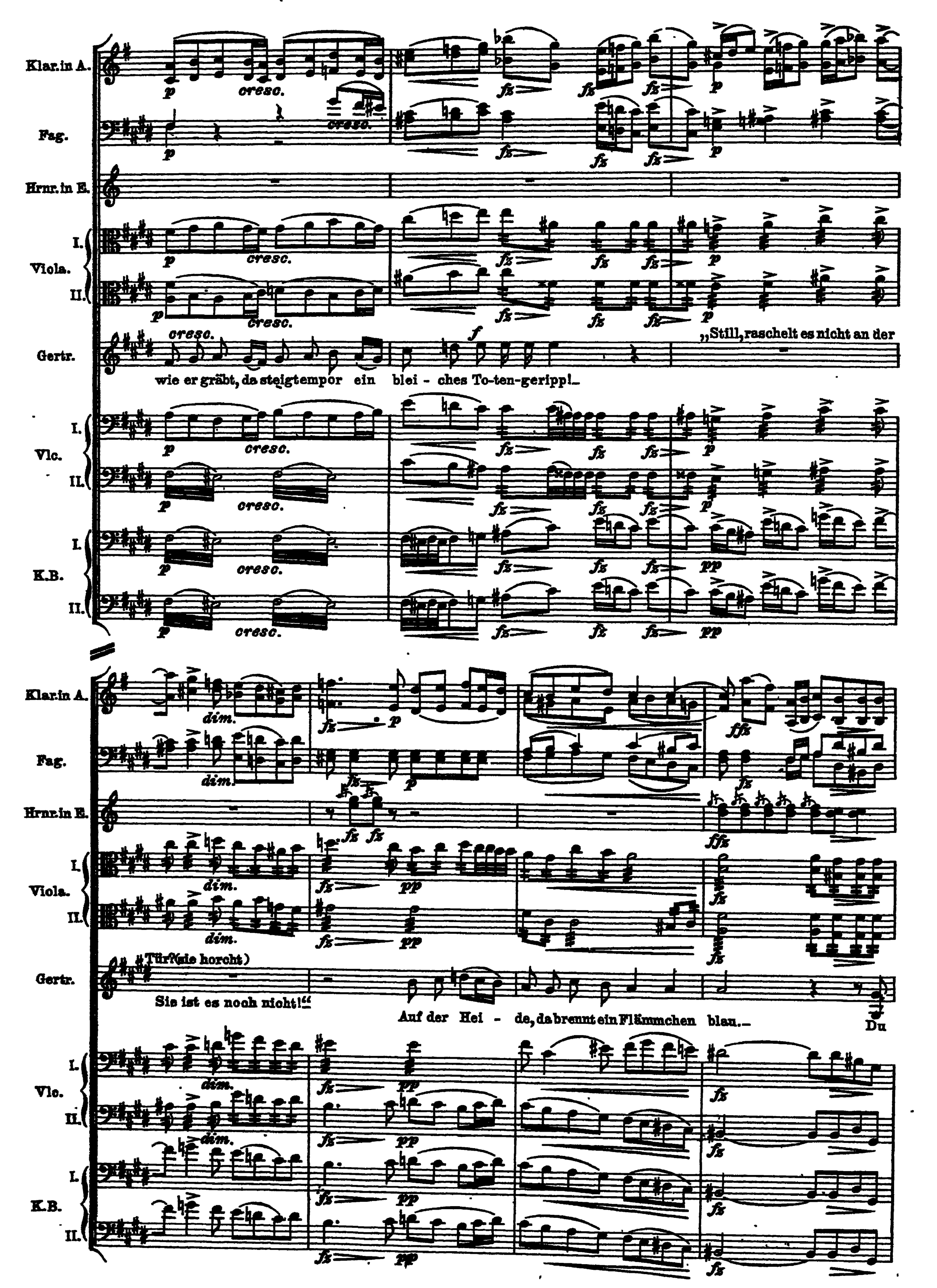
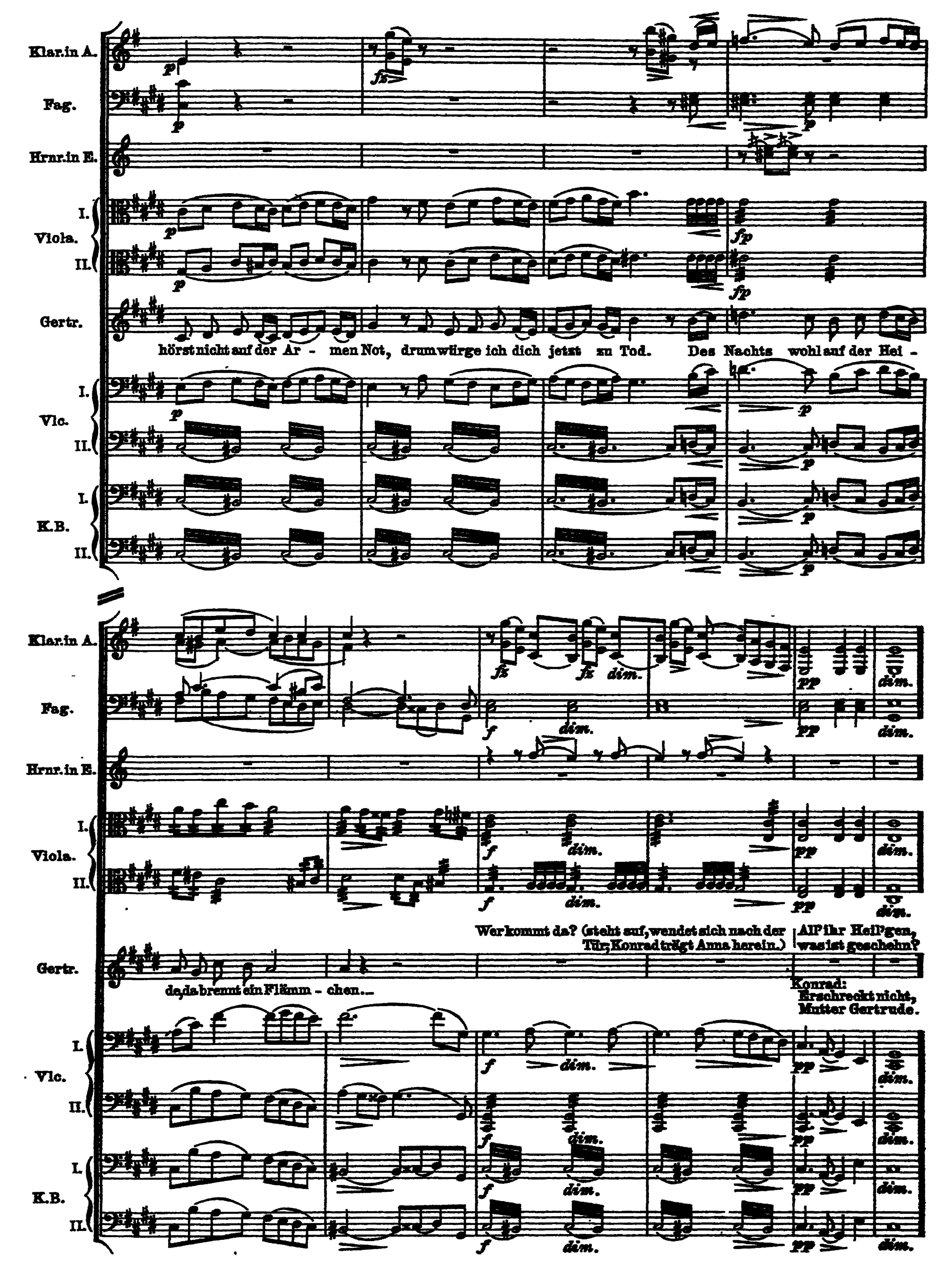
No. 44. Tristan, Act III
Slides of short notes, preceding longer ones,
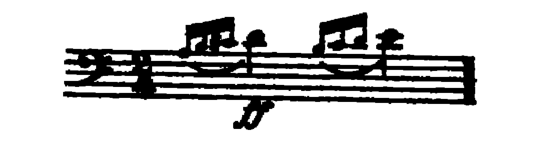
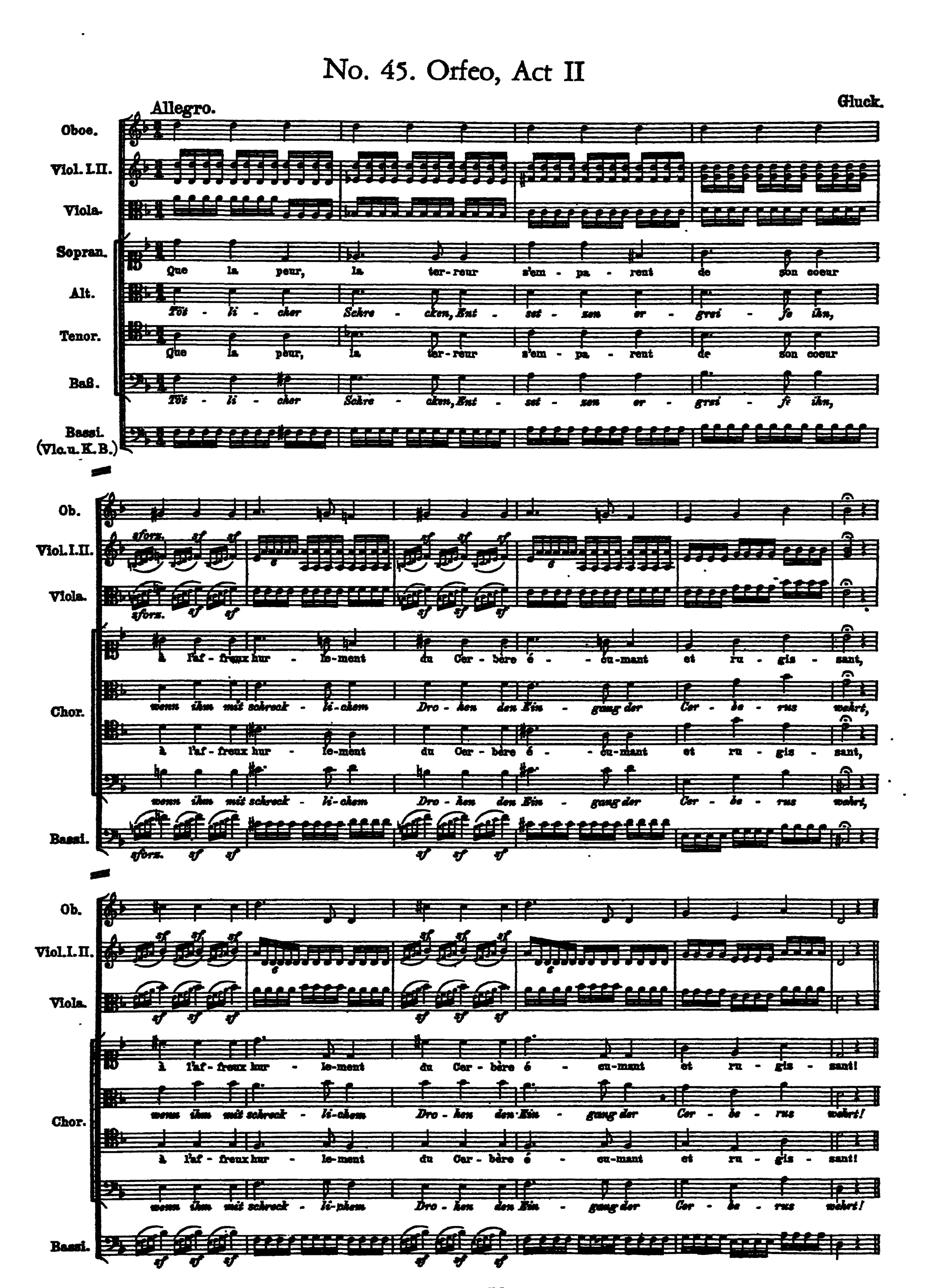
are executed by sliding rapidly with the finger on the string, without paying too much attention to the precision of the intervals; this can be extremely effective. The in the Hades scene of “Orfeo” is well known, where the double-basses deal furious blows to
the orchestra by running up to F with the four short notes B, C, D, E (with the words “at the terrible howling of foaming Cerberus”). This rough barking, one of Gluck’s finest inspirations, becomes all the more terrible as the composer uses the third inversion of the diminished seventh chord (F-G#-B-D). Furthermore, to give his idea all the weight and vehemence possible, he doubles the basses not only with the violoncellos but also the violas and the whole mass of violins in the octave. (Example 45.)
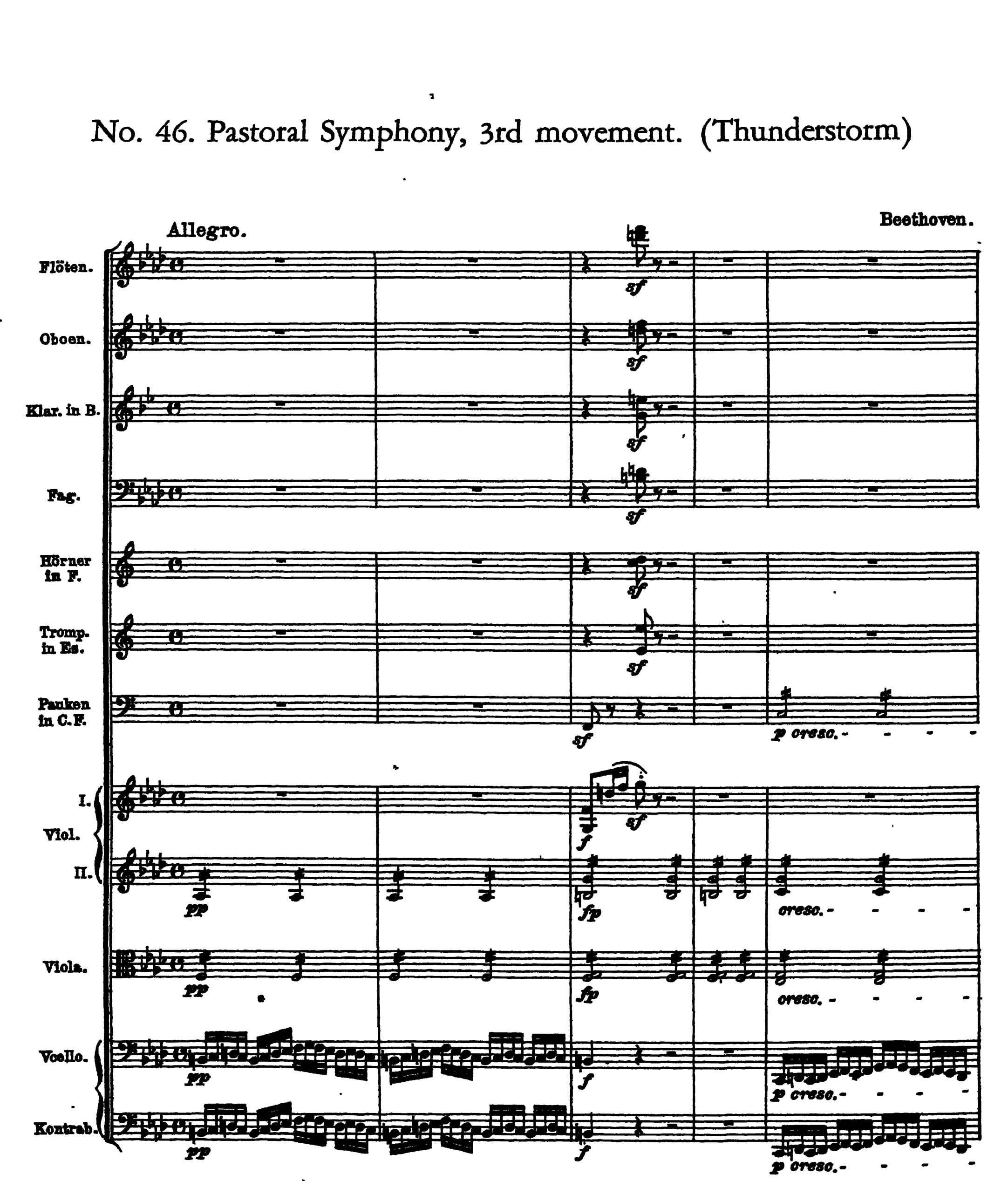
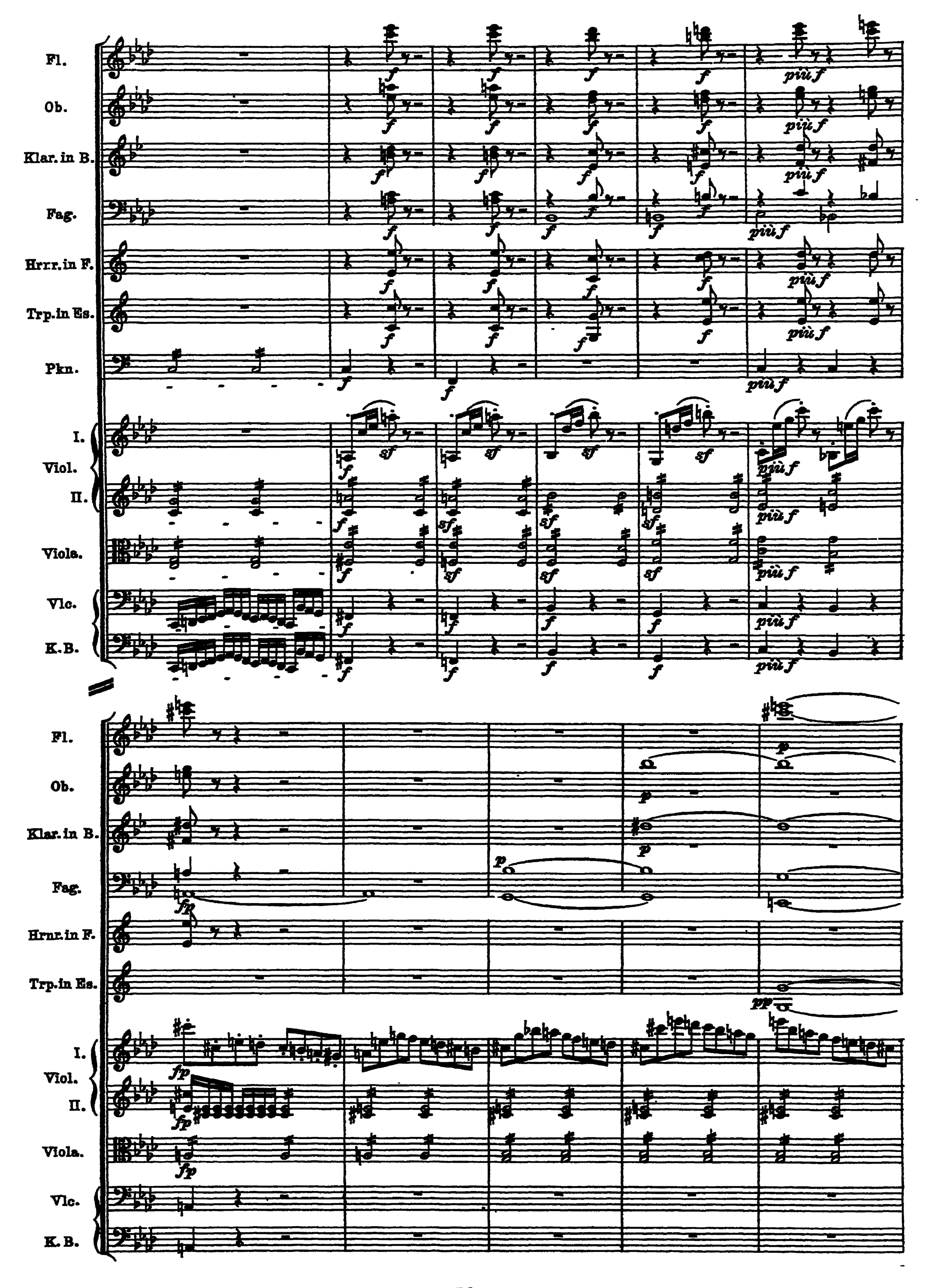
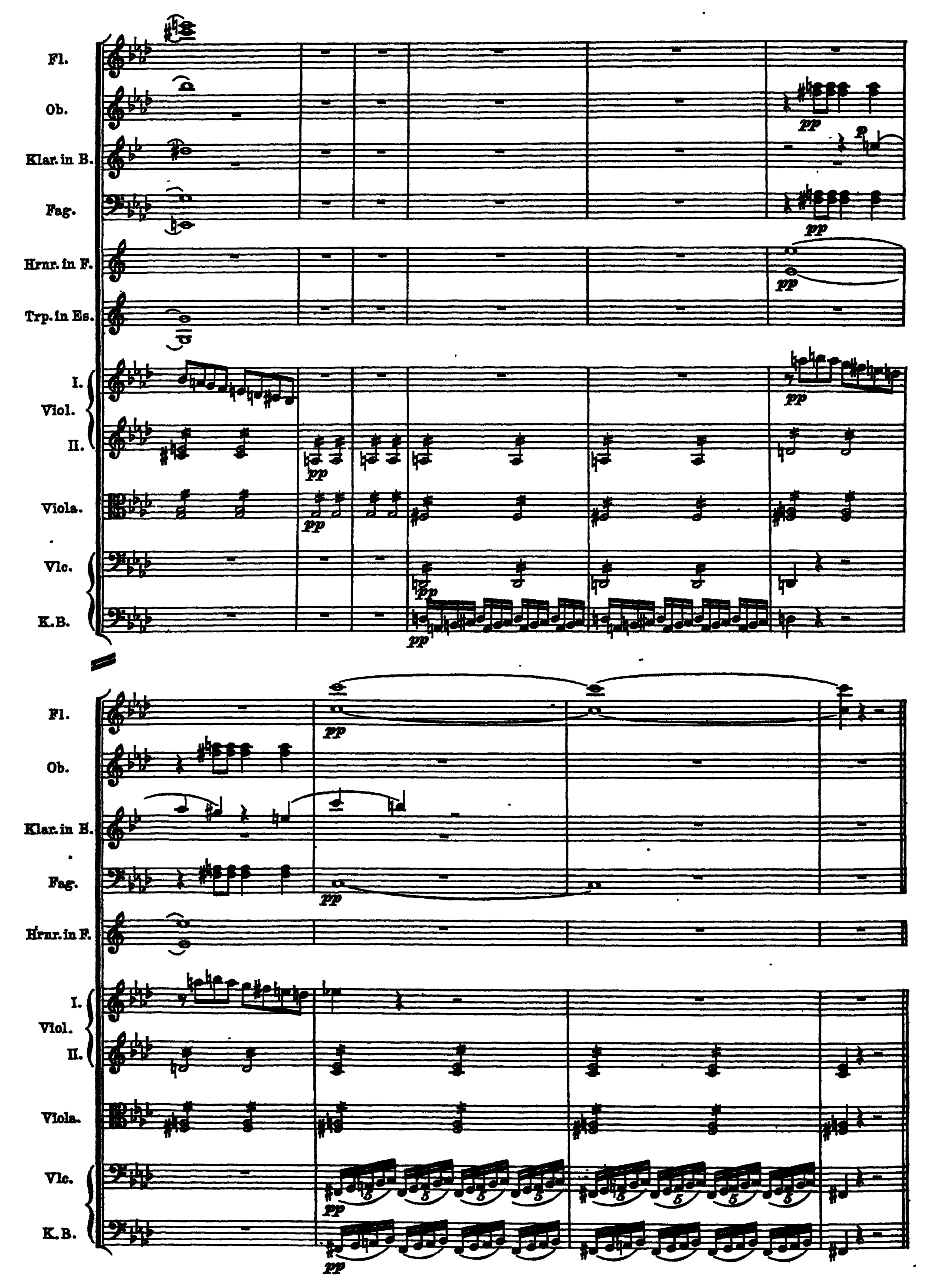
Beethoven has also availed himself of these not too clearly articulated notes; but—contrary to the previous example—he accents the first note of each group. These bass passages are to be found in the storm scene of the Pastoral Symphony; they depict in striking fashion the wind driving the rain violently, and the hollow rumbling of the storm. It is interesting to
note that Beethoven here, as in many other pieces, gave the double-basses notes which they cannot execute. One might conclude from this that the orchestra for which he wrote possessed double-basses descending as low as the C an octave below the violoncello C. Such instruments are no longer to be found today. (Example 46.)
In passages for wind instruments only it is excellent to double the lowest part of the bassoons, bass clarinets, low horns, or even of the trombones or bass tubas, with one or, if necessary, several desks of double-basses; unless one prefers to let the double bassoon or the double-bass clarinet play the lower octave.
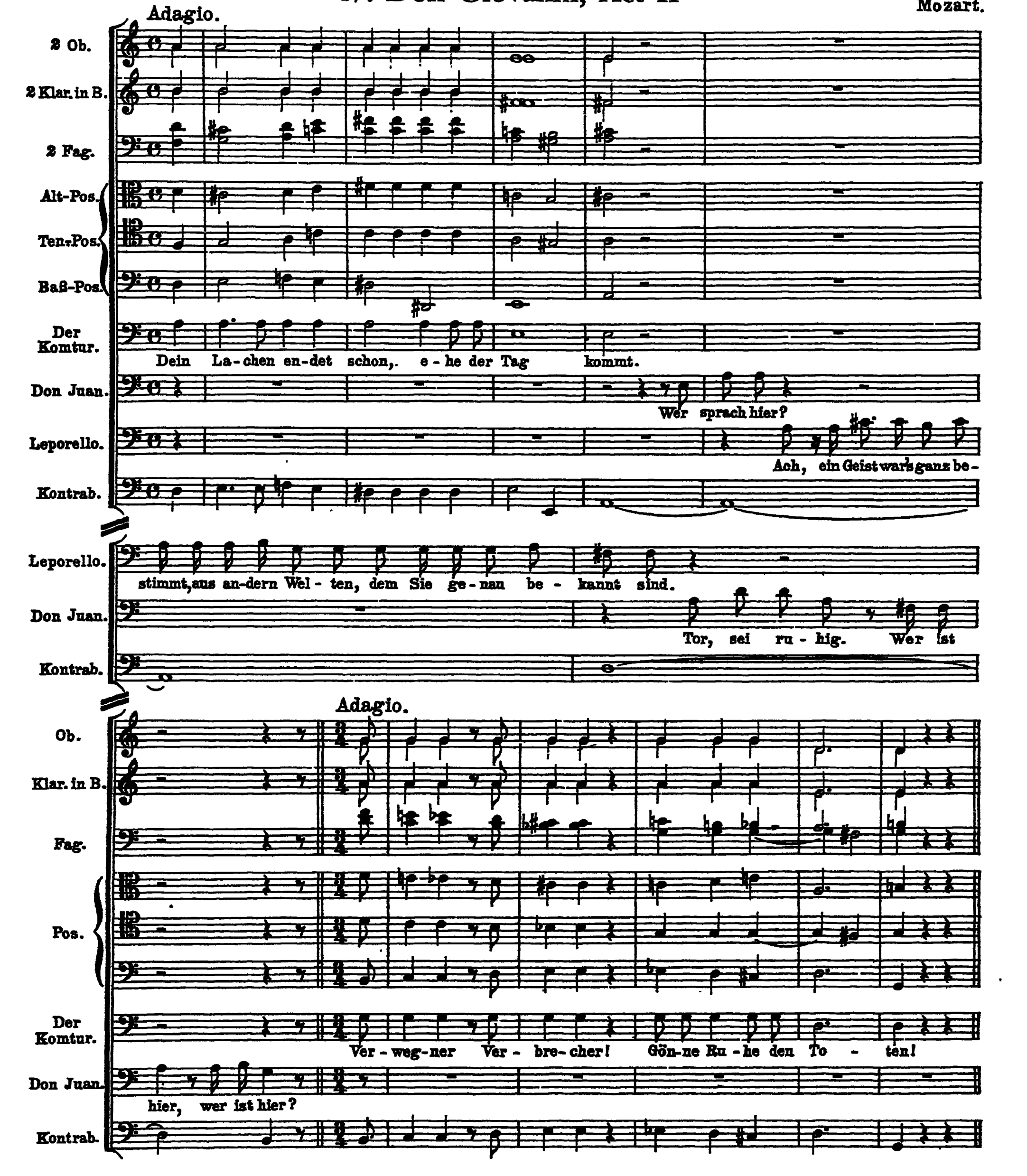
47. Don Giovanni, Act II
stimmt,aus an-dern Wel- ten, dem Sie ge-nan be - kannt sind.
The cemetery scene in “Don Giovanni” is frequently executed by wind instruments alone; however, just the double-basses which the divine Mozart added to the trombones give the scene a peculiar, ghostlike color (especially if placed backstage). {Example 47.)
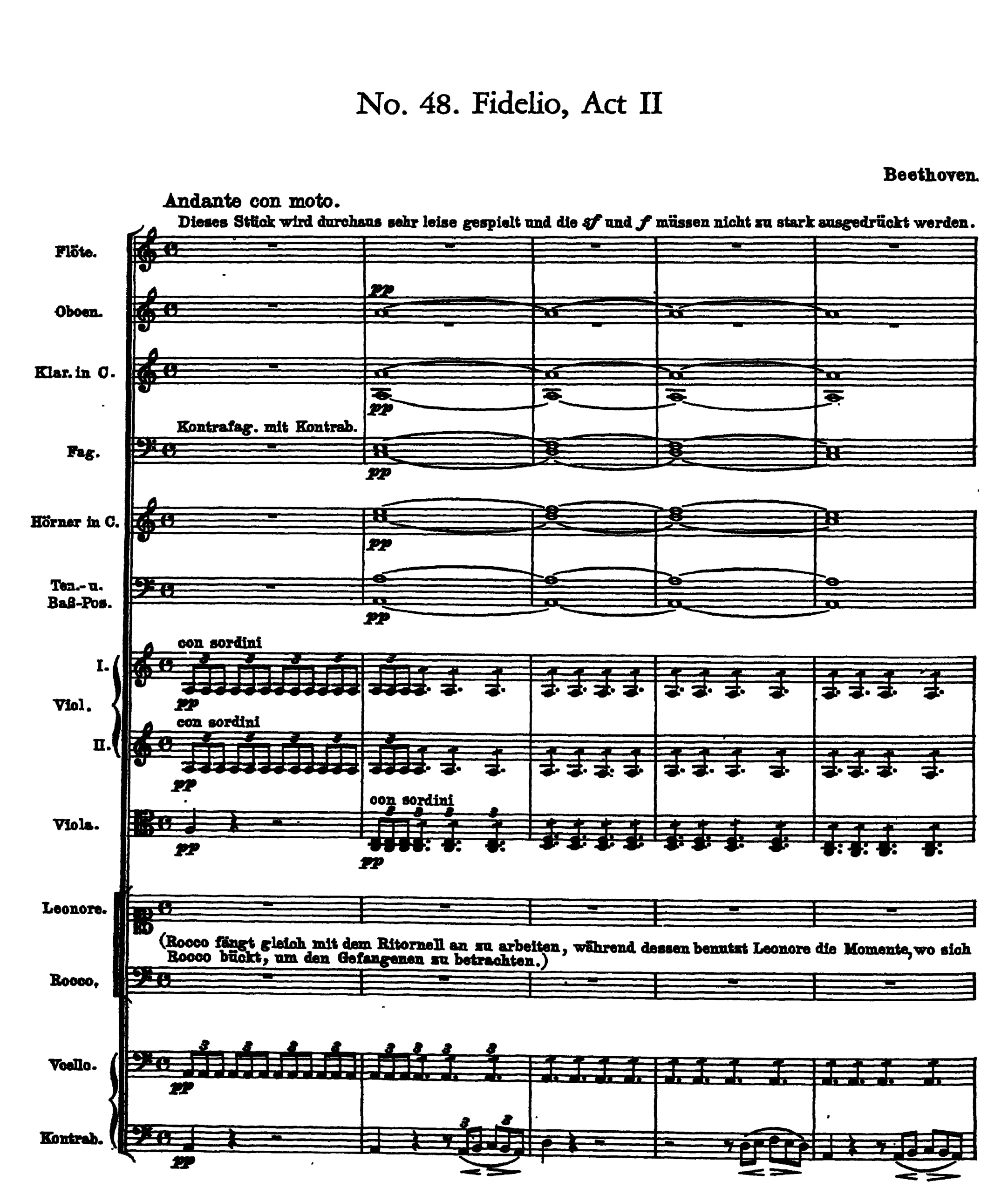
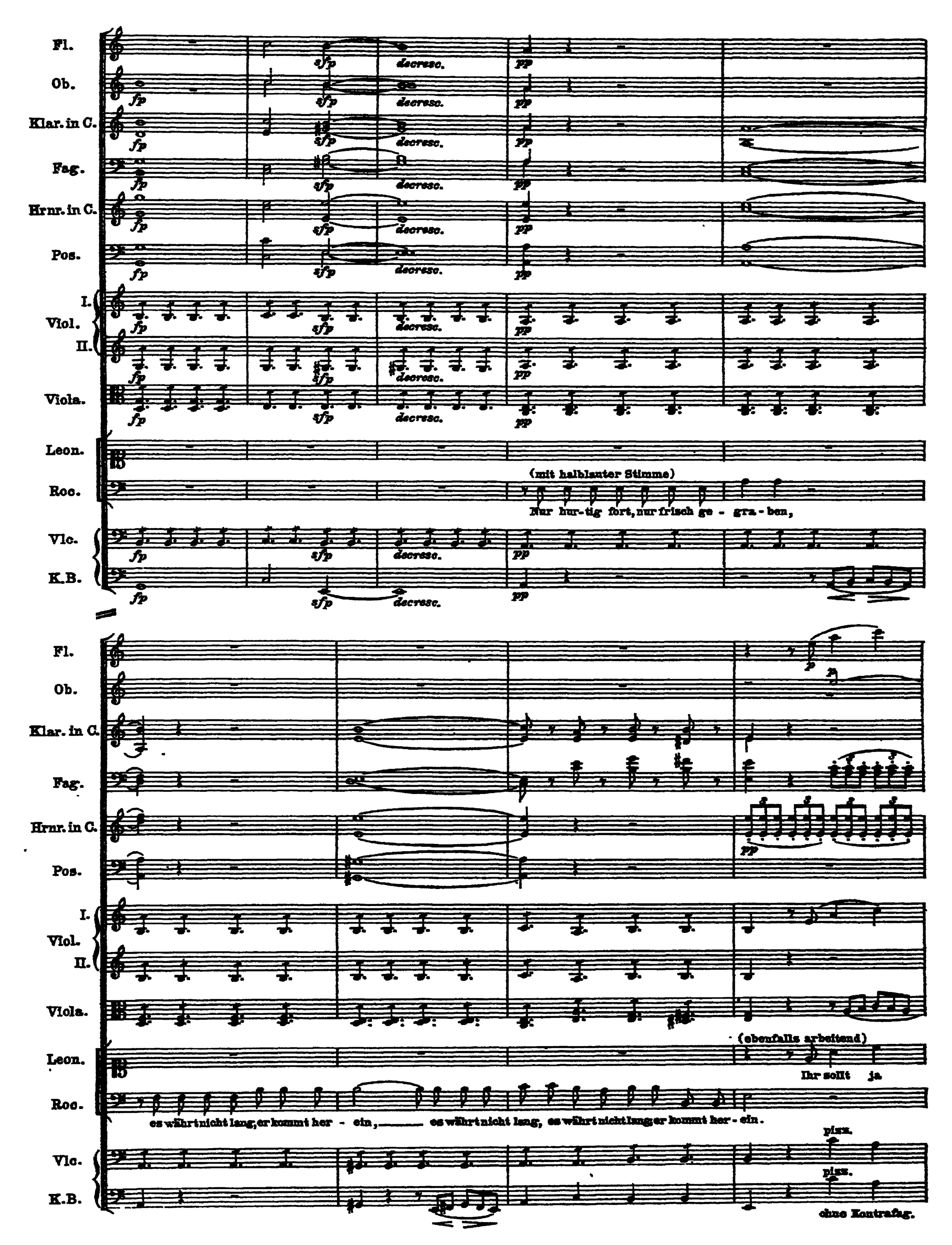
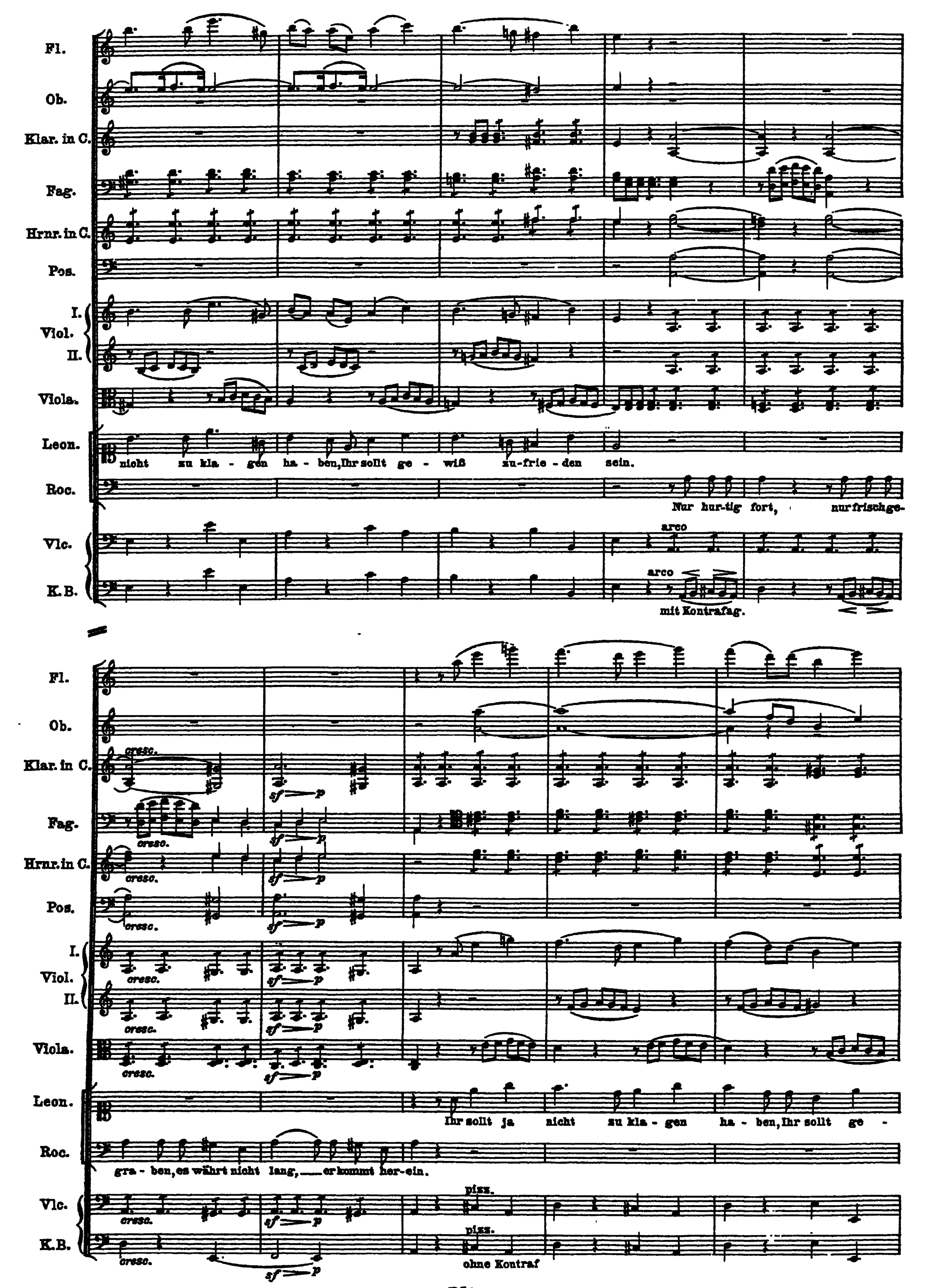
A fine and dramatic effect can sometimes be obtained by giving the real bass to the violoncellos, or at least the notes which determine the chords and fall on the accented beats, while the double-basses, below the violoncellos, play an independent part whose design, interrupted by rests, permits the harmony to rest
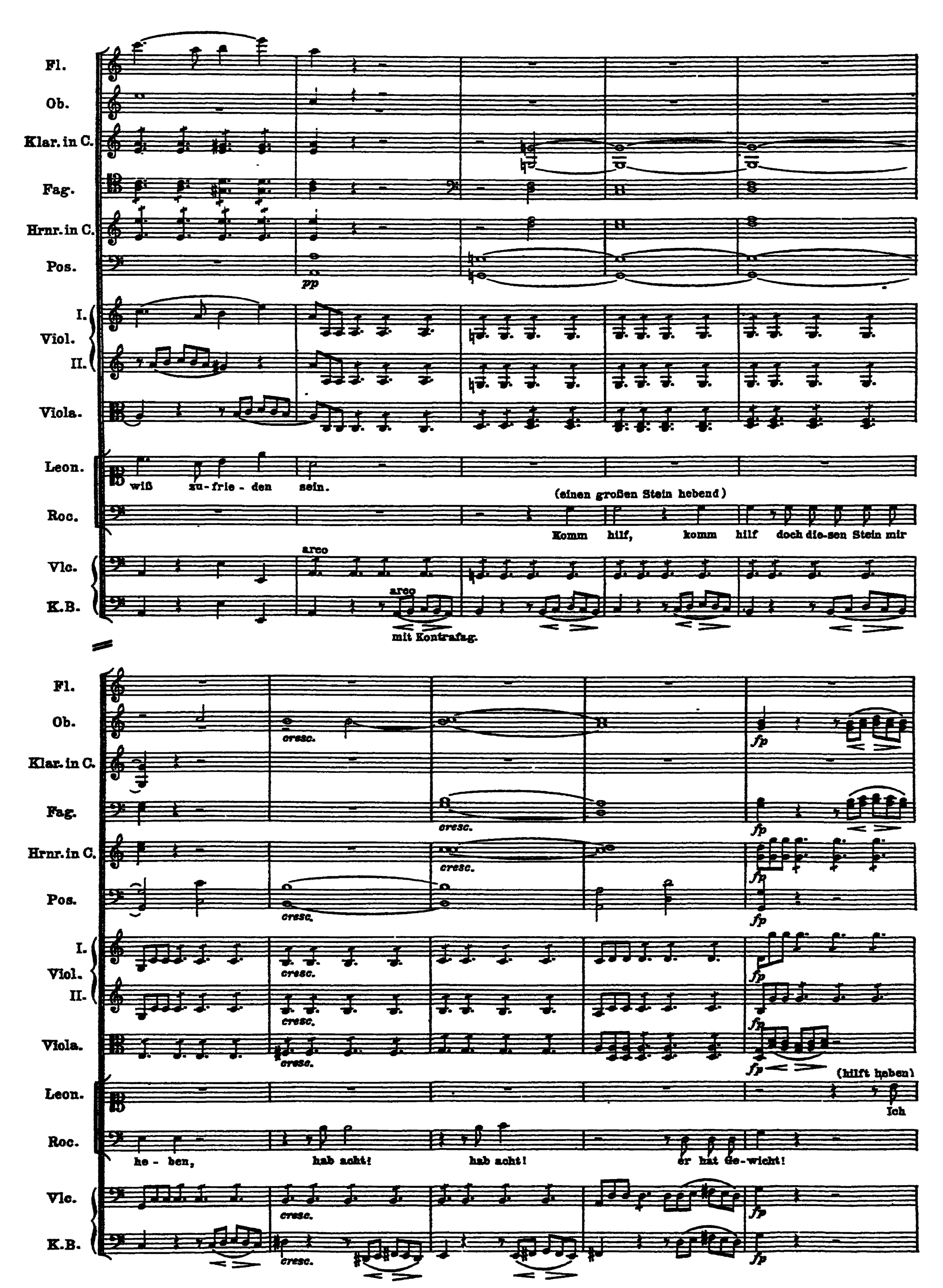
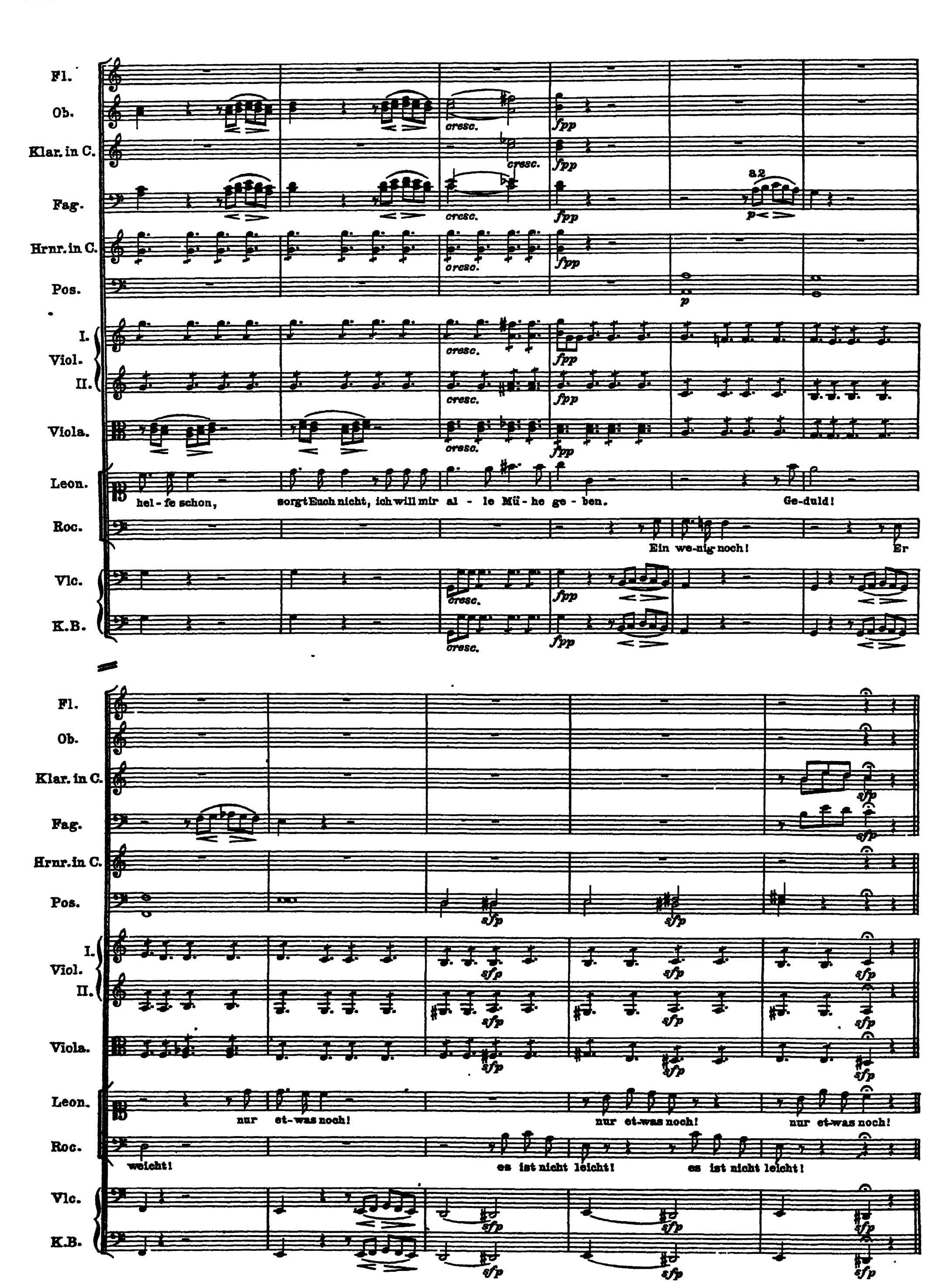
on the violoncellos. In the admirable scene of “Fidelio” where Leonore and the jailer dig Florestan’s grave. Beethoven has displayed all the solemn dignity and gloomy sadness of this kind of instrumentation. How-
ever, he gave the real bass to the double-basses (Example 48.)
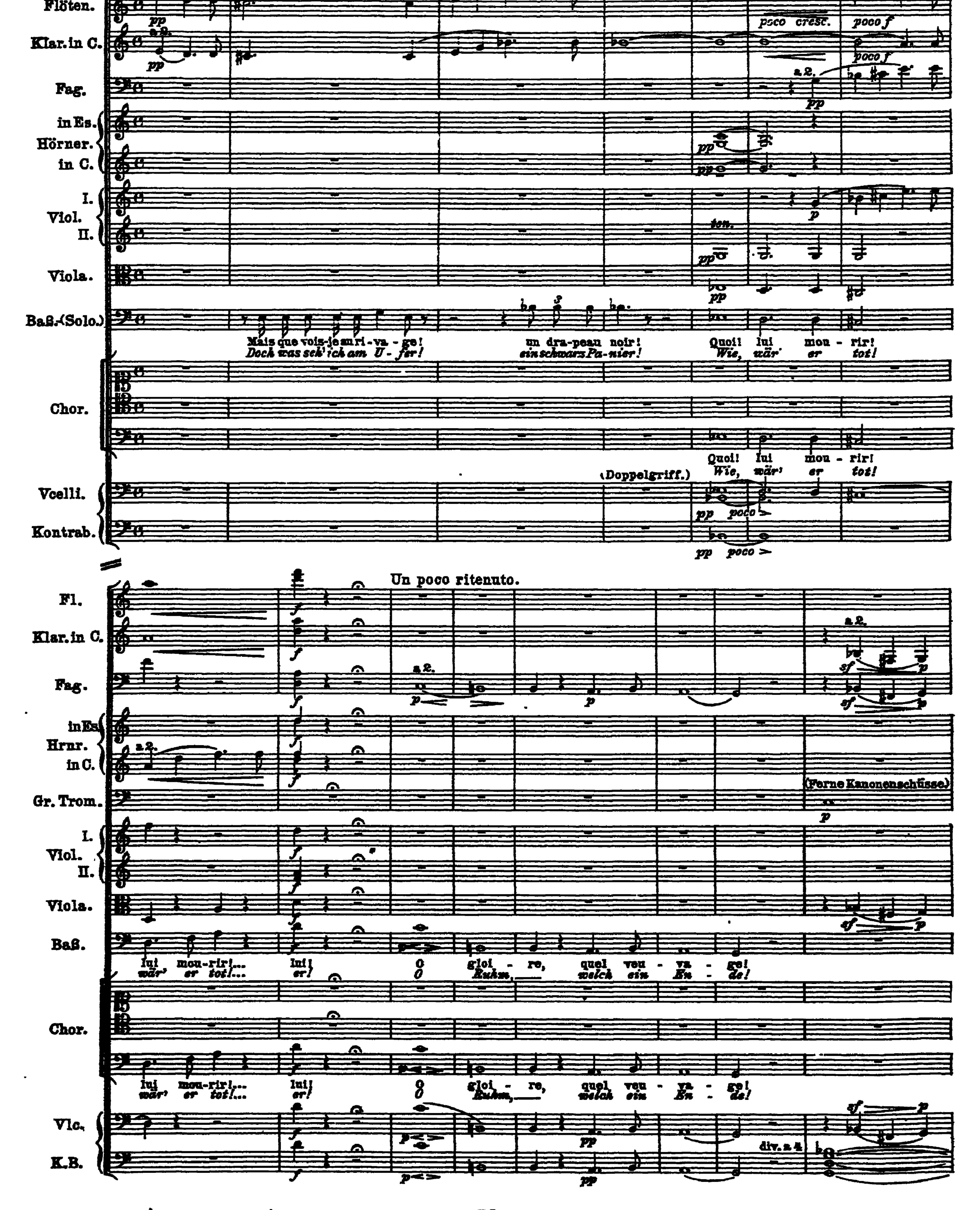
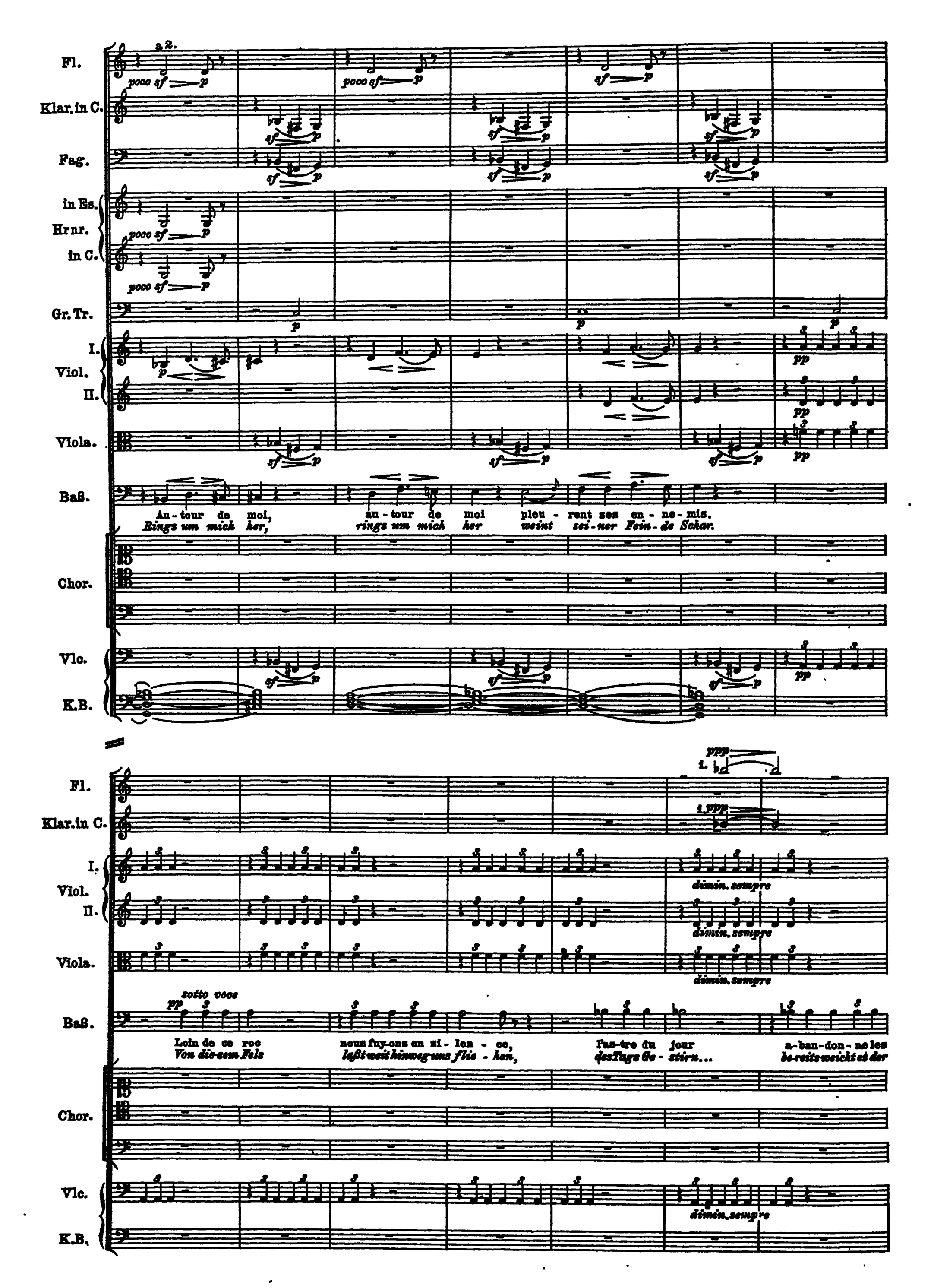
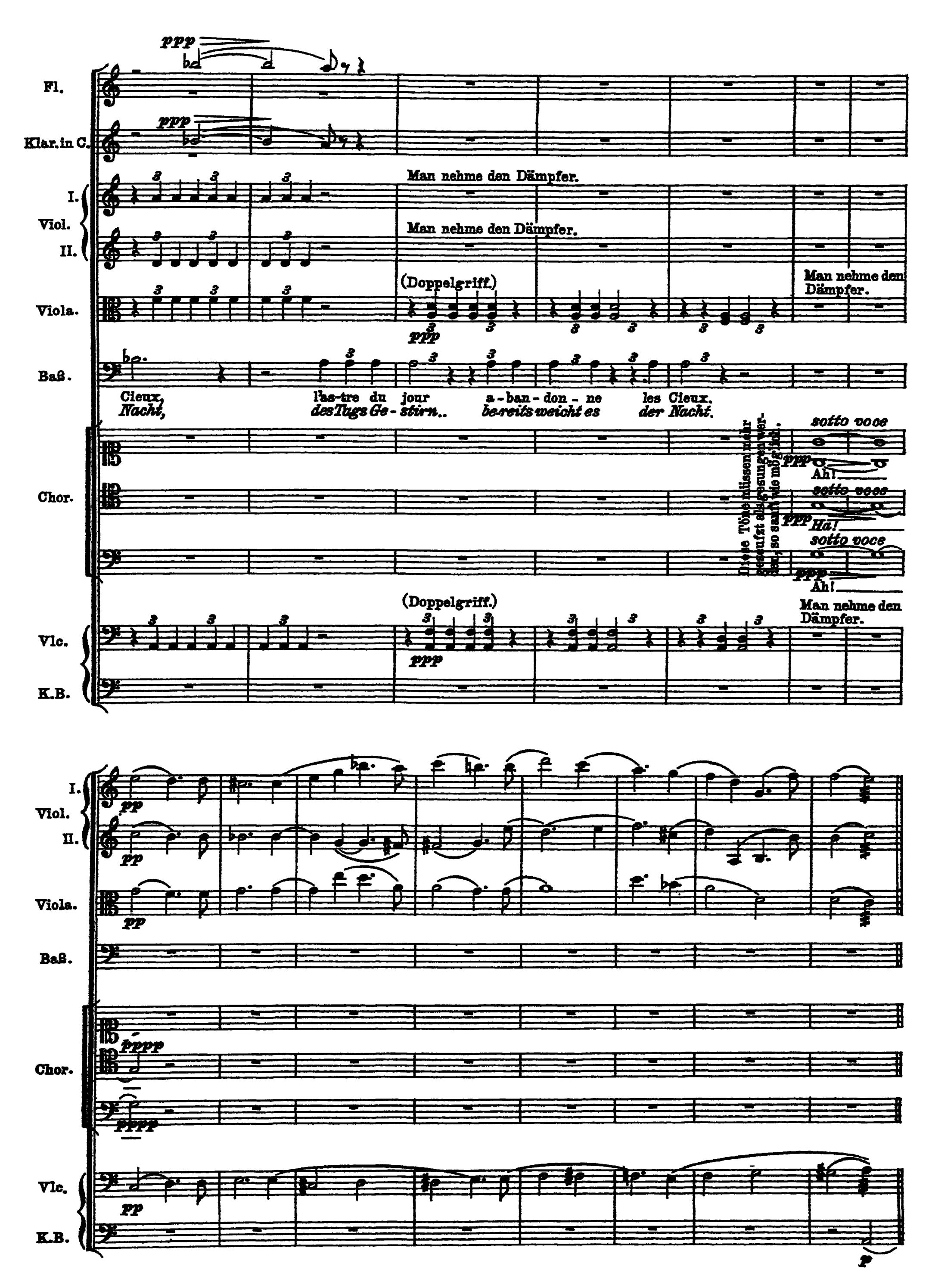
To indicate a mournful silence, I have divided the sustained pianissimo chords beneath a decrescendo of double-basses into four parts in a cantata; they play the rest of the orchestra. ‘Example 49.)
No. 49. Le Cing Mai, Cantata for Bass and Chorus Berlioz.
The pizzicato of the double-basses, in forte as well as in piano, is of good sonority unless it is employed on very high tones; but it changes its character according to the harmonies which it supports. ‘Thus, the famous pizzicato A in the overture to “Freischuetz” derives its threatening and infernal effect only from the echo of the diminished seventh chord
No. 50. Tristan, Act I
(F#-A-C-Eb), which thereby is transformed into its first inversion on a weak beat. The same A, written as a major tonic or dominant, and played mezzoforte similarly to the passage in question, would no longer have anything strange about it.
Wagner.
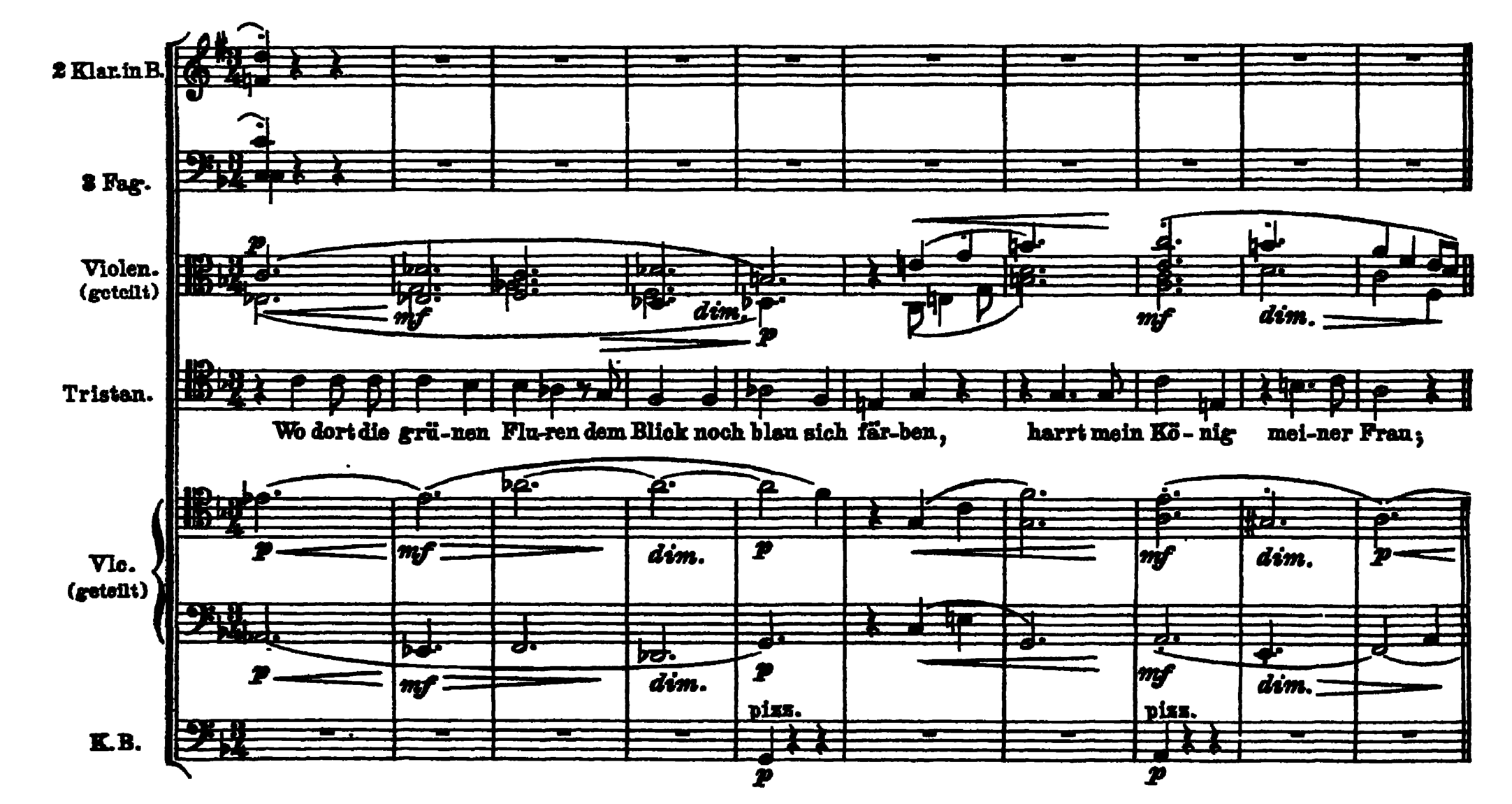
In this the pizzicato G of the double-basses melodic contours, as well as “Tristan” and “Mei-
together with the ninth-chord always gives me a sensation of color.
ee ree ree er ee ere ees ee
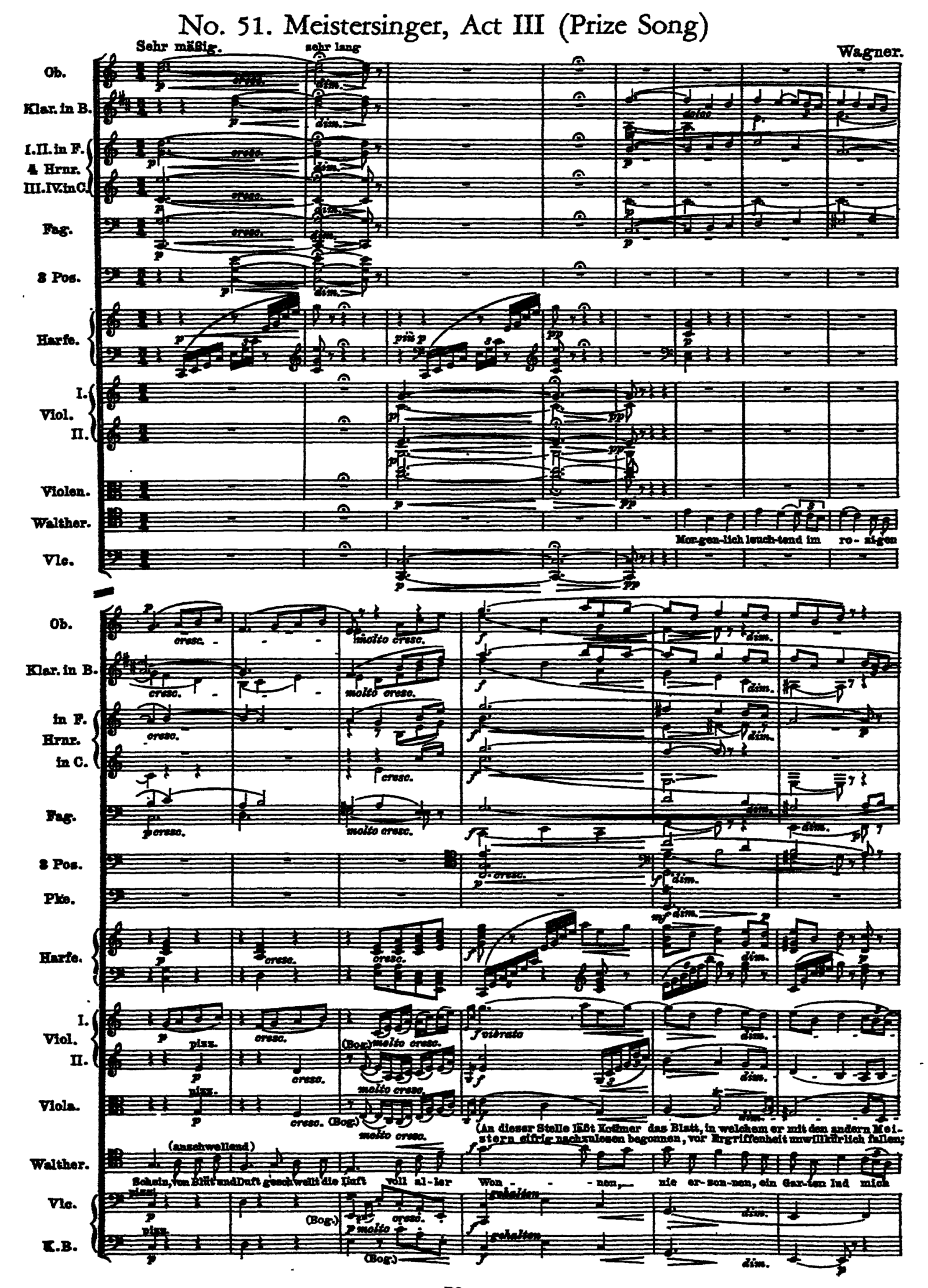
I should like to offer a few suggestions for the treatment of the string group, always so difficult, and a strangely refractory instrument in the hand of bunglers. The best models for study are to be found in Mozart’s string quartets with their impeccable style and technique, and particularly in the polyphony of the string quintet in Wagner's scores. The “Siegfried Idyll” with its wonderful
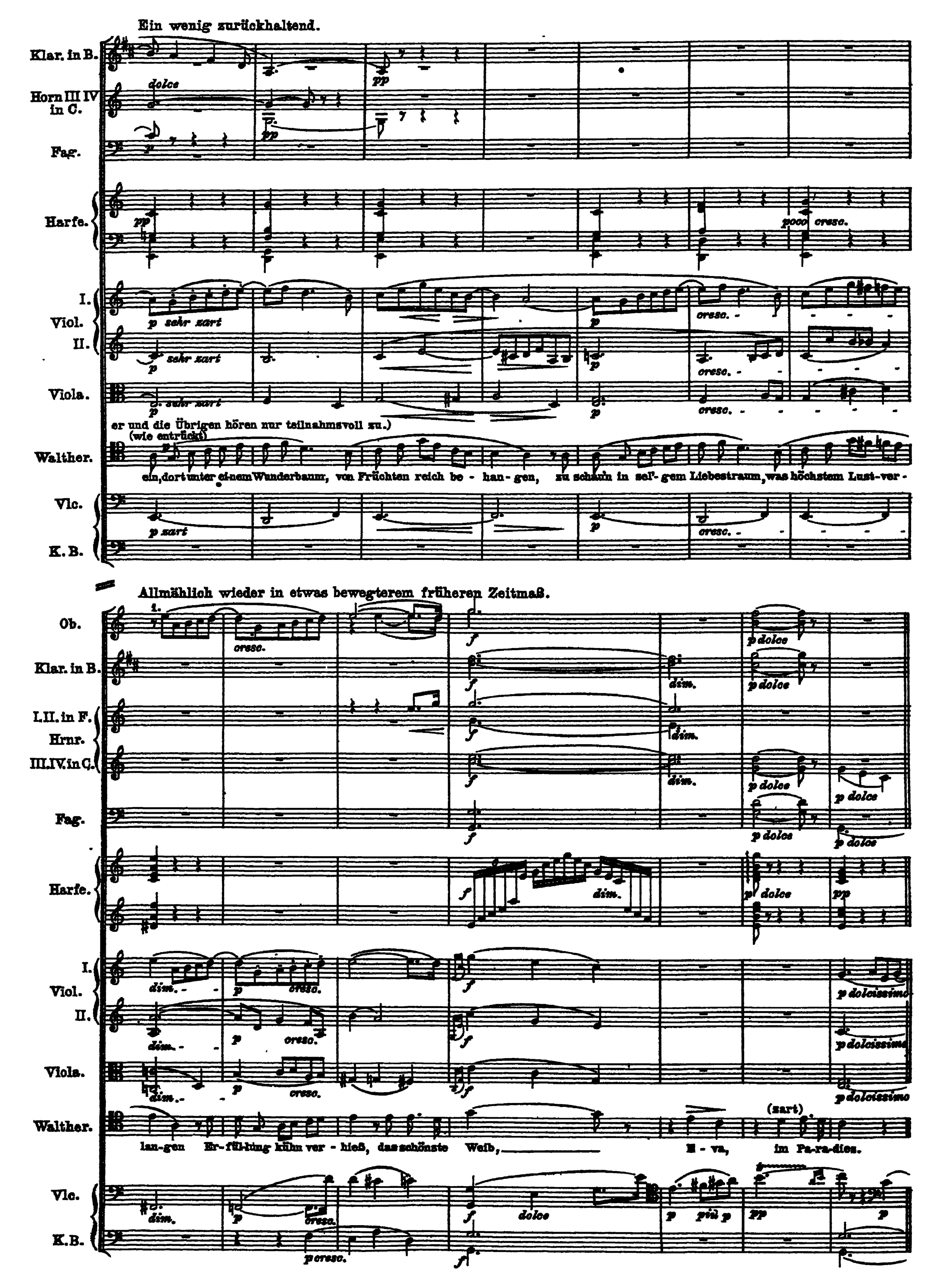
stersinger’ with their almost total avoidance of tremolos, offer on almost every page a complete compendium of the art of developing the full sonority of the strings. The whole Prize Song is an outstanding model for polyphonic line and the employment of open harmony, permitting a rich resonance of overtones; see-particularly the bars from Walther’s “Dort unter einem Wunderbaum” to “das schoenste Weib” (Example 51).
What other group of instruments could improve Entering in low position, with infinite softness, upon the effect of the string quintet in the passage, seemingly motionless and yet vibrating mysteriunique in its sublime inspiration, after Tristan’s ously, it leads the dying Tristan to a beautiful words, “Siehst du sie, siehst”du sie noch nicht”? world of dreams. (Example 52.)
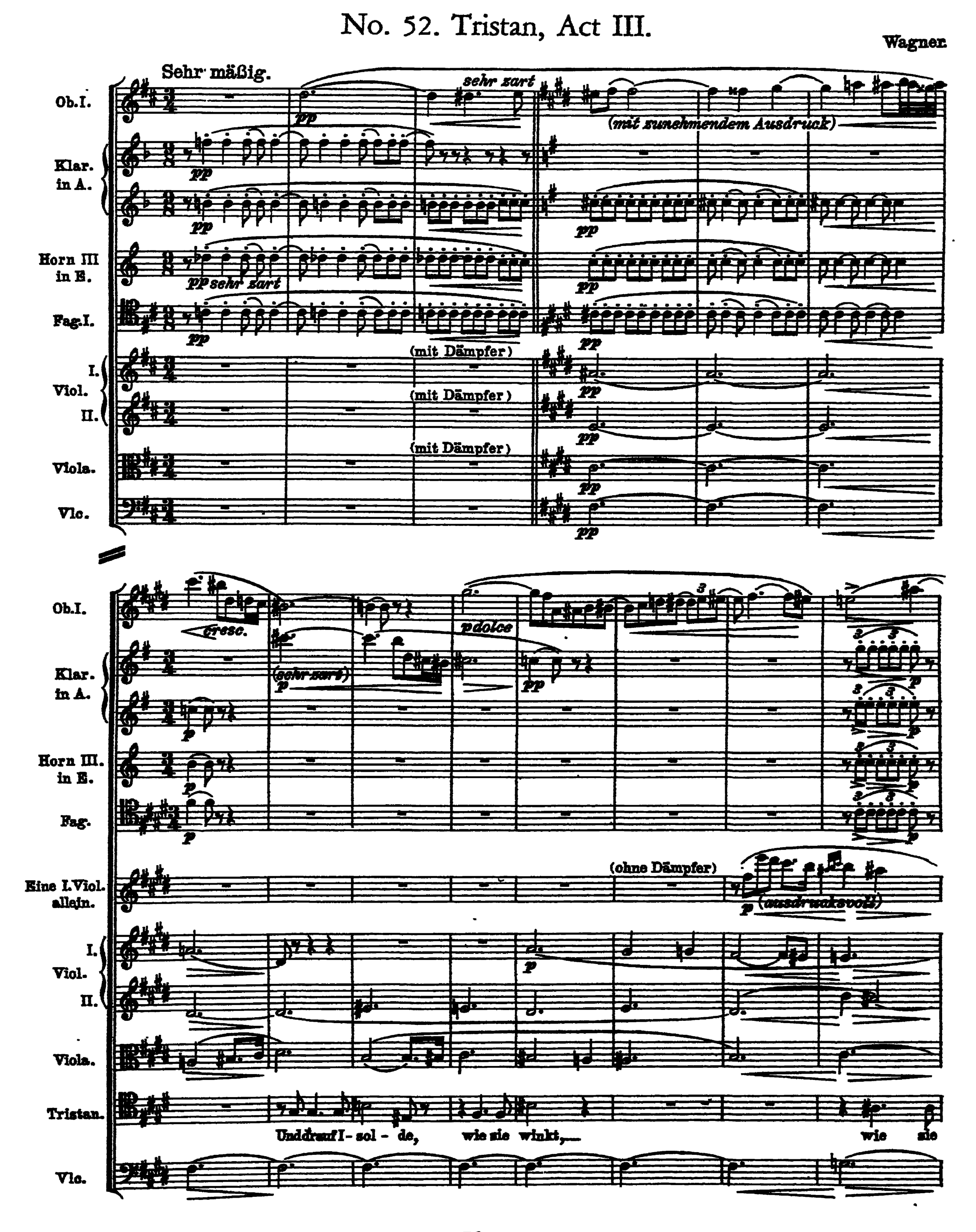
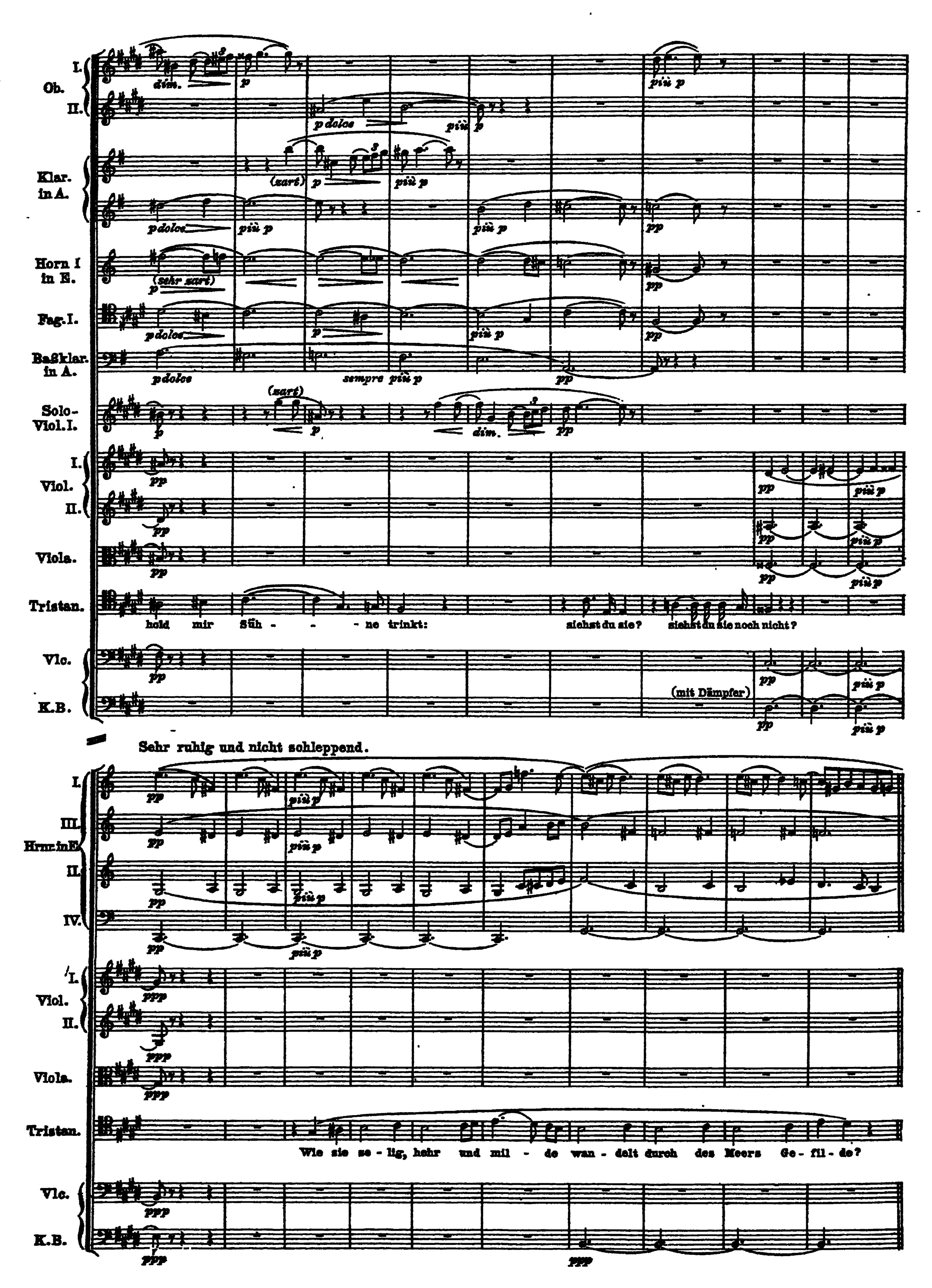
Mutes are employed on double-basses, as on other bowed instruments; but their effect is not very characteristic; they diminish the tone of the double-basses very little and make it sound more gloomy and vague.
A Piedmontese artist, M. Langlois, who played in Paris about fifteen years ago, produced very peculiar high tones of incredible power on the double-bass (with the bow) by pinching the highest string be-
Instruments With Plucked Strings