 Playable Books
Cecil Forsyth · section 55 of 60
No. 51. The Double-Bass.'
Read and hear this section in the playable edition →

Fr. Contre basse; It. Contrabasso; ' Ger. Kontrabass.

has only recently been standardized in pitch. In the seventeenth and

The instrument which had emerged in the latter halt of th ighteenth century as fittest to survive was a three-stringer. It wai
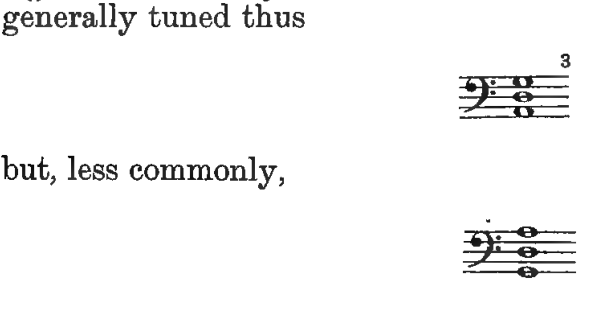
This was the Bass for which Beethoven wrote, the Bass which still remains the most characteristic in tone-colour and the most powertul in tone-quality. Up to Beethoven's day, however, little attempt was made by composers either to study the Bass as an independent instrument or to provide it with parts suitable to its nature. This laxity extended in particular to questions of downward compass. A single part was written for the Cellos and Basses. Provided the written notes lay no lower than the 3rd Cello-string the result was, of course, a bass-part sounding in octaves throughout. The upper line of the octave-part sounded on the Cellos as written: the lower part sounded on the Basses an octave lower.
Example 271
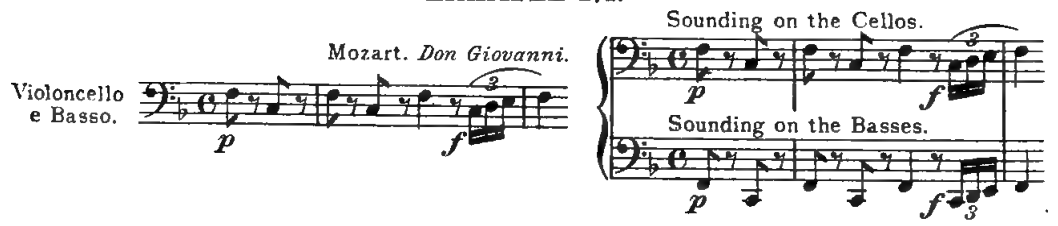
or posein the ner day lit always noeque thi, single-stave double. occurred which the Cellos could play at their written pitch on their
'Or, more simply "The Bass." The student is reminded that the word Bass when used in the sense of Double-Bass is printed with a capital.
2 The older Italian word Violone is now practically obsolete.
3 It must be clearly understood that the Bass is always a transposing-instrument! The actual sounds are an octave below the written notes. All the examples, reterences to tuning, and so on, must be read by the student with that provision in his mind.
4th string, but which the Basses could not play so as to sound an octave below that.' In these cases it was common until quite recently to allow the Bass-players discretion in the rearrangement of the passages to suit their instruments. They made a jump into their upper octave wherever they found it convenient. With players of judgment and experience the result in the concert-room was probably not so haphazard and confusing as it would seem on paper. Still the plan lacked the artistic nicety and exactitude which we now regard as essential to fine orchestral playing. It has therefore become a necessity to rearrange these passages whenever their range is outside that of our modern four-stringed Bass. The result in performance is a proper unison of the Bass-players throughout, though of course the original outline in the lower octave of the single-stave double-part is disturbed. string negler about the begin the he mi real ture, the tuning then became what it remains to the present day—a system of fourths,
This type of instrument, which is practically the only one now used in our theatres and concert halls, was indisputably known as early as 18023 However, its undoubted deficiencies in tone and attack as compared with the old three-stringer were held insufficient to counterbalance its advantages oi compass. It struggled into the orchestra only very gradually. Iwo tactors, however, were strongly in its favour. First, the modern demand-initiated by Wagner-for the lowest possible notes in the orchestral ensemble. Second, the improvements in the lowest Brass- and Wood-Wind. When these generally recognised and adopted, the necessity for the heavy jagging notes of the powertul three-stringer was no longer felt. A smoother and less obstinate tone-quality was preferred. People began to say that the instrument always made its part sound "like a Händel bass." The same reason which had preserved its existence in the first half of the century hastened its downfall in the second. It has now more or less completely lost caste, and is scarcely ever seen in our concert-rooms. There is, however, a good deal to be said for the instrument in one way or another, and some reference to its capabilities will be made later.
It has often been asserted that the existence of these passages presupposes the instruments on which they could be played. There is, however, no necessity to split logie on the point, for we know as a fact that the instruments in general use at that time were the ordinary three-stringers. These instruments were occasionally tuned in ifths, A, D, G, downwards. This was more especially the case in France. The diffculties of technique, however, were always in favour of the tuning in fourths. enormous church-Basses are still in existence. These might well have been tuned down to the low E or even to C. But there is ao ground for supposing that they ever were so tuned
"It is mentioned by N. W. Koch in his Muskalsches Lexikon, 1802. See Widor,
The general adoption of the four-stringed Bass only partially solves the difficulties of the old classical one-stave two-part passages. So long as they do not go below the low E, they can now be played by the Cellos and Basses so as to sound throughout in the two intended octaves. But these parts sometimes go down lower still to the D, and frequently make use of the bottom-string Cello C. As far an such phe bass par, the disabie ar af a center by go remain or by the conductor.
Symphy, come on Clear it que the shes a fing othe Contral note the low Cello D.'
Example 272

Here it is quite obvious that the mere raising of the third quaver by an octave would defeat the composer's intentions. securing the pedal D effect on the second halt of each bar is to adopt this formula for each bar. The Cello part, of course, remains

It must not be imagined that the effect of these unintended unisons between Cellos and Basses was always disastrous. In nine cases out of ten they have no orchestral significance at all. Even in the solo opening of Schubert's Unfinished symphony:

it is doubtful if any one has ever felt much perturbed by the sudden unison in bar 5. This unison is intended and foreseen by the com- Ine consideration of this typical passage, however, involves a point which is sure to bother the student. He will probably ask for
1 The Cellos here have the same written notes, but they perform them in measured demisemiquaver tremolo.
2 If the Peters score of this Symphony is correct, the Bass-part was undoubtedly written for an instrument possessing the low E. See the corresponding passage immediately after the double-bar. The Basses descend with the Cellos to the low E. The Cellos then continue downwards to D and Of (open string), but the Basses jump up a seventh before taking these notes. In several other places the Basses have the low E some rule-of-thumb by which he can assure himself that his descending passages will have the effect of descent, while at the same time they remain within the compass of the instrument.
The point is of less artistic importance than one would suppose trom the statement of its logic. In ordinary detached basses, even when the "lay" of the part is clearly downwards, it matters very little. By reading the Bass-part back for a few bars a convenient place can always be found in which to jump to the upper octave. Purely melodic passages rarely occur in these depths. But when they do occur, especially when they are solo passages with or without the Cellos, they must be treated rigorously with regard to pitch as one would treat melodie passages on any other instrument. Sequence-patterns, in Bass-parts, and, if these however, occur continually descending-sequence, it is otten a little troublesome, especially it the notes be long and heavy or the tempo slow, to secure the continual feeling of descent. In these cases, if the end of the sequential-passage lies below the low E, it is often wise to begin the whole Bass-passage an octave higher. The notes will then sound in unison with those of the Cellos. It may be added that there is no greater pittall tor the young composer than the use of the bottom register of the Bass. analogy from the added resonance of the lowest pianoforte notes is absolutely false. The rule should be "keep the Basses up" They then or somepape of inting their pand foote, te enforced, to the dismal profundities of their bottom strings they merely sound like a herd of unwieldy "hippos" stirring up the mud on the river-
as only above recto the tina repthe esses" Cat be taken " must be taker where for special effects excessively deep notes are necessary. And it is this necessity which has created the demand for a Bass whose compass extends still lower than the low E.
This necessity has been met in four ways.
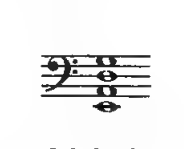
(1) By the invention of the five-stringed Bass, whose tuning is the same as that of the ordinary four-stringer, but with the addition of a fifth (bottom) string tuned to U. This instrument has the fundamental technical disability of an irregular tuning. It has the further disadvantages of increased size and increased length of string, —both important matters in such a formidable monster as the Bass. These five-stringed Basses are used in French and Belgian orchestras. They have been tried here, but not with any general success. However, one must add that some solution of the difficulty has been found by the recent introduction in this country of a five-stringer whose bottom string is tuned to Bi. Under this system the tuning remains a perfectly regular series of fourths, and the player has the further advantage of an additional semitone in his downward compass.
(2) By the lengthening of the ordinary bottom string (the b) and the addition of a mechanism. In this case the E-string is prolonged to the length necessary for producing the deep C. In ordinary circum- stances the mechanism remains out of action, and the string retains its vibrating-length as an I-string. By a simple pressure of the thumt thie mechanism can be switched-on, and, by the addition of the upper string length, the four lower semitones Eb, D, Do, O can be obtained.
(3) By a temporary alteration in the tuning. The player alters This is the his string to suit the depth of the passage before him. Wagnerian procedure. In the Eb pedal at the beginning of Das Rheingold half the Basses are instructed to tune their bottom-strings down one semitone. This plan is unsatisfactory. The system of fingering is disturbed; the vibrating-length of the string becomes incorrect; it is difficult to retune the string to its proper pitch. The inconveniences to the player are so obvious as to be scarcely worth pointing out. However, it the plan of a casual mistit-tuning is adopted, it is better at the beginning than in the middle of a work. In either case time must be allowed for the tuning and the retuning of the string.
(4) By a permanent difference in tuning. Some_players have adopted the low D tuning for the bottom string. Their strings then run upwards D-A-D-A. This innovation is by no means generally accepted among Bass-players, It involves the old disadvantageurther irregular tuning, and therefore an irregular finger-technique. more, it does not give the low U. Ut all these methods that of the five-stringer tuned in perfect fourths appears to be open to the fewest objections. The student must, however, be warned that none is regularly available in this country. Players do not, as a rule, possess five-stringed Basses or mechanically controlled bottom-strings. more ine, it is maestrobat exp the dificulties of accurate be or and recovery are great. The fingering, founded as it is on a series of fourths, is thrown out of gear. The other stringed-instruments are practically never called on for this sacrifice. Why then the Basses? More than any others they demand help in order to secure an accurate intonation. The whole "truth" of the String ensemble depends on them. Is it not then better for the composer to make up his mind that the lowest String-sound at his disposal is at present
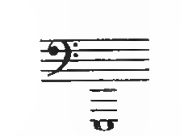
One would hesitate to ask this question if it could be shown that the addition of a semitone or two downwards added materially to the sonority or the sense of depth in the orchestra. This is, however, very far from being the case, and as we possess many fine Bass-players who perform on the E-A-D-G instrument, it is surely the wisest course o regard that instrument as it should be regardea, viz. as clearly standardized in its tuning as the Violin or the Cello
1 Occasionally also D-A-D-G. This is practically the old three-stringer tuned in fourths, with the addition of a bottom-string tuned in fifths with the third-string.
It must not be forgotten that this question of tuning is not a question " in the air" for Bass-players. It is a question that intimately concerns their technique. On that point a few words will be said
authoriore earing rd is trap in ander tinto countied use in ent same orchestra of Basses of different systems. In especial the distinguished composer recommends the inclusion of "the 3-string Italiar Double Bass" for the sake of its great cantaoule powers. This is practically a return to the method universal in English orchestras twenty-five or thirty years ago. The undoubted advantage lies in the extraordinary tonal strength of the old three-stringer. But the system was abandoned owing to the serious lack of uniformity which resulted in the Bass-department. A group of players, halt ot whom were compelled to stop playing when the music descended below G, was a source of some anxiety to conductor and composer alike.

The fingering of the Bass is something like that of the Cello. The proportion between the vibrating string-lengths of the two instruments, however, is as 2 to 1. It therefore follows that the distance between the adjacent semitones is twice as great on the Bass as on the Cello. When the hand is closest to the nut the maximum stretch between the Ist and 4th fingers is only a whole-tone, and, of individual pairs of tingers, the Ist and 2nd alone can be separated sutliciently to produce a true semitone. If the instrument were tuned in titths, like the Cello, the simplest scale passages would involve continual shitting Luned in fourths, however, the instrument is, so to speak, readjusted to the human hand. The necessity for excessive shitting is obviated, and in this respect the difficulties of the instrument are not much greater than those of the Cello.
It is unnecessary to go very fully into the fingering. In the lower registers it is a system by means of which the fingering 1-4 is used for adjacent ascending whole-tones and 2-4 for adjacent ascending semitones. In those keys where the open strings are not wholly available -that is to say, in keys north of D and south of Fla simple position-technique is adopted. This technique furnishes a method of pertorming a series of tour notes on a single string by means of a shitt taken between the 2nd and 3rd notes of the series. The fingering used is either 1-4 or 2-4, according to the stretch involved. In the higher parts of the compass, as the vibrating string-length diminishes the distance between the notes becomes correspondingly smaller. The fingering adopted is then very similar to that of the Cello.
1 The two keys Bb major and A major are transition-keys partly playable by the one method, partly by the other.
Chromatic Technique.
The chromatic technique is simple. Each series of four upward semitones between any open string and its neighbour is produced by a repetition of the fingering 2-4. The following example will make this
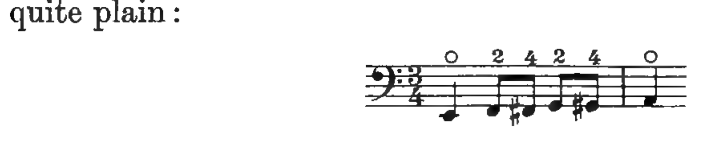
This system is used regularly in the two lower octaves of the instru-
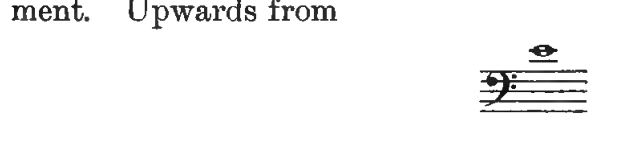
the Ist finger is brought into play.
The above much-compressed account of the left-hand technique will be sufficient to show the student that the Bass is as fairly chained down to a tuning in fourths as are the other stringed-instruments to a tuning in fifths. Any disturbance of this tuning must therefore be adopted with a knowledge of the risks run. The bottom-string of the Bass is not a vaguely indefinite note whose alteration is matter of indifference to the player.

The bass-clet is regularly employed for Bass-parts. The highest register, however, is usually written in the tenor-cief on the fourth line

Whatever the register or clef the written part remains an octave above the actua. sounds. A rare exception to this procedure is sometimes found in the case of the Natural Harmonics.!' These may

be written at their actual pitch. For the higher of these Harmonies the treble clef is occasionally used.
Of late years, under the influence of the modern German school of music, our Bass-players have been compelled to acquire such a degree

of virtuosity that it is a little difficult to set any upward limit to their
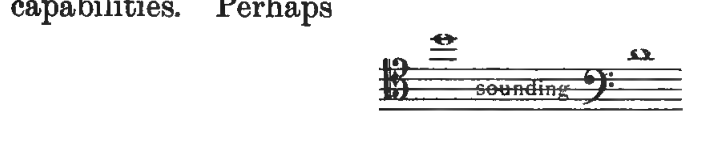
may be suggested. Above that the notes and the execution are in an ensemble unsatisfactory.
Chords.
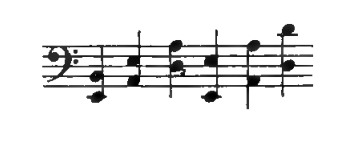
A certain number of two-part chords are possible, but very few are advisable. In fact chords are not worth writing for the orchestral Basses, unless either both notes are open or one of the notes is an open string and the other clearly playable as a stopped note on the adjacent string. This may be taken as applying theoretically to all thirds, fourths, fifths, sixths, sevenths, and octaves. In practice, however, all Bass-chords, even when possible as double-stops, are better written in two parts divisi. A narrow exception may be made in favour of those fifths and octaves which have one open string. The list is as follows:
Natural Harmonics.
These are particularly easy on the Bass. Hitherto, however, they have not been much used in the orchestra, perhaps because the instrument is usually fulfilling other functions. As a general rule the higher the string the more satisfactory the Harmonic. On the bottom-string only two are worth using: on each of the other strings there are at least five.
A word must be said with regard to their notation. Owing to the fact that the upper Harmonics lie high up in the treble-register it case the treble were would be necessary, if the part were still to be written as a transposing-part, to use the treble-ciet and a great many leger lines. Therefore, in this case only, it is as well to treat the Bass as a nontransposing instrument: to write the harmonics at their actual pitch, adding the direction "actual sounds": and to place the usual harmonic sign o above each note.
It is scarcely worth while giving the theoretical list of Harmonics possible on each string. In practice they may be reduced to these

It will be noticed that the lowest Harmonics are not available on the E-string. As a matter of fact, all Harmonics on that string are somewhat thick in utterance, and their avoidance only involves the loss of one note (the G♯), as the lower note (E) is obtainable in a better quality on the A-string. , Furthermore, the highest Harmonic given on the two top strings—viz., the high C on the 2nd string and the high F'on the first string-is a little difficult to produceitisnot absolutely impossible, but it should be avoided.
The rest of the Harmonics given in the above list are by no mean. theoretical notes. They are all obtainable in a good sound quality and can be employed either in tenutos or in chord-combinations for divisi-Basses. Their restrictions in the way of key are, of course, obvious. Provided the composer marks the notes clearly as Harmonies and as "actual sounds," the use of the treble- or tenor-clef for the highest notes is a matter of indifference.
divisi Cellos and the pases told a harmonic in three octaves trewhere the
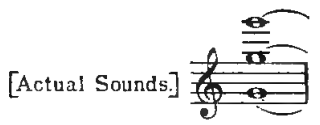
the Basses play the lowest of the three notes. This is the third Harmonic given in the list of Ist-string Harmonics above. In the Full Score Verdi writes the note thus—
Double-Basses.
Harmonies.
This is the old-fashioned way, adopted in order to show the player the proper fingering. The bottom note indicates the string; the middle note
che fingering; and the top note the actual sound.
applies to the top note, and is necessary here because the notatior is not in actual sounds, but in the usual Bass convention of an octave above true pitch. It is not of much importance which method the composer adopts, provided he makes his meaning clear. The notation in actual sounds seems to be simpler from the composer's point of Nowadayst here is the need to intony pay no to the ta t the ot their Harmonies.

As it is impossible in the lower positions to stop a perfect fourth with the Ist and 4th fingers on the same string, the whole of this series is ruled out of court. The complete Harmonic compass of the instrument is therefore merely the list of natural Harmonics already
student wire yo no notes lay plaid gy dise Co for himsolin al armed notation. In each case he has only to write a note two octaves below the actual sound and to add the diamond-shaped note a pertect fourth higher.
given. For the sake of accuracy it must be said that, with the very finest Bass soloists an elaborate Harmonic-technique, both Natural and (in the top register) Artificial, is available. It is not, however, for general orchestral use.
Shakes.
Both major and minor shakes are quite playable on the Bass, but on the lower strings their effect is generally rather grumbly and unsatistactory. Even on the top string they must be employed with some caution. When used merely in passing they often come out surprisingly well, but unless a very special effect is intended, it is wise not to persist with them too long. They are hetter when backed up by some other tone-colours, such as those of the Bassoons or Tuba. reference has already been made to a shake of this kind."
The Bass Bow.
The old Bass bow associated with the name of Dragonetti is now practically obsolete. Right down to our own day it preserved the type of ancient bow which was at one time in general use for instruments of the Viol family. Attacked by this bow, the Bass became an engine of desolation, dealing out destruction to all the finer tone-colours of the orchestra. The modern bow commonly called the Bottesini is modelled on the Cello bow. It is, however, larger, heavier, and shorter, and is provided with black hair of a coarser quality. Its use gives the player a much greater variety and ease than was possible with the old type of bow. The instrument is brought more into line with the other Strings. The old "hacking" Bass-tone disappears, and in its place we have a smoothness of tone-production and a plasticity of phrasing that was undreamt of by the older generation of Bassplayers.
The extreme shortness of the Bass bow as compared with the length of the string which it has to set in vibration makes a long tenuto an impossibility. Even in the p the bow must be changeo every three or four seconds. That is not a caution against writing a single long-held note p, for the players will change their bows at discretion, and so secure the tenuto effect. But in the case of a long legato phrase it is absolutely essential that the bowing should be broken up. If this is not done, each player will phrase his part for himself, and places may occur where the whole of the players will accidentally give an undesired prominence to an unintended phraseology.
It is better to face the fact fairly and squarely that the Bass part must be phrased to suit the instrument rather than to join up the whole of the legato with a long slur that is an impossibility in performance. When we come to the f and the mf the necessity of
1 See pages 158-9.
continual change of bow is still more pressing. Here even a and le loge tenato none in the bos tas the onlind of it. sa is far better either to divide the Basses and give them two parts on the one note, so that each part alternately covers up the change of bow in the other part, or to write a rhythm in tairly short notes. The latter method is the best possible, provided it falls in with the musical scheme of the work. Nothing gives so great an impression ot power as a simple rhythm, even on a single note, consigned to the Basses.
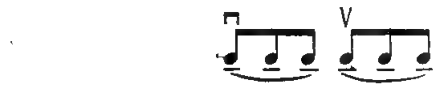
At the opening of the C minor Symphony of Brahms the pedal O is entrusted to 2 Horns f tenuto and to the Drums, Double-Bassoon and Basses in quavers. The Bass-part appears thus—

and the slur underneath the six notes merely indicates that the composer wishes each quaver prolonged so far as is consistent with the heavy throbbing rhythm. It is probably not a bow-mark from which the louré lines have been omitted, but only a caution against this sort of attack—

The desired effect could perhaps best be obtained by the louré, but under the conditions († pesante, un poco sostenuto) it would probably be necessary to split the slurs up thus—
The Bowed-Tremolo.
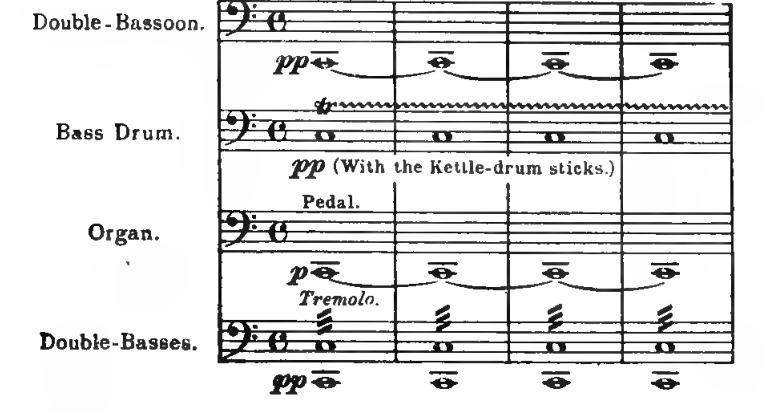
The Bowed-Tremolo is of course in constant use from fff to ppp, especially in the midale- and lower-registers of the instrument. Alone, associated with the Cellos, with the rest of the Strings, with the Wood-wind or with the Drums ' it is always effective. So familiar are these tone-combinations that it is scarcely necessary to quote examples. However, the following four bars with which Strauss's Also sprach Zarathustra opens may be of especial interest. The deep pedal is laid out for divis Basses tremolo, supported by the Organ tenuto and the Double-Bassoon. A roll on the Bass-Drum, performed with kettle drum sticks, completes the score.
1 See page 49.
Example 274
Strauss. Also sprach Zarathustra. Sehr breit.
11 (With the Kellle-drum sticks.)
In the above example the Bass divisi presumes a certain number of five-stringers in the orchestra. It may be mentioned that, though the Bass-part looks so effective on paper, it adds little but scratch and excitement to the ensemble. The weight of the tone comes principally trom the Urgan Pedal and the Double-Bassoon. And here the student may again be reminded of what was said above! with regard to the general want of tone in all howed-tremolos. It applies with particula force to the Basses and, whenever a great accession of quality Is wanted, it always pays to change the bowed-tremolo to a simple rhythm. However many crescendo signs and fortes are put into such a part, the tone only becomes more scratchy, not much greater in volume. It the tremolo be changed to a short-note rhythm on which the player can use the full length of his short bow, the increase in energy is astonishing.
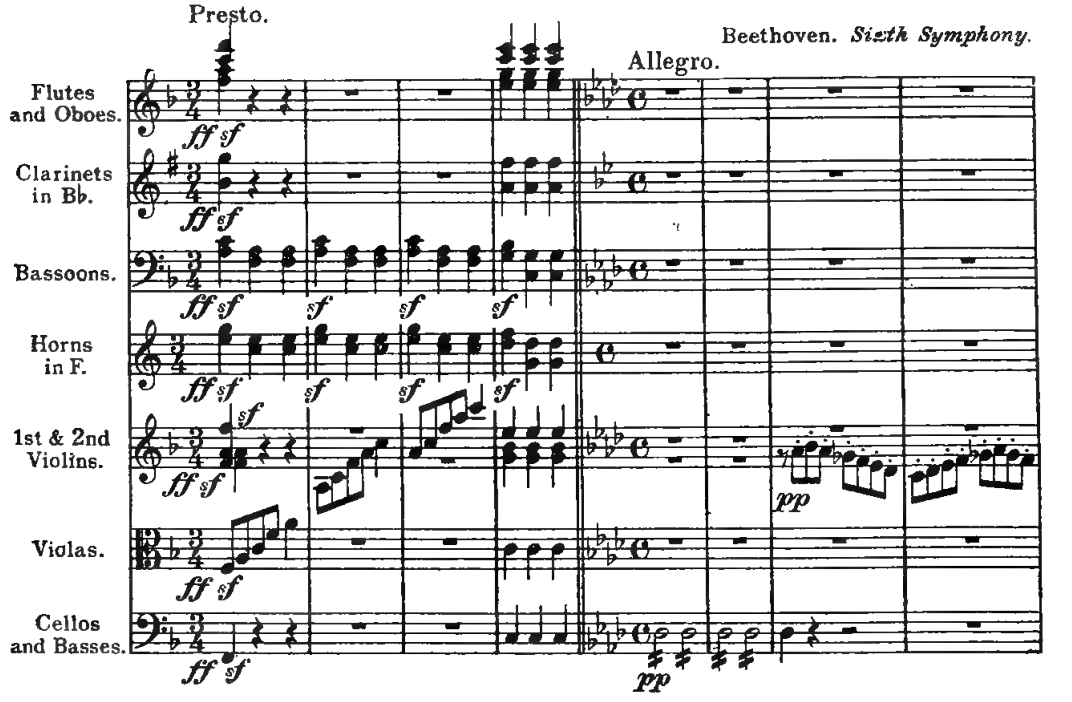
The classical masters employed the bowed-tremolo of the Basses only sparingly. Even when they clearly required what we should call "a tremolo effect," their almost invariable routine was to write a measured-tremolo consisting of tairly rapid reiterations of the same note. On the heavy thickly-strung Bass this is good and effective. The rhythmical collusion of the players is distinctly less tame than it would be in the higher Strings. Indeed, in a true bowed-tremolo Bass-players are unable to change the bow as rapidly as Violinists and Cellists. Instances of this partial tremolo may be found in such places as the First Movement? of the Choral Symphony (bowed demisemiquavers f, supported by the Drums in : Allegro ma non troppe time): and in the Last Movement of the same work (bowed semi quavers in § Adagro ma non troppo time). The beginning oi the Storm in the Pastoral Symphony is also a case in point. unexpected measured tremolo of the Cellos and Basses which interrupts

3 Peters's Score, page 239. See also the quotation from Halévy's La Juive, Ex. 86.
seen by quoting it in the manner in which it should be quoted-as an interruption. The student will then have no difficulty in perceiving wherein lies the virtue of the orchestral technique-in the rests that are to be found on the right-hand side oi the double-bar. The score is a little compressed. The Flutes and Oboes and the Ist and 2nd Violins are each grouped together on a single stave.
Example 275
The Fingered-Tremolo.
Owing to red great length the steing or thir Base practically only one fingered-tremolo is possible, the minor third. too great a stretch when the player's hand is near the nut. It only becomes possible when the lower note of the tremolo is at least a major third above the open string. A list of fingered-tremolos, fairly complete for all orchestral purposes, would consist of all the minor thirds whose lower notes are any of the following:

On the lower strings these tremolos can only be of the rarest use in certain deep mysterious prano passages. Un the upper-strings, however, and especially on the top-string, they come out well, and might be highly effective in a mj or f ensemble of an agitated character.
The ponticello and col legno are both used on the Bass, and when properly played are perhaps more effective than on any other stringedinstrument.
It is customary nowadays to mute the Basses whenever that muffled quality is called for in the String-ensemble. Cases, of course, occur where muting is only required in one special department of the Stringer, the is aral atter of as a deadent of the stratio, it 1, best not to omit the mutes from the Bass-parts. All the difficulties mentioned above with regard to the proper weight of the mutes become still more serious in the case of the Bass. The solidity of the bridge, the amplitude of the string vibrations, and the immense resonance of the sound-box, all join in producing a series of air-vibrations which can only be effectively damped by a very heavy close-fitting mute.1
The Pizzicato.
The fuzzicato is continually employed. So common is it that some Bass-parts have nearly as much pizz as arco. Almost invariably the Basses play with the Cellos, both pizzicato. Occasionally the Cellos play a legato version of the bass col arco, and the Basses play the essential notes of the bass pizzicato. This is a capital plan for lightening the general weight of the orchestra. It relieves the stodginess of a persistent unimportant Bass-part and at the same time leaver the Cellos to support the harmony with the necessary orchestral tenuto
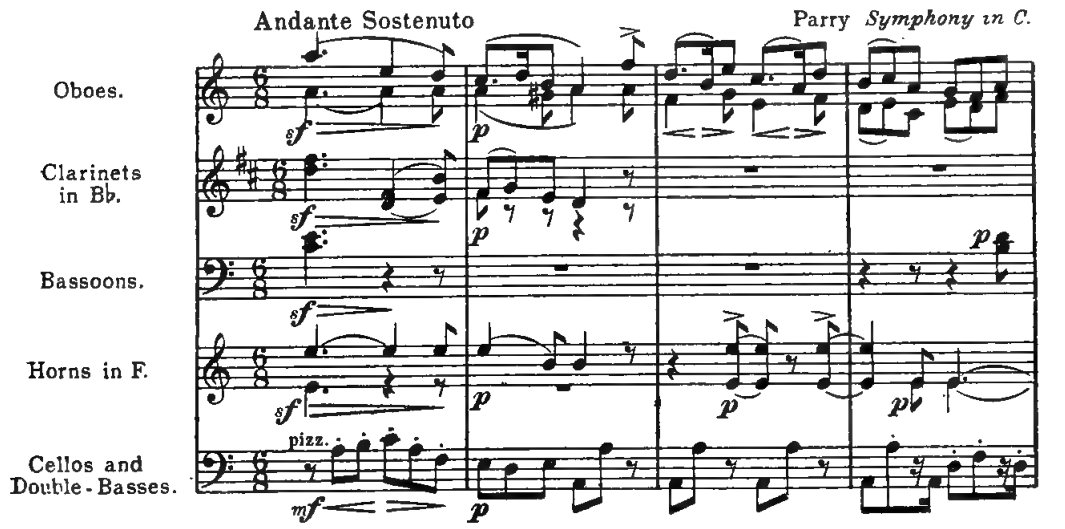
Here are two short instances of the Bass pizzicato. The first is a characteristically English example of a simple tune harmonized for the Horns and Wood-Wind, and supported by the pizzicato of both Cellos and Basses.
Example 276
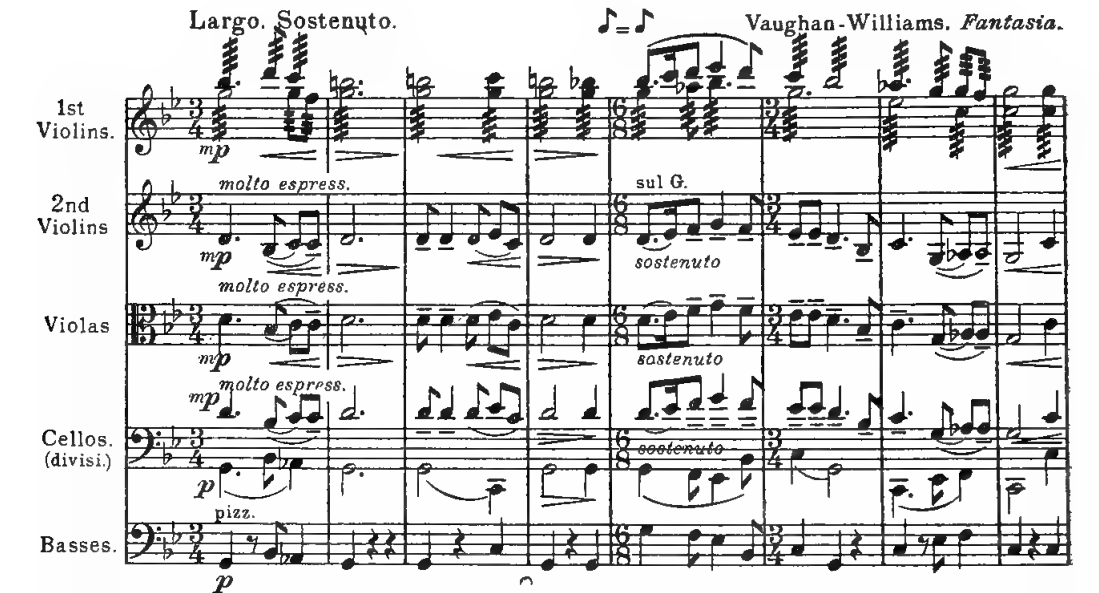
In the second, from Vaughan Williams's String Fantasia,? the Basses
1 For an instance of solo muted Basses see the extract given below from the last Act of Verdi's Otello. Example 279.
= Fantasia for double string-orchestra and solo string-quartet on a theme by Thomas Tallis.
are pizzicato while the 2nd division of the Cellos play col arco. The two are at one time mainly in octaves with an occasional unison necessitated by the pitch (bars 1-4), at another mainly in unison with occasional octaves (bars 5-8). In fact these few bars give a good reneral idea of the routine employed in associating Cellos arco witt Basses pizzicato. In this work the composer writes regulariy tor the Basses down to the low D. The unison on the first three notes of bar 5 is therefore clearly employed for musical reasons, not for reasons of pitch. The other interesting feature of this quotation is the expressive melodic unison of Violins, Violas, and Cellos, all playing with the emotional louré bow-stroke.' The very modern spacing of the three constituent parts of this passage-the two-part tremolo in the Ist Violins, the melody and the bass—is also worthy of notice.?
Example 277
sions of quick atos ashpuld not be to tinued too a temport ts musica, contusion resulting in such cases there are instrumental dithculties. The string-vibrations are necessarily so ample that some time must be allowed if each note is not to be damped by its successor. In addition to that, rapid pizzicato playing in the f and the # is ar exhausting physical exercise, and some consideration should be shown to the player on that point.
As with all the other stringed instruments, the most resonant pizzicatos are to be found on the lower strings. But it must be remarked that in the bottom-register pace is musically out of the These notes have a tendency to "drag." In other words, they protong their sound in a mauner that one might consider noi quite proper in a pizzicato. Still, the player is able to control
1 See above, page 343.
« For a few notes of pizzicato Basses see Exs. 141, 144, 155, 182, 224, 238, 278, 296.
this to some extent. Pizzicatos are written right up to the top of the bass compass. In these altitudes, however, the notes become dry and

may fairly be taken as a working upward limit, though for most
prate spurposes even try cultiva tonese for putting in Bass puzzicato notes. This is a matter which is largely concerned with his Ieeling for the rhythm that underlies his design. It is often surprising how few Bass pizzicatos are absolutely necessary in an orchestral ensemble. Yet the omission of those few notes, or the substitution of a tenuto Bass-part col arco, will often befog the whole passage.
Even a single Bass note played pizzicato in the proper place can eloquent and even poetical. Strauss has drawn attention to the pizzicato G of the Basses, which, in the Ist Act of Tristan just touches the word blau (blue) with colour. The passage may be seen on page 32 of the Full Score. Another happy instance of two simple pizzicato notes has already been quoted from Bridge's Isabella. In this example the composer's intention is, of course, not the illustration of an external idea. The cleverly placed pizzicato is, however, none the less delightful from a musical point of view.
2 The chord for four Horns is omitted from the Ist Bar of this Example.
Within the present limits of space it is impossible to illustrate adequately the curious psychological effect produced at times by the pizzicato of the Basses. The student must seek these for himself in

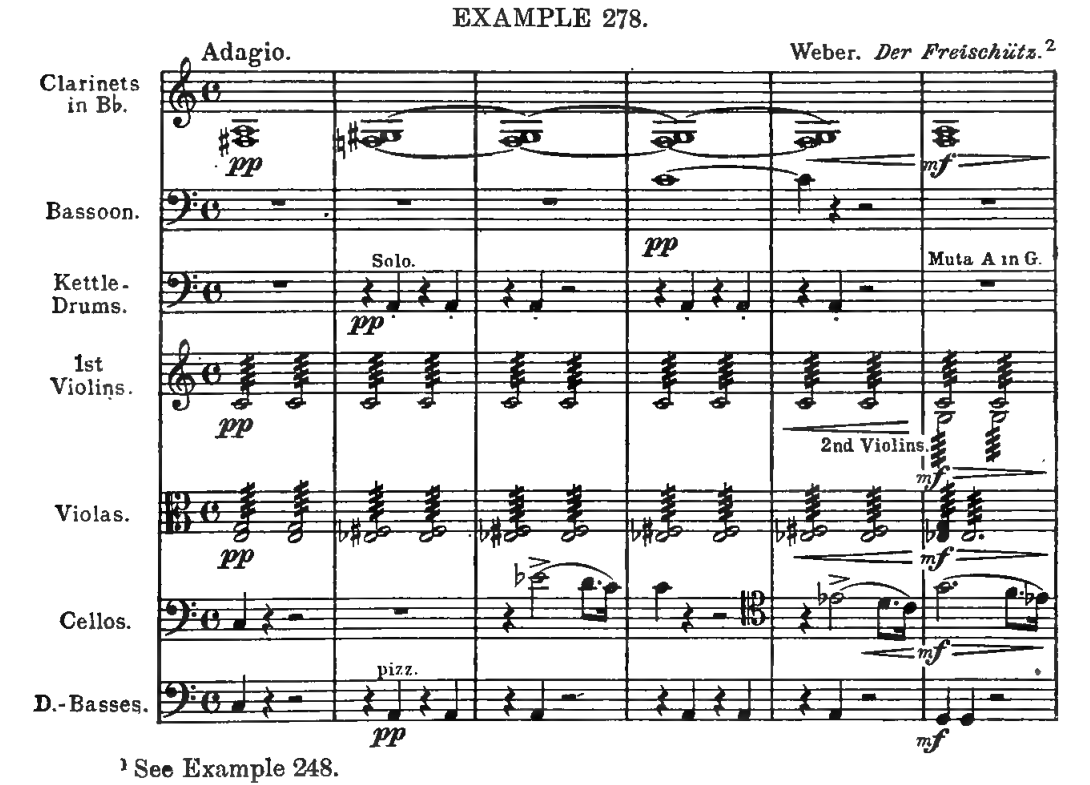
of Drama is to be found in Weber's familiar passage on page 451. Here the means is the simplest: the result, the most magical. The essence of the orchestration is the contrast between the mass of held Harmony above and the lugubrious mechanical stroke of the Basses and Drums below. The colour in the low Clarinet-notes, in the tremolo Strings, and even in the high Cello melody, is less essential to the tragedy. Since the days of Der Freschütz this kind of orchestral effect has been used again and again often in a much more elaborate form. The type, however, always remains the same, a mass of tremolo harmony, with a pizzicato underneath.

The tone-quality of the Bass ditters markedly trom that of all the other Strings. Uwing to its pitch it cannot invoke the aid of any association with the human voice. Hence comes its somewhat strange and "unearthly" character. Fortunately this demoniacal quality only becomes apparent when the instrument is forced to the front dissoche Bass emains soberugie-cooticient in the banker und Yet there ciated from other sotter tone-colours.
are moments when the unique quality of its tone might well be used for purposes of orchestral characterization. The first to perceive this was probably Mozart. In the 2nd Act of Don Giovanni, where the statue intones the words Di rider finirai pria dell' aurora ... Ribaldo audace! lascia a morti la pace, the composer adds the Basses to the solemn chords for Trombones and Wood-wind. The effect, though often omitted in performance, is "astonishly fantastic." 1
Another passage whose effect the student should not fail to note occurs in the accompaniment to Wotan's recitative in Act II. of Die Walküre (Full Score, page 163). This is indeed a locus classicus, for though the part is excessively simple trom the player's point of view, the effect of the never-ending Bass pianissimo associated in turn with the Bass Clarinet, the Horns, and the Trombones is weirdly powerful.?
A third instance may be referred to, this time from the inimitable of dill atone he forget the extrao dinera noten i Deedent act prayer have scarcely floated away when the Moor appears silently and murderously at the back of the stage. At that moment the muted Basses attack their deep open 4th string and begin a slow heavilymoving cantabile as Uthello paces into the bedroom. The savagery and raw brutality of their notes exactly express the stage-picture, and
1 Strauss.
'See also Example 7 (the opening of Marcel's "War-Song " in Les Huguenots) for an instance ot the Basses employed pizzicato without the Cellos.
one may say with contidence that, as a master-stroke of orchestration, score bout abbreviation hello eaters at the poco pr their first bar alone would be hard to beat. The following is the complete Full-Score without abbreviation. The first six bars are the concluding portion of the Ave Maria. Othello enters at the poco più mosso.
Example 279
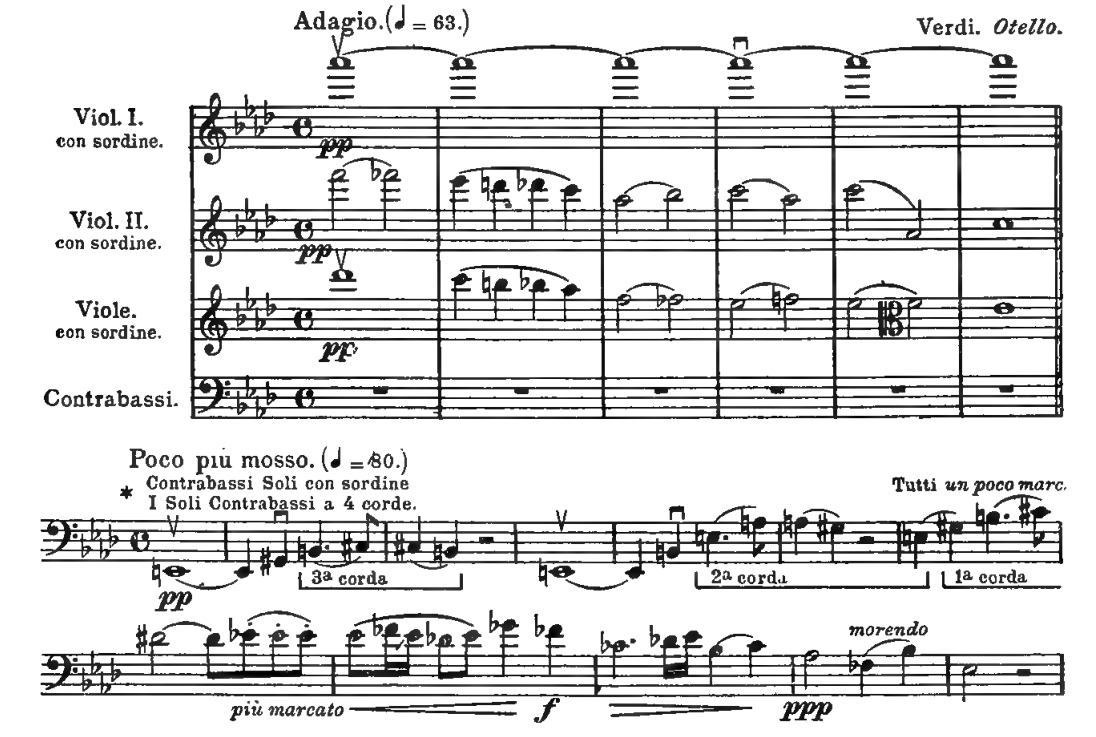
The student should notice in this example the meticulous care indie tibich sol Corase basi a corde tiesia ined to chafact that even when Otello was written the three-stringed Bass was still in general use all through Italy. Verdi probably had a single desk of tour-stringers, and they made the entry on the low ba The rest entered at the 7th bar (marked "Tutti un poco marc." The footnote, " ie. "see the fingering marked (in the "Vedi diteggiatura segnata, part) " refers merely to the indications under the stave ("3ª corda," ètc.) of the correct strings. It may be added that, in this country at any rate, the first entry of the Basses is not made po, but with a heavy mournful sforzando. This is perhaps a tradition from the first performance under Verdi's direction.
It is, however, rather in the use of its top-string cantabile that the Bass may be a somewhat new weapon in the hand of the composer. This cannot effectively be done for the same type of music or in the same simple way as that which suits the other Strings. It needs a inese of edemand do it of chazacter in tee my fuland a goto it
* Vedi diteggiatura segnata (Composer's note in the Full Score).
would be unbearable. When employed, however, only as an incident appearing and disappearing from the colour-screen, the unnatural insistent quality of the tone makes a strong impression on the Istener The actual unison of Basses and Cellos, or of both, with the Bassoor softens without obscuring the characteristic Bass quality. In such cases the Bassoon and Cello parts must be written an octave below the pitch of the written Bass notes. A unison of this sort, when kept well up in the higher registers of the instruments, is one of the most suggestive in the orchestra. Its psychological significance should not be confused with that of the big melodie passages for tutti Strings which are to be found in many modern works.
The historical use of the Bass in the orchestra need not detain us long: Down to Beethoven's day its parts were of the simplest. Even individuality of the instrume is cole be resent is a the te fo thats tal expression.!, In consequence, performers lacked technique. Very hard things have been said about these early Bass players. They have been called "hewers of wood.". The fact, however, remains that whenever . composers have made calls for an extended technique Bass-players have always answered the call. In this country especially there have always been capable and earnest players. At the present day one may assert with confidence that our best orchestras owe their rich quality mainly to the exceptional powers of tone and attack which are to be found in the Bass-department. This is a gratifying feature, and, it one may be allowed to adapt Canova's remark into musical terms, one might say that it would be well worth a journey trom Italy to Londor to hear a dozen fine English Bass-players deliver the noble recitatives in the Choral Symphony, or some of the massive melodic passages in Ein Heldenleben.
Bass-players were not always thus. Before Beethoven's day they were accustomed mainly to an easy-going sepulchral kind of plidge-

and to play with accuracy vital passages such as this,
Example 280

and this,
EXAMPLE 281. Allegro ma non troppo.

1 There are occasional exceptions, but the statement is generally true.
"It might perhaps be added "and drawers of water" from the eyes of their unfortunate audiences.
Rapid pianissimos in the bottom register with very little to cover them up,
Example 282
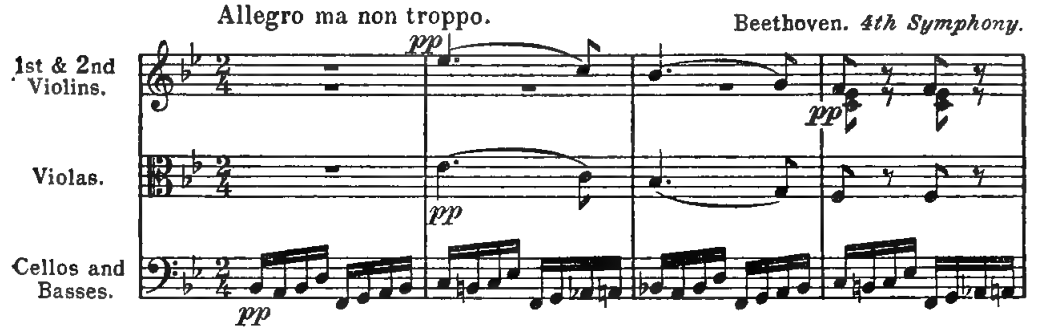
sudden skips to their top octave,
Example 283

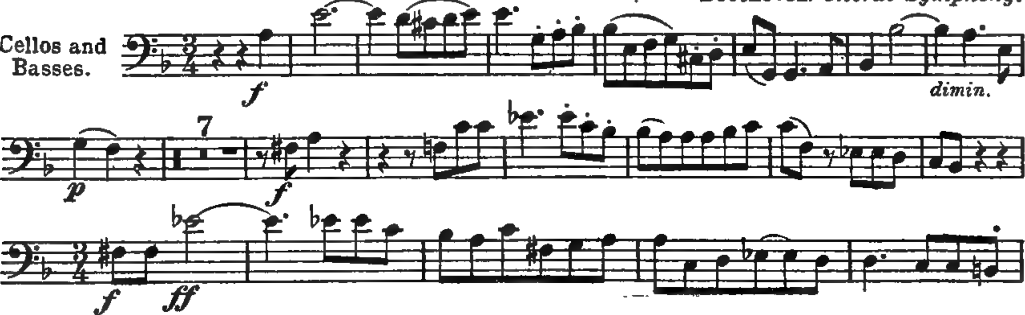
and expressive phrases, such as those in Fidelio, which sound like the utterance of some huge monster toiling underground,
Example 284

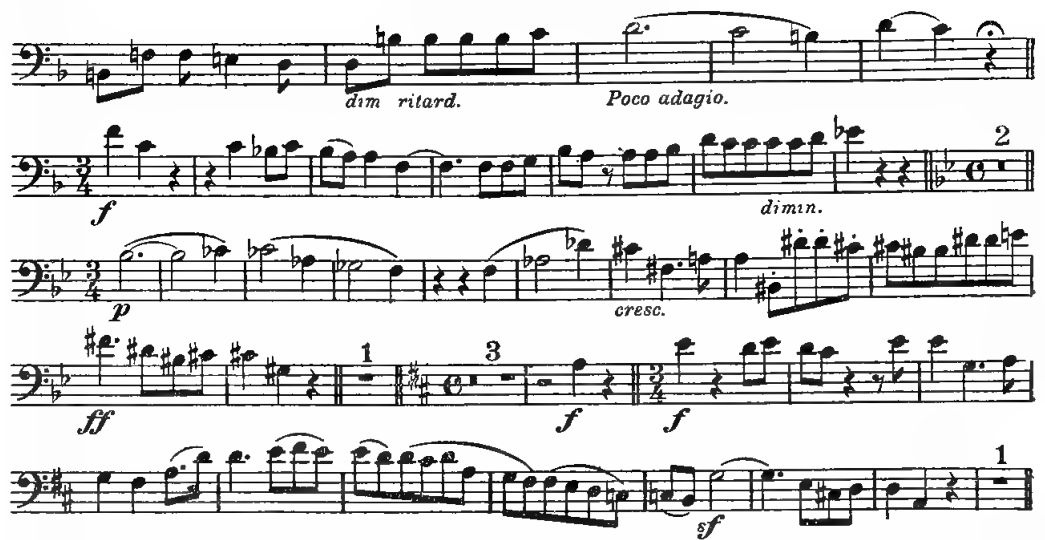
All these and many others were demanded of the Basses. In the Choral Symphony they receive what we may call their final apotheosis, for there they are selected to be the representative voice of the orchestra through which it utters its pleading, its remonstrances, and its contentment.
Example 285
In the manner of a Recitative but in tempo.
Beethoven. Choral Symphony.
1In this example the harmony is held by a thick ensemble of Oboes, Clarinets, Bassouns, Horns, and Trombones, while the other Strings play repeated notes (triplets to each crochet). The Violins and Violas are muted.
From a perusal of the above passages the student will see that though Beethoven treated the instrument with an unexampled freedom, and indeed elevated it to the position which accorded with its merits, yet he generally associates it with other instruments. As a rule, it is not allowed to shine alone. The Cellos or Bassoons share its dignity. This point has already been treated as far as it deals with the joint playing of actual Bass-parts. A little qualification, however, is needed.
True there are some instances, especially in the composer's latest works, where he foreshadowed the modern dissociation of the Cellos and Basses, some instances where he treats the latter instruments not merely as the lower part of an octave-combination. Such passages are among the most interesting in his works, for they clearly point the way to our modern developments. They are, however, in a great minority, and it was Beethoven's peculiar gift to this department of orchestral technique that he first recognized the combination of Cellos and Basses, not merely as a smoothly satisfactory Bass, but as a plastic medium tor musical expression.
It would be impossible without elaborate quotation to establish this fact in detail. It is, however, well understood that the general "cunning" of present-day Bass-parts is a legacy from Beethoven, and though the extent and proportions of this craft have been much enlarged since his day, they had their origin in his brain.
The smoothly-running legato passages written for facility of utterance on the top-strings: the strenuously attacked groups of bowed quavers and semiquavers: the immensely effective little scales of three or four notes running up to a top-note: these with others too numerous to mention were first standardized by him as an integral part of the Bass-routine. In especial he recognized moderate movement is a necessity of the instrument: that when it stands still it becomes stodgy. We are all too much inclined to take these niceties oi technique for granted. They dia not, however, drop out of the skies—unless, indeed, Beethoven was the Saint who drew them down.
Since Beethoven's time the development of the Bass has been mainly in the direction of its dissociation from the Cellos and Bassoons, both of which instrumental groups are used nowadays in a more plastic and less stereotyped manner than they were in the old Scores. It must be understood that the Cellos and Basses still form what may be called the routine orchestral Bass. But there are many passages where the former instruments must be detached for passage-work in their uppercolours of Wood Wind and Horns need the support either of all of of Again, there are many other passages where the mixed some of the Basses.! Furthermore, the amount of movement and figure

or general orchestral purposes a totally different method has to be mployed, a method which leaves both the Cellos and the basses tre to play the passages most congenial to their separate natures.
A caution must be added here. The above remarks do not in any way indicate the old-style of so-called "simplified Bass-parts"—a nervously apologetic system of writing in which the Cellos were directed to play what the composer wanted and the Basses were left to play what he didn't. These perished with Mendelssohn's popularity. On the other hand, they do reter to the many modern passages where the inclusion of the two instrumental groups in an octave-combination would falsify the musical value of the phrases allotted to one.
There is another class of Cello-and-Bass-passage peculiar to the modern school. In type these passages invariably consist of brilliant contrapuntal phrases or harmonic figures played in octave combination right up to the top register. They are often of excessive technical difticulty. Indeed fitty years ago a composer would hardly have written them even for the Cellos alone. Some objection has been taken to this form of Bass writing: However, it may be legitimately urged that its use introduces a wholly new sound-effect into the orchestra. In fact, one may say with confidence that nothing so clearly differentiates the old from the new as this type of Bass-passage. Its surging tumultuous quality brooks no denial. The listener is shot off his feet and upward It is an earthquake followed by a volcano.
The Basses are less commonly divided than any other of the Stringgroups. Uccasionally, but very rarely, a single instrument is detacheo for the purposes of Solo playing. An instance of this from Mahler's First Symphony has already been quoted." It is, however, a very rare effect, only employed for special purposes of characterization, and it is merely mentioned here for the sake of completeness. Brilliant passage-work and imposing cantabiles are by no means beyond the powers of the finest artists. But in order to write such passages, the
1 ' In passages given exclusively to the Wind it is an excellent effect to double the lower parts of the Bassoons, Bass-Clarinets, or deep Horns, even of the Trombones or Bass-Tubas, by one or more desks of Double-Basses. ..."—Strauss.
2 Example 13.
composer needs an intimate aquaintance with the instrument, and in particular, a tamılarity with its elaborate system of Harmonıc-playıng in the highest register. The Bottesinz Concertos show the capabilities of the Bass in their widest extent. These works, however, are rarely heard in public.
It has already been mentioned that a desk or two of Basses is often detached to give solidity to an ensemble of Wood-Wind, of Wood-Wind and Horns, of Violas and Cellos, or of divisi Cellos. This is a common procedure nowadays. It is of special value in the theatre, where the umcultv oi securino a nrm bass is notorous. Une mav sav ın passin. hat the Basses as a whole need to be much more continuallv emplover there than in the concert-room. It does not follow that they require constant legato passages. Indeed that is rather the wrong style to adopt. But owing to the position of the orchestra in a theatre, and the restricted resonance of the floor on which they are placed, they are continually needed to outline the Bass of the harmony. This may not apply so tully to those theatres where the orchestra is either blessed with a strong battalion of Cellos, or placed on a resonating double- Hoor. It is, however, none the less true as a genera, proposition. The continued absence of the Basses trom the general orchestral ensemble in the theatre robs the orchestra of its "body" and quality.
One occasionally finds in modern scores that when the Cellos are "employed upstairs" the Basses are playing divisi in octaves. This is not, as a rule, very satisfactory. The Bass octave-divisi does not really represent the Cello-and-Bass octave-combination. This is probably not due to the fact that the Basses are likely to play out of tune, though this explanation has been offered more than önce. It is rather caused by a confusion in the upper harmonics. The Basses are greatly virtuous in their power of reinforcing these upper partials, and, if they are written in octaves, the one set of harmonies blots out the other. In most cases, especially if strength is looked for, it would be better to add a low Horn, a Bass-Clarinet, a Double-Bassoon, or even a Bassoon. All the Basses would then play in unison probably in the lower octave of the octave-combination, but this is a matter for the composer's discretion. In the p and the pp the splitting-up of the Basses into two octave-parts does not matter so much. Even here, however, the effect can generally be got better by some other means.
The Bass divisi is not often used for harmonic or contrapuntal purposes. H'or its purpose, however, it is highly effective. Rossini, in his William Tell Overture, and Meyerbeer in Act V. ot Le trophete,
1 Mr. Claude Hobday played the Bottesini Concerto in Ff minor at a Philharmonic Concert on March 24, 1904. It may be of interest to mention that, for this particular work, the artist retunes his instrument, raising each string one whole tone. The compass of the Concerto as written is from
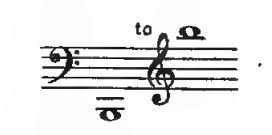
and the soloist transposes his part a seventh.
each made some rather timid experiments in this direction. In the Meyerbeer example the Basses are arranged in two and three parts as an accompaniment to the recitative of Fidès. The Cellos are omitted from the quotation. In the Full Score they double the Bass-parts in the unison, and are therefore written in the octave below.
Example 286
Meyerbeer. Le Prophete.
Recitative.

bien cou-pa - ble peut-è - tre?
In his Cantata, , "The 5th of May, or, The Emperor's death," Berlioz has divided his Basses into four parts "with a view of expressing a lugubrious silence." As this Score contains a part for the unusual orchestral instrument, " Distant Cannon," the student may care to see an extract.
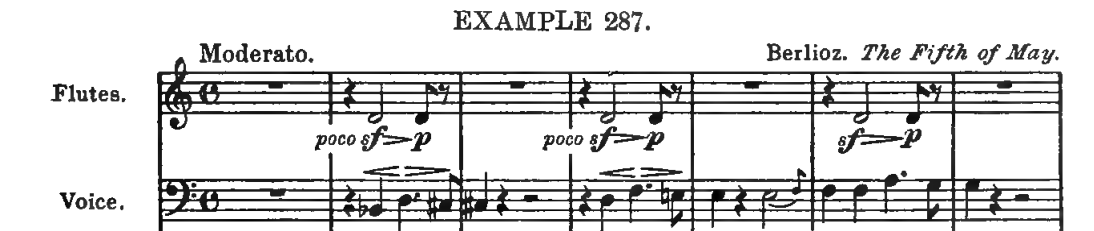
Berlioz. The Fifth of May
autour de moi, pleu - rent ses en - ne- mis.
autour de mos,
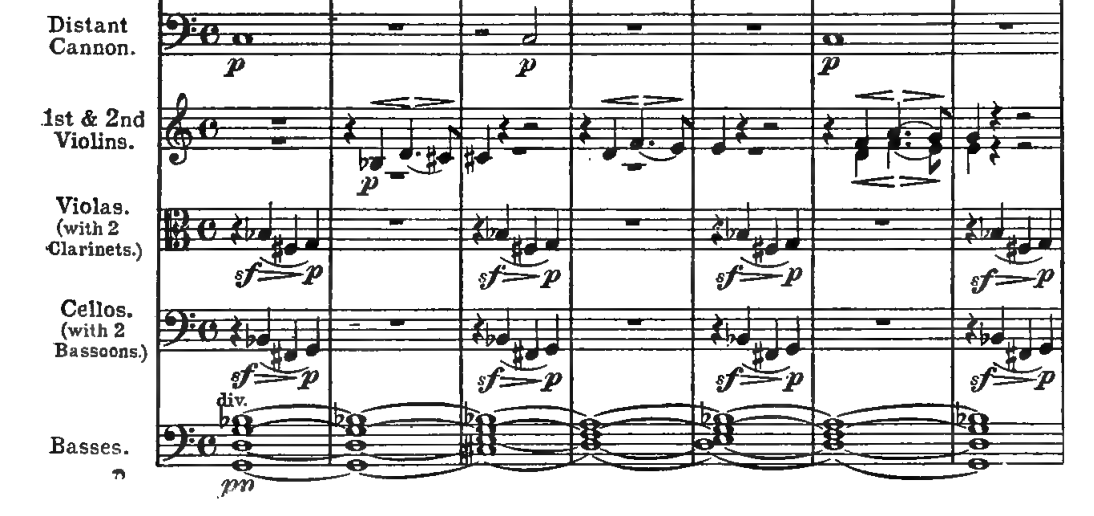
It must be admitted that this example has something of the Berliozian taint. Its orchestration appears to be prompted not only by a genuine musical impulse, but also by a delight in "the glory of the boast." It is nevertheless a remarkable foreshadowing of moderr orchestral methods. In the Full Score the two Clarinets in C'and the two Bassoons double the Viola and Cello parts respectively. The 2nd and 4th Horns (omitted above) help the two top Bass-parts in Bar 2 only.
A portion of the striking accompaniment to the long Oboe Solo in Strauss's Don Juan has already been quoted on page 214. The student should notice here how carefully the chords are restricted. There are no "diminished-sevenths" and "Six-four-two's" as in the Berlioz example. This is in the interests of lightness and clarity. Furthermore, he should notice in performance how intensely soft and almost woolly is the sound of these divisi Basses. This again is clearly an instance of intentional tonal weakness produced by the clash of upper partials.
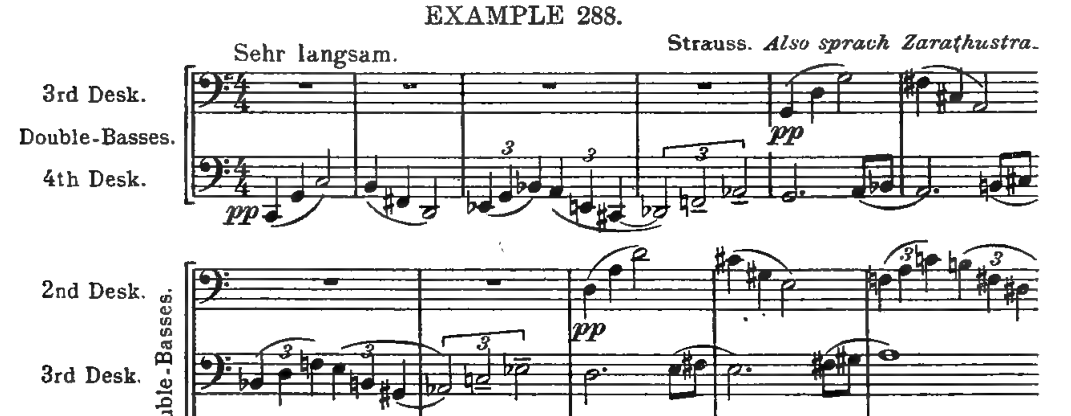
The opening and closing bars of the Pathetic Symphony are familiar to all. A few bars of the former have already been quoted on page 240. Both passages are good models of the harmonic simplicity which is almost a necessity in dealing with these very deep sounds. Far more complex and interesting from the technical point of view is the extraordinary Fugue in Strauss's Also sprach Zarathustra (" Von der Wissenschaft" section).
He said a la po la pie d
4th Desk.
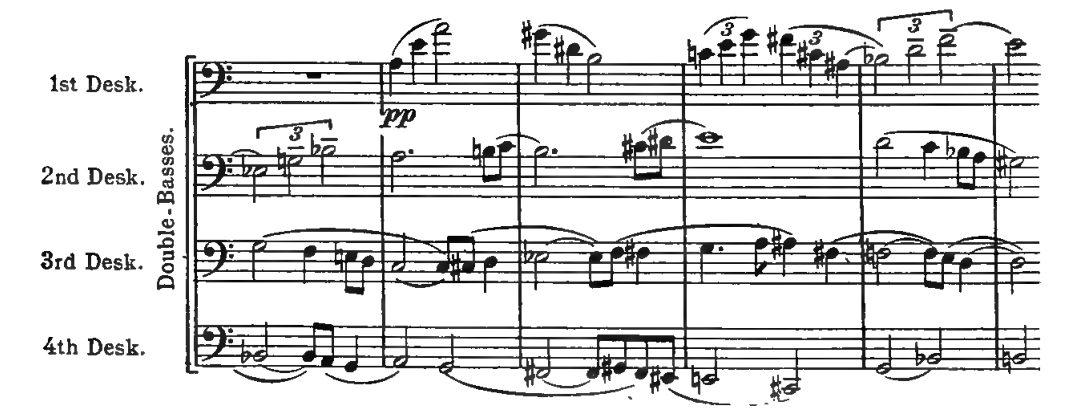
Here four desks of Basses are employed, and it will be observed that the lowest part is written for instruments which have either five strings or a mechanical apparatus for lowering the 4th string (E) to C. The Cello-parts are omitted trom the above extract. In the • Full Score a desk of Cellos plays with each desk of Basses. The written notes are the same, and it therefore doubles the Bass-melody in the octave above.
In his chapter on "Colour," 1 Sir Charles Stanford calls the Bass a "dangerous rogue-elephant." This is rather cruel. It is so long since he was corralled and shut up in the Government Keddahs that he has by now become docile. Such a huge brute can indeed still be mighty unpleasant, if he is ill-treated. It is therefore safer to treat him well. Then he will show his true elephantine nature in not withholding his skill from the humblest "chores" or his strength from the most burdensome tasks. Humour him a little. Don't let him stand about, perhaps catching cold, and probably getting in everyone's way. Give him a certain amount of freedom, air, and exercise. Above all don't stable him in the cellar.