Playable Books
Hector Berlioz · section 10 of 67
The Harp
Read and hear this section in the playable edition →

This instrument is essentially anti-chromatic; that is to say, successions of semitones are, basically, not possible on it. The reason for this will be discussed
tween the thumb and forefinger of the left hand, thus moving almost to the bridge. -If there were need to render in the orchestra the violent outcry of a female voice, no other instrument could produce it better than the double-basses treated in this fashion. I doubt whether our artists are familiar with M. Langlois’ method; but they could easily learn it within a short time.
presently. Formerly the range of the harp was only five octaves and a sixth.
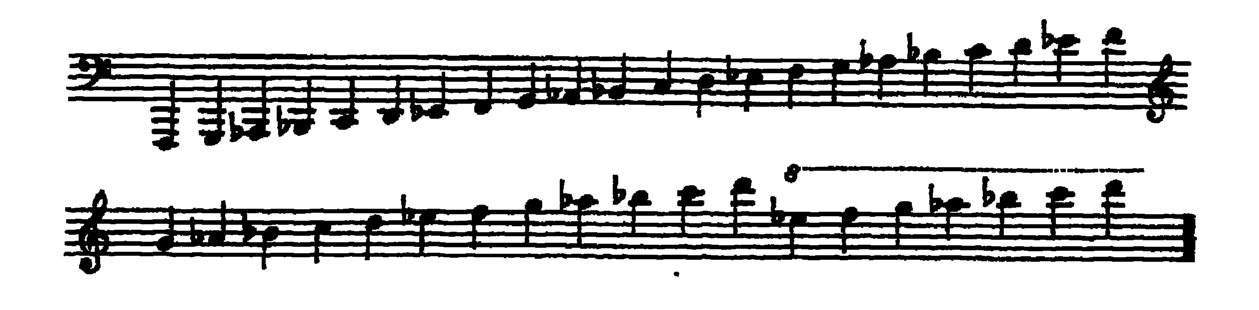
As one sees, this scale is in the key of E>. All harps were tuned in this key, until the skillful manufacturer Erard invented a mechanism which eliminated the disadvantages of this system. He proposed tuning the harp in Cb, a method adopted by almost all modern harp players.
The chromatic intervals can be obtained on the old harp only by means of seven pedals, successively set into position by the player’s foot. Each of these raises the note to which its mechanism applies by a semitone over the entire range
of the instrument—not individually. Thus the F#-pedal cannot sharp one F without raising at the same time all the other Fs on the instrument. Hence, the following combinations are all impossible (except in very slow tempo): chromatic scales; sequences of chords with chromatic progressions, or belonging to non-related keys; most embellishments consisting of appoggiaturas with accidentals or several such short notes. All these are impracticable or, at best, extremely difficult and very ugly. Completely impossible on the Ebharp are the following three seventh and three ninth chords, which must therefore be banned forever from the composer's store of harmonies:

It is evident that all chords containing Ch and Bb simultaneously are not possible. As the harp is tuned in Eb and the pedals raise each string only a semitone, Cb can be produced only with the Bh-pedal, which immediately eliminates all the Bbs of the scale. The situation is the same with Db, which is attained by raising the Ch, as well as with Gb, produced by raising the F.
¢ pedals of the Eb-harp can restore to their natural state only the three flatted tones (Bb, Eb, Ab) and can sharp only four other tones (F, C, G, D); therefore, this
harp is playable
only in eight keys: Eb, Bb, F, C, G, D, A, E.
The other four keys (Ab, Db, Gb, Cb) can be obtained only by enharmonic changes, and by quickly taking and releasing
one or more pedals. In Ab major, for instance, the Db is
nothing but an enharmonic C}. The player must therefore quit the C#-pedal immediately after taking it to keep the Ck open, the major third of the key in which he is playing; furthermore, he must skip the Dh-string when ascending diatonically. This is so awkward that such scales may be considered almost impracticable:

These inconveniences and difficulties are still greater in Db major and Gb major, both keys being almost inaccessible, with the exception of a few chords. Furthermore, the keys of Gb major and Cb major present new difficulties by compelling the player to transpose several notes of their scales: he must strike the Ff-string when the written note is Gb, the
Bh-string for Cb, and the C¥-string for Db. The key of Cb becomes somewhat casier-if it is written in its other form— Bh. But since this key (like that of Ab) requires all the pedals, there still remains the frightful culty of ski one string and then releasing and at once ga. because the leading-tone (enharmonic) and the tonic are played on the same string.

The following example illustrates the fact that the execution of a chromatic scale of two octaves, e.g.

necessitates the use of five pedals, which have to be put into action very quickly—in succession—for the first octave alone; then they have to be released just as quickly to restore the
raised notes to their original position so that they are available for the second octave; finally the pedals have to be retaken as in the first octave. Such a scale is therefore impossible on any harp, even in very moderate tempo.
In the case of a succession of chords in several non-related keys, the impossibility of execution becomes still more evident. Here several pedals would have to be taken and released simultaneously:
Certain appoggiaturas and ornaments containing
matic successions may, in fact, be executed after a fashion; but most of them are, as I have already mentioned, scarcely practicable. Those which may be admitted as exceptions are of rather poor quality, since the taking and the instantaneous release of the pedal impairs the vibration of the



Figurations like the following, however, and similar pascontaining semitones ina brief tonal gamut and
at a lively pace, are next to impossible:

tenn ee Bare is pi lower stave usually has the F-clef, G-clef; but if the high range of the bass low range of the treble notes demands it, either
clef may be used on both staves s simultaneously. arrangement increases num! Passages impracticable on the Eb-harp still further. A passage that may easy for the right hand becomes impossible if the accompaniment in the left hand contains notes which are chromatically altered by a while the harmony uses them


The two chords marked * are not played since they contain an Fk which is sharped in the melody. In these cases the note appearing in two different forms must be omitted in one of the two parts. In the preceding example it is better to leave the chord in the left hand incomplete and to eliminate the Fh.
When a melody previously played by other instruments is to be repeated by the harp, and if it contains impossible or dangerous chromatic passages, it must be skillfully modified by substituting notes belonging to the same harmony for one or more of the altered notes. Thus, instead of giving the following melody to the harp in the form previously played by the violins:

the author considered it better to write it for the harp as follows:

The nature of the harp mechanism requires the sacrifice of the four consecutive semitones in the third bar.
Impressed by all these grave disadvantages, M. Erard some years ago invented a different mechanism, after which the new harps are called double-action harps. In the following I am going to explain this mechanism; I shall show how it permits the harpist to play in all keys and to produce all chords, solidly or in arpeggio-form—even though he may not be able to execute chromatic sequences. °
The double-action harp is tuned in Cb. Its range is six octaves and a fourth:


Its seven pedals are so arranged that the player, by means of each of them, can raise each string at his option either a whole tone or a semitone. By using the seven pedals successively for the semitones, the Cb-harp is altered to the keys of Gb, Db, Ab, Eb, Bb, F and C, and is set for these keys. If each string is then raised another semitone by means of the second notch for the pedal, the seven tones of the natural scale are altered to F#, Ct, G#, D#, At, Ef and Bt, whereby the harp is tuned in G,
Thus, all keys are available to the harp. The minar keys can be set only if they are played the same way ascending as descending, without observing the usual modifications of the sixth and seventh steps; otherwise two more pedals would have. to be taken and released.

If the augmented second between the sixth and seventh steps is used in both directions of the minor scale, this scale can be set too, and the accidental use of the pedal is not necessary, an advantage considerable enough to justify the use of this scale:
Chords of four notes can be struck with each hand if the two extreme notes are within an octave:
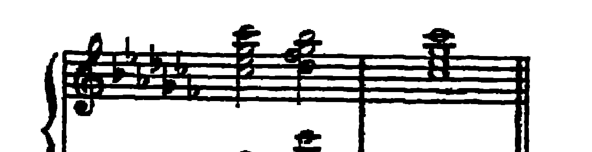

As for the six chords impracticable on the Edharp, it will be seen that the double action makes them possible. The chord is very easy to ex-
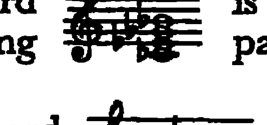
ecute, its four notes being part of the scale
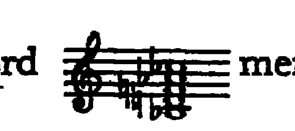
of the Cb-harp. The chord ee requires the use of the two semitone pedals Dk and F4;
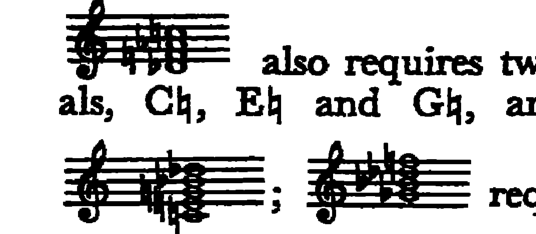
also requires two, Fy and Ch. Three ped: als, Ch, Eh and Gh, are needed for the rd
=. FP requires but one, Fk; and the last chord gi again three (Fh, Al and
Thanks to the great stretch between the thumb and
little finger, intervals of a tenth can also be played; consequently, chords such as these are possible:
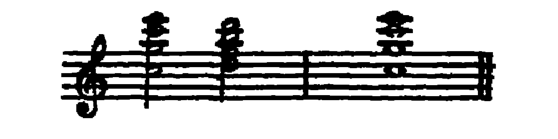
However, this position is less convenient and less natural, and therefore also less sonorous because none of the fingers can attack the string with as much force as in the normal position.
Incidentally, chords in the extreme low range of the instrument have no sonority and produce confused harmonies; they should be avoided:

Ch). All this is done without difficulty. Even the chord which seems to contain at once Ch and Cb
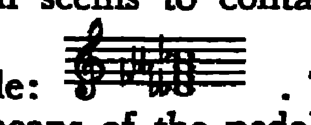
is practicable:. The Dbb (or Ch) is attained by means of the pedal raising Cb a semitone, and Cb is produced with the pedal raising Bb a semitone; Abb comes from the G? raised a semitone; Fb
uires no pedal, being a normal tone in the scale of the Cb-harp. This chord, as it is written above, will therefore be executed in this strange form:
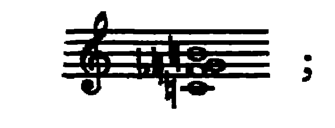
=; hence it is better to write it in C
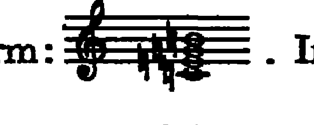
major in this form:. If the double-action
harps are to be employed in an orchestral piece set in B major for the other instruments, it is better to write the harp part, for the sake of sonority and convenience, in its normal key of Cb:

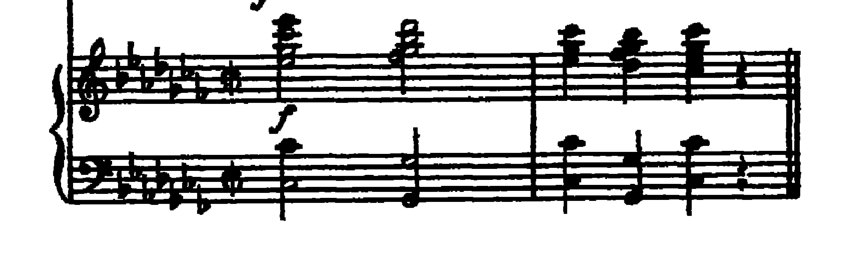
Composers should take care, in writing harp parts, to forewarn the player a little in advance of the changes in pedaling, for instance by placing a few bars before the occurrence of the modulation such words as, Prepare Gt, Take pedal for Ch, ‘etc.
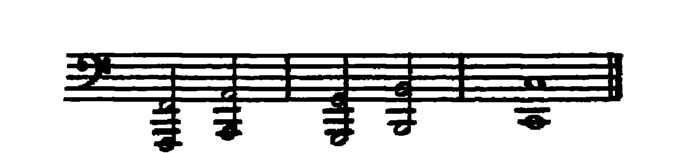
The nature of the harp having been sufficiently explained, we now proceed to the fingering. Many composers confound it with that of the piano, which it does not resemble at all.
These low tones are only fit for doubling a bass passage an octave lower:
To produce the tones of a chord successively, either ascending or descending, is in the very nature of the harp; these chord figurations have been named arpeggios from the Italian, arpa. They should, generally, also not exceed an octave, especially in a fast movement; otherwise the hand would have to change its position, which causes considerable difficulties.
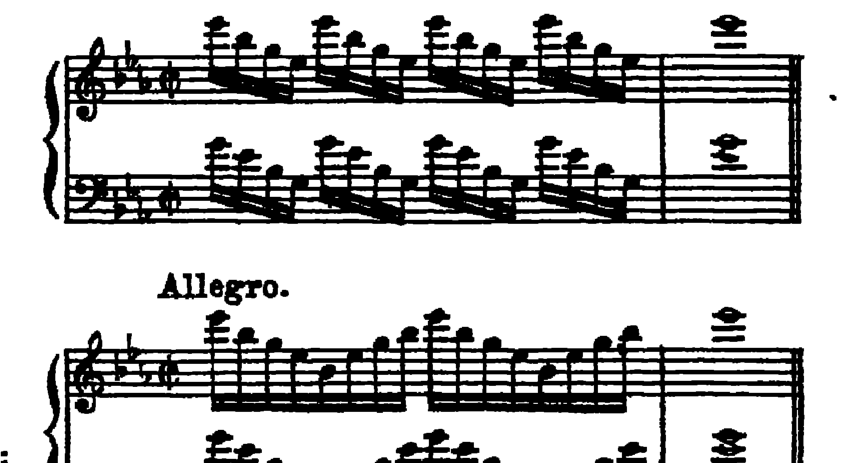

Only the note at the conclusion of a passage may, exceed the octave:

The following example is also very easy to execute because the change in the position of the hand occurs in the upward direction, and the third finger, which could scarcely be used here, is not needed at all; nor does it demand two consecutive notes with


Generally care must be taken not to place the two hands too close together; they should be an octave or at least a sixth apart; otherwise they interfere with each other. If the two hands play an arpeggio chord in thirds with each other, the same string will be taken by one hand as soon as the other has left: it. Consequently the string has no time to vibrate, and the tone is stifled the moment it is produced.
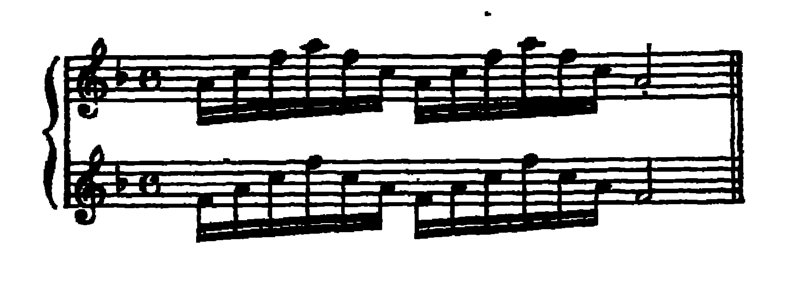
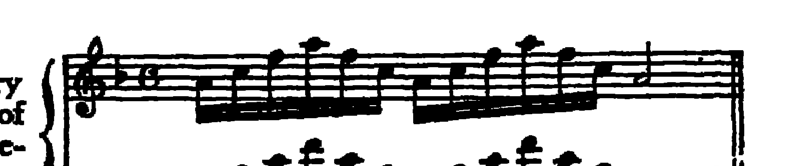
All passages which require the skipping of a finger from one string to another can be written only in very moderate tempo.
When a rapid series of diatonic octaves or sixths is desired, they should generally be written for two - hands. The sixths, as well as scales in thirds, can also be played by one hand, but only in descending. In this case the thumb slides from one upper note to the next while the other three fingers play the lower notes.
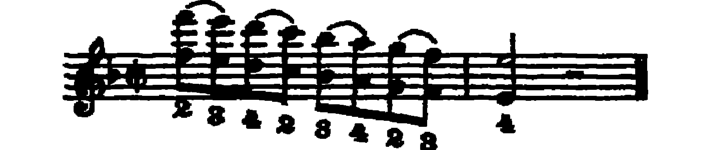
is difficult because of the distance between the thumb and the other fingers; the following two are easier:
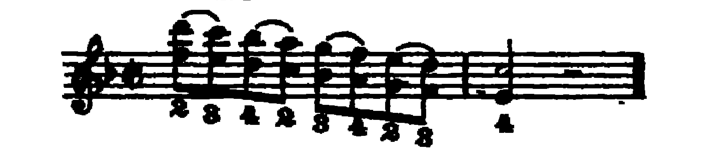
If one wants to employ a rapid arpeggio of more than an octave, it must be written in one part distributed between both hands, instead of two parts. One hand plays a fragment while the other changes its position and prepares for the next fragment, and so on, reciprocally: RE


This arpeggio would be impossible if doubled in the octave. The following example is impracticable in quick movement, but quite possible in slow time:
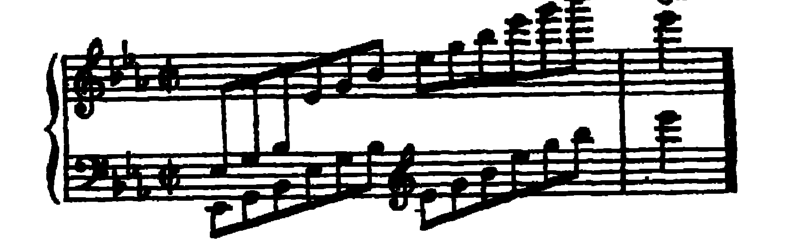
In the second act of “Tannhaeuser”’, with Tannhaeuser’s words “Zu Gottes Preis, in hoch erhab’ne Fernen, etc.” occurs a harp passage which it is practically impossible to execute:
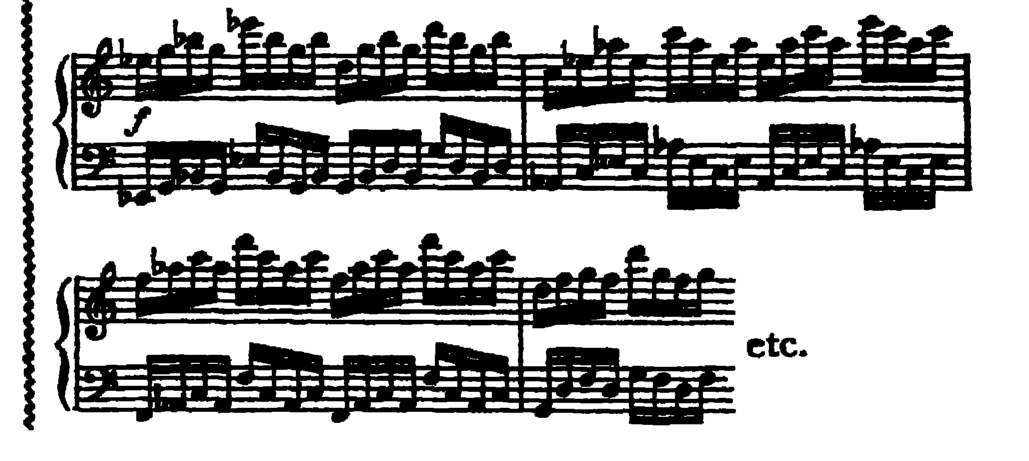
The trill can be executed on the harp, but its effect is only tolerable in the high notes. The repetition of one note was difficult and unpleasant on the old harps on account of the grating noise caused by the first finger striking the string immediately after the thumb, thus interrupting its vibration:

These scales in thirds form an exception to what has been said about keeping the hands apart; they can be executed with both hands. The disadvantage of one string being taken by two hands in quick succession is much smaller in diatonic progressions because the intermediate note allows a little more time for vibration. Nevertheless, it is better to write these series of thirds for two harps, giving the higher part to one and the lower part to another; or, if only one harp is available and a full tone is desired, to separate the
On the new harps the repetition is easy and pleasant: the double action of the pedals makes it possible to raise the adjoining string by a whole tone so that the repetition is produced on two strings in unison:
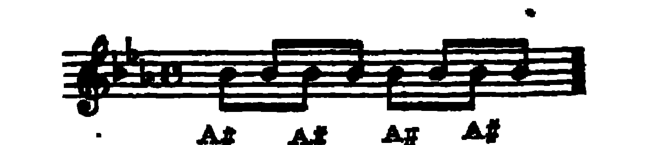
Repetition in two or four voices (occasionally very useful in the orchestra) can be obtained by using two or more harps and giving them chord which cross each other. These offer no difficulty and produce exactly the desired effect:
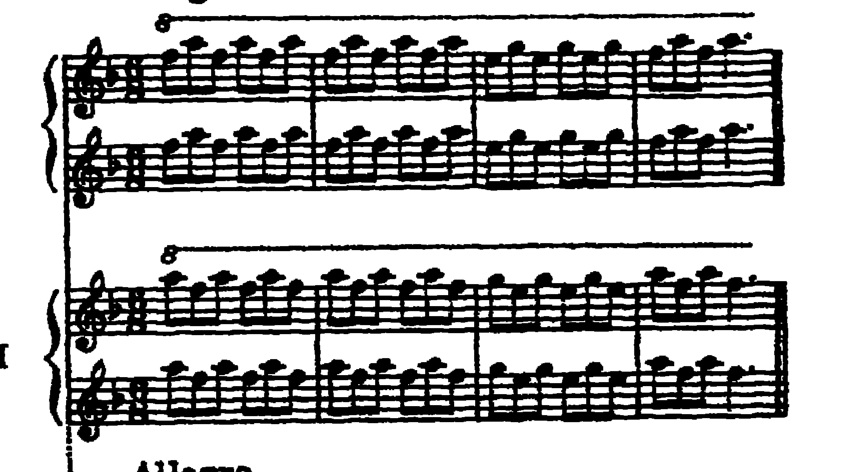

The effect of harps increases in proportion to the aumber employed (except where music is intended for execution in a small circle and close to the listeners). The tones, chords and arpeggios of a mass of harps can be heard with extraordinary brilliance above a whole orchestra and chorus.
Nothing can be more in keeping with ideas of supernatural splendor or of religious rites than the tones of a great number of harps, ingeniously employed. Employed singly or in groups of two, three or four, they also have a very felicitous effect, either in combination with the orchestra or as an accom-
iment to voices or solo instruments. It is remarkable that of all known timbres those of horns, trombones, and brass instruments generally blend best with the harp. Unfortunately, the lower strings, whose tones (with the exception of the soft and dull strings of the extreme low range) are veiled, mysterious and beautiful, have scarcely ever been used for anything other than bass accompaniments of the left hand. It is true that the players have no special liking for pieces moving within the lower octaves. These strings are far from the performer’s body, forcing him to bend forward, stretch his arms and to stay for longer or shorter periods of time in this uncomfortable position. But this reason can have had little weight with composers. The fact is, they simply have not thought of utilizing this peculiar timbre.
An example of the beautiful and soft sound of the low strings:
a. a er ee ee See see ae
tasias, variations and concertos. But nothing can match the beauty of these mysterious sounds when they are combined with the medium tones of flutes and clarinets. It is strange that the affinity of these timbres and the poetry of their combination should have been recognized and actually used only once— very recently. (See example 8, p. 30, quoted in reference to harmonics on the violin, where harmonics on the harp are also employed.)
The best and almost the only harmonics on the harp are produced by touching the center of the string lightly with the lower, fleshy part of the hand while playing with the thumb and the first two fingers of the same hand; this produces the upper octave of the normal sound. Harmonics can be played by both hands simultaneously.


It is even possible to produce two or three harmonics at a time with one hand; but then it is advisable to let the other hand play only one:
, Harmonies Not all strings of the harp are fit for
f harmonics. Only the two octaves above the lowest should be used; they alone are long enough to be divided by touching in the center and have sufficient tension to
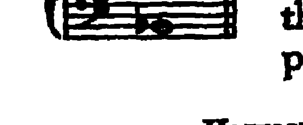
produce clear harmonics.

If the course of a piece or the character of its instrumentation require the sudden transition of the harp part from one key into another very remote one (e.g. from Eb to Ek), this cannot be effected on the same instrument. A second harp must be kept ready,
tuned in the sharped key, which immediately continues the part of the harp in the flatted key. If the transition is not so sudden and only one instrument is available, the composer must give the player a sufficient number of rests to set al] pedals necessary for the modulation. When the harps are numerous and are -treated as an integral part of the orchestra (not merely as an accompaniment for an instrumental or vocal solo), they are usually divided into first and second harps and are given two separate parts; this adds greatly to the richness of their effect. Even a greater number of different harp parts may be well justified. This becomes indispensable, as we have seen, when a sudden transition into distant keys is intended.
The Theban bas-reliefs, where an exact representation of ancient harps is to be found, prove that these had no pedals and consequently could not modulate.

The strings of the highest octave have a lovely crystalline tone of voluptuous freshness, able to paint pictures of fairy-like delicacy and to whisper delicate secrets with lovely melodies. It is necessary, however, that they are not attacked with force by the player, lest their tone become dry and hard, similar to that of a broken giass.
The harmonics of the harp—particularly of many
in unison—are still more magical. Solo players employ them frequently in the cadenzas of their fan-
The no less ancient harps used to this day by Welsh and Irish bards have several rows of strings. This arrangement doubtless places the chromatic style and modulation more or less within their power.
In speaking of repeated notes I have pointed out above the advantage offered by modern harps in tuning two strings in unison by means of the double
action, e.g. one of these Cbs being produced by the Cb-string, the other by the
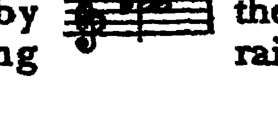
Bb - string raised a semitone; or
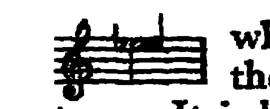
where one Eb is played on the Eb-string,
the other on the Db-string raised two semitones. It is hardly believable what effects great harpists are now able to derive from these double strings, which they: call synonyms. M. Parish-Alvars, perhaps the most extraordinary virtuoso ever to be heard on this instrument, executes runs and arpeggios which at first sight seem utterly impossible. Yet their whole difficulty consists only in an ingenious application of the pedals. He plays, for instance, the following passage with astonishing rapidity:
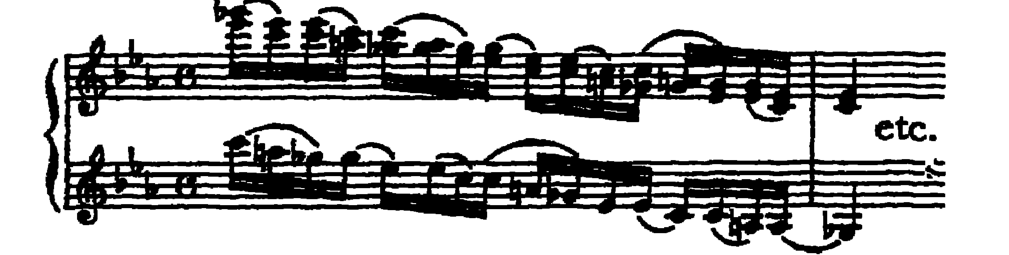
The facility of this passage is explained by the fact that the player simply has to slide three fingers downward across the strings without any fingering and as fast as he likes, because the instrument is tuned by means of the synonyms in a sequence of minor thirds producing the chord of the dinimished seventh. Instead of the scale


No. 53. Dante-Symphony, 1st movement
Quasi Andante, ma sempre un poco mosso. Liszt.
The Au, it must be remarked, cannot be doubled and hence. cannot be played twice in succession. In fact, it is not possible to have four synonyms at a time, simply because there are only seven tones in the scale, whereas four synonyms would require eight strings. Furthermore, the tone Ah can be produced onfy on one string, Ab, and not on Gb, which can be raised only two semitones by the double action, that is to Ab. The same limitation is found on two other strings, Cb and Fb.
Three synonyms are therefore still wanting on the harp: D, G and A. This defect (for such it is indeed) would disappear if the manufacturers would provide, as Parish-Alvars proposes, a triple action for the pedals of the three notes Cb, Fb and Gb, which would
it raising these strings by three semitones.
Mr. Erard should not allow such a defect to remain in the mechanism of this instrument. It would be worthy of so skilled a manufacturer to be the first to remove it.
If one does not use all synonyms at once, obviously other chords than the dimmished seventh can be obtained. Anybody can work out these manifold combinations for himself once he has clearly understood the effect of the pedals upon the strings. There will be even more combinations available after the three synonyms lacking at present are gained by a triple action of the pedals Cb, Fb and Gb.
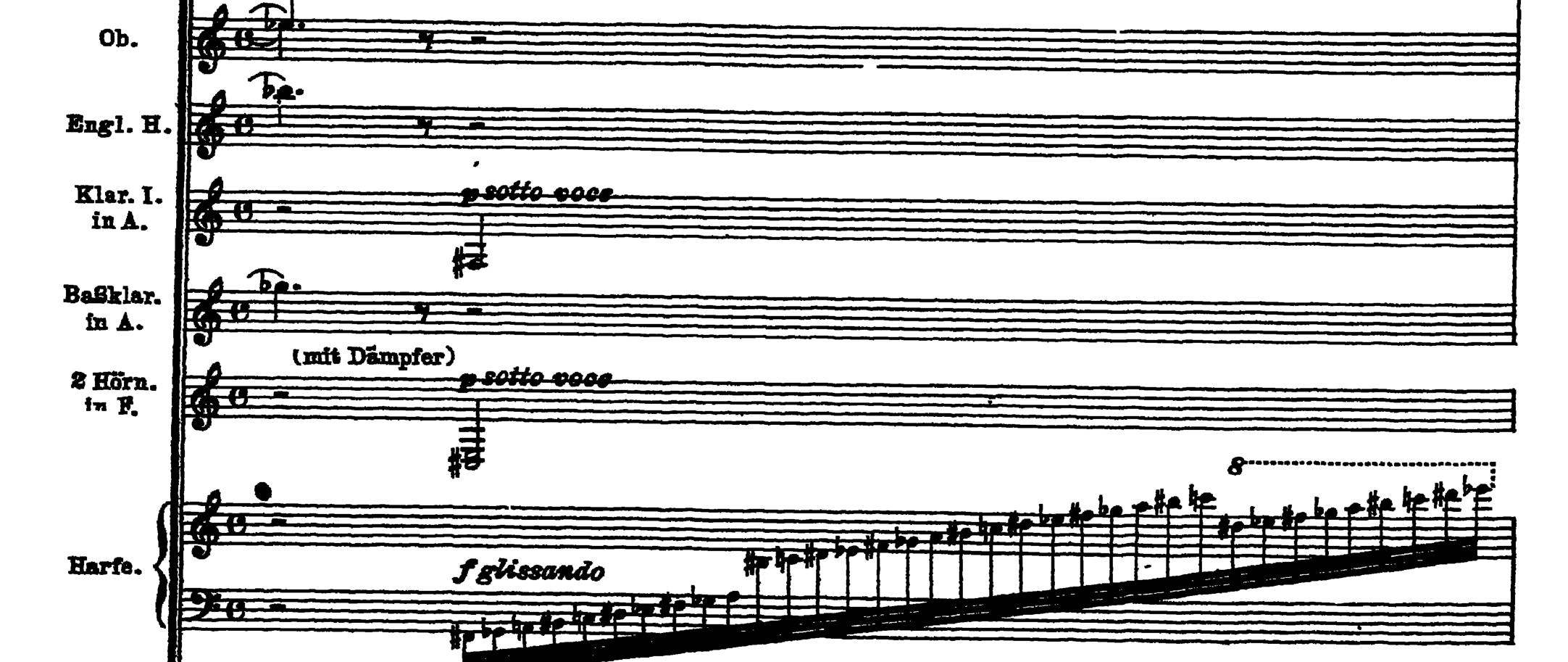
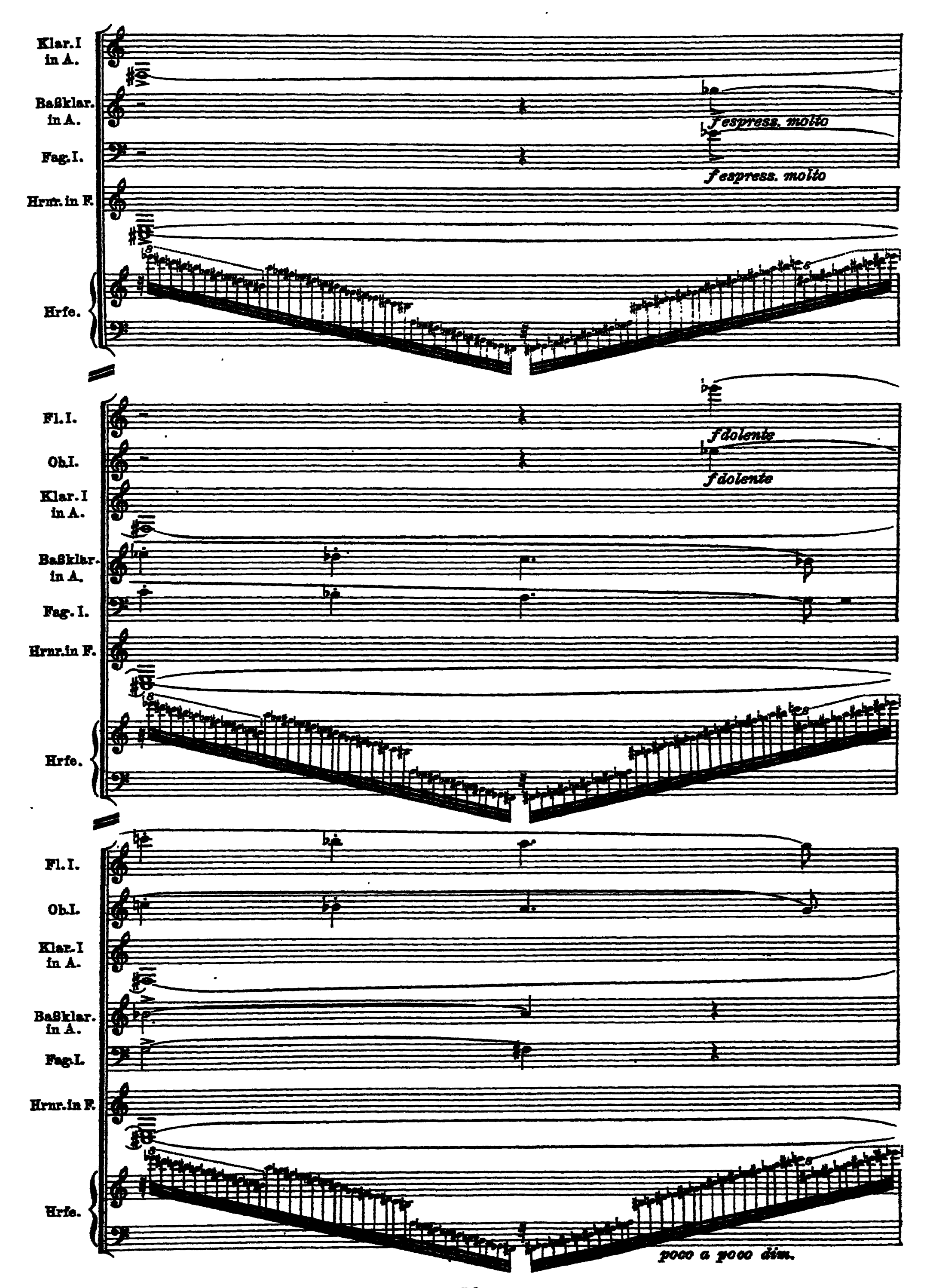
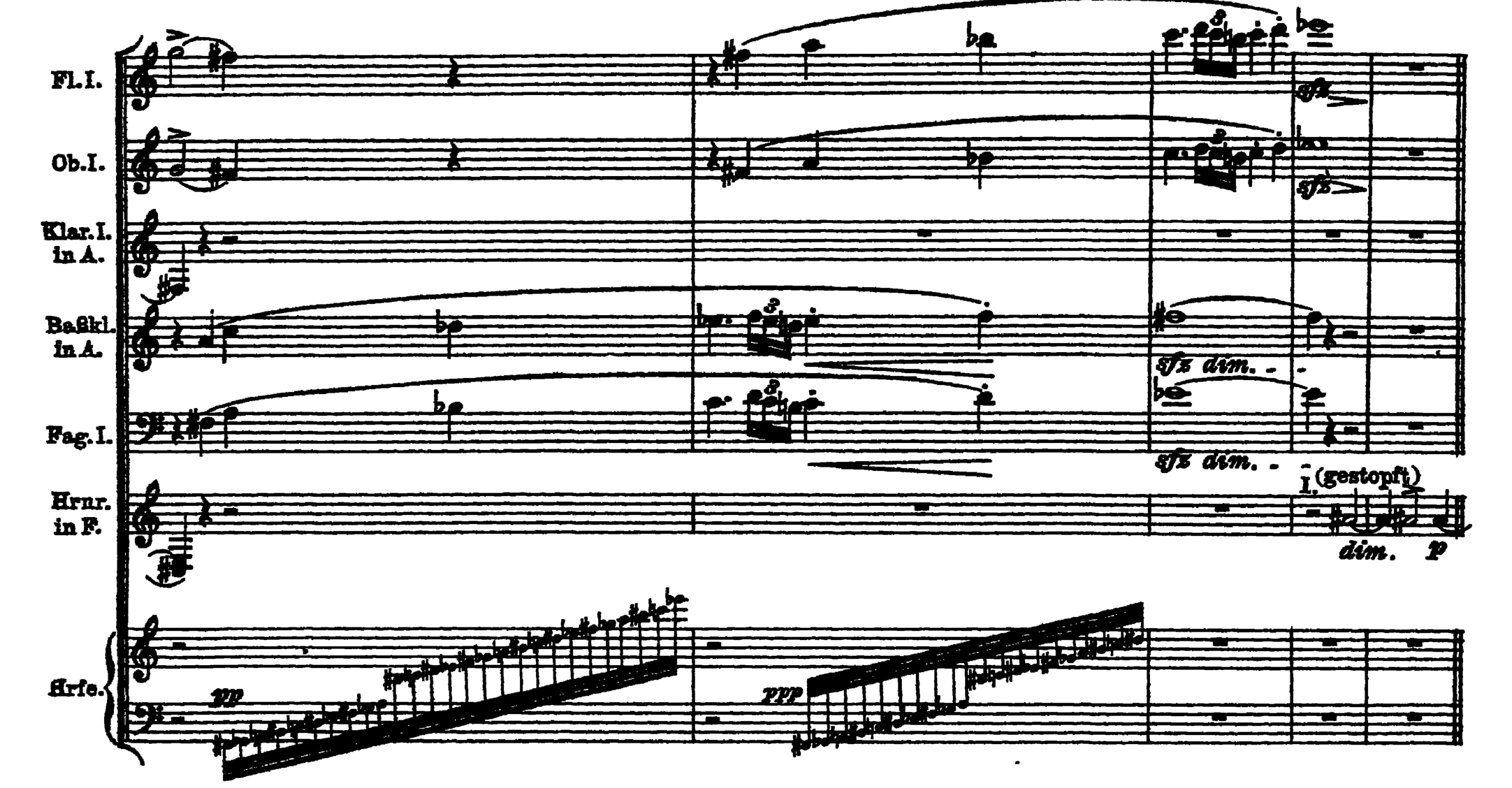
A brilliant example for the above mentioned method of glissando (on the diminished seventh chords) is to be found in Liszt’s Dante-Symphony; here it symbolizes the spirits of the unfortunate Francesca da Rimini and her lover as they rise from the inferno. (Example 53.)

Viol. II. Fate ——

In connection with the harp, I wish to point out again the cautious use which Richard Wagner made of this instrument (see “Lohengrin” as an outstanding example, also the second act of “Tristan”). Whenever he employed it, he achieved extraordinary and striking effects with the timbre of this beautiful instrument. I can only warn beginners again to use all particularly bright and characteristic colors of the orchestra very sparingly and, before writing them, to consider seriously whether these colors are indispensable in this particular place or whether they might be replaced by simpler ones.
Nowadays all these special orchestral titbits such as harps, flageolets, percussion instruments, are being terribly misused. Especially the percussion instruments should be used only as isolated highlights if their effect is to be felicitous and characteristic; see the single triangle stroke at the end of the second act of “Tristan”. Otherwise the ear of the listener becomes unnecessarily dulled: fine light-accents become formless smears of color.
Berlioz was unusually familiar with the technique of the harp, which in view of its difficulty cannot be expected from every author. A funny utterance of Richard Wagner’s to the harpist Tombo is reported. During the first rehearsal of the end of “Rheingold” in Munich, when Tombo sadly declared the harp part to be, absolutely unplayable, Wagner said to ‘the excellént artist, “You
cannot expect me to be able to play the harp; you
see what effects I want to achieve; now arrange
your part as you like”. Those who do not feel sure
they possess the inspired instinct of a Wagner, had
petter follow the saying: Quod licet Jovi, non licet
— ce eee ee ee
The harp must always be treated as a solo instrument, also in the orchestra, lest one write unnecessarily notes which are inaudible.
In the tutti of a modern orchestra only a group of several harps is effective. The harp part of “Tristan” is played by four harps in Bayreuth!
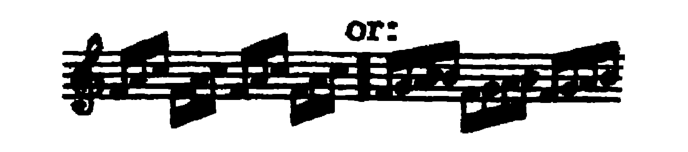
An effect on the harp not mentioned by Berlioz is the bisbigliando (“murmuring”), used for executing tremolos. The tremolo is written as for the piano, for mstance 3; the harpist does not play it eS sin one hand, but distributes it be- i
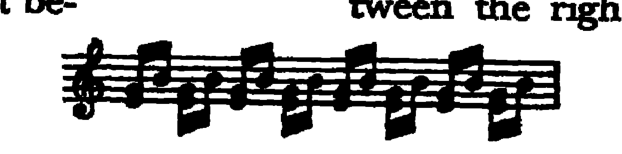
and left hands:
Figures like the following can also be executed in this fashion: