 Playable Books
Hector Berlioz · section 35 of 67
The Bass Ophicleide
Read and hear this section in the playable edition →Ophicleides are the altos and basses of the bugle. The bass ophicleide is excellent for sustaining the lowest part of massed harmonies; among the different ophicleides, it is the one most frequently used. It is written in the F-clef, and its range is three octaves and one tone:

A skillful player can execute the major and minor trills, beginning from the second C of its scale (2s M. Caussinus has shown in his excellent textbook).
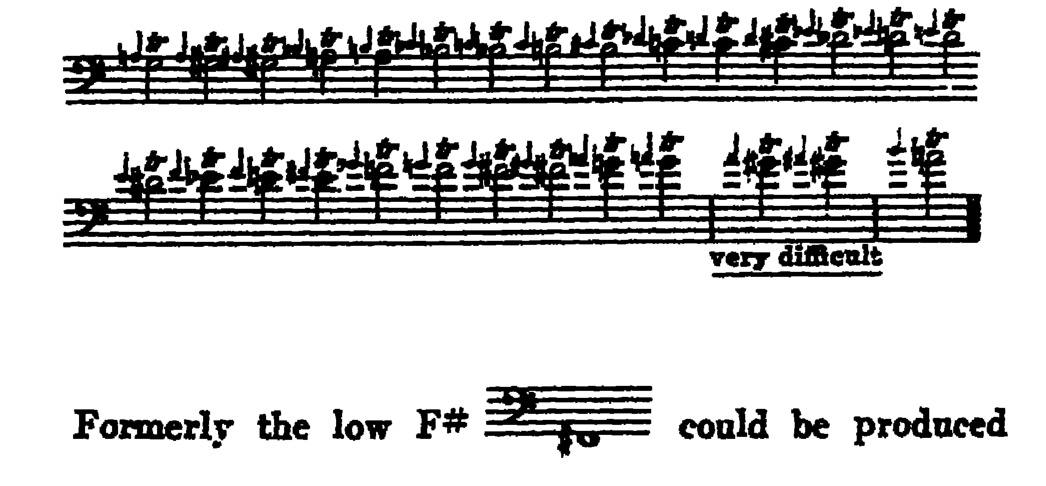
Staccato passages are considerably more difficult and are scarcely practicable in fast tempo. There sre bass ophicleides in two keys, C and B>; now they are also made in Ah. The latter will be very useful because of the very low pitch of its lowest tones, which are in unison with the three-stringed double-bass. The ophicleide in B® has already rendered important service in this respect. They are both written as transposing instruments:


Formerly the low F¥# ———— could be produced
only very imperfectly with the lips and left much to be desired as regards intonation and steadiness. Thanks to the valve added to the instrument by M. Caussinus it now sounds as well as the’ other tones.
Diatonic and even chromatic passages up to a certain speed can be executed in the three higher octaves of the ophicleide; bat below they are extremely difficult and of very inferior effect, ¢.g.:

One can perceive that the first low G in the second example is in unison with the G E= of the double-
bass. Unfortunately the ophicleide in Ab ig still used very little.
The sound of these low tones is rough; but in certain cases, under a mass of brass instruments, it works miracles. The highest tones are of a ferocious character, which has not yet been utilized appropriately. The medium range, especially if the player is not skilled, recalls too closely the tone of the serpent and cornett; I believe that it should rarely be used without the cover of other instruments. Nothing is more clumsy—-I could almost say, more monstrous—nothing less appropriate in combination with the rest of the orchestra than those more or less rapid passages played as soles in the medium range of the ophicleide in certuin modern operas. They are like an escaped bull jumping sround in a drawing-room.